Looking for your next adventure? Explore our current campaigns and the Mythveil weekly schedule.
One Hobby, Many Beginnings — United States
The beginning of a hobby is not always the moment somebody puts it in a box. Sometimes it begins with a question the existing rules cannot answer, a character who survives long enough to return, or a referee willing to discover what happens next. The American history of tabletop role-playing includes its first published games, but it cannot end with their creators. It also belongs to the people who changed the rules, wrote the adventures, organised the meetings and imagined experiences the earliest books had never described.
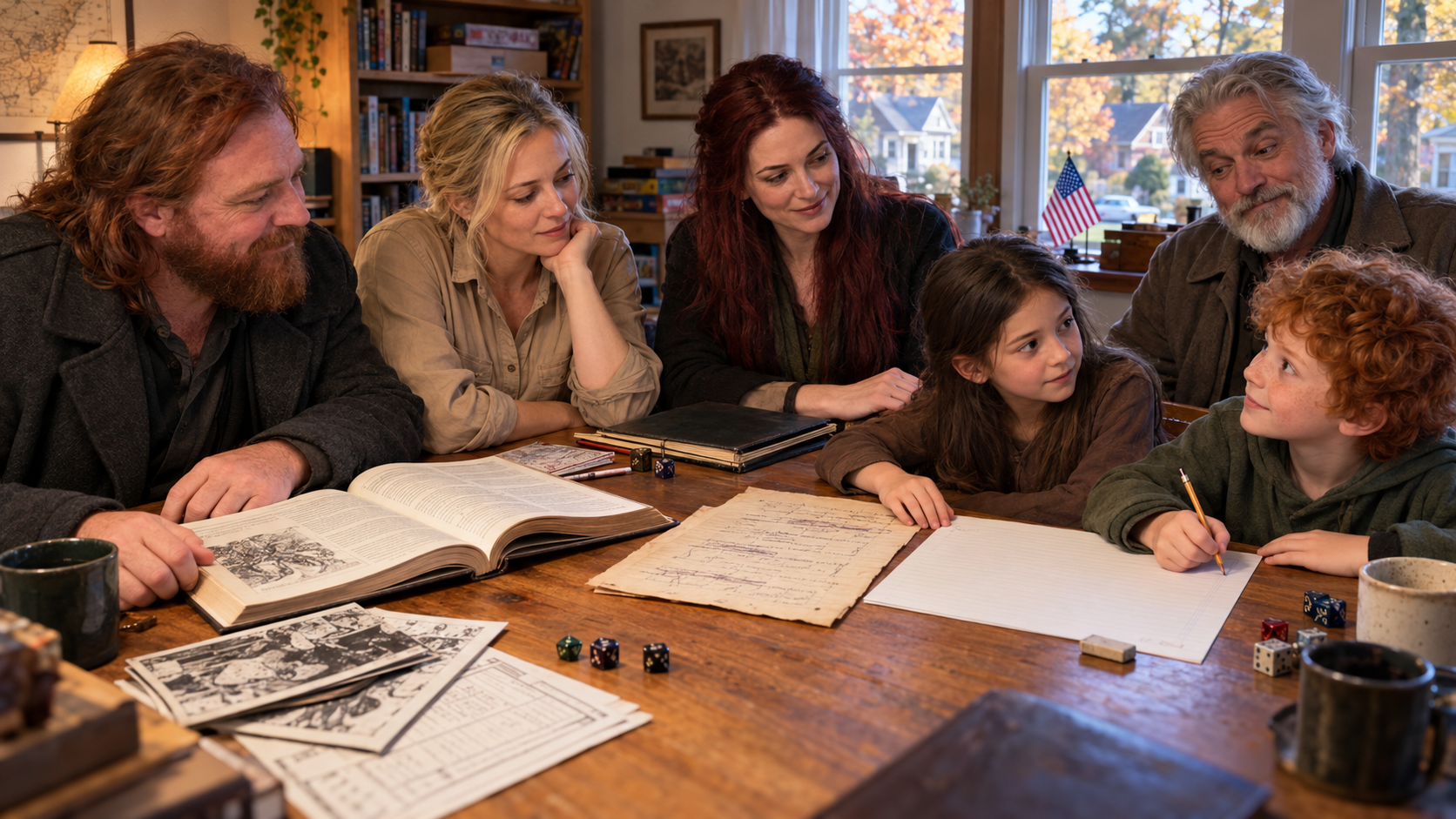
Mara is comparing a printed rulebook with a loose sheet covered in pencil corrections.
“Which one is the real game?”
“The book gives them rules,” Stacy says. “The notes tell us what this group changed.”
Chibi leans closer.
“Can we change it too?”
Sean studies a heavily crossed-out paragraph.
“After we discover why they were so annoyed with that bit.”
My name is Eljara. Today, our family is following the history of tabletop RPGs in the United States.
We begin before the first published D&D set and follow the different activities that grew around it. Designers and companies will appear throughout the journey. So will the people who made the hobby something that could be learned, discussed and played beyond its original circles.
Before 1974: the game is not yet in the box
In Minnesota’s Twin Cities, groups associated with David Wesely and Dave Arneson were experimenting with historical wargames, referees and situations that could not be resolved by moving military units alone. The documentary research behind Secrets of Blackmoor follows this environment through interviews and surviving material, including the influence of the older military game Strategos. (secretsofblackmoor.com)
Wesely’s Braunstein games of the late 1960s assigned participants individual roles and interests within a developing situation. A player’s concern did not have to match that of an army commander. The precise early sequence remains complicated by retrospective dating; the collected interviews should not be flattened into an unquestioned single birthday. (boggswood.blogspot.com)
Meanwhile, Gen Con began in Lake Geneva, Wisconsin, in 1968, organised by Gary Gygax, his family and fellow enthusiasts. It was a wargaming gathering before there was a published D&D hobby for it to serve. (gygaxmemorialfund.org)
Arneson’s Blackmoor dates to 1971, providing a central connection between those experiments and the continuing fantasy campaign that helped produce D&D. The campaign and the later commercial game are related historical developments, not interchangeable events. (secretsofblackmoor.com)
The early history therefore begins with connected groups and evolving practices. The product came afterwards.
1974: three small booklets make a new kind of game available
Dungeons & Dragons, created by Gary Gygax and Dave Arneson, was first published in 1974. The Strong National Museum of Play preserves an early set donated by William “Bill” Hoyt, who had played with both creators. Its woodgrain-patterned box contained three small booklets, rather than the substantial hardcover volumes many later players would associate with the game. (museumofplay.org)
The museum’s examination also complicates a familiar simplification about early play. The first volume described hired non-player companions whose loyalty could be tested through secret referee rolls. The third included information, rumours and encounters with people beyond the immediate adventuring party. Relationships and uncertain information were already present alongside combat. (museumofplay.org)
Publication made something important possible: people outside the original groups could obtain the written procedures and attempt to create their own games.
But a rulebook is not a transcript of every table that uses it.
The distinction will recur throughout this history. We can date the appearance of a book more confidently than we can reconstruct everything people subsequently did with it.
1975: another answer appears almost immediately
Ken St. Andre’s Tunnels & Trolls appeared in 1975. The Phoenix librarian developed an alternative after finding D&D’s presentation difficult to use. Its approach included ordinary six-sided dice and an emphasis on making fantasy role-playing more accessible. (k6trolli.pl)
The historical significance is not an uncontested claim about which game deserves second place. It is how quickly a different published answer emerged.
Someone could be enthusiastic about the possibility of fantasy role-playing while disagreeing with how its first commercially available example worked.
That distinction separates the medium from one particular product.
Mara looks again at the handwritten corrections.
“So they didn’t have to stop liking the idea?”
“No,” Caelwyn says. “They could try another way.”
Sean moves the eraser closer.
“A surprisingly useful piece of equipment.”
The early American story was already becoming more than a single game accumulating supplements. It included designers asking which parts of the experience they wanted to keep—and which they wanted to change.
1975–1976: the players begin publishing their conversation
Lee Gold launched Alarums & Excursions in June 1975, emerging from the science-fiction fan publishing culture around Los Angeles. It collected contributions from different participants, including session reports, rules variations and discussion of how games were actually being played. Its contributors were not confined to one city. (designers-and-dragons.com)
This format mattered. Readers could answer one another, describe disagreements and circulate ideas without waiting for an official supplement to settle the question.
Other publications soon added different voices. The Dragon began in June 1976, while Jennell Jaquays’ The Dungeoneer also debuted that year. Bob Bledsaw and Bill Owens’ Judges Guild Journal followed after the 1976 Gen Con. (designers-and-dragons.com)
The scene was acquiring more than products. It was acquiring a public conversation about using them.
Gold and Jaquays belong within this early development, not in a later corrective paragraph after the supposedly complete story of the founders.
Writing about play, editing other people’s contributions and distributing usable adventures were ways of building the hobby too.
1977–1983: a new player should not need to know the original group
The D&D Basic Set edited by J. Eric Holmes appeared in 1977, followed by revisions associated with Tom Moldvay in 1981 and Frank Mentzer in 1983. These introductory sets explained the game for readers who might not already understand the conventions of miniature wargaming. (en.wikipedia.org)
That was a different challenge from inventing another monster or extending a character’s level range.
How could a book teach an unfamiliar activity to someone who had never watched it happen?
The question matters historically because personal demonstration and written explanation are not equivalent. A group with an experienced player can ask questions. A newcomer opening a box must make sense of the instructions before that experience exists.
The Basic sets should therefore not appear merely as smaller books beneath the shadow of more elaborate rules.
They represent repeated attempts to make entry possible.
They also remind us that a publication can change the hobby through its clarity and organisation, not only through mechanical novelty. Helping someone begin is itself a consequential piece of design work.
1977–1981: the dungeon is no longer the only destination
Traveller was published on 22 July 1977 at the Origins Game Fair on Staten Island, New York, a date recorded by Marc Miller’s Far Future Enterprises. Science-fiction role-playing now had another clearly identifiable publication point in the developing market. (farfuture.net)
At Chaosium, company formation and RPG publication followed different dates. Greg Stafford founded the company in 1975, initially publishing the Glorantha-set board wargame White Bear and Red Moon. RuneQuest appeared in 1978, combining Stafford’s setting with the rules work associated with Steve Perrin. (chaosium.com)
Sandy Petersen’s Call of Cthulhu followed in 1981, using related percentile-based procedures for investigations involving Lovecraftian horror. The game offered a different kind of campaign from a continuing ascent through fantasy combat. (chaosium.com)
These developments were not just changes in decoration.
A spacecraft, a Gloranthan community and a supernatural investigation could ask different things of the players. The books offered different relationships between setting, character and danger.
An American history limited to D&D editions would miss these expanding expectations about what a role-playing game could be for.
The 1980s: a more visible hobby faces public suspicion
During the 1980s, D&D became entangled in the American Satanic Panic. A later oral history drawing on former TSR employees describes concern that controversial illustrations could be used in public attacks on the game. Those recollections show anxiety about public reception entering editorial decisions. (wired.com)
Accusations that fictional magic encouraged devil worship belong to the history of that panic. They are not evidence that playing a fantasy game caused the alleged effects. (wired.com)
This chapter requires two kinds of care.
We should not present the accusations as established facts. Nor should we turn the entire country into a single hostile audience. A media controversy, a publisher’s reaction and an individual family’s experience are different subjects.
Mara touches a drawing of a wizard.
“They thought pretending was the same as doing it?”
“Some people did,” Stacy says.
Chibi looks at his pencil.
“I’ve drawn three dragons. None of them came.”
The controversy belongs in the history, but it should not become the only story we tell about a decade in which people continued developing very different games.
1985–1986: personality and general-purpose rules take different paths
Greg Stafford’s Pendragon appeared in 1985, bringing Arthurian role-playing together with explicit procedures for character personality. Its British legendary setting should not be confused with the location of its American game development. (chaosium.com)
The first GURPS Basic Set appeared at Origins in Los Angeles on 3–6 July 1986. In a later anniversary account, Sean Punch distinguishes it from Man to Man, released the previous year, which supplied the combat system rather than the complete game. (warehouse23.com)
The contrast illustrates the different scales at which design could work.
A game might develop procedures closely connected to a particular kind of character and story. Another project could work towards a framework intended for wider use.
Neither approach required every group to abandon what it already enjoyed.
The chronology also benefits from treating components carefully. A preliminary combat game, a complete role-playing system and a later revision do not all represent the same publication event.
The hobby’s development was becoming more varied than a procession of increasingly large rulebooks.
1988–1991: dangerous societies become central campaign settings
Mike Pondsmith’s Cyberpunk began in 1988. R. Talsorian’s thirtieth-anniversary celebrations in 2018 explicitly commemorated the tabletop game and its creator, rather than treating the property as something that began with its later digital adaptations. (rtalsoriangames.com)
Shadowrun appeared through FASA in 1989, combining technological dystopia with fantasy. Early supporting material such as Sprawl Sites provided urban locations, encounters and contacts, illustrating how a city could function as an ongoing campaign environment. (shadowrunwiki.com)
Vampire: The Masquerade followed in 1991. Its later publishing retrospective identifies personal horror, struggles over morality and conflict between younger and ancient vampires as important parts of the line’s development. (theonyxpath.com)
These games were not identical, and they did not invent every form of political or personal role-playing.
They did, however, make particular dangerous societies central to their published identities.
The threat could be an employer, an institution, an older rival—or a need the character could not simply stop having.
For our historical reading, this is another widening of campaign possibilities. Leaving the dungeon did not mean leaving danger behind. It could mean discovering that the place where a character lived was itself structured around unequal power.
1997–2000: the responsibility for a major game changes hands
In April 1997, contemporary reporting recorded Wizards of the Coast’s announced acquisition of TSR. Players interviewed at the time expressed both hopes for renewal and concern about what the change would bring. These were reactions to a proposed business transition, not a unanimous verdict from the hobby. (wired.com)
By March 2000, Ryan Dancey was publicly explaining plans for an Open Game License that would permit other publishers to build on released rules material. The proposal connected shared mechanical foundations with the production of compatible games and supplements. (salon.com)
The significance here is practical rather than merely corporate.
A person writing adventures for an established audience needs to know what can be published and on what terms. Those conditions affect the relationship between a large publisher and the smaller businesses around it.
They do not make every part of a brand, setting or book interchangeable with the material released for reuse.
The history of the hobby therefore includes its publishing arrangements alongside its rules. What people could make available to others was shaped by both.
2001–2002: independent publishing becomes an explicit shared project
In 2001, Ron Edwards and Clinton R. Nixon rebuilt The Forge around a discussion community concerned with role-playing and independent publication. Its focus included creators retaining control of their own work rather than treating an established publisher as the necessary destination for every manuscript. (en.wikipedia.org)
A particularly clear contemporary milestone is the 2002 Diana Jones Award, given to Edwards and Sorcerer. The award statement describes the game’s progression from a self-published digital product to a hardcover through Adept Press and recognises Edwards’ support for creator-controlled games. (dianajonesaward.org)
This was not the invention of independent activity. The early fanzines and alternative games in our account already demonstrate other forms of it.
What becomes visible here is a deliberately organised conversation linking actual play, design choices and the means of publication.
The award’s enthusiasm is also a contemporary judgement, not a requirement that later readers accept one community’s preferences as the correct direction for all role-playing.
An independent game could challenge established assumptions without becoming a universal replacement.
2002–2009: a magazine publisher develops its own game line
Lisa Stevens formed Paizo in May 2002. The company initially published magazines including the official D&D periodicals Dragon and Dungeon. Pathfinder Adventure Path launched in August 2007, while the Pathfinder Roleplaying Game followed in 2009. Stevens’ own account preserves these separate dates. (paizo.com)
That order is important.
The adventure series did not begin as supplementary material for an already published Pathfinder rulebook. Regular adventure production preceded the standalone RPG.
This provides another route into game publishing: editorial experience, serial adventures and a readership could form part of a system’s development.
Mara places an adventure beside a rulebook.
“So this came first?”
“In this case, yes.”
Chibi opens it cautiously.
“Did the monsters have to wait for the rules?”
Sean examines the first encounter.
“They appear to have kept themselves occupied.”
For the history, Stevens belongs here because of her role in building this publishing operation. The point is not to let her career replace the company’s wider work, but to recognise that production and organisation shape what eventually reaches a gaming table.
2010: Apocalypse World connects several national histories
Meguey and Vincent Baker began writing Apocalypse World in 2008 and published it in 2010. Their own retrospective explains that drafts and playtest material circulated among colleagues before release. By publication, games including Monsterhearts and Monster of the Week were already being developed in response. Meguey coined the term “Powered by the Apocalypse.” (lumpley.games)
Readers of our Canada and New Zealand chapters will recognise those titles.
This is a documented connection between national histories, not simply a resemblance between games.
The Bakers also describe PbtA as a label for creative inspiration rather than a requirement that every associated game reproduce one identical set of mechanics. Different designers could take the influence in different directions. (lumpley.games)
That matters to our wider series.
An American design could help enable work elsewhere without reducing those later games to copies. Their particular concerns, procedures and contributions still belong to the people who developed them.
Influence connects histories. It does not make the subsequent work disappear into the history of the first author.
2012: a table can continue across a country
Roll20’s development began with Riley Dutton, Nolan T. Jones and Richard Zayas wanting to play together despite living in different places. The company’s January 2013 account records an April 2012 Kickstarter, public beta testing in June and regular service from September 2012. (bloghub.roll20.net)
Those are distinct steps: developing a tool, obtaining support, testing it publicly and declaring it ready for ordinary use.
Its significance in this history is not that distance had previously made all play impossible. It is that a particular set of online tools was being built around the practical needs of a dispersed tabletop group.
Maps and communication could now be organised within that shared environment.
The account begins with friends who wanted to keep playing. Their problem was not a shortage of fictional worlds. It was how to meet when the participants were no longer in the same room.
That practical history belongs beside the history of new rules.
2015: the ongoing campaign becomes something an audience follows
Critical Role’s first broadcast episode aired on 12 March 2015. The episode chronology maintained by CritRoleStats explicitly corrected an earlier date, with help from people associated with the production. (critrolestats.com)
This represents a different development from the virtual tabletop.
An online tool can help a private group play. A broadcast presents the playing itself as an ongoing production for people outside that group.
The distinction is easy to lose when both arrive through a screen.
A viewer might encounter the hobby through performed conversation, character decisions and the rhythm of a continuing campaign rather than first reading a rulebook.
But a programme’s audience is not the same thing as a national population of active players, and a broadcast style is not a standard every private table must reproduce.
Mara looks at the microphone in a photograph.
“Do we need one?”
“For people who aren’t in the room to hear us,” Stacy says.
Sean glances at Chibi.
“For people who are in the room, probably not.”
2017–2020: a familiar horror game receives a different historical focus
Chris Spivey’s Harlem Unbound appeared in 2017, documented in the Smithsonian’s catalogue as a sourcebook for Call of Cthulhu and GUMSHOE. Its bibliographic entry also credits Brennen Reece in the creative development. It was not a new standalone system. (si.edu)
The second edition appeared through Chaosium in 2020. The publisher’s release identifies the Harlem Renaissance, racism and Black American experience as central to Spivey’s treatment of the Cthulhu Mythos. (chaosium.com)
This connects back to the earlier history of Call of Cthulhu while showing how its subject could be revisited.
A familiar genre did not require every later book to keep the same people at the centre of its historical picture.
The contribution was not simply adding another location to a list. It involved asking whose experiences shaped that location and what an investigation meant within those circumstances.
This publication does not date the beginning of Black participation in role-playing. It makes one particular body of Black-authored work visible in the published record.
2021: Indigenous creators build another possible America
Coyote & Crow Games was formed in 2021 to support publication following the first game’s successful crowdfunding campaign. The studio describes Coyote & Crow as the work of an Indigenous-led team drawn from across the continent, imagining an alternative future in which European colonisation of the Americas had not occurred. (coyoteandcrow.net)
Its account identifies Kenna Alexander, a citizen of the Cherokee Nation, as the designer who began developing the project in 2018. That earlier design work and the later company formation belong to different stages. (coyoteandcrow.net)
Here, cultural perspective is part of who is creating the world and what possibilities the world explores.
It is not generic decoration placed around a familiar adventure.
The continental collaboration also deserves to remain visible within this United States chapter. A US-based publishing history should not silently turn all Indigenous contributors into members of one nation or one community.
As with Harlem Unbound, the publication establishes a specific creative contribution. It does not establish that the people it represents had been absent from the hobby until a prominent book appeared.
2023: publication terms become a public conflict
On 27 January 2023, following opposition to proposed licensing changes, Wizards of the Coast announced that OGL 1.0a would remain unchanged and that the entire System Reference Document 5.1 would be released under Creative Commons. The announcement directly linked the decision to the feedback the company had received. (dndbeyond.com)
At the end of June 2023, Paizo announced the final text of the Open RPG Creative License, ORC, developed by Azora Law through a process involving multiple publishers and public feedback. It was intended as a system-independent basis for sharing designated game material. (paizo.com)
These were not new character classes or another fictional world. They concerned the conditions under which people could publish work connected to games.
That places them within the history of production and participation.
By this point, the relationship between a major rights-holder and other creators was itself a subject of organised public disagreement.
The episode also underlines a recurring distinction: the owner of a particular game is not the owner of every creative activity undertaken by the people who play it.
2024: the early documents become part of the public record
The Making of Original D&D: 1970–1977 was released on 18 June 2024. It brought together early documents, including drafts and original published material, with historical commentary by Jon Peterson. Its value lies in making the development of the game available for examination, rather than requiring readers to rely entirely on later recollections. (wpn.wizards.com)
The same anniversary year, The Strong National Museum of Play opened Dungeons & Dragons: 50 Years of Storytelling. Its announced displays included early game material, original artwork and an inaugural issue of Dragon sent to Gygax, alongside discussion of controversies and the game’s wider development. (museumofplay.org)
Preservation does not settle every historical argument.
It gives those arguments something more substantial to work with.
A pencil correction, a letter or the differences between two printings can reveal changes that disappear from a polished anniversary narrative.
The small papers our fictional family keeps handling are not incidental to the story. In the actual historical record, materials of that kind can help show how the work happened.
2025–2026: new systems and long-running games remain neighbours
Daggerheart launched on 20 May 2025 through Darrington Press. Its release combined physical and digital availability with play events and material for creators, showing another route from a publicly visible role-playing production into the publication of a game system. (daggerheart.com)
At the same time, older lines continued to develop.
On 3 July 2026, Steve Jackson Games marked forty years of GURPS. Sean Punch’s retrospective traced the game from its original Basic Set through later editions and acknowledged the participants who had sustained it. (warehouse23.com)
These developments should sit beside one another rather than be forced into a story of automatic replacement.
A new game can appear without making the older one historically finished.
The contemporary shelf contains accumulated choices: continuing lines, revised rules, new systems and different publishing arrangements.
Their coexistence is part of the history. It is not a problem that a national survey needs to resolve by selecting one definitive way to play.
What the published record reveals—and what it leaves harder to see
The sources assembled here support a development from experimental wargaming groups to published role-playing, early alternatives, fan discussion, new genres, independent production and changing ways to gather.
They are strongest where people preserved documents, published interviews or left an identifiable institutional record.
They are weaker at reconstructing an ordinary campaign that lasted for years without producing a commercial book.
This is therefore a chronological survey, not an exhaustive catalogue of American role-playing. Superhero games, old-school revival communities, solo forms and individual regional scenes require fuller histories than the space given to them here.
The same applies to school groups, military communities, libraries, rural tables and games conducted in languages other than English.
Prominent publications do not provide a complete demographic picture. Nor can sales, crowdfunding supporters, convention attendance and streaming audiences be added together into a reliable national player total.
The first published games are comparatively easy to name. The people who made the hobby last are far more numerous than the names printed on their covers.
Where did your American role-playing story begin?
Tell us where and approximately when you started.
Was it a small D&D box, a copy of Tunnels & Trolls, a library book, a convention or somebody’s handwritten invitation? Did you begin in Glorantha, aboard a starship, in a dangerous future city or with a game your own group was still inventing?
Which magazine, shop or online community helped you find other players? What did your group change? Which things did it keep using long after a newer edition appeared?
We would particularly welcome early club notices, campaign records, convention programmes, fanzines and memories from communities less visible in familiar publishing histories.
Mara places the corrected sheet beside the rulebook instead of inside it.
“Now we can see both.”
Stacy writes a date at the top of their new notes.
Chibi reaches for a pencil.
“Should we put our names on this one?”
“Yes,” I tell him.
Sean looks at the first proposed change.
“Especially if it goes wrong.”
Caelwyn opens the book.
Our journey has followed founders, editors, writers, organisers and people who wanted to keep playing when the available arrangements no longer suited them. No single company contains that history. No single person needs to carry it.
The history of tabletop RPGs in the United States begins with connected experiments. It becomes the history of a hobby when other people take what they have found and make something of their own.
Continue One Hobby, Many Beginnings with our journeys through Germany, Italy, Spain, Norway, Denmark, Sweden, Finland, Iceland, Australia, New Zealand, the United Kingdom, Ireland and Canada.
Bring your own campaign questions to the Mythveil Seminar: Campaigns That Remember Your Players.
Read. Play. Watch. Support. Or collaborate.
Read Mythveil Chronicles · Join our campaigns · Support the research and stories · Collaborate with us
Every table has a beginning. Your next chapter could start with us. Find your next game in the Mythveil weekly schedule.