One Hobby, Many Beginnings — Part Two: Italy
A rulebook crosses a border. A translator changes a name. Someone opens a shop, starts a club or discovers that a book will let them choose what happens next. Italy’s role-playing history begins wherever those journeys become somebody’s own.
Looking for your next adventure? Explore our current campaigns and the Mythveil weekly schedule.
On Sean’s first research card, beneath the word Italy, he has written Nantes.
“That is in France,” I tell him.
“The game took a slightly longer route.”
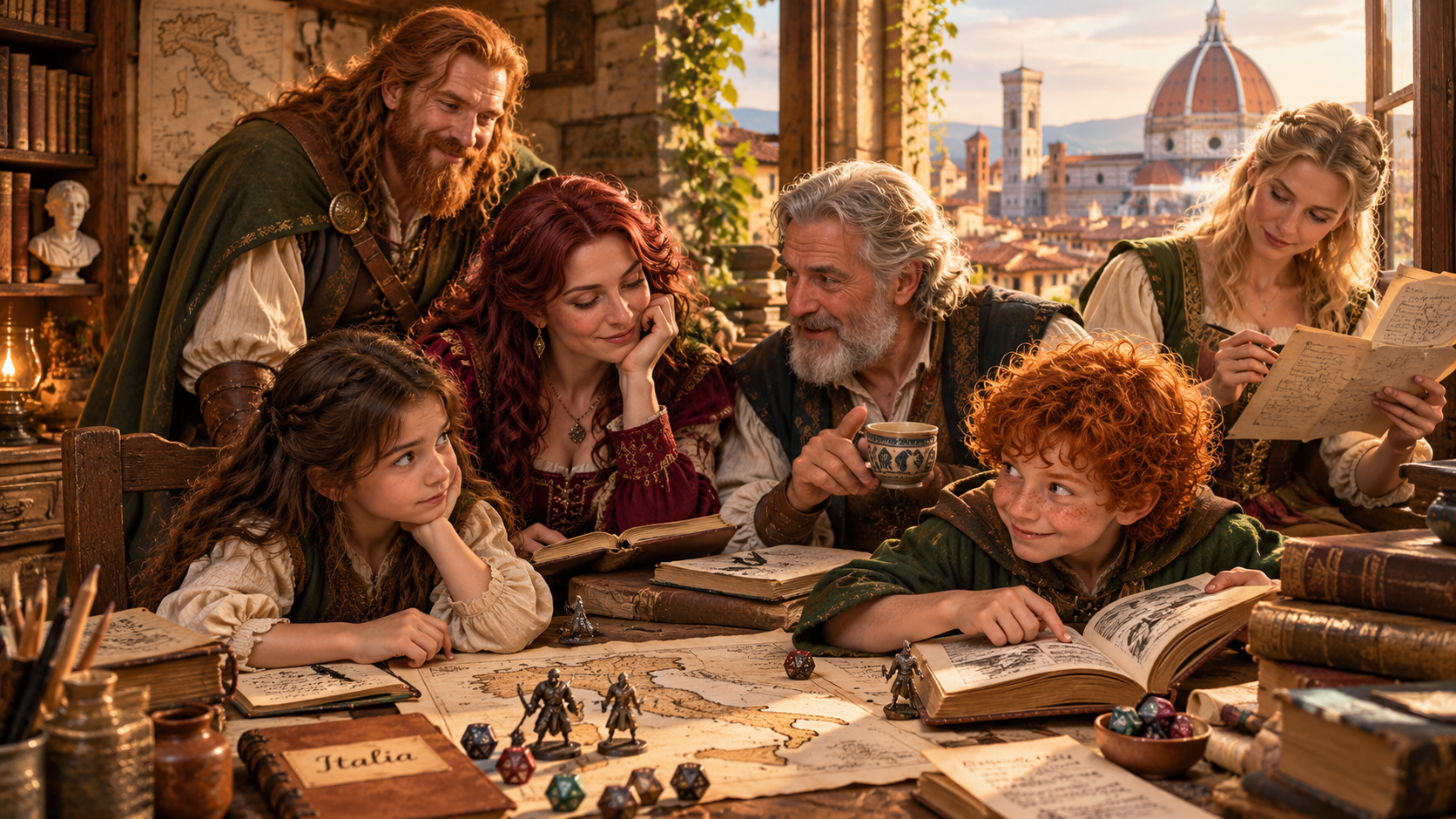
My name is Stacy. Today, our family is following the history of tabletop role-playing in Italy. Sean has brought the memories, Eljara is examining the publishing decisions, and Caelwyn wants to know who helped newcomers find a place to play.
Mara is looking at the books.
Chibi has already put a finger between two pages.
We have not started the adventure yet. He is taking precautions.
The story we are tracing is not simply about American games becoming available in Italian. It is about what happened when people translated them, read them, shared them and began making things of their own.
Before the red box: an Italian beginning in French
Game designer Luca Giuliano remembers starting with a French-language edition of Dungeons & Dragons bought in Nantes. A few days later, he began playing with his first group: three women. He recounts the experience on his own website alongside an older discussion of D&D from his 1991 book, In principio era il drago. Source: Luca Giuliano
That is one person’s beginning, not a survey of Italian players. Nor does the date he gives for the edition automatically establish the date of his first session.
But the route is revealing.
An American game, a French-language book, an Italian reader and a particular group of people.
The national borders on our map explain less than the relationships crossing them.
“Was it already their game?” Mara asks.
“They had not written the rules.”
“That isn’t what I asked.”
No. It is not.
A game can belong to a publisher in one sense and become part of somebody’s life in another. The second kind of belonging is what publication lists struggle to capture.
We will need the dates. We should not mistake them for the whole story.
1981–1984: people were already playing and making
The Italian edition of D&D was not the starting gun for all organised activity.
Club TreEmme dates its foundation in Modena to 1981. Its history encompasses board games, miniatures and role-playing, with meetings and events bringing different interests together. It was a community of players, not simply an audience waiting for one particular translated rulebook. Source: Club TreEmme at Play Modena
Original Italian RPGs also appeared before Italian D&D.
I Signori del Caos, by Giovanni Maselli, Auro Miselli and Franco Tralli, was published in 1983. Kata Kumbas, by Agostino Carocci and Massimo Senzacqua, followed in 1984. Andrea Angiolino records both in his historical overview; Tralli’s publisher biography independently confirms his work on the earlier game. Source: Andrea Angiolino at RiLL · Franco Tralli publisher biography
This is not a tidy sequence in which people first receive a translation, then learn to play, then eventually become creative.
Those activities overlap.
Someone discovers an imported game. A group experiments. Another person begins writing rules while the market for translations is still developing.
Eljara moves two cards beside one another.
“Receiving and inventing are not opposite activities.”
“They would make a rather poor queue,” Sean says.
Exactly.
We are looking at a developing network, not an assembly line.
1985: somebody had to make the rules understandable
The first Italian translation of D&D appeared in 1985, published by Editrice Giochi and translated by Giovanni Ingellis. It drew on the American Basic edition of 1983: the version associated with the familiar red box. The Accademia della Crusca documents these details in its investigation of Italian role-playing vocabulary. Source: Accademia della Crusca
The finished box is easy to remember. The work that made it readable is less visible.
At a retrospective discussion in Lucca in 2023, participants recalled Italian summaries accompanying English-language rules. Spartaco Albertarelli also remembered typing while Ingellis dictated translations, including D&D material. These are later recollections, but they make the process wonderfully concrete. Source: FantasyMagazine, 40 years of the Red Box
Before the polished publication, there is a person trying to express an unfamiliar activity clearly enough for someone else to attempt it.
That is more demanding than replacing individual words.
A reader needs to understand what they are allowed to do, when a rule applies and why the person behind the screen is describing a corridor rather than moving all the pieces themselves.
“Couldn’t they just ask someone?” Caelwyn says.
“When someone was available.”
He nods.
“Then the explanation in the book matters.”
It does. A clear translation can stand beside a new player when an experienced friend cannot.
A borrowed word becomes something you do
Ingellis retained Dungeon Master and master rather than replacing them completely. Italian players also came to use masterare and masterizzare for running a game. The Crusca considers both forms acceptable, while noting that their exact spoken beginnings are difficult to establish. We should not assign their invention to the publication year merely because that would make a convenient story. Source: Accademia della Crusca
What interests us is the movement from an imported label to an activity people can describe in their own language.
You do not merely own a book about a master.
Someone in your group does the job.
For our reading of the history, this is a small sign of the hobby becoming ordinary enough to generate its own everyday speech.
“Do they have a word for someone who volunteers another person to do it?” Sean asks.
“Several, probably.”
Chibi carefully avoids looking at either of us.
Another 1985 beginning: the adventure on the bookshelf
In the same year, Edizioni EL launched its Librogame publishing line with Lupo Solitario, the Italian version of Lone Wolf. This belongs to the history of gamebooks: books in which the reader follows choices between numbered sections, sometimes using additional rules to resolve danger. It is connected to tabletop role-playing, but it is not the same activity. Source: Edizioni EL history
The difference matters.
A gamebook supplies the available branches in advance. Around a role-playing table, someone can propose an action that nobody has printed as an option.
Yet a book you can play alone offers a distinctive entrance into participatory adventure. You do not first have to assemble a group or persuade somebody to run the evening.
The series editor, Giulio Lughi, recalled encountering these books through the Frankfurt book fair. He also explained how the publisher wanted different series to remain recognisably related, with the visual identity developed by the Tassinari–Vetta design studio. Source: interview with Giulio Lughi
For a reader, those recurring colours and formats could make an unfamiliar kind of book easier to recognise.
Chibi has now placed fingers between three different pages.
“Why are you holding it like that?” Mara asks.
“In case I die.”
“The book?”
“Me.”
A practical approach to branching narrative. The librarian may disagree.
We should not claim that every Italian role-player came through gamebooks. The more useful question is whether, for some readers, choosing a path on the page made the idea of choosing a path at the table easier to imagine.
When a translation becomes part of the memory
Lughi offers a precise example of a translator leaving a lasting mark.
He explained that he changed Kai to Ramas in Lupo Solitario because he preferred how the new name sounded for Italian readers. He tested alternatives aloud. More broadly, he described trying to simplify cumbersome language without losing the original’s emotional force. Source: interview with Giulio Lughi
That is not an abstract debate about whether translation involves creativity. It is a particular person making a particular decision.
Consider what follows for the reader.
A name encountered repeatedly becomes attached to imagined places, dangers and achievements. Discovering a different name in another language can feel less like learning a correction than meeting a second version of a familiar memory.
“Which name is the real one?” Mara asks.
Eljara rests a hand on the book.
“We can identify the original. That does not make somebody’s experience of the translation imaginary.”
That distinction is valuable throughout this series.
We are tracing works with identifiable origins. We are also tracing lives in which their translated forms became the first ones anyone knew.
1986: Germany returns under another name
Here our Italian journey connects directly with the previous instalment.
Das Schwarze Auge, known in English as The Dark Eye, reached Italy through Edizioni EL in 1986 as Uno Sguardo nel Buio. Its rules and adventures appeared in the publisher’s familiar book-oriented format. In that early Italian presentation, Aventuria was called Atlantide. Source: La Compagnia delle Dodici Gemme
This was not simply a solo game because it stood near gamebooks. It included the material for group role-playing.
But the publishing context changed the encounter.
A German game that readers of our first essay met through its domestic history now enters another language, another set of shelves and another collection of names.
The comparison is not about deciding which audience understood it properly.
It is about noticing that the same game can have more than one cultural arrival.
A history organised only by country risks cutting these connections apart. A history organised only by product risks missing what happened when the product changed surroundings.
We need both views.
1988: the shop that made room for something unfamiliar
Florence’s Stratagemma opened in 1988. The city’s official account places it among Italy’s early specialist shops, covering role-playing games alongside other tabletop interests. Source: FeelFlorence
The Lucca retrospective identifies Mirella Vicini and Eva Di Bellavia as the women behind the shop. Their approach included familiar family games as well as specialist material, and part of the small premises was reserved for playing. Source: FantasyMagazine
That combination is worth considering.
You can enter a shop looking for something you already understand and discover something you do not. More importantly, there may be somebody there to explain it.
The physical space becomes part of the invitation.
Caelwyn studies the note about the playing area.
“They gave up room for stock.”
“Yes.”
“To make room for players.”
“That appears to be the idea.”
He looks satisfied.
A shop can be a business and a meeting place. Those functions are not automatically enemies.
Nor should Vicini and Di Bellavia appear merely as a surprising footnote. The concrete decisions they made belong to the story of how people gained access to the hobby.
1991: the magazine refuses to stay in one box
By October 1991, the first issue of KAOS was explicitly presenting role-playing alongside films, comics, books and music. Its opening editorial, preserved in a later transcription, described following the fantastic across different forms rather than producing only a magazine of game rules. Source: KAOS 1 transcription and overview
This matters to our approach at Mythveil.
We are not imposing connections between media on a past that understood them as completely separate. Here, the editors themselves declared those connections part of their purpose.
For a reader, a magazine can do more than announce releases. It can suggest that interests which felt scattered belong in the same conversation.
The novel on one shelf, the comic on another and the adventure being prepared for Saturday can begin speaking to one another.
That does not mean every story should become a licensed game. It means players have more than one source of imaginative material.
Sean looks at our table.
“Apparently we have been using this editorial arrangement.”
“I noticed.”
“It requires another shelf.”
That, too, I noticed.
1993: Lucca gives the meeting a larger room
The organisers date the beginning of Lucca Games to November 1993, crediting Renato Genovese, Beniamino Sidoti, Cosimo Lorenzo Pancini and Roberto Gigli. Their stated aim included letting visitors try new games with authors and publishers, rather than building the event solely around tournaments. This Games section was a new development within the older comics event, not the beginning of all organised gaming in Italy. Source: Lucca Games history
The important change is one of encounter.
A game is no longer only something described in a catalogue. Its maker may be standing beside it. A reader can become a participant, ask a question or discover another approach by sitting down.
This is not proof that every visitor felt welcome or that every promising project found an audience.
It shows an opportunity being deliberately constructed.
The people who organise such opportunities belong in the history alongside those whose names appear on covers.
Without a room, a timetable and somebody willing to explain what happens next, many interesting games remain closed books.
1993: familiar history becomes an unfamiliar world
The same year brought Lex Arcana, published by Dal Negro and created by Leo Colovini, Dario De Toffoli, Marco Maggi and Francesco Nepitello. It imagines a Roman Empire sustained by mastery of magical knowledge. Players belong to a special imperial unit whose members include fighters, scholars, scouts and interpreters of omens. Source: studiogiochi
This gives us another kind of transformation.
Instead of taking players only to an invented kingdom elsewhere, a game can begin with recognisable history and ask what happens when its assumptions change.
For Mythveil, the distinction is important: historical fantasy is not the same as historical reconstruction.
The interesting question is what the invented element does to the world.
If magical knowledge supports an empire, magic is not merely an extra weapon. It becomes part of how authority understands its own survival.
Mara considers the imperial assignment.
“What if the emperor is wrong?”
Caelwyn looks at her.
“Then knowing what is right becomes rather important.”
That is a campaign question, not a claim about any particular historical emperor.
The setting gives a group material to argue with. It does not need to provide a history lesson disguised as unquestionable truth.
1995: the players can help decide which scene exists
A different kind of experiment arrived with Luca Giuliano’s On Stage!, published by DaS Production in 1995.
Its theatrical structure gives players more than control of their characters. An auction determines who temporarily controls a scene, including its location, participants and ending. Giuliano’s description makes that redistribution of responsibility explicit. Source: Luca Giuliano on On Stage!
In ordinary terms, a player can help decide what scene happens, not only what their character does inside it.
That is a different creative question from designing a new kingdom or translating another spell list.
Giuliano later identified several influences on the project: Amber Diceless Role Playing, the holodeck from Star Trek, and Tom Stoppard’s film Rosencrantz and Guildenstern Are Dead, which approaches Shakespeare through two comparatively minor characters. Source: RiLL interview
Here is another route that crosses both borders and media.
We do not need to declare that Italians are naturally theatrical or that Italian designers invented collaborative storytelling. The documented example is more interesting than the stereotype: one designer drew on particular works and built a different arrangement of play.
Chibi raises a hand.
“Can my scene have a dragon?”
“You would have to fit it to the story,” I tell him.
“A small dragon.”
His commitment to negotiation remains admirable.
1996–1997: questions outside the table, stories closer to home
The decade was not an uninterrupted celebration.
Lucca’s own history records a 1996 response to press controversy about role-playing: a staged trial of the hobby and a discussion asking whether playing could be harmful. This establishes that the argument existed, not that the allegations were correct. Source: Lucca Games history
A fond account of the period should leave room for people having to explain and defend what they did.
Meanwhile, published worlds continued to develop. Italia, the 1997 supplement for Lex Arcana by Andrea Angiolino and Francesca Garello, combined geographical material with fictional reports, Etruscan magic and adventures connected to Cumae and its Sibyl. Source: studiogiochi on Italia
The contribution is specific. Garello is not merely evidence that women existed somewhere in the hobby; she is a named co-author of a work we can examine.
For our reading, this also illustrates how a familiar landscape can become available for unfamiliar stories.
A place need not stop being recognisable when it becomes fantastic. Sometimes recognition gives the invention something to work against.
A different period: 2013 and the voices beyond the room
Now we leave the early decades behind.
Fumble began in January 2013 as a podcast of people playing role-playing games. Its own history describes a later expansion into a network and, from 2018, publishing games. These dates belong to a different period from the red box, early translations and the first Librogame releases. Source: Fumble
The new possibility is not simply receiving more information about a game.
A listener can hear the activity unfold: someone hesitates, another person proposes an unexpected action, the group negotiates uncertainty and a situation changes.
Listening does not replace participation. It can make participation easier to imagine.
Nor does an entertaining recorded group establish how every home table should sound.
“You do not need to perform for an audience,” Caelwyn says.
“Unless somebody has invited one,” Sean adds.
“Ask first.”
A useful principle in any decade.
Fumble’s later publishing activity also gives us a concrete progression from making play audible to making new games available. It is one project’s path, not the story of the entire country.
The journey can lead outward again
For a later example of Italian design reaching an international audience, consider Emanuele Galletto’s Fabula Ultima.
Need Games explicitly presents it as a tabletop RPG inspired by Japanese-style videogame RPGs. In 2023, it won Gold for Best Game at the ENNIE Awards. That is an award date, not a claim that the game first appeared that year. Source: Need Games
The connection is useful precisely because it is not purely national.
An Italian designer draws on another medium and an international set of influences, then produces a game for people elsewhere to make their own.
That does not erase the earlier games. It does not prove that the whole scene shares one taste.
It demonstrates that receiving ideas and sending new ones outward can remain part of the same history.
By now, our arrows are crossing the map in several directions.
Sean appears pleased.
“Your Nantes problem has become rather widespread.”
“It was never a Nantes problem.”
“I shall note that.”
Whose Italy have we described?
The sources gathered for this essay make certain names and places particularly visible: publishers, established designers, organised clubs and shops whose stories were recorded.
That is not a complete map of Italian play.
Small private groups, rural communities and many experiences in the south and on the islands are less clearly represented in this selection. An absence from our source collection is not evidence of an absence from the hobby.
We also cannot turn one remembered group into a national participation survey, or one editor’s account into a complete explanation of what every reader preferred.
Our approach combines dated publication information with personal recollections and the stated aims of organisers and creators. Those sources answer different questions.
Eljara sorts two pages into separate piles.
“This tells us what they intended.”
“And that one?”
“What somebody experienced.”
“They do not match exactly.”
“They rarely have to.”
The differences can be informative. We should not polish them away merely to give the history a smoother plot.
What, then, made these worlds our own?
Not the removal of everything foreign.
The examples point in almost the opposite direction.
Italian role-playing developed through encounters: with other languages, existing game communities, the book trade, historical material, comics, theatre and later recorded play. The creative work lies in what particular people did with those encounters.
Our comparison with Germany is therefore not a contest between national personalities.
Uno Sguardo nel Buio alone makes that separation difficult: the history of one German game becomes part of an Italian publishing and reading history.
The more useful questions remain practical.
Who made a work understandable? Where could somebody encounter it without already knowing what to ask for? Who provided the first group? What did players preserve, alter or create when they finally began?
At Mythveil, we care about the point where these questions stop being abstract.
A translator chooses a word. A reader remembers it.
A shop provides a place to sit. Someone comes back.
A game supplies a world. The group does something its author never anticipated.
The experience becomes theirs without requiring them to deny where it came from.
Where did your Italian story begin?
Tell us in the comments where and roughly when you started.
For those who began in the 1980s or 1990s, what reached you first: an imported rulebook, the red D&D box, a Librogame, Uno Sguardo nel Buio or an Italian-designed game? Who explained it? Was there a particular shop, club, magazine or friend?
For readers who arrived later, tell us about that route too. Perhaps it began with a recording, an online group or a much newer game.
Which language did you use? Was there a name, translation or homemade rule that still feels right to you, even though another edition does things differently?
We would especially welcome experiences from places and groups that rarely appear in the familiar publishing histories. An approximate memory can remain approximate. It is an invitation to conversation, not an examination.
Mara turns back to Chibi.
“You still have your finger in the old page.”
He looks down.
“I might need it.”
“Are you going forward?”
“In a minute.”
I leave him his bookmark.
A history of the hobby should allow us to remember where we started without requiring us to remain there.
The rules may come from somewhere else. The first adventure you remember having with your friends happened to you.
Every table has a beginning. Your next chapter could start with us. Find your next game in the Mythveil weekly schedule.
Read. Play. Watch. Support. Collaborate.
At Mythveil Chronicles, we explore the history, culture and human choices behind the worlds we inhabit at the gaming table.
Read Mythveil Chronicles · Join our campaigns · Support the research and stories · Collaborate with us