Looking for your next adventure? Explore our current campaigns and the Mythveil weekly schedule.
One Hobby, Many Beginnings — Australia
The first journey was into somebody else’s game. Later, Australians wrote adventures that travelled to other tables, argued about what role-playing could become and built games around very different kinds of human conflict. Their contribution cannot be found only on the covers of rulebooks. Sometimes it is waiting inside an adventure you already know.
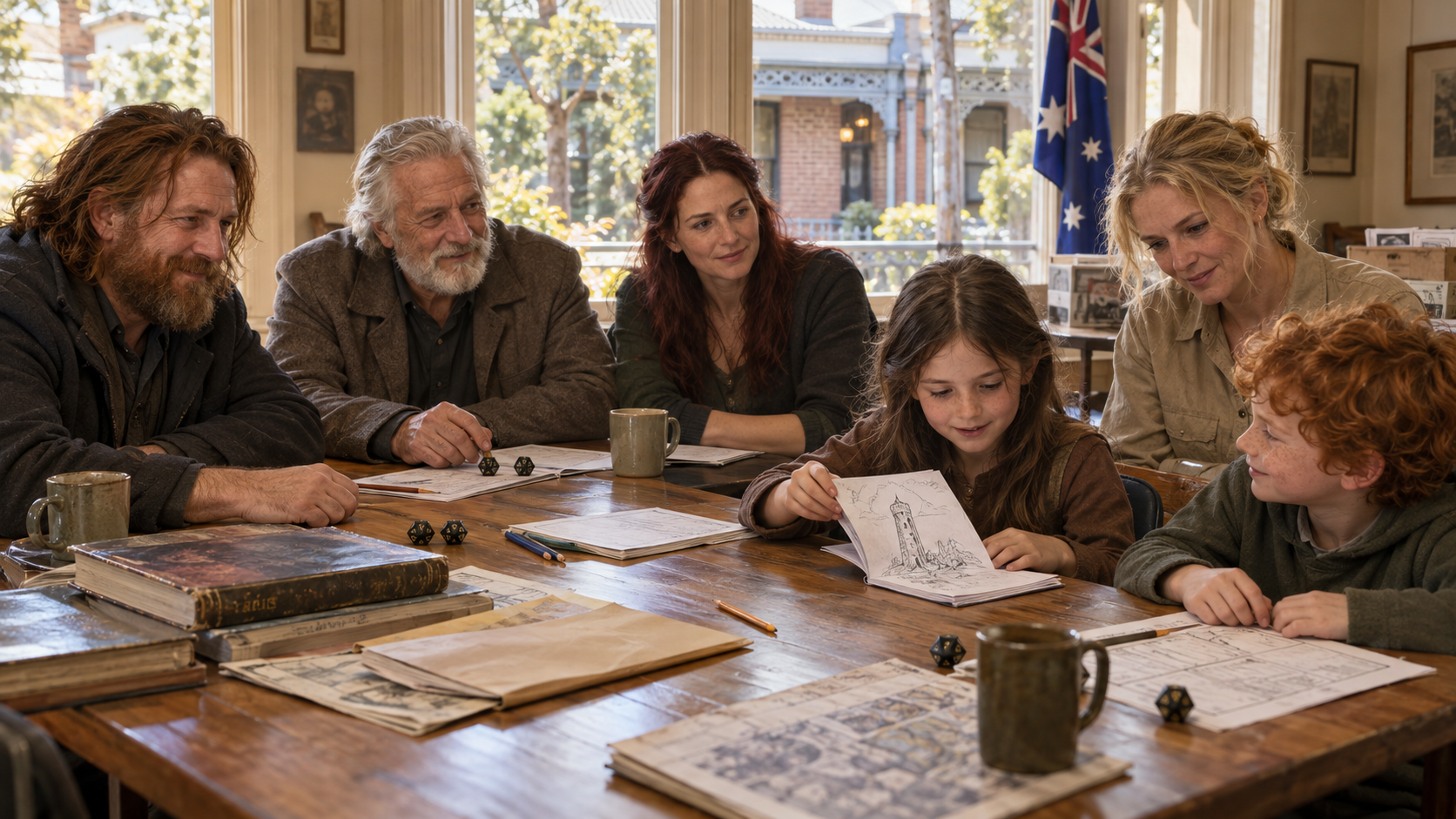
Chibi has made a small book from folded paper.
There is a tower on the front. Inside, he has drawn something with rather more teeth than seems necessary.
Mara reaches for it.
“Can I read it?”
“Not that page. That’s the surprise.”
Stacy turns one of our older books over and examines the credits.
“Where was this game published?”
Sean points to the imprint.
“And where was the adventure written?” she asks.
He checks again.
My name is Eljara. Today, our family is following the history of tabletop RPGs in Australia, beginning with the early encounters and the people who made the hobby accessible.
We are interested in what arrived, but also in what subsequently travelled in the other direction: scenarios, design ideas and approaches to play.
Receiving a game does not make a community merely its audience. People can become its contributors long before they publish a rulebook of their own.
The 1970s: beginnings remembered, beginnings documented
The international starting point is comparatively clear: Gary Gygax and Dave Arneson’s Dungeons & Dragons appeared in 1974. The Australian museum ACMI places the game within the development of collaborative storytelling through rules, characters and conversation. That publication date, however, is not automatically the date of its first Australian session. ACMI
A revealing early recollection comes from Garth Nix. In a 2012 interview, he remembered beginning with the original three-booklet game at around eleven and tentatively placed the date in 1974. He described running a campaign through high school and subsequently playing with friends in Canberra. His uncertainty should remain attached to the date: this is a personal memory, not independent confirmation of Australia’s first game. Lightspeed Magazine
Marion Anderson provides another identifiable beginning. She recalled joining a university D&D group in 1979, when its members needed another player. The invitation led to a lasting involvement in role-playing and, eventually, professional contributions. Chaosium
These memories differ in precision, but both direct our attention towards people rather than products.
Somebody had a book. Somebody else explained enough to begin.
Our evidence does not securely establish the first imported set or the first Australian Dungeon Master. We can nevertheless follow early participation without assigning the whole country a single founding evening.
1974–1979: a book needs a way to reach its readers
Milsims dates its establishment to 1974. Its company account describes a mail-order business whose original wargaming range expanded to include role-playing and other games. Mind Games in Melbourne identifies 1977 as its founding year. These are useful dates for the development of specialist retail, although neither alone establishes exactly when a particular RPG first appeared in stock. Milsims
That distinction keeps two histories from collapsing into one.
A retailer’s beginnings tell us about a potential route to a game. A player’s recollection tells us about an encounter with it. To connect the two precisely, we would need dated catalogues, advertisements, correspondence or similarly specific evidence.
For our purposes, the practical question is already visible.
How does a person move from hearing that such a game exists to actually playing it?
Possessing an English-language rulebook does not mean understanding how to turn its procedures into an evening with friends. Access to the language and familiarity with the activity are different things.
A shop can make a game available. A group makes it usable.
Neither contribution should disappear simply because later books provide more convenient milestones.
1983: the superhero still has to return to ordinary life
Joseph Italiano’s Super Squadron appeared through Adventure Simulations in 1983. In the author’s afterword, reproduced in a documented examination of the books, Italiano described seven years of development, an initial manuscript of approximately twenty pages and repeated unsuccessful attempts to arrange publication. One early requirement was making the text understandable to somebody other than its author. Wayne’s Books
That is a substantial threshold.
A game can function within a friendship because its missing explanations are supplied by the person who invented it. Publication asks whether those explanations can travel too.
Super Squadron also gave attention to the superhero’s private existence: secret identity, romantic relationships, marriage and children. Its play example connected injury and recovery with the practical demands of ordinary life. Supplements subsequently included The Tome in 1985 and Super Science in 1986, extending the game’s material beyond its original scope. Wayne’s Books
Mara considers the injured superhero.
“Can they stay home?”
“Perhaps,” Stacy says. “But someone may want to know why.”
Sean looks up.
“The truly invulnerable character has never had to explain an absence.”
For Mythveil, this is an early point of recognition. A dramatic encounter can matter because the character must carry its consequences somewhere else.
We can identify Super Squadron as an early Australian-designed RPG without turning that into an unsupported claim that every earlier local experiment has been found.
1983 onward: conventions make different tables visible to one another
Arcanacon began in Melbourne in 1983. ACMI’s account places it alongside other Australian gatherings, including Phantastacon and CanCon, within a community culture of independently created material and shared enthusiasm. Each event has its own history; one founding date should not be borrowed to explain them all. ACMI
A convention changes the practical demands on an adventure.
At home, a Game Master knows the group’s habits. Around another table, the players may interpret the same description differently, misunderstand an assumption or pursue a possibility nobody previously noticed.
That does not necessarily mean the scenario has failed. It may reveal what its author had been supplying without realising.
A written adventure needs to communicate more than what happens in a room. It has to help another person understand why the room matters and what might happen when the players interfere.
The later Conquest describes its own history as beginning in 1989 and explicitly includes opportunities for creators to run original games alongside established systems. This is a different event from Arcanacon, not another name for it. Conquest Games Convention
The significance lies partly in those encounters between tables.
People did not need to agree on a single style before they could discover what somebody else was doing.
The 1980s–1990s: Australian adventures enter other people’s campaigns
Marion Anderson recalled Mark Morrison encouraging her to attend local conventions in the early 1980s. By the middle and later years of that decade, she was co-writing convention scenarios with her husband and friends in the loose group known as the Cthulhu Conglomerate. Sending material to Chaosium led to invitations to contribute professionally. Her first published work involved maps and research for Terror Australis. Chaosium
The route becomes particularly concrete in historian Shannon Appelcline’s account: Morrison’s “Crack’d & Crook’d Manse” appeared in Mansions of Madness in 1990, while “Tatterdemallion” by Penelope Love and Richard Watts appeared in Fatal Experiments that year. Contributors from the same circle also worked on Horror on the Orient Express. zindex.designers-and-dragons.com
Here is an Australian contribution that a count of locally published rulebooks would miss.
The underlying game already existed. The new work lay in the situations, characters, atmosphere and choices that another group could experience.
Authorship was also distributed. Research and cartography were not incidental decorations around somebody else’s “real” creative work. Anderson’s account places them within the process by which an adventure became publishable. Chaosium
A player elsewhere might remember the house, the journey or the disturbing discovery without ever checking where its writer lived.
That does not make the contribution less significant.
An adventure can cross a border so successfully that its journey becomes invisible.
The late 1980s and 1990s: the conversation between the books
The Ariel Archives preserve another kind of record: Australian magazines, supplements and smaller publishing ventures. Their inventory distinguishes the first five issues of Australian Realms, produced by Planar Games, from its continuation under a successor. It also records Gammazon’s six published issues and a seventh written but never printed. Ariel Archives
The distinction between written and published matters. So does the existence of the work.
Illustrator Ian Coate adds a participant’s perspective. He remembers joining Australian Realms at seventeen, during the 1980s, and working with editor Corey Swallow. Looking back, he stresses an appreciation of the difficulties involved in putting the magazine together that he did not fully possess at the time. Ian Coate
A magazine gives people a place to contribute without first creating a complete game.
A drawing, a rules discussion or a short piece of adventure material can enter a larger conversation. None requires a new system to justify its existence.
There is another reason to keep these publications in view: a history organised only around surviving businesses makes abandoned projects look as though they never happened.
The unfinished issue belongs to the history of the labour, even when it does not belong to the publication count.
1989–1992: “systemless” did not mean without design
John Hughes presented “New Directions in Australian Roleplaying” in Sydney in May 1991, revising it slightly for Arcanacon X in July 1992. His discussion of systemless role-playing explicitly adopted a Sydney–Canberra perspective, distinguishing thematic play from other theatrical, multi-team and freeform approaches. It was not a census of national practice. Myth-O-Logic
One example was Memory, written by Philippa Hughes, John Hughes and James Townley, presented at Necronomicon I in October 1989. Five dead Sydneysiders confronted their relationships and memories through an intensely structured scenario involving flashbacks and substantial Game Master control. Myth-O-Logic
The example makes a useful distinction unavoidable.
Removing familiar dice procedures does not automatically remove structure. It does not necessarily redistribute authority either.
“Who decides what happens?” Stacy asks.
“That question has not disappeared,” Caelwyn replies. “It has changed its address.”
For us, the interesting issue is where the design has gone: into characters, framing, information, timing or the interaction between participants.
These experiments should not be presented as a country collectively abandoning traditional games. Hughes himself treated the available approaches as different possibilities.
A method is evidence of something people tried, not proof of what everybody became.
1991–1992: difficult stories require more than dramatic ambition
The practical section of Hughes’ presentation addressed expectations, playtesting and the responsibilities of the person running the game. He recommended explaining the intended experience beforehand, listening to players, giving clear notice of demanding content and making time for discussion afterwards. He also mentioned a content-rating practice at Necronomicon. Myth-O-Logic
Hughes warned against forcing people into emotional situations they did not wish to explore. Sensationalism, in his account, could damage the trust on which the experience depended. These concerns were being expressed in this particular Australian convention setting in the early 1990s; that is not a claim that Australia invented every later safety practice. Myth-O-Logic
The underlying distinction remains valuable.
An emotionally ambitious scenario is not successful merely because its author has chosen a disturbing subject. The participants still have to understand what they are joining and possess meaningful room to respond.
Chibi has been listening to the word surprise with some concern.
“Do I have to tell Mara everything?”
“Not every secret,” Stacy says. “But she should know what kind of game you are offering.”
A hidden door and a hidden expectation are not the same thing.
Into the 2000s: an old adventure can find a new table
The convention material did not all disappear when its original events ended. Appelcline identifies “The Old Damned House” by Penelope Love and Liam Routt among the earlier Australian scenarios later included in the 2007 second edition of Mansions of Madness. zindex.designers-and-dragons.com
That is a small bibliographic detail with a larger consequence.
The publication date on a book is not always the beginning of every idea it contains. A scenario may have already passed through performances, revisions and smaller circulation before reaching a later collection.
Equally, the players encountering that collection may experience it as something entirely new.
For a history of the hobby, both moments matter: the circumstances of creation and the circumstances of discovery.
This is why the years between prominent releases should not be treated as empty. A community can be writing, running, revising and sharing work without producing a succession of widely recognised new brands.
Not every private campaign will become recoverable evidence. We should avoid filling that silence with invented activity—but also avoid mistaking the silence for inactivity.
2014: Fragged Empire takes a different direction
In an interview dated 18 June 2014, Australian designer Wade Dyer introduced Fragged Empire before its crowdfunding campaign. He described four years of development and a distant future in which genetically engineered peoples were rebuilding after a devastating war. His stated interests included cultural tension, exploration, long sandbox campaigns and tactical miniature combat. The date identifies a development and funding milestone, not the arrival of every finished product. Geek Native
This is a useful obstacle to a tidy theory.
Australian design had not followed one inevitable path from detailed rules to increasingly unstructured drama.
For Mythveil, Dyer’s premise raises a different question: what does it mean to live after a war when the identities created by that war remain?
We might imagine people trying to negotiate trade or cooperation while carrying incompatible accounts of what happened. A campaign can explore those tensions without making every individual a spokesperson for their entire society.
That is our possible reading of the setting, not a substitute for testing the rules.
Dyer also emphasised collaboration with artists and other contributors. He described working effectively with visual creators as a skill in its own right, rather than a problem solved simply by having money available. Geek Native
A world takes shape through several kinds of work.
The writer is not the only person deciding what others will notice.
2017: Australian designers look towards an awful sea
In a February 2017 interview, Hayley Gordon and Vee Hendro introduced Storybrewers Roleplaying, based in Sydney, and their first major project, Alas for the Awful Sea. Its setting drew on the nineteenth-century British Isles. Gordon discussed historical research and writing; Hendro described art direction and graphic design, while both stressed their collaboration. The Hardboiled GMshoe’s Office
An Australian game did not have to depict Australia to represent Australian creative work.
The designers were interested in communities under pressure, with supernatural elements connected to their circumstances rather than simply added as wandering monsters. Hendro offered a scenario involving overgrazing, competing approaches to resources and a dangerous creature that complicated the dispute. The Hardboiled GMshoe’s Office
The publisher’s description likewise places poverty, politics and folklore in contact, using a modified system descended from Apocalypse World. Storybrewers Roleplaying
For Mythveil, this gives the supernatural somewhere to live.
A community can already be divided before the creature appears. Removing it may not resolve who controls the land, who needs an immediate income or who will bear the cost of a long-term decision.
Those are interpretive questions, not compulsory answers supplied by the premise.
The approach also cautions us against drawing a lineage too quickly. Similar concerns in an earlier Australian convention text do not establish a direct influence on Storybrewers. To make that claim, we would need evidence connecting the people and their work.
A resemblance is a reason to ask, not permission to invent an ancestor.
2018: a reputation can carry an adventure
Good Society: A Jane Austen Roleplaying Game makes a different kind of conflict central. The publisher’s digital edition identifies a December 2018 rules document, accompanied by materials including Desire and Relationship Cards and a Deck of Connections. itch.io
Its official description places ambition, family obligation, relationships and reputation at the heart of play. Participants can influence the developing story through connections, rumours and the use of tokens, rather than treating social life as decoration between more important battles. Storybrewers Roleplaying
Sean appears interested.
“Can someone lose a duel without anybody drawing a sword?”
Stacy gives him a patient look.
“Have you never been to dinner?”
The change is not simply from violence to politeness. The question is what the game makes consequential.
A withheld invitation can matter when access to a social circle affects a character’s hopes. A promise can become difficult because fulfilling it harms somebody else. Reputation is playable when it changes what people can do, not merely when it appears as an adjective.
This offers another way to understand a living world.
Its motion need not always be military or supernatural. It can consist of obligations, expectations and competing interpretations of the same action.
None of this makes tactical adventure obsolete. It enlarges the range of experiences that a role-playing game can deliberately support.
1987–2019: returning to Terror Australis
The distinction between Australian authorship and Australia as a setting deserves its own examination.
Terror Australis originally appeared in 1987. Writing about the expanded edition in 2019, Geoff Gillan described preparing a summary of Australia’s European history from 1788 into the 1920s, particularly to help readers unfamiliar with the country. He also contributed material about everyday life and Queensland, while another writer handled the history of Australia’s First Nations. Chaosium
That is a documented account of tasks within a publishing project.
It does not, by itself, establish who authorised particular cultural material or whether every relevant community endorsed its presentation.
For our reading, historical detail should do more than make an unfamiliar place look convincing.
Who exercises authority? Whose account becomes an official record? Which people can travel freely, ask questions without danger or expect an institution to protect them?
Those questions are relevant to the construction of an investigative setting. They also prevent colonial history from becoming a neutral background behind the supernatural plot.
Research and historical atmosphere are valuable, but they are not identical to perspective.
Knowing more about a place should make us more attentive to the people within it—not merely give us more scenery to describe.
A country is not a common store of interchangeable stories
We need to distinguish three relationships: a game created in Australia, a game set in Australia and a game drawing on the cultural knowledge of particular First Nations.
They are not equivalent.
The present-day Creative Workplaces guidance on Indigenous Cultural and Intellectual Property emphasises cultural authority, consent, attribution, integrity and the sharing of benefits. It recognises First Nations peoples as the principal interpreters and custodians of their cultures. These principles help frame our editorial questions; they are not evidence of what a particular publisher did in 1987. Creative Workplaces
The implications for this series are straightforward.
We should not replace the familiar European assumption that every landscape awaits adventurers with the equally careless assumption that every tradition awaits adaptation.
Nor should an article about mainstream publishing stand in for the experiences of Indigenous players or creators whom its sources have not adequately represented.
At the same time, we cannot responsibly invent consultation, participation or approval to make a publication’s history more reassuring.
Some questions need people with the relevant knowledge to answer them.
Acknowledging that is not a failure to tell the history. It is part of telling it accurately.
The labour that allows the next game to happen
The public description of Conquest identifies it as a volunteer-run, not-for-profit event, supported through ticket sales and smaller sponsors. Its programme accommodates original designs as well as established games. Those are the organisers’ descriptions of their model, not a financial analysis conducted by us. Conquest Games Convention
The continuity with earlier parts of our story is practical rather than mystical.
Someone needs to organise a room. Somebody must explain what is on offer. A designer has to make the material intelligible to people who did not sit beside them while it was written.
The work can be easy to overlook precisely when it succeeds.
A player arrives, finds the right table and enjoys an adventure. The arrangements that made the evening possible remain outside the fictional world.
Our emphasis on creativity should not erase that work. Equally, it should not romanticise an arrangement that depends on the same few people giving more than they can sustain.
A community contributes through what it makes.
It also contributes through the conditions it creates for others to make something.
What the surviving record cannot tell us yet
We have followed early recollections, specialist retail, locally designed games, convention scenarios, publishing relationships and later independent projects.
This is not a complete census of Australian role-playing.
We have not securely identified the first imported D&D set, the first Australian session or a comparable historical series of national player numbers. A retailer’s age cannot supply those answers. Neither can a convention’s attendance or a collection of successful publications.
The geographical record is uneven too. The sources examined here are especially strong around Melbourne, Sydney and Canberra. They do not adequately represent every city, regional community, remote group or migrant-language table.
A further imbalance concerns visibility.
An adventure printed by an international publisher becomes easier to trace than one played for years by six friends. That does not make the first experience more valuable to its participants.
Nor does this history show an inevitable progression from imitation to originality, or from complicated games to emotionally sophisticated ones. The examples pursued different goals and sometimes assigned authority in very different ways.
There was no single moment when Australia stopped receiving games and began creating. Those activities could take place around the same table.
Where did your Australian story begin?
Tell us where and approximately when you started.
Was it an imported D&D book, Super Squadron, RuneQuest, Call of Cthulhu, a convention game or something a friend had written? Did a mail-order catalogue, specialist shop, school club or university group help you find the hobby?
Which magazines did you read? What did your group change? Did you ever run an adventure for people who had never met its author?
We would particularly welcome early catalogues, dated programmes, small publications and memories from places less visible in the usual accounts. An uncertain date can remain uncertain. A private campaign need not become a commercial product before it deserves to be remembered.
Chibi has finished arranging the pages of his little book.
He passes it to Mara.
“You can run it.”
She looks at the tower on the cover.
“What will you do?”
“I’ll play.”
Sean moves the dice between them.
Stacy does not add her own instructions. Caelwyn settles back, and I put our notes aside for a moment.
The surprise has not disappeared because its maker is no longer the only person holding the book. It has changed hands.
We began with games arriving from elsewhere. Along the way, we found people writing adventures, explaining unfamiliar approaches, assembling magazines and making room for different kinds of stories.
Their achievement was not simply to prove that another country could manufacture a rulebook.
They gave other people something to play—and accepted that it would become a different experience when those people did.
Continue One Hobby, Many Beginnings with our journeys through Germany, Italy, Spain, Norway, Denmark, Sweden, Finland and Iceland.
Bring your own campaign questions to the Mythveil Seminar: Campaigns That Remember Your Players.
Read. Play. Watch. Support. Or collaborate.
Read Mythveil Chronicles · Join our campaigns · Support the research and stories · Collaborate with us
Every table has a beginning. Your next chapter could start with us. Find your next game in the Mythveil weekly schedule.