
Looking for your next adventure? Explore our current campaigns and the Mythveil weekly schedule.
One Hobby, Many Beginnings — Sweden
What makes a role-playing game belong to a place? The language of its rulebook? The landscape beyond its imaginary roads? Or the people who keep changing it until it becomes something they recognise as their own? Sweden’s history offers several answers—and they do not all agree.
Stacy has written one word above our notes.
Swedish.
Sean studies it.
“The language, the people or the world?”
“That,” she says, “is what we need to establish.”
Mara looks between them.
“Can a game come from somewhere else and still become yours?”
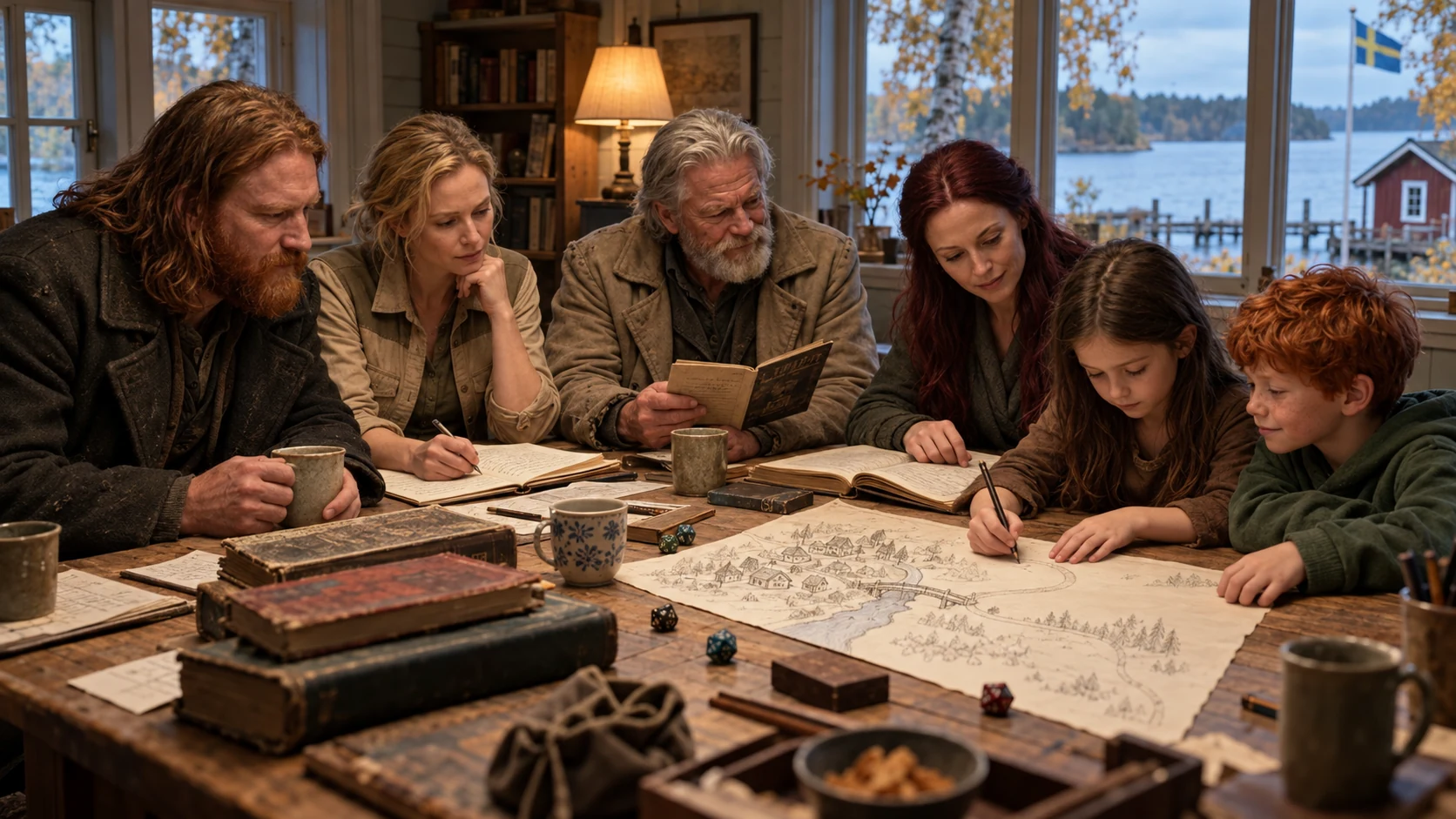
Chibi is drawing a village beside a river. He has not yet decided where the bridge belongs.
My name is Eljara. Today, our family is following the history of tabletop RPGs in Sweden.
We could begin with successful publishers and familiar titles. But that would risk treating everything earlier as preparation for a future nobody at those first tables could have known.
Instead, we are looking for the moments when people took something they encountered and began making choices of their own.
1977: the players before the Swedish box
GothCon’s own history traces its beginnings to KONVENT’77, organised in Gothenburg by Arne Husberg and H. G. Wessberg in 1977. Approximately 20–30 visitors gathered in student-union premises on Götabergsgatan. Wargames and miniatures dominated, but participants could also try Dungeons & Dragons. The following year’s gathering featured the then-new AD&D Monster Manual.
These are recollections preserved by the convention, not proof of the first Swedish role-playing session.
They nevertheless establish something important: people were encountering and playing imported RPGs before a Swedish-language publishing breakthrough.
The book arriving and the hobby beginning are different events.
A person might discover role-playing through a demonstration, a friend or a borrowed rulebook. They might understand the possibilities before understanding every English sentence.
We should therefore resist placing the entire country’s beginning inside a single commercially successful box.
Nor should we move every early table to Stockholm simply because later publishing histories make the capital easier to see.
1982–1985: not D&D translated into Swedish
Drakar och Demoner appeared through Äventyrsspel in 1982. Its foundations were Chaosium’s Basic Role-Playing and the fantasy material Magic World—not a translation of Dungeons & Dragons. Historian Shannon Appelcline traces that connection through Chaosium’s Worlds of Wonder. (Designers & Dragons)
The distinction is more than a correction to a title.
It changes the story from “Sweden received D&D in another language” to something involving licensing, adaptation and subsequent redesign.
In his 2011 recollection, designer Anders Blixt describes several stages. Åke Eldberg prepared the revised 1984 edition. In the summer of 1985, Blixt was commissioned to write Drakar och Demoner Expert. His choices included replacing percentile rolls with a twenty-sided die and making parts of the rules modular: groups could include or omit particular procedures.
Here, the historical interest lies in decisions rather than purity.
The designers inherited a working foundation. They also decided that some things should work differently.
“That sounds less like receiving instructions,” Caelwyn says, “and more like beginning a conversation.”
“A conversation with revisions,” Stacy adds.
For our reading, that is the useful threshold. A game does not need to emerge without influences to acquire a distinct history.
What matters is whether we can identify what people changed, why they changed it and what those changes made possible.
1984: the future becomes strangely familiar
Mutant followed in 1984. The historical work of Orvar Säfström and Jimmy Wilhelmsson describes its post-apocalyptic setting as a meeting between influences such as Mad Max and Escape from New York and a recognisably Scandinavian atmosphere. (Fandrake’s history of Mutant)
Among its central creators were Gunilla Jonsson and Michael Petersén, whom Helmgast also identifies as the authors of the original KULT. Jonsson therefore belongs within the account of formative Swedish game design, not in a late footnote announcing that women also participated. (Helmgast)
A local imagination need not dress itself in a national past.
It can look towards a damaged future.
Imagine recognising enough of a place to understand what has been lost: roads that no longer connect functioning settlements, objects whose purpose survives only imperfectly, communities arranging new lives around inherited wreckage.
The fantastic gains force from what remains familiar.
The later Mutant family moved through markedly different forms, including Mutant 2089, Mutant Chronicles and Undergångens arvtagare. Their shared name should not be mistaken for an unchanged setting or a single uninterrupted design. (Fandrake)
Continuity can include disagreement with what came before.
1987: an island worth occupying
Erik Granström’s Svavelvinter first appeared in 1987 as an adventure for Drakar och Demoner. Three sequels and a volume about Trakorien followed, forming the publications known as the Conflux Suite. Granström later developed the setting into four novels; those novels, in turn, became the foundation for Free League’s separate Svavelvinter RPG. These are related works, not interchangeable editions of one book. (Granström’s retrospective)
His description brings together Renaissance intrigue, Mesopotamian polytheism, philosophical concerns and dark humour. The original adventure’s northern island, Marjura, has been occupied by Trakorien to obtain valuable sulphur. (Erik Granström)
Sean stops at that detail.
“Not an ancient prophecy?”
“A resource,” Stacy says.
“Considerably more reliable at attracting an occupying force.”
For Mythveil, this is a revealing worldbuilding choice.
Occupation becomes more than a villain’s preference. Someone wants something the place contains. From that premise, a Game Master can ask who benefits, who supplies the labour, who resists and who cannot afford to leave.
Those are questions we can bring to the setting, not claims that every campaign must answer them identically.
A world begins to feel inhabited when its conflicts have reasons to continue after the adventurers walk out of the room.
1988: making a place for the people
Sverok dates its foundation to 1988. Its organisational history emphasises young people creating associations and learning democratic organisation through their shared interests.
This gives us another kind of beginning.
A publisher can produce a game. An association can help people arrange the conditions in which they continue playing.
Someone has to decide how newcomers join, how responsibilities are shared and what happens when the people involved disagree.
“Is that in the rulebook?” Mara asks.
“Usually not in the one about dragons.”
She looks faintly disappointed.
Organising does not guarantee a welcoming community. But it creates places where those questions can be addressed rather than left entirely to whoever already possesses the keys.
And the number of people belonging to an organisation must not quietly become a count of everyone playing tabletop RPGs. Membership, participation and book ownership describe different things.
1991: what if the world itself is lying?
KULT first appeared in 1991, created by Gunilla Jonsson and Michael Petersén. Its later reimagining, KULT: Divinity Lost, uses a new ruleset and an updated contemporary setting. Those changes matter when discussing particular editions. (Helmgast)
Helmgast’s description of the later game centres on humanity living inside an Illusion, with another reality concealed behind ordinary appearances. Discovering the truth also means confronting the forces that maintain that confinement.
Our interest here is not simply that Sweden produced another horror game.
It is the kind of question such a premise permits.
Knowledge is often offered to adventurers as a reward: learn the monster’s weakness, identify the murderer, decipher the inscription.
But what happens when knowledge threatens the framework that made a person’s life understandable?
“Knowing more is not always comforting,” Caelwyn says.
“No,” Stacy replies. “But comfort and accuracy were never the same promise.”
That is our interpretive connection, rather than a claim about every designer’s intention.
A contemporary horror setting can turn a familiar corridor into a problem of belief. The danger is not only that something is hiding there. It is that the corridor may never have belonged to the world you thought you inhabited.
1996–1997: the argument outside the game
The later visibility of Swedish RPGs can make their acceptance seem inevitable.
The parliamentary record tells a less comfortable story.
In October 1996, Bengt Silfverstrand and Birthe Sörestedt submitted motion 1996/97:Kr508, arguing that organisations primarily devoted to role-playing should no longer receive state funding. Their case associated the hobby with violence and other harms. The motion documents those allegations; it does not establish them as facts. (The original motion)
In 1997, the Cultural Affairs Committee recommended rejecting the proposal. Drawing on the youth agency’s report Rollspel som fritidssysselsättning, it discussed creativity, cooperation and verbal expression. It also reported that the Swedish research considered did not support the causal connection between role-playing and violence alleged in the debate. (Committee report)
This was not a national ban on role-playing. Equally, the dispute was not imaginary.
Public recognition and access to support were being contested.
The contrast matters to the history we tell now. Something later celebrated as a source of creativity could previously be treated as a threat requiring restriction.
Nor do we need to defend every game by insisting that it is educational. We can acknowledge disturbing fiction while asking for evidence before attributing real-world harm to the people who play it.
Another 1996: detail was not going out of fashion
While arguments about the hobby entered parliamentary documents, designers continued answering different creative questions.
Eon was released in November 1996. Helmgast’s twentieth-anniversary retrospective describes a Gothenburg-based undertaking that deliberately pursued a detailed Swedish RPG and an extensive world with its own past, myths and legends. Its fourth edition followed in 2014.
That makes it a useful obstacle to a tidy theory.
Swedish design did not advance along a single road from complicated systems towards ever-lighter storytelling.
A carefully described world and extensive procedures could themselves be the ambition.
Elsewhere, Drakar och Demoner continued through further versions, including Chronopia and the later Riotminds period. Säfström and Wilhelmsson’s historical account treats those developments as substantial parts of its story, alongside changing artwork and debates in Sinkadus. (Fandrake)
We should not compress the years between an early favourite and a recent revival into a blank space labelled “and then it came back”.
For somebody at a particular table, an intervening edition may have been the beginning that mattered most.
2011–2018: new publishers, older relationships
Fria Ligan—Free League Publishing—was founded in 2011. Yet the company’s own later account describes a longer prehistory among freelancers associated with Järnringen, who wanted to keep producing material for Mutant and Coriolis. (Fria Ligan)
The October 2018 merger announcement makes those connections explicit. Nya Järnringen brought Symbaroum into the combined company. The statement also expressed an intention to publish most products in both Swedish and English.
This is more revealing than a story of sudden emergence.
The company had a founding date. The working relationships and attachment to particular games reached further back.
Mutant: År Noll appeared in Swedish in 2014. By a 2017 publisher announcement, English, French, Spanish and Portuguese translations were already reported. The setting’s history was being carried outward through a new game, not merely preserved in recollection. (Fria Ligan)
The same announcement connected generations of creative work in Forbidden Lands: Nils Gulliksson’s illustrations, Simon Stålenhag’s cover art and Erik Granström’s setting history and scenarios. (Fria Ligan)
The names matter.
“The publisher made it” can conceal writers, illustrators, translators and independent teams doing different jobs. Following those people often explains continuity better than following a logo alone.
2014–2017: a forest to exploit, a childhood to remember
Symbaroum first appeared in Swedish in 2014. Its setting places the displaced Ambrians beside Davokar, a forest covering the remains of a fallen civilisation. Resources and treasure invite exploration—and exploitation. Its rules use a player-facing, roll-under D20 system, not the Year Zero Engine simply because the game later joined Free League’s catalogue. (Official game description)
For our reading, the interesting tension is already present before anyone opens a tomb.
Is the expedition recovering something lost, taking something that belongs to others, or disturbing something better left alone?
The same object can be treasure to one person and evidence of dispossession to another. A living-world campaign can make those competing interpretations consequential.
Tales from the Loop, released as an RPG in 2017, offers a different relationship with place. Based on Simon Stålenhag’s art, it combines an alternative 1980s with everyday problems and extraordinary machines. The core book includes the Mälaren islands near Stockholm and an American setting around Boulder City, Nevada, written by Matt Forbeck. (Official game description)
Here, the familiar is not merely background scenery.
Imagine a child trying to understand something impossible while still worrying about a friend, a parent or getting home.
The spectacular event does not abolish ordinary life. Their collision gives it emotional weight.
The game’s five Gold ENNIEs in 2017, including Best Game and Product of the Year, provide a concrete marker of international recognition. They are not a measurement of worldwide market share. (Free League)
Different ways to make the darkness speak
Vaesen, written by Nils Hintze and based on the work of Johan Egerkrans, builds its supernatural investigations around a mythic nineteenth-century northern Europe. Industrial change exists alongside communities whose older understandings of the world still matter. (Official core-rulebook description)
One question we can bring to such a setting is whether dismissing an explanation also removes the danger it describes.
A village custom might be mistaken. It might also preserve an observation whose reasoning has been forgotten.
That tension gives investigation something more interesting to do than sort every encounter into “rational” or “superstitious”.
MÖRK BORG demonstrates a markedly different approach. Free League’s 25 February 2020 release announcement credits Pelle Nilsson of Ockult Örtmästare Games and Johan Nohr of Stockholm Kartell, with Patrick Stuart editing the English text. It was published under the Free League Workshop label for externally developed games: a rules-light, visually forceful vision of an apocalyptic world. (Free League)
The distinction between creator and publisher remains essential.
So does the distinction between these games.
A folkloric investigation, a dense fantasy society and an abrasive end-of-the-world adventure do not become the same design philosophy because their creators have connections to Sweden.
The country supplies a context, not a compulsory mood.
2023: the dragon travels again
Dragonbane arrived in 2023 as a new version of the tradition that began with Drakar och Demoner. This was not simply the 1982 text transferred unchanged into English. The release materials presented it as a reimagining. (GamingTrend)
In a 2022 interview, Tomas Härenstam explained that an English-language launch had not initially been an obvious choice. International interest helped encourage it. He also described a deliberate emphasis on humour alongside dangerous adventure, rather than making the game another variation on unrelieved grimness.
And yes, Dragonbane includes duck-like adventurers called mallards.
Chibi looks up.
“Can the duck have a sword?”
Sean pauses.
“I suspect we have reached the important part of the research.”
The broader movement is worth noticing.
An early game built from licensed American material became the starting point for decades of Swedish adaptation. A later version then reached an international audience again.
That is not cultural contamination followed by purification.
It is exchange followed by work, disagreement and further exchange.
Something can become distinctive without pretending it has no ancestors.
Whose success are we remembering?
Numbers help establish scale, but only when we let them describe what they actually count.
Appelcline’s historical account reports more than 100,000 copies of Drakar och Demoner sold over the decade following its 1982 appearance. This is a retrospective historical figure, not a sales ledger we have independently audited. Copies are not unique players, and cumulative sales are not a census of active groups. (Designers & Dragons)
The history also needs people who never became a sales figure attached to a successful company.
Writing in Arbetet in 2024, Magnus Dahl challenged accounts that left working-class players and outsiders on the margins. He recalled an AD&D group in Jakobsberg and questioned a success story centred on those who later became prominent creators or entrepreneurs. He also praised the historical book he was discussing; his objection was to who remained absent from the picture. (Dahl’s commentary)
His recollection does not establish the social composition of every Swedish group.
It does ask something we should not evade.
“Do you have to publish something to count?” Mara asks.
“No.”
“Then we should remember the people who just played.”
Exactly.
The worth of a campaign does not depend on whether its participants eventually turn it into a business.
Where did your Swedish story begin?
Our sources are strongest around published games, named designers, established organisations and preserved arguments. They cannot represent every private table, rural community, minority-language experience or Sámi player.
A Swedish-language book is not automatically evidence of a single Swedish experience.
Tell us where and approximately when you began.
Was it imported D&D, a particular Drakar och Demoner box, Mutant, KULT, Eon or something a friend had made? Did Sinkadus, a club or a convention help you find other players?
What language did you read, and what language did you use at the table?
We would especially welcome memories that do not fit the familiar publishing story: borrowed books, homemade settings, forgotten groups and campaigns that mattered deeply without ever appearing in print.
Chibi has finished drawing the bridge.
Mara examines his village.
“That wasn’t there before.”
“No.”
“Where does it go?”
He pushes the paper towards her.
“You draw that bit.”
Caelwyn moves a pencil within her reach.
Stacy leaves the heading unfinished.
We came looking for the moment when a borrowed game became somebody’s own. Perhaps the better question is what they did with it—and what they allowed another person to add.
A world can have roots without growing behind a locked gate.
Continue One Hobby, Many Beginnings with our journeys through Germany, Italy, Spain, Norway and Denmark.
Bring your own campaign questions to the Mythveil Seminar: Campaigns That Remember Your Players.
Read. Play. Watch. Support. Or collaborate.
Read Mythveil Chronicles · Join our campaigns · Support the research and stories · Collaborate with us
Every table has a beginning. Your next chapter could start with us. Find your next game in the Mythveil weekly schedule.