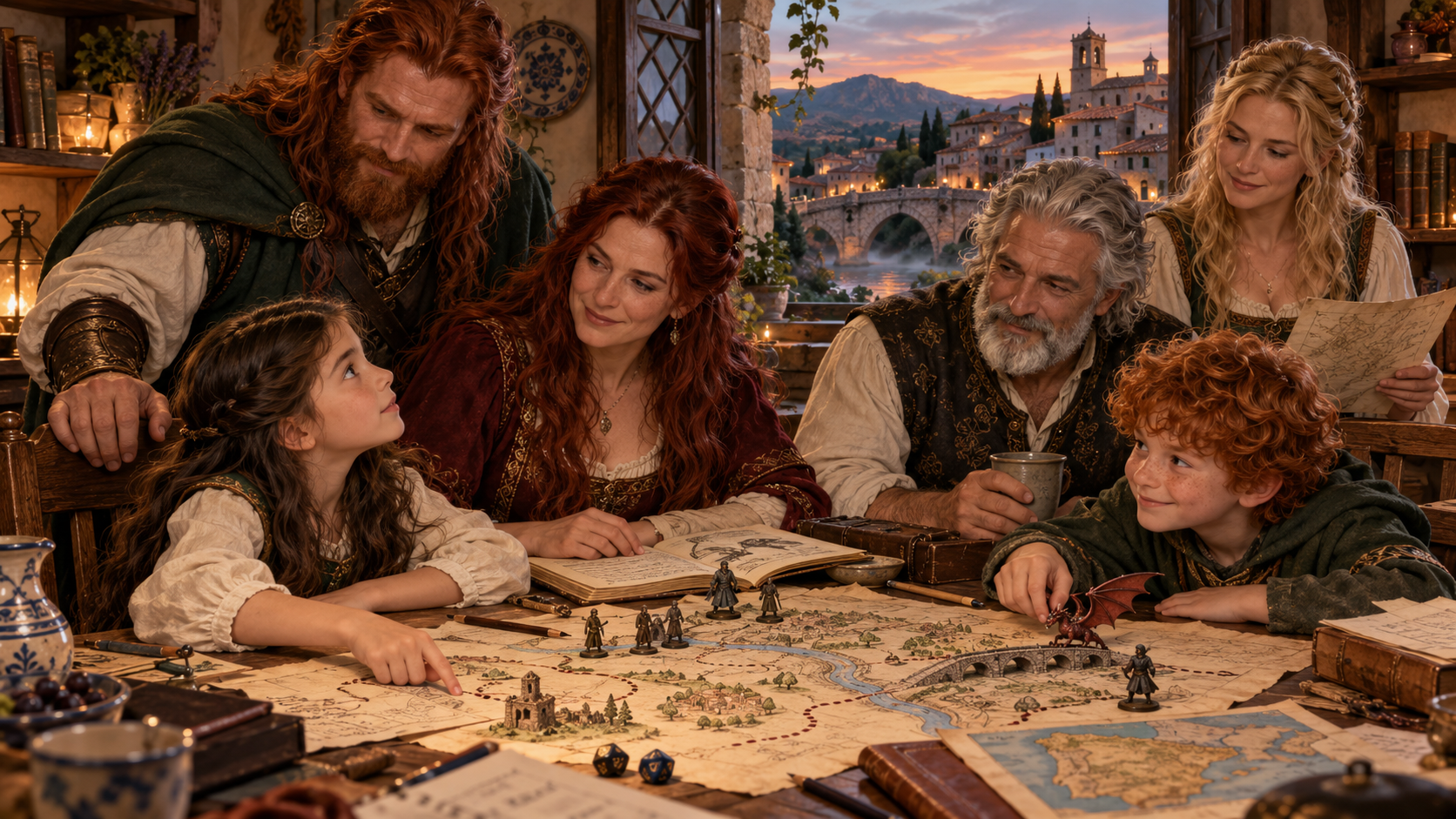
One Hobby, Many Beginnings — Part Three: Spain
In 1990, Aquelarre turned towards the history, beliefs and unsettling stories of the Iberian Peninsula. To understand why that mattered, we need to travel backwards: to imported games, borrowed rooms, magazines and the people who made those worlds playable.
Looking for your next adventure? Explore our current campaigns and the Mythveil weekly schedule.
Imagine a road approaching a village at dusk.
There is a bridge ahead. A man stands beside it, asking travellers their names.
Your companion tells you not to answer.
Behind the houses, a bell begins to ring. You recognise the sound. You do not know why the stranger smiles when he hears it.
Mara reaches across my notes.
“Can we go another way?”
“Yes.”
“Then why are we still here?”
A reasonable opening contribution.
My name is Caelwyn. For this part of our journey, I want to begin with a game rather than a shipment of books. With the moment when an unfamiliar hobby offered a particularly unsettling possibility: perhaps the strange world did not have to be somewhere else.
Aquelarre first appeared on 13 November 1990, published by Joc Internacional and designed by Ricard Ibáñez. Its setting joined the historical kingdoms of medieval Iberia with a supernatural world in which demons, magic and legendary creatures could be as real as the dangers of human society. Source: Nosolorol
Its invitation was not simply to escape into another country.
It was to look again at the ground beneath your feet.
What does it mean for a game to reflect a place’s soul?
That is a large claim to make for a rulebook.
Fortunately, I do not mean that a country possesses one personality, conveniently available between character creation and the combat chapter.
I mean something more particular: the recognition that familiar landscapes, inherited stories and arguments about the past can belong inside a game.
Publisher Francesc Matas describes encouraging local creation as part of Joc Internacional’s purpose. In his account, translated international works and stories connected to inherited symbols were meant to complement one another. Aquelarre’s cultural roots were not an accidental feature discovered afterwards; they mattered to the publishing idea. Source: interview with Francesc Matas Salla
For our reading, this makes the game a kind of mirror.
Not a mirror that shows an entire country correctly. One that returns certain things its players might recognise: a place name, a religious image, a warning, an uncomfortable relationship between authority and belief.
Eljara studies the word soul on my page.
“Something can feel familiar without speaking for everybody.”
“Exactly.”
“Good. I would rather not fit an entire peninsula into a character sheet.”
Neither would I.
Our earlier journeys through Germany and Italy already encountered distinctive creations, including DSA and Kata Kumbas. Spain was not the first place where players made something their own.
Aquelarre gives us a particularly strong example of local history and inherited imagination becoming the substance of a playable world.
But it did not appear from nowhere.
To understand the book, we have to leave its fictional village and return to the people opening unfamiliar games.
Before Aquelarre: a hobby already finding its readers
The preserved record of Maquetismo y Simulación, usually shortened to MS, begins in September 1979. It started as an internal bulletin within the Aeri Popular de Catalunya, grew beyond that original role and eventually became the first phase of the publication later known as Líder. Its early setting was the wider world of simulation games, not a fully formed national RPG industry. Source: MS archive at Sinergia de Rol
This matters because it gives the incoming games somewhere to land.
People were already exchanging information, discussing rules and organising activities. An unfamiliar form of play could travel through those connections.
The stories told about publishing sometimes begin with a company discovering a market. At the table, the beginning can be considerably smaller.
Someone has a book.
Somebody else understands enough of it to explain the idea.
A third person asks whether they can try something the explanation did not mention.
“That is when you find out whether you understood it,” Stacy says.
“Or whether you can improvise convincingly,” Sean adds.
Those are not always the same skill.
The early bulletin does not prove that every Spanish group emerged from simulation gaming. It does show why we should not picture the first translated rulebook arriving before any community existed to receive it.
1984: when the game outgrows the room
Valencia offers a wonderfully practical example.
The Club Dreadnought traces its beginnings to February 1984, when friends interested in historical simulation games decided that their increasingly large and lengthy sessions needed dedicated premises. A permanent meeting place grew out of an ordinary difficulty: playing at home was becoming awkward. Source: Club Dreadnought history
This was not yet a declaration of a uniquely Spanish storytelling philosophy.
They needed somewhere to put the game.
Caelwyn the historian can find that significant. Caelwyn the person expected to clear the table before dinner finds it entirely understandable.
“Couldn’t they use a smaller map?” Mara asks.
Sean gives her the patient look of a man who has encountered enthusiasts before.
“Apparently not.”
A room changes more than storage. It can make regular meetings possible and give newcomers somewhere to find the people they need.
Later that year, Zaragoza hosted strategy and simulation gaming days on 8–9 December 1984. A historical reconstruction drawing on MS records a small D&D tournament among the activities. These were not the later JESYR in Barcelona: those began in December 1986, bringing together groups from several cities, including Madrid, Murcia, Alicante, Zaragoza and Valencia. Source: history of Spanish RPG conventions
The distinction is important.
We are not following one city teaching an otherwise empty country to play. We are watching scattered groups become more visible to one another.
1985: the red box opens another door
Dalmau Carles Pla published Spanish-language Basic D&D in 1985, with Olga Montero credited for the translation. The red box became an important publication landmark, but it did not erase the imported books and earlier sessions that preceded it. Source: bibliographic overview of Dalmau Carles Pla
Translation changes what somebody can attempt independently.
You no longer necessarily need another person to explain both the rules and the language in which the rules are written.
But the translated book still cannot gather your friends, negotiate an evening when everyone is free or persuade somebody to run the adventure.
“It should include a spell for that,” Sean says.
“The calendar?”
“The people.”
There are limits even to fantasy.
For this series, the distinction remains central: the original publication, the local translation and somebody’s first memorable game are different beginnings.
We do not need uncertain sales totals to understand why the Spanish edition matters. Making the instructions accessible is a substantial achievement on its own.
The people translating were also the people playing
Ana Isabel Utande remembers her introduction at approximately 1984, during afternoons spent playing with Luis Serrano and friends. A D&D purchase made out of curiosity changed the direction of those gatherings. Their circle became The Fumbler Dwarf, and translated material began travelling beyond the original group. Source: interview with Ana Isabel Utande
Later, Utande and Serrano worked on the Spanish RuneQuest line.
The working arrangement deserves a moment of attention: WordPerfect files on floppy disks, sent by post from near Madrid to Barcelona. Utande also recalls advising on material to publish. These were players helping shape what other players would receive. Source: interview with Ana Isabel Utande
Stacy turns the imaginary disk over in her hand.
“So the electronic document went through the postal service.”
“Yes.”
“An admirably physical cloud.”
The joke is ours. The disks in the post are part of her recollection.
This is why a simple sequence of import, translation, community and original creation does not quite work. Community was already helping translation happen.
The people did not remain permanently on opposite sides of a publisher’s counter.
1987–1989: more worlds, and somewhere to discuss them
Matas dates Joc Internacional’s acquisition of Líder to November 1987. He describes it as both a means of communicating with readers and a promotional tool. Its pages answered questions and supplied material as well as advertising publications. Source: interview with Francesc Matas Salla
Those functions can coexist.
A magazine can help sell games while also helping readers become contributors. A question sent to an editor might reveal confusion in a rule, suggest another adventure or bring a new writer into view.
Joc’s Spanish editions of La llamada de Cthulhu and RuneQuest appeared in 1988, followed by El Señor de los Anillos, the Middle-earth role-playing game, in 1989. The growing selection offered different imaginative starting points rather than a single mandatory route through the hobby. Source: interview with Francesc Matas Salla
We are approaching the circumstances that make Aquelarre less mysterious as a publishing event.
There are readers accustomed to encountering different worlds, people translating and writing, places to meet, and a magazine capable of carrying new material between them.
A local creation does not need to reject that accumulated experience.
It can use it.
Back to 1990: Aquelarre’s roots cross borders
Ibáñez identifies Call of Cthulhu as an influence on both Aquelarre’s percentage-based rules and its preference for vulnerable people rather than effortlessly triumphant heroes. He also names François Bourgeon’s French comic Les Compagnons du crépuscule, known in Spanish as Los compañeros del crepúsculo, as an influence on its harsh medieval atmosphere. Source: interview with Ricard Ibáñez
That is a more interesting ancestry than cultural isolation.
An American horror game and a French comic help an author make something rooted in the Iberian Peninsula.
The work becomes distinctive through the choices made with those influences.
In our reading, the important change is one of emphasis. A character need not be destined for greatness before their trouble becomes worth following. Finding food, protecting somebody or escaping a dangerous obligation can be enough to make the next decision matter.
The supernatural enters a life that already has pressures.
“Can I still have a sword?” Chibi asks.
“Perhaps.”
“Then I’m ready.”
“For what?”
He looks at the notes.
“I haven’t decided.”
Confidence remains inexpensive until somebody asks it to solve a problem.
Aquelarre did not become its own creation by forgetting other games. It became its own creation through what it chose to do with them.
Somebody also had to draw this world
Its visual identity was another collaboration, not simply an author’s idea appearing intact on a page.
Montse Fransoy recalls entering the project through Arnal Ballester, her teacher at the Escola de la Dona. What began as an assignment for a handful of illustrations grew into years of work. She describes Ballester’s artistic direction and covers, her own interior illustrations and Montse Bosch’s maps. Source: interview with Montse Fransoy
Fransoy also identifies the intended visual direction: somewhere between medieval woodcuts and the Tarot of Marseille. That describes a deliberate artistic language, not proof that every image reproduces medieval art precisely. Source: interview with Montse Fransoy
For our argument, the distinction strengthens the work.
A game can suggest age, danger and familiarity through the way it looks. The reader begins interpreting the world before the first character has rolled anything.
Eljara considers the illustration notes.
“People remember the author.”
“They should.”
“They should remember who taught them to see the place, too.”
Exactly.
The soul we are talking about was made through choices. It did not arrive already complete because somebody wrote a country’s name on the cover.
Whose legends are we calling medieval?
Here Mara asks the question that prevents the essay from becoming too comfortable.
“Did the people who lived there really believe all of it?”
“Which people?”
“The ones in the village.”
“Which village?”
She frowns.
“You know what I mean.”
I do. But the question becomes more interesting when we make it smaller.
Ibáñez names collectors and writers including Joan Amades and José Miguel de Barandiarán among his sources for regional traditions. He identifies Amades as especially important to Dracs, the later Catalonia-focused supplement. Source: interview with Ricard Ibáñez
These are valuable clues about the game’s creative materials.
They are not a licence to treat every collected story as a direct record of what every medieval person believed.
A later collection can preserve an older tradition, reshape it or contain material whose age is difficult to establish. To make a historical claim, we still need to ask when something was recorded, by whom and about which community.
Stacy places two sheets beside each other.
“This is what the game makes true.”
“And the other?”
“What the evidence lets us say about the past.”
“Must they agree?”
“No. But we must know which one we are reading.”
That is the distinction we also explored in our Ars Magica essay.
Historical fantasy can ask an intelligent question without becoming historical documentation. Its responsibility is not to remove invention, but to avoid disguising invention as established evidence.
The place matters because somebody has to live there
Let us return to our invented bridge.
The stranger is still waiting.
A visiting adventurer can decide the road is unsafe and leave the region. A person who belongs to the nearby village may not have that luxury.
Their home is there. Someone is expecting them. The other route might take more time than they have.
That is an imaginative possibility we can build from Aquelarre’s combination of ordinary lives and extraordinary dangers. It is not a claim that the opening scene comes from a published adventure.
The frightening thing need not stand outside society, waiting in a convenient wilderness. Its effects can enter an existing network of needs, loyalties and disagreements.
Does a neighbour need help? Who will be blamed if help fails? What happens when the person with the best explanation is also the person nobody trusts?
For Mythveil, that is where local history and folklore become more than decoration.
A recognisable place gives a decision somewhere to hurt.
“Can we ask the priest?” Mara says.
“In our scene, yes.”
“Does he know?”
“That is what you would have to discover.”
The existence of an authority does not make the answer automatic. Nor should a game turn every authority into the same fool or villain.
The human disagreement is part of the world, not an interruption between supernatural encounters.
1987–1992: other games were looking beneath familiar ground
Aquelarre was not alone in making our world strange.
Ars Magica first appeared in 1987, created by Jonathan Tweet and Mark Rein-Hagen. Its Mythic Europe places magi, their companions and their communities within a world of working magic. Vampire: The Masquerade followed in 1991, launching the World of Darkness line. These are original publication dates, not a claim that their Spanish translations appeared simultaneously. Source: Atlas Games on early Ars Magica
Placed beside Aquelarre in 1990, they make a revealing comparison.
Ars Magica gives us a community that can study and practise extraordinary powers. The shared home of its magi and companions—the covenant—can continue across years of fictional time. Its magic belongs within an enduring social world, not just an isolated encounter. Source: Atlas Games on Ars Magica
Aquelarre places its people amid medieval society and supernatural danger, where getting through the next difficulty can matter more than becoming a legendary conqueror. Source: Nosolorol on Aquelarre
Vampire turns towards the modern city and changes the position of the player: you are not simply discovering that monsters exist. You play one, attempting to navigate hunger, relationships and the consequences of being a predator who still possesses human attachments. Source: World of Darkness on Vampire: The Masquerade
These are different experiences. Putting them together does not make them one system or one shared universe.
Our comparison is narrower:
The familiar world becomes part of the fantastic problem.
History, a town, a household or a modern street no longer needs to be left behind before the adventure starts.
Sean looks towards the window.
“So we spent all that time looking for another world.”
“Some games did.”
“And then somebody thought to look under this one.”
“Several people, by different routes.”
He nods.
“Worse. We cannot blame one person.”
A resemblance is not a family tree
We should not announce a coordinated movement simply because several release dates sit close together.
Nor did these games invent the use of our world in supernatural role-playing. Call of Cthulhu had already appeared in 1981, and its influence on Ibáñez is explicitly acknowledged. Source: Chaosium on Call of Cthulhu Classic
What the comparison gives us is a question about different uses of familiarity—not a claim that everybody suddenly discovered storytelling around 1990.
The later KULT, originally released in 1991, makes everyday reality itself an imprisoning illusion. Nephilim, first published in 1992, will give our French instalment another closely timed point of comparison. Neither needs to be treated as Aquelarre’s descendant to make the juxtaposition useful. Source: Helmgast on KULT
We will return to those roads when the series reaches their own contexts.
For now, the connection to our World of Darkness work is already practical. In “The Devil Keeps His Promise”, we considered how a dangerous bargain can become persuasive precisely because it works.
That does not make an Aquelarre bargain and a World of Darkness bargain mechanically equivalent.
It gives us a shared question: what happens to an existing human life when the impossible begins answering back?
The answer depends on the game, the situation and the people involved.
That is why the comparison is worth making.
Aquelarre was a Spanish answer, not the only Spanish answer
A game can illuminate a place without replacing everybody else who lives there.
Mutantes en la sombra, created by José Félix Garzón and Igor Arriola, appeared through Ludotecnia in Bilbao in April 1991. Its concerns included extraordinary human abilities, secrecy and the interests of governments—not medieval Iberian folklore. Source: bibliographic overview of Mutantes en la sombra
That is an important neighbour for Aquelarre.
An original Spanish game does not have to prove its origins by choosing a recognisably local historical setting. Its creators are also entitled to science fiction, international influences and invented futures.
The same plurality appears in memories of actual play.
Óscar Recio Coll places his beginnings at approximately 1989–1990, through books, his older brother and the Club Arioch in Palma de Mallorca. He remembers Xesca Guasp running one of his early club sessions using Hurlements, a French game. Source: interview with Óscar Recio Coll
His account also recalls later helping check the Spanish Ars Magica text associated with Kerykion. Here the connection is not merely something we notice by comparing books: a participant’s own path runs between the games and their communities. Source: interview with Óscar Recio Coll
Our map now includes Barcelona, Madrid, Valencia, Zaragoza, Bilbao and Mallorca.
It still does not include everyone.
That is a reason to keep asking, not to colour in the empty spaces with assumptions.
The memories that do not fit inside a publishing catalogue
One more beginning deserves a place here.
Susana Gil Castro recalls discovering a group playing D&D during a youth-group trip. Her account settles on 11 January 1991, in Gualba, and includes her surviving first character sheet. Later, she joined the club La Pifia and began running games herself. Source: interview with Susana Gil Castro
For a publishing chronology, January 1991 comes after Aquelarre.
For her, the significant event was a group around a table and an invitation to join.
Both histories are true. They measure different things.
Eljara taps the character sheet.
“This can tell us when she began.”
“Among other evidence, yes.”
“Does the rulebook tell us why she returned?”
“No.”
“That is why we ask her.”
A historical essay needs more than affectionate recollection, but it also needs more than publication dates. The two can question and enrich one another.
The materials used here include publisher records, archive descriptions and retrospective interviews. They reveal particular routes. They do not establish a complete account of every region, language or group in Spain.
And the Spain publishing these games in 1990 is not identical to the medieval Iberia imagined inside Aquelarre.
Keeping those worlds distinct allows us to understand the relationship between them.
What Aquelarre gave back to the landscape
We began with the possibility that a game could reflect the soul of a place.
After following its origins, I would put it more carefully—but not less warmly.
Aquelarre offered one way to recognise that familiar ground could carry adventure, dread, humour and difficult choices. It did not have to provide a universally agreed version of the past to make people curious about that past.
Our reading of its achievement is not that Spain finally stopped borrowing.
Borrowed games, translated rules and a French comic are part of the story.
The achievement lies in making choices that gave those influences another home.
A country’s creative life is not weakened because its books have travelled. Nor does every local creation need to become a declaration of national identity.
Sometimes an author simply recognises something worth looking at more closely.
The bridge near the village.
The story attached to a ruin.
A promise whose meaning changes when someone is desperate enough to keep it.
In our opening scene, the danger is invented. The question it gives the players is immediate: what are you prepared to do for the people on the other side?
That is enough to begin an adventure.
It may also be enough to make a familiar landscape feel different afterwards.
Where did your story begin?
Tell us in the comments where and roughly when you began playing in Spain.
Was it D&D, Aquelarre, RuneQuest, Cthulhu, a journey into Middle-earth or something less often remembered? Did a friend introduce you, or did you find your people through a shop, club, youth centre or magazine?
In what language were the books—and in what language did you play?
We would particularly welcome memories from the smaller groups and places that rarely appear in publishing histories. A remembered date can remain approximate. You do not need a perfect archive to begin a conversation.
And one more question, prompted by Aquelarre:
Has a game ever made a place you already knew feel strange, important or full of stories again?
Mara looks back at the bridge in my notes.
“We could come back in daylight.”
“We could.”
“With more people.”
“A good idea.”
Chibi picks up a pencil.
“And a dragon.”
Sean closes the book before negotiations can advance.
For now, the stranger can wait.
Sometimes a game takes us somewhere we have never been. Sometimes its greater achievement is making us look again at home.
Every table has a beginning. Your next chapter could start with us. Find your next game in the Mythveil weekly schedule.
Read. Play. Watch. Support. Collaborate.
At Mythveil Chronicles, we explore the history, culture and human choices behind the worlds we inhabit at the gaming table.
Read Mythveil Chronicles · Join our campaigns · Support the research and stories · Collaborate with us