Time Without Tide

Learn more about our Time Without Tide campaign
There is something strange about old houses. Not haunted houses. Just old ones.
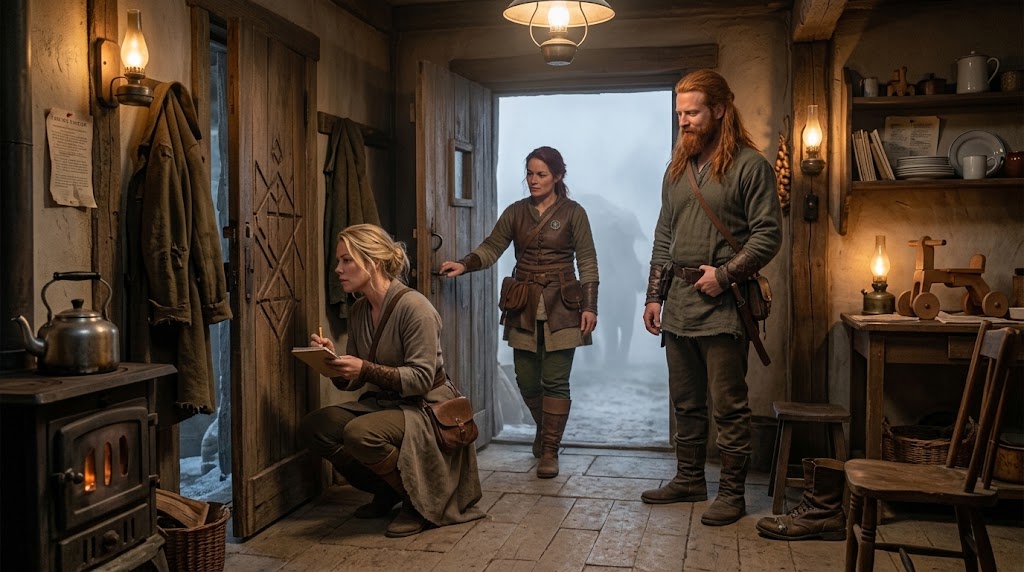
A doorway with marks cut into the frame. A shoe hidden where nobody was supposed to find it. Something placed beneath a floorboard before the boards were nailed down. A symbol scratched into timber and then covered by generations of paint.
We find these things and ask what they meant. Sometimes we know. Sometimes we think we know. And sometimes we call them superstition because that is easier than admitting that somebody once considered them important enough to put inside the walls of their home.
CAELWYN: “A house has always been more than shelter.”
It is a boundary. Inside. Outside. Family. Stranger. Known. Unknown.
That is why so many traditions gather around doors, windows, hearths and thresholds. They are the places where one world touches another. And people have always been very interested in deciding what may cross.
STACY: “Which sounds wonderfully mystical until you realise how practical it is.”
A lock is also a ritual performed at a threshold. You close the door. You turn the key. You check it once, perhaps twice. Not because the door has changed. Because you want to know that whatever belongs outside stays outside.
CAELWYN: “And if you believed there were things a lock could not stop?”
STACY: “Then you would build something else.”
That is where Time Without Tide becomes interesting. Because we have a habit, particularly in modern horror, of treating the supernatural as an interruption. There is a normal world. Then something impossible appears. The characters discover it. Everything changes.
But what happens when the impossible has been around long enough for somebody’s grandmother to know what to do about it? What happens when the strange has traditions?
CAELWYN: “Then people stop asking whether it exists. They ask how to live beside it.”
That difference matters.
Imagine generations discovering that certain things work. Perhaps nobody remembers why a particular mark is placed above a doorway. Perhaps the explanation has changed five times. Perhaps one family calls it a blessing, another calls it an old sailor’s custom, and someone educated rolls their eyes while carefully making sure it is still there.
Because nobody wants to be the person who removes it.
STACY: “Especially if the last person who removed one had a very educational evening.”
CAELWYN: “There are lessons people prefer not to repeat.”
STACY: “And that is how superstition becomes architecture.”
Not because everyone agrees about what is happening. They don’t need to.
One person might say there is a supernatural presence beyond the wall. Another might describe an environmental phenomenon. Someone else might insist that the whole thing is nonsense. But if all three still avoid opening the same door after sunset, their disagreement becomes considerably less important.
That fascinates me. Because knowledge does not always begin with understanding. Sometimes it begins with: Don’t do that.
CAELWYN: “And eventually someone asks why.”
STACY: “Of course. Someone like me.”
CAELWYN: “Unfortunately.”
STACY: “Thank you.”
But yes. Eventually somebody measures the doorway. Tests the material. Compares accounts. Looks for environmental changes. Checks whether the stories agree. Asks what happens if the mark is damaged, moved or reproduced somewhere else.
That is also human. We inherit rules, and then somebody inevitably pokes them with an instrument.
CAELWYN: “Which is useful. Until the instrument answers.”
STACY: “That’s the good bit.”
Because this is where the usual argument between reason and superstition becomes far less useful than we pretend.
If something consistently happens, investigation does not make it less supernatural. It simply gives us more information about it. And tradition does not automatically become foolish because the people who created it could not explain the mechanism.
Sometimes people learn the rule before they understand the reason. Human beings have done that for a very long time.
CAELWYN: “Which means the oldest person in the room and the person carrying the newest instrument may both know something the other does not.”
STACY: “Exactly.”
And that gives us a much more interesting supernatural world than one divided neatly between believers and sceptics.
Imagine growing up somewhere like that. You do not need to understand every protection built into your home. You simply learn them.
Don’t move that stone. Leave that window closed when the fog comes in. Never answer a voice from the other side of the wall unless you can see who is speaking. The third stair creaks. The fourth one shouldn’t.
Children would learn these things before they understood them. And eventually they would stop thinking they were strange.
CAELWYN: “Until an outsider arrived.”
STACY: “And opened the window.”
CAELWYN: “There is always one.”
STACY: “There really is.”
But that outsider reveals something important. Normality is local.
What seems absurd to someone arriving in a community may be ordinary to everyone who lives there. And in a world like Time Without Tide, that distinction can become wonderfully uncomfortable.
Because the local custom might be nonsense. It might be a distorted memory of something that once mattered. It might work for entirely different reasons than anyone believes. Or it might be the only thing standing between an ordinary household and something nobody has seen for three generations.
You don’t know. Not immediately. And neither should the players.
CAELWYN: “That uncertainty is where the supernatural keeps its teeth. Not because nothing is known. Because something is known. Just not enough.”
STACY: “Yes. That’s the part I love.”
A completely unknowable supernatural world eventually becomes arbitrary. Anything can happen because there are no rules.
But a world where people have discovered fragments of the rules? That becomes dangerous in a different way.
You know enough to survive. Perhaps. You know enough to recognise when something is wrong. Usually. And you know enough to understand why everyone in the room has suddenly gone quiet when somebody knocks three times on a door that has not been used in forty years.
CAELWYN: “Do you open it?”
STACY: “Absolutely not.”
CAELWYN: “Progress.”
STACY: “I said I wouldn’t open it. I didn’t say I wouldn’t measure it.”
And perhaps that is where the house begins to know us in return.
Because once the supernatural becomes part of everyday life, our homes change around it. Our habits change. Our stories change. Our children inherit rules whose origins they may never know.
A protection becomes decoration. A warning becomes a proverb. A survival technique becomes tradition.
Until one day someone looks at an old mark above a doorway and asks why it is there. Most of the family shrugs. Grandmother remembers part of the story. The child knows the rhyme. The researcher reaches for an instrument.
And somewhere beyond the wall, something that has been quiet for a very long time hears them talking.
CAELWYN: “The house remembers.”
STACY: “Even when we don’t.”
The supernatural does not need to invade everyday life. Sometimes it has been there so long that everyday life has grown around it.
That is where a living world begins: not with the monster at the door, but with the people who learned generations ago why that door stays closed.
Worlds That Remember.