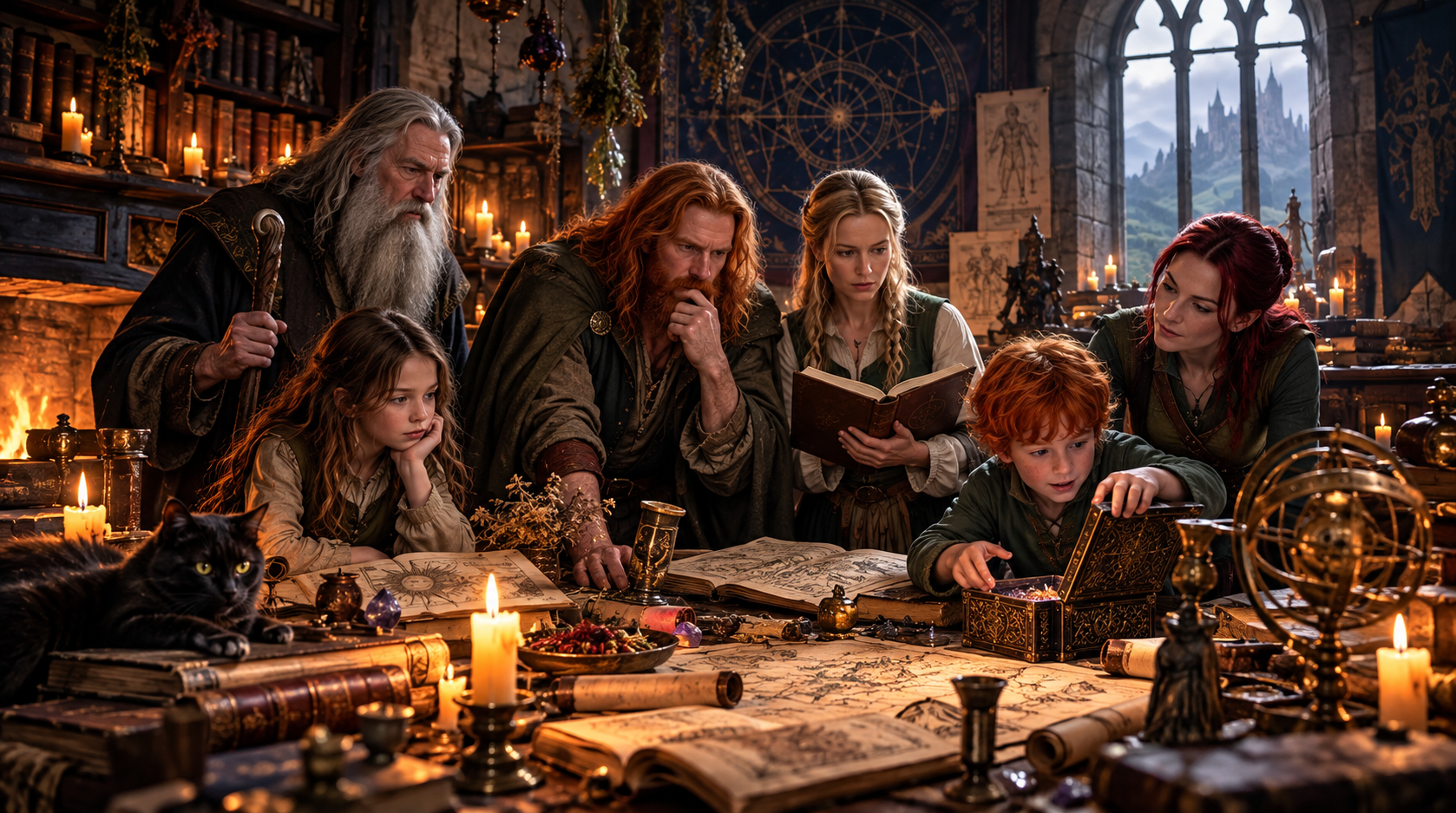
Nearly forty years of Ars Magica have led to one enormous Definitive Edition. But to understand what Atlas Games has preserved, we have to follow a stranger trail: through medieval manuscripts, House Tremere, Vampire, the Order of Hermes, Dark Ages: Mage and Sorcerers Crusade — and finally ask how much of Mythic Europe resembles the occult Middle Ages that actually existed.
The book on Stacy’s side of the table is enormous.
This is not a metaphor.
She has been turning pages for long enough that Sean has made tea twice, Chibi has investigated whether the binding could conceivably contain a secret compartment, and Mara has reached the sensible conclusion that any book large enough to injure somebody when dropped should probably count as equipment.
Cael looks at it.
“So this is the new edition?”
“Definitive Edition,” Stacy corrects.
“That sounds dangerous.”
“It means they have spent twenty years deciding what belongs in it.”
Sean looks over his cup.
“More dangerous.”
There is a reason we are beginning our review of Ars Magica Definitive Edition here rather than with character creation, combat or a list of mechanical changes.
Because this is not really a new game.
On 17 September 2026, Atlas Games officially released Ars Magica Definitive Edition, built upon the Fifth Edition line that has developed for roughly two decades.
And behind those twenty years lies an even longer history.
Ars Magica first appeared in 1987.
Which means that when we open the Definitive Edition, we are not simply reviewing a new rulebook.
We are opening nearly forty years of people arguing about what magic might look like if medieval Europe had been right about it.
That is a much more interesting book.
The central idea is still brilliant
The great trick of Ars Magica has always been remarkably simple.
It does not take modern fantasy and dress it in medieval clothing.
It asks us to imagine Mythic Europe: a medieval Europe in which many of the things people believed about their world are actually true.
Magic works. Miracles matter. Demons are not metaphors. The supernatural can inhabit forests and lonely places. Astrology can describe genuine relationships between the heavens and earthly affairs. Learned magicians can investigate hidden properties of creation.
The result is not historical Europe. That distinction matters throughout this review.
But neither is it simply generic fantasy with France painted on the map.
And that is where Ars Magica becomes fascinating.
Mara has been listening.
“So they made the world the way medieval people thought it was?”
“Sort of,” I tell her.
She frowns.
“Sort of is usually where you start talking for twenty minutes.”
She has learned us too well.
There was no single “medieval belief in magic”
This is the first place where Mythic Europe has to meet the historical Middle Ages.
Modern popular culture likes a tidy arrangement.
There was Christianity over here. Science somewhere else. Magic hiding in a dark corner. And perhaps a village woman gathering suspicious herbs while an inquisitor approaches over the hill.
Real medieval culture was considerably messier.
Historian Richard Kieckhefer describes medieval magic as a crossroads where religion, natural philosophy, learned culture and popular practice continually met. Medieval magical practices were not confined to some clearly defined class of “wizard”. Priests and monks, physicians, healers, diviners and ordinary people could all use practices we might now place under the enormous heading of magic.
Stacy closes the book.
“That already causes a problem.”
“For Ars Magica?”
“For every roleplaying game that gives magic its own chapter.”
Fair.
Because medieval people did not possess our modern filing system.
A prayer used alongside herbs to cure an illness might contain elements we would separate into religion, medicine and magic. Medieval natural magic could be understood as exploiting hidden properties already placed within creation rather than breaking the laws of nature.
From the twelfth century onward, translated Arabic learning also helped European scholars engage increasingly with astrology, alchemy and other occult sciences.
The occult Middle Ages were not populated by D&D classes.
They were populated by people.
And people disagree.
Where Ars Magica gets something profoundly right
Ars Magica necessarily turns this confusion into a game system.
Its famous Hermetic magic therefore cannot simply reproduce historical magical practice. It must be learnable, predictable enough to play and sufficiently structured that players can reason with it.
Yet beneath that artificial structure lies something remarkably appropriate.
Magic is treated as knowledge.
It has traditions. Teachers. Texts. Arguments. Experiments. Institutions. Rules that practitioners believe describe reality. And limits that become intellectually interesting precisely because somebody eventually tries to break them.
That feels far closer to parts of medieval learned magical culture than the familiar fantasy model in which a wizard acquires Fireball because they reached the appropriate level.
Cael has been quiet for a while.
“So if someone in this world knows magic exists, why doesn’t everyone want to learn it?”
“Why doesn’t everyone become a surgeon now?” Stacy asks.
He considers that.
“Fair.”
Access matters. Education matters. Language matters. Teachers matter. Money matters. Social position matters. And what society believes you are doing matters enormously.
A medieval necromancer might have been a cleric
The British Library holds a fifteenth-century manuscript catalogued as Sloane MS 314.
Inside the same volume we find material on geomancy, Geoffrey Chaucer’s Treatise on the Astrolabe, a necromantic ritual written in Latin — and a fragment of a medieval baptismal service.
Think about that physical object for a moment.
Not a fantasy novel. Not modern occult revivalism. A manuscript.
Astronomy and astrology. Divination. Christian liturgy. Necromancy.
Together.
Sean finally puts down his tea.
“That is considerably more interesting than another fellow in a pointy hat.”
Quite.
And it exposes both the strength and limitation of Ars Magica.
Its Order of Hermes is a wonderful fictional institution.
But medieval occult practice was much less conveniently organised.
The Order that escaped its own game
And now our review takes a peculiar turn.
Because the Order of Hermes did something few roleplaying factions ever manage.
It escaped.
The Order existed in Ars Magica from the beginning, while its Houses and institutional detail developed through the early game and supplements.
Among those Houses was House Tremere.
Yes.
Those Tremere.
Or, more accurately, their ancestors.
Before Tremere became synonymous for many players with blood sorcery, chantries and an extraordinarily unhealthy organisational culture in Vampire: The Masquerade, Tremere was part of Ars Magica.
This is not an Easter egg added retrospectively.
It belongs to the shared design ancestry of the games.
And the connection became particularly important when Ars Magica passed through White Wolf.
For a time, the boundary between Ars Magica and the emerging World of Darkness was porous enough that elements of Mythic Europe were treated as part of the earlier history behind the World of Darkness. House Tremere re-emerged as the vampire Clan Tremere, while the Order of Hermes became part of Mage: The Ascension. Later publications increasingly separated the continuities.
There is an almost archaeological pleasure in following the pieces.
The family resemblance has paperwork, too: “Order of Hermes” and “Tremere” remained with White Wolf when Ars Magica changed ownership, and today belong to Paradox while Atlas uses them for Ars Magica with permission.
Chibi looks delighted.
“So the vampires stole the wizards?”
Eljara shakes her head.
“No.”
“The wizards became vampires?”
“Some fictional wizards became fictional vampires in another fictional universe.”
Chibi thinks.
“So the vampires stole the wizards.”
We move on.
Tremere before Thaumaturgy
This history matters because looking backward changes how we see the Definitive Edition.
House Tremere in Ars Magica is not simply the prototype for a vampire clan.
It belongs to a society of magi organised around law, hierarchy, apprenticeship, political rivalry and magical authority.
Those ideas mutate when they enter Vampire.
The name survives. The hierarchical instinct certainly survives. The association with disciplined learned magic survives in radically altered form.
But Thaumaturgy and later blood sorcery belong to the metaphysics of Vampire, not to a historical medieval magical tradition.
This is precisely where comparison becomes useful.
Not because one version is correct and another wrong.
Because we can watch a fictional idea evolve.
Then Mage inherits the Order
The Order of Hermes became one of the central magical traditions of Mage: The Ascension.
But Dark Ages: Mage brings us much closer to the period under examination.
Its default setting is 1230. Its Order of Hermes exists alongside several other magical Fellowships, each approaching supernatural practice through its own conceptual framework rather than through one universal medieval magical culture.
And here something fascinating happens.
Historically, that plurality can sometimes feel closer to the evidence than a single grand magical theory.
The medieval Latin Christian world was not intellectually isolated. Jewish, Christian and Islamic intellectual traditions interacted. Classical material survived and was reinterpreted. Arabic scholarship profoundly affected European astrology, medicine, philosophy, mathematics and occult learning. Local practices existed beside elite learned traditions.
That does not make Dark Ages: Mage a historical reconstruction either.
Far from it.
But its competing magical cultures illuminate something important:
There was never one medieval occultism.
Eljara smiles.
“Meaning the interesting question was never simply whether magic worked.”
“No.”
“It was who got to say what magic was.”
Exactly.
Sorcerers Crusade shows what happens next
Mage: The Sorcerers Crusade pushes the World of Darkness lineage forward toward the Renaissance.
That matters because popular history often gives us a ridiculous switch.
Middle Ages: superstition.
Renaissance: suddenly everyone becomes rational.
Science arrives. Lights come on. End credits.
History did not behave itself so neatly.
Learned magic, astrology, alchemy, natural philosophy, theology and emerging approaches to nature continued to overlap and compete.
The Renaissance did not erase the occult Middle Ages.
It transformed them.
So how historical is Hermetic magic?
Not literally historical.
There was no medieval Order of Hermes corresponding to the organisation in Ars Magica. There was no standardised European system equivalent to its magical Arts. There was no House Tremere secretly organising magicians across Europe.
But asking whether those things “really existed” misses what Ars Magica does well.
Its achievement is structural rather than documentary.
It understands that learned magic can be intellectual. That books matter. That masters and pupils matter. That magical knowledge can have institutional politics. That religion cannot simply be removed from medieval life. That supernatural belief interacts with social reality. That old authorities and newly translated knowledge can coexist. That magic can be simultaneously an intellectual problem, a spiritual danger, a practical technique and a political weapon.
That is a more complicated world than “magic versus science”.
And Ars Magica is unusually comfortable living in complicated worlds.
Where Mythic Europe becomes too clean
This is also where we have our largest reservation.
A game requires categories.
History resists them.
Hermetic magic in Ars Magica is so satisfying partly because it makes supernatural causality intelligible. Players can learn its grammar. They can combine concepts. They can investigate limits. They can become better at thinking like magi.
That is excellent game design.
It is also precisely what the historical record refuses to give us.
The real medieval occult landscape is fragmented. Regional. Socially uneven. Often contradictory. Sometimes surviving only because somebody condemned it. Sometimes preserved by the very educated religious people modern fiction would place on the opposite side of the magical divide.
The system becomes richer, not poorer, when the Order of Hermes is understood as one extraordinary magical culture inside a much larger medieval world, rather than as the hidden explanation for medieval magic itself.
The covenant may be Ars Magica’s greatest invention
There is another reason Ars Magica has lasted.
The magus is not necessarily the real protagonist.
The covenant may be.
A covenant has a location. Resources. Relationships. Problems. Neighbours. Enemies. History. Books. Debts. Political obligations.
People grow older. Apprentices become magi. Decisions made years earlier can alter what later characters inherit.
This is where our Rexborn instincts start ringing bells.
Not because Ars Magica secretly uses Rexborn. Obviously it does not.
But because it understood something decades ago that remains central to living-world campaign design:
A campaign becomes deeper when the world can outlive an individual adventure.
Cael looks at the map again.
“So if we save the village—”
“It remains saved,” Stacy says.
“Unless something else happens to it.”
“Yes.”
“And if we burn it?”
Everyone looks at him.
“It was an example.”
Sean raises his cup.
“Very reassuring.”
The covenant gives consequences somewhere to accumulate.
That remains one of Ars Magica’s strongest ideas.
What the Definitive Edition is actually preserving
A definitive edition of a game this old faces a peculiar problem.
Modernising too aggressively could destroy the thing people wanted preserved. Changing too little could turn the project into an expensive monument.
The important question is therefore not simply how much material Atlas has accumulated.
It is whether Ars Magica still has something worth saying.
It does.
Perhaps more now than when it first appeared.
Modern fantasy gaming has become very good at producing spectacular characters.
It is not always equally good at producing societies. Or institutions. Or intellectual traditions. Or places that possess a history before the protagonists arrive.
Ars Magica begins from almost the opposite direction.
Your characters are exceptional.
But Europe does not exist for them.
The Church has its own structures. Nobles have ambitions. Communities have obligations and memories. Other magi have projects. The supernatural has rules that existed before you discovered them.
Your covenant occupies a place within all of this.
That is why the Definitive Edition matters beyond nostalgia.
But is this really the medieval world?
Mara has been quiet for several pages.
That is usually dangerous.
Finally she asks:
“If people really believed some of these things, does it matter that they weren’t true?”
Nobody answers immediately.
Because that is the question beneath the entire game.
For the historian, of course truth matters. We cannot write that demons caused an illness simply because a medieval source says they did.
But when reconstructing how people understood their own lives, belief itself becomes historical evidence.
A person who believed an oath endangered their soul behaved differently because of that belief. Someone convinced that celestial influences affected the body could make medical decisions accordingly. A theologian who believed demonic magic possible could construct laws and arguments around that possibility.
Belief produces behaviour.
Behaviour produces consequences.
Consequences become history.
And suddenly the central conceit of Mythic Europe stops looking like a cute fantasy trick.
It becomes a remarkably powerful method of imaginative history:
What would this world feel like from inside its own assumptions?
That does not make it historically accurate.
But it can make it historically intelligent.
Forty years of magical inheritance
This is why we would not review Ars Magica Definitive Edition by simply comparing tables with Fifth Edition.
The book carries too much history for that.
Behind it stands the original Ars Magica. Behind its Order of Hermes stands decades of development.
One branch of that imaginative family escaped into Vampire, where Tremere became something entirely different.
Another entered Mage: The Ascension, where the Order of Hermes survived in a new cosmology.
Dark Ages: Mage returned those ideas to a medieval setting but surrounded them with competing magical worldviews.
Sorcerers Crusade carried them into a Renaissance transformed by new intellectual conflicts.
And meanwhile Ars Magica itself continued along another road.
These games became different answers descended from related questions.
And behind all of them stands a stranger Middle Ages
The most interesting discovery in revisiting Ars Magica in 2026 is therefore not that medieval people believed in magic.
Of course some did.
It is that “magic” itself becomes harder to define the closer we look.
A charm. A prayer. An astrological diagnosis. An amulet. A herb. A ritual. A demon. A hidden property in nature. A learned text translated from Arabic. A forbidden experiment performed by an educated cleric.
These things did not occupy one neat medieval category.
That scholarship makes Ars Magica more interesting, not less.
Because we can now see where Mythic Europe simplifies. Where it invents. Where it inherits older scholarship. And where, despite all its fantasy, it grasps something essential.
The Mythveil verdict
We are not going to give Ars Magica Definitive Edition a number.
A number would tell you very little.
Instead, here is what survived our table.
As a reconstruction of actual medieval magic, Ars Magica is necessarily fictional and far too systematic.
As a game about inhabiting a medieval world in which supernatural assumptions have consequences, it remains unusually ambitious.
As a magic system, its great strength is not simply flexibility. It makes magic something characters can study, discuss, dispute and understand.
As a campaign structure, the covenant remains exceptional because it gives history somewhere to happen.
And as a Definitive Edition, its greatest value may be that it preserves a design lineage stretching back almost forty years without pretending those forty years never happened.
Stacy finally closes the book.
There is a substantial thump.
Chibi looks disappointed.
“No secret compartment.”
“You checked?”
“Obviously.”
Sean is staring at the old manuscript reproduction beside it.
“So after all this, what did medieval people actually believe about magic?”
Eljara smiles.
“Which medieval people?”
Sean smiles back.
“Exactly.”
And Mara looks at the enormous volume.
“So is it good?”
Silence.
Cael folds his arms.
“Yes.”
Stacy immediately objects.
“It is considerably more complicated than—”
“I know.”
He taps the cover.
“But we have been arguing about it for hours.”
There are worse tests for a roleplaying game.
Nearly forty years after Ars Magica first asked players to enter Mythic Europe, the most interesting thing about it is still not whether its Middle Ages were real.
It is that the game makes us curious enough to go looking for the real ones.
And once we do, they turn out to be stranger than the fantasy.
Read. Play. Watch. Support. Collaborate.
At Mythveil Chronicles, we explore the history, mythology, design and human choices that make fictional worlds feel alive — and remember what happens inside them.
Play: https://startplaying.games/gm/dunchan
Support: https://www.patreon.com/c/mythveilchronicles
Collaborate: https://www.linkedin.com/in/francisco-jos%C3%A9-z-b05aab371/