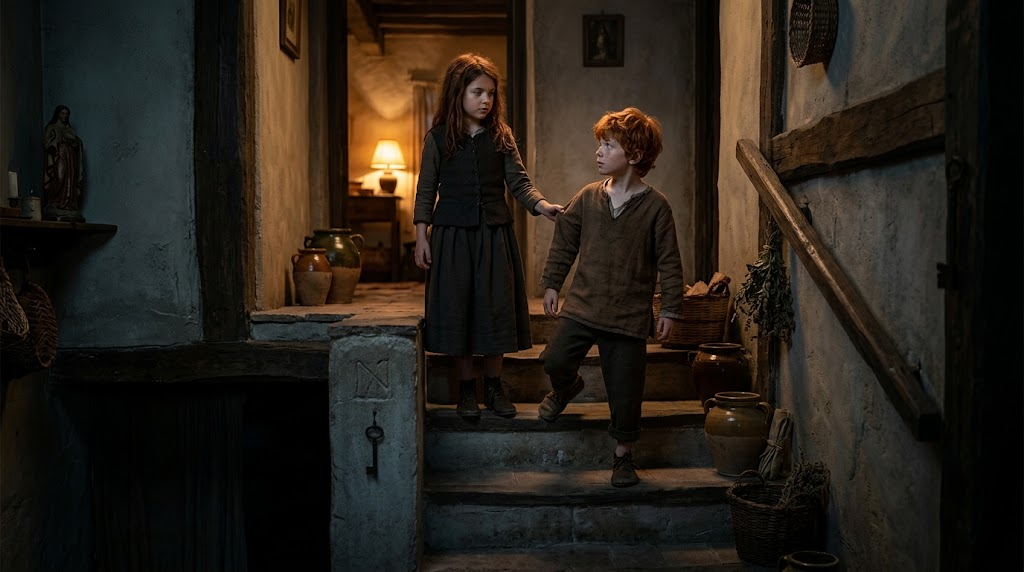
Andaluria: Blood & Desire · October · Week 1 — The Rules We Remember
MARA:
“Chibi.”
CHIBI:
“What?”
MARA:
“Grandma said not to go down there.”
CHIBI:
“I’m not going down there.”
MARA:
“You’ve got one foot on the stairs.”
CHIBI:
“That’s not down.”
MARA:
“It’s the beginning of down.”
CHIBI:
“Oh.”
Children rarely inherit theology.
They inherit rules.
Don’t go near the well.
Come home before dark.
Stay on the road.
Don’t answer when something calls from outside.
And if Grandma tells you to come inside, you come inside.
Across the Iberian Peninsula, frightening beings have long appeared in stories and warnings told around children. Valencian tradition has its own espantacriatures — creatures such as the Butoni and Quarantamaula, whose stories could help give danger a face.
That does not make every frightening story ancient wisdom.
Sometimes adults frighten children simply to make them obey. Stories can carry prejudice, social control and fears that have long outlived whatever created them.
But they can also carry information.
MARA:
“So Grandma can be wrong.”
CHIBI:
“Grandmas can be wrong?”
MARA:
“Yes.”
CHIBI:
“All of them?”
MARA:
“I think so.”
CHIBI:
“We should check.”
A child does not need to understand unstable masonry, contaminated water and the physics of falling into a deep well.
“There’s something in the well” is easier to remember.
Andaluria makes that uncomfortable.
Because here there really might be something in the well.
If monsters have shared the world with people for centuries, children should inherit traces of that relationship.
Rhymes.
Games.
Warnings.
Names they are told never to say.
Paths they must leave before sunset.
Things sewn into their clothes.
A little ritual they perform without knowing why.
Perhaps one village teaches:
“If you see them, hide. They take people.”
Another says:
“If you see them, leave bread at the stone and walk away.”
The first village remembers monsters.
The second remembers neighbours.
Perhaps both are right.
Perhaps neither remembers why.
CHIBI:
“What if Grandma tells me there’s a monster downstairs?”
MARA:
“You don’t go downstairs.”
CHIBI:
“I ask what kind.”
MARA:
“From up here.”
CHIBI:
“And what it does.”
MARA:
“From up here.”
CHIBI:
“And its name.”
MARA:
“Chibi.”
CHIBI:
“What?”
MARA:
“Why are you on the next step?”
CHIBI:
“I’m asking carefully.”
That may be how old knowledge survives.
Not as a book.
As fragments.
A warning. A rhyme. A gesture. A story. A thing above the door.
Most may be harmless.
Some may be wrong.
Some deserve to disappear.
But in a world where supernatural beings genuinely exist, one possibility remains.
One of them may still be an instruction.
And perhaps the frightening moment is not when a child finally sees the monster.
It is when they recognise it.
They have heard about it all their life.
They simply thought Grandma was telling them a story.
MARA:
“Chibi?”
CHIBI:
“Yes?”
MARA:
“Come back up.”
CHIBI:
“Why?”
MARA:
“Because Grandma said so.”
Chibi looks down the dark stairs.
Then back at Mara.
CHIBI:
“Okay.”
For once, nobody asks why.
WORLDS THAT REMEMBER
At Mythveil Chronicles, a living world remembers through more than chronicles and kings. Knowledge survives in families, songs, children’s games, old warnings and stories nobody quite believes anymore.
Your characters inherit those fragments.
Whether they listen to them is their choice.
Whether the world remembers why they existed is another matter.
Real TTRPG. Real story. Real choices. Real consequences.
A living world that moves on — with or without you.