Looking for your next adventure? Explore our current campaigns and the Mythveil weekly schedule.
One Hobby, Many Beginnings — Finland
An imported rulebook can begin a friendship. A translation can open a door. A campaign can survive long enough for another generation to enter it. Finland’s role-playing history connects these possibilities—but also reveals the work, disagreements and practical obstacles between them.
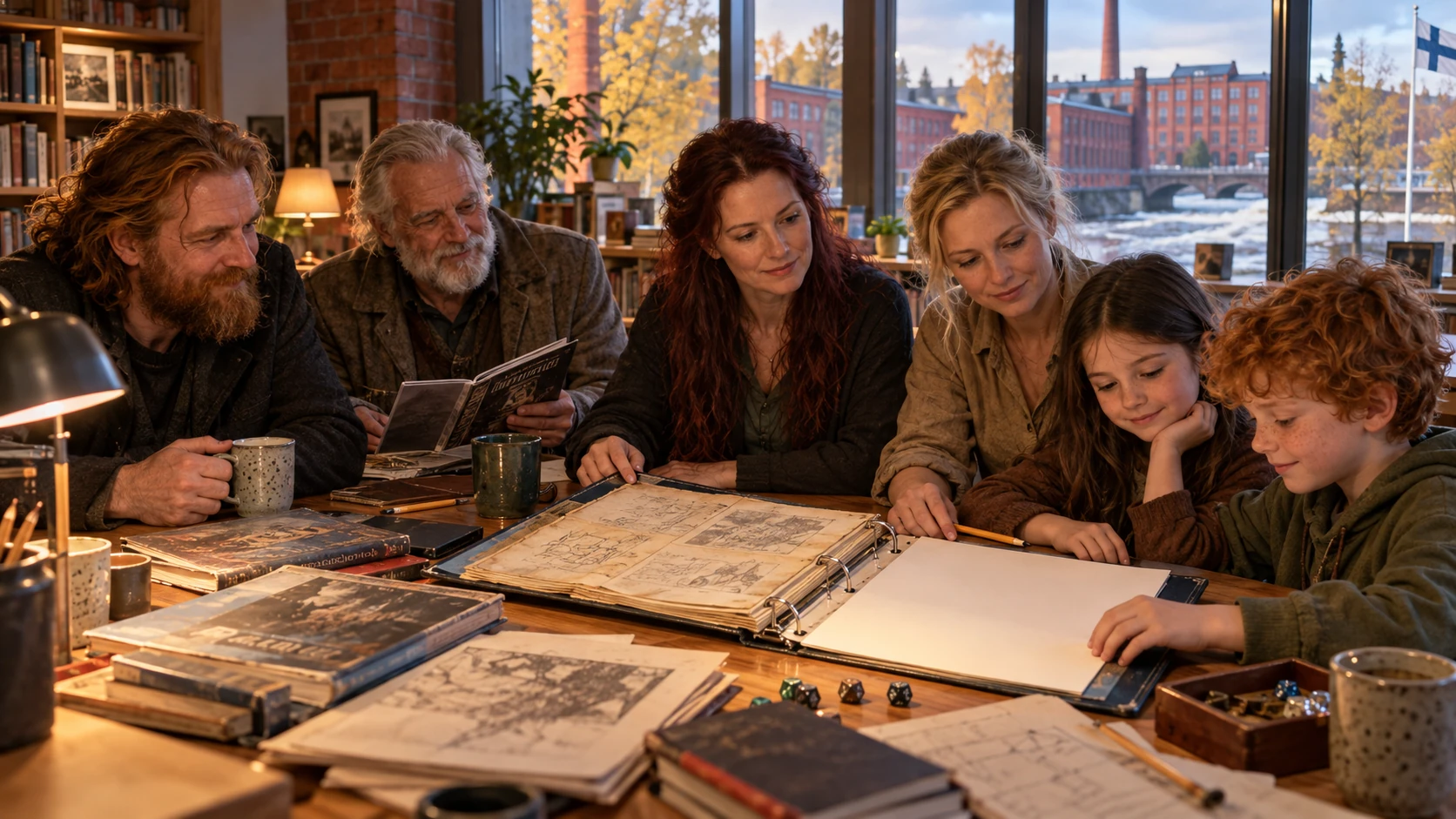
Mara is examining a folder of old character sheets.
“Do you have to know everything that happened before you can join?”
Stacy looks at the pages.
“That depends on what the group expects you to know.”
“And what they are willing to explain,” Caelwyn adds.
Chibi has found a sheet with almost no writing on it.
“This one looks easier.”
My name is Eljara. Today, our family is following the history of tabletop RPGs in Finland.
We could organise the journey around first editions, influential designers and recognisable titles. Those things matter. But another question keeps appearing between them.
What allows a world that already means something to one group of people to become accessible to somebody else?
Sometimes the answer is a translation. Sometimes it is a different approach to design. Occasionally, it is much less glamorous: a functioning printer, a manageable workload or a bus with enough seats.
Before the translations: finding the people who already played
In a 2018 report for Yle, Finnish Museum of Games researcher Niklas Nylund described role-playing arriving through exchange students in the late 1970s. The article distinguished those early encounters from the broader expansion associated with Finnish translations during 1988–1994.
That distinction changes where our story begins.
A game could already be travelling between friends without being available in their language. Someone might explain unfamiliar rules aloud, lend a book or demonstrate what playing actually involved.
An untranslated sentence and an unfamiliar activity are different obstacles. A person can help with both.
We cannot identify Finland’s first tabletop session securely from the evidence assembled here. Nor can the experiences of a few documented early players tell us how easily someone elsewhere could find a group.
The first box in a shop was not necessarily the first adventure. It might, however, have been the first beginning available to someone who did not already know the right people.
1985–1987: a Finnish beginning with an unexpected ancestry
Risto J. Hieta, writing as Nordic, published Acirema in 1985, followed by Acirema II in 1986. The Roolipelikirjasto catalogue describes it cautiously as the earliest known Finnish RPG. Despite its English title, The Secret Treasure of Raguoc in the Acirema Dungeons, the original material was in Finnish.
Its documented influences complicate the familiar story of tabletop games inspiring computer games. The library’s description identifies ideas drawn from Advanced Dungeons & Dragons games for Mattel’s Intellivision, at a time when Hieta was not yet deeply familiar with tabletop design. Here, influence travelled back towards the table. (Roolipelikirjasto)
Miekka ja magia followed in 1987. A surviving copy, together with associated gaming materials, is documented in the collections of Tampere’s historical museums. It therefore should not displace the earlier Acirema publications in an uncomplicated claim to be Finland’s first RPG. (Finna)
Sean considers the route.
“So the beginning took a detour.”
“Several beginnings do,” I tell him.
What matters is not whether an early designer followed the route we now consider conventional. It is that the surviving work lets us see someone making a game from the possibilities they understood.
1988: translating the rules was only part of the job
Jari Pauna recalled translating the first Finnish D&D basic rules himself, using an Amiga and a dictionary. Other translators joined subsequent projects, but should not automatically receive credit for that first translation. His 2018 interview also reproduces his contemporary account of preparing the publication.
The printer in Turku could not read the Amiga disks. Text had to be transmitted by modem; typesetting brought further difficulties. The intended Christmas market was missed. The printed games finally arrived in February 1988, allowing accumulated orders to be dispatched. (Roolipelitiedotus)
“A formidable guardian,” Sean says.
“The dragon?”
“The incompatible file format.”
There is something worth remembering beneath the joke. A translation does not become useful merely because its final sentence is finished. It has to reach somebody in a form they can actually use.
RuneQuest also appeared in Finnish in 1988, offering another route into fantasy role-playing. The Finnish game guide notes that its rulebooks did not prescribe a complete setting, leaving groups room to attach other or homemade worlds. Finnish RuneQuest play was therefore not automatically Gloranthan play. (Roolipelitiedotus)
Even the sales story needs care. A 2023 editorial clarification contrasts an often-repeated 65,000 D&D basic boxes with Pauna’s recollection of 35,000. These are conflicting retrospective figures, not audited accounts. “Several tens of thousands over multiple years” is safer than a precise-looking count of players. (Roolipelitiedotus)
1988: what a national epic does—and does not—give a game
Pasi Janhunen’s Adventurers of the North – Kalevala Heroes, usually shortened to ANKH, appeared through Nelospelit in 1988. Janhunen had initially proposed licensing an existing system; the publisher preferred an original game. In his 2018 interview, he acknowledged choosing a broad mixture of fantasy influences rather than a tightly researched adaptation of the Kalevala.
That admission is more useful than pretending a title guarantees cultural depth.
The source material itself also requires attention. The Finnish Literature Society explains that Elias Lönnrot shaped the Kalevala into a literary work, published in major versions in 1835 and 1849, drawing on oral poetry, especially Karelian material, alongside Finnish and Ingrian traditions. He arranged, connected and modified that material; the resulting epic is not an untouched transcript of a single ancient worldview. (Finnish Literature Society)
For a game designer, there are consequently several layers to consider: oral traditions, their literary reconstruction and a further adaptation for play.
“Whose story are we borrowing?” Stacy asks.
That question should come before declaring something authentically national.
ANKH’s distribution offers another warning against easy conclusions. Janhunen confirmed sales through bookshops and petrol stations but did not know the sales figures. A later comment from Mike Pohjola, reproduced with permission, relayed publisher recollections suggesting that cheap petrol-station sales helped clear an oversized print run. This is second-hand retrospective evidence, not a verified stock record. (Roolipelitiedotus)
Yet Janhunen valued meeting people who had entered the hobby through his game. Commercial difficulty and personal significance can coexist. (Roolipelitiedotus)
A flawed doorway can still be the one somebody remembers walking through.
1994: a meeting place beyond the home campaign
The first Ropecon took place on 6–7 August 1994 at Paasitorni in Helsinki. Its own retrospective names Niko “GNiko” Mikkanen as the principal organiser, estimates attendance at approximately 700, and identifies the guest of honour as the American designer Steve Jackson, associated with GURPS—not his British namesake. (Ropecon)
The number describes one event, not the country’s entire role-playing population.
What interests us is the meeting itself.
A convention allows someone to discover that the procedures taken for granted by their home group are not universal. Another Game Master may explain differently, prepare differently or invite different kinds of decisions.
That encounter can be uncomfortable. It can also make a familiar hobby feel newly spacious.
By 2004, Ropecon’s programme explicitly asked how games could portray believable societies, religions and myths, and how the real world could inform play. It also offered practical guidance for newcomers and Game Masters. These were questions being discussed within the community, not concerns we have retrospectively imposed on it. (Ropecon 2004 programme)
Around 2000: a manifesto is not a census
Mike Pohjola’s Turku Manifesto circulated in 2000, emerging from debates closely connected to live-action role-playing. In his tenth-anniversary reflection, Pohjola described its priorities as character immersion for players and convincing world simulation for Game Masters. He also recalled vehement objections, competing manifestos and later friendships with people who had challenged him.
This is an important Finnish contribution to discussion about role-playing.
It is not a reliable description of how every Finnish group played.
A manifesto argues for an approach. Its visibility can tell us that an argument travelled, not that a country unanimously accepted it.
“What happens when people disagree?” Mara asks.
“In this case, they wrote more.”
Sean glances at the growing pile of notes.
“That does explain a few things.”
Meanwhile, Praedor appeared in 2000, with Ville Vuorela adapting Petri Hiltunen’s comics and the world of Jaconia into a tabletop RPG. It demonstrates another creative undertaking within the same period: making an already established fictional world available for other people’s adventures. (Roolipelitiedotus)
The task is not simply to reproduce recognisable places.
A comic can follow the decisions its author makes. A game must give another group enough understanding—and enough freedom—to make decisions the author never wrote.
2003 onward: whose language is the table using?
Eloria was founded in Vaasa, or Vasa, in 2003. It identifies itself as a Finland-Swedish role-playing association, active principally in Ostrobothnia, and includes both tabletop and live-action role-playing. Its stated working language is primarily Swedish, while it also seeks to include Finnish- and English-speaking participants. (Eloria)
This belongs within Finland’s history without being absorbed into an exclusively Finnish-language narrative.
A book’s language, a group’s language and the country in which they meet are separate facts.
The distinction is practical as well as historical. A player may be able to consult an English rulebook but feel more confident describing an emotional scene in another language. A group can negotiate that without becoming less genuinely part of its local community.
Oulu supplies another perspective. In a 2019 interview, Timo Mattila and Mari Vauhkonen described CRYO, formally organised since 2001, arranging game nights, player-and-Game-Master recruitment meetings, Maracon events and a direct bus to Ropecon. They also discussed balancing activity against the capacity of volunteers. (Roolipelitiedotus)
“Sometimes the missing rule is transport,” Sean observes.
The bus does not create a story. It helps people reach the place where one might begin.
Roudan maa: folklore has to do something
Wille Ruotsalainen’s Roudan maa developed from a setting into a standalone RPG in 2016. The early dating needs a qualification: his 2017 retrospective names 2003 for the setting book, whereas the contemporary Ropecon 2004 programme announces its appearance at that event. Those sources should not be silently made to agree. (The author’s retrospective; Ropecon 2004 programme)
The design discussion is more revealing than the disputed year.
Ruotsalainen wanted the rules to support Kalevala-inspired magic and the sudden danger of violence. He objected to a hit-point model that made a character’s distance from death too readily measurable. These were his stated design goals, not results we have established through our own playtest. (Roolipeliloki)
He ultimately used a licensed foundation from Robin D. Laws’ HeroQuest role-playing game, not the board game of the same name. His account credits contacts through Kalikos, the Finnish Glorantha society, with helping the approach to the rights holders. (Roolipeliloki)
For Mythveil, the useful question is what the connection enables.
Does the supernatural affect ordinary obligations? Does drawing a weapon change the conversation? Can a settlement’s customs shape decisions rather than merely decorate a description?
A local subject and an internationally developed system need not be enemies. Their combination should be judged by what it allows people to play.
2004–2008: opening more than one kind of game
Arkkikivi, internationally Arkenstone Publishing, began in 2004. Its 2008 account describes a partnership between the brothers Markku, Eero and Jari Tuovinen. Markku’s professional translation work supported Finnish editions of independent games; importing smaller American publications was another way to broaden the available choices. The company explicitly named The Forge as an inspiration. (Arkenstone Publishing)
Translation here did more than make familiar adventures easier to read. It could introduce different expectations about who establishes scenes, how conflicts develop and when a story should end.
Eero Tuovinen’s Zombie Cinema, published in 2008, provides one example. Its scene-by-scene rotation of guiding responsibilities and board-based tracking support a crisis story normally completed within a single session, with human relationships at its centre. (Roolipelitiedotus)
That is not a lesser campaign waiting to grow up.
It is a different design undertaking.
Our interest in worlds that remember should not make us mistake duration for quality. A deliberately bounded evening can leave a lasting memory, just as a long campaign can lose its meaning through repetition.
A healthy creative history has room for both.
2008–2012: adapting a dangerous place without dice
Ville Vuorela’s Stalker appeared in Finnish in 2008 and in English in 2012 through Burger Games. The publisher describes a modernised adaptation of the world and themes of Arkady and Boris Strugatsky’s Roadside Picnic, published with Boris Strugatsky’s permission. It should not be presented simply as a tabletop conversion of the similarly named video-game series. (Burger Games)
Its FLOW system is diceless, using structured evaluation of characters’ actions and players’ descriptions rather than random rolls. Diceless does not mean without procedures or consequences. (Official Stalker description)
The design question is especially interesting for a world defined by danger and incomplete understanding.
How does a group decide what happens without making every outcome feel arbitrary? What can a player infer, prepare for or describe persuasively? Where does the Game Master’s judgement enter?
Those questions belong to our reading of the design, not to a claim that removing dice automatically produces deeper play.
A borrowed literary world becomes playable through decisions about participation. The permission to use its name is only one part of that work.
2013–2014: the next generation is not an afterthought
Mike Pohjola’s Myrskyn sankarit appeared as a boxed game in July 2013, published and distributed by Tactic. Its own presentation connected the project to a practical change: children of earlier role-players were reaching an age when they might want adventures of their own. That was the team’s stated motivation, not a demographic census. (Project introduction)
Miska Fredman’s Astraterra followed in 2014 through Ironspine. Its original campaign described development involving children and an exploration game intended to be enjoyed across ages. The publication year is independently documented in the Finnish library catalogue. (Finna)
Mara looks back at the old character sheets.
“So you don’t start by giving children all your homework?”
“Preferably not.”
Chibi pushes the thickest folder away.
“Good.”
The difficult part is not always reducing the number of rules.
Experienced players know when to ask questions, what kinds of proposals are possible and which details they can safely invent. A beginner may need those permissions made explicit.
Designing for newcomers exposes assumptions that long familiarity has made invisible.
An invitation is more useful when somebody can understand what accepting it involves.
2022: who is allowed to become a designer?
Kristel Nyberg did not describe beginning as a child with an imported D&D box. In a 2022 interview, she recalled discovering role-playing near the end of her university studies through Changeling: The Dreaming, and joining the Helsinki university association Alter Ego. (Roolipelitiedotus)
Her path matters because it interrupts the idea of a single proper entry point.
The same interview discusses Tivoli, her Finnish-language Powered by the Apocalypse game about difference, friendship and a supportive community. Nyberg explained that complex mathematical discussions had once made designing her own game seem beyond reach. Adaptable existing systems offered another possibility. (Roolipelitiedotus)
Ninni Aalto, responsible for illustration and layout, described readability and a varied, open-ended portrayal of characters as priorities. Participating in playtests helped her understand the intended experience. Nyberg reported nearly 200 physical copies sold, including crowdfunding, at the time of the interview—a dated statement, not a current total. (Roolipelitiedotus)
“The rules are not the only thing someone has to read,” Stacy says.
She is looking at the layout.
A design can communicate welcome—or difficulty—before a reader reaches the first procedure.
The work of making a game belongs to more people than the name most prominently printed on its cover.
Organising again does not mean nobody tried before
A 2016 study by Pauli Hulkkonen identified difficulties approaching communities and a need for more active participants. Its evidence included interviews, 186 individual survey responses and 29 responses from 61 contacted communities, across several non-digital gaming activities. It was not a representative census of Finnish tabletop players. (Pelitutkimus)
Hulkkonen also documented earlier attempts at nationwide organisation: one around the transition from the 1980s to the 1990s, traced partly through Riimukiwi, and Roolipelikilta, connected with Helsinki 2000. His account describes ambitious work exceeding the capacity of a small number of volunteers. (Pelitutkimus)
The Finnish Roleplaying Society, Suomen roolipeliseura, was founded on 3 June 2017 in Sonkajärvi. Its founding retrospective describes an organisation built around connecting and supporting practical projects. It was a new attempt, not the first evidence of Finnish collective activity. (Suomen roolipeliseura)
A community may feel effortless to someone whose evening has already been organised.
Somebody else answered messages, arranged the venue and remembered where the equipment was stored.
Continuity needs work that people can keep doing—not merely work they can survive once.
That is as relevant to a local group as to a national organisation.
Preserving the books, sharing the voices
The society’s Roolipelikirjasto helps make smaller publications discoverable. Its history includes Antti Leppä’s Forge & Illusion platform, brought under the society’s care in 2017, and subsequently replaced as the library developed. Preservation here includes technical maintenance, not just deciding that old games matter. (Suomen roolipeliseura)
An obscure booklet has a better chance of entering a history when someone has kept it, described it and made it possible to find.
There is also another way to transmit the hobby: let people hear it happening.
Yle’s account of RopeLIVE recalls the earlier Radiomafia programme Lohikäärmepuu, in which listeners could call into a role-playing broadcast. RopeLIVE itself began in 2021, initially conceived as a one-off radio programme for Yle’s ninety-fifth anniversary, before becoming a continuing production involving cameras and audience participation. (Yle)
A rulebook can explain what a player may do.
Hearing a session can reveal the hesitations, questions and small negotiations between those instructions.
Neither replaces playing. Each can make the unfamiliar less forbidding.
1981–2026: a world survives because people can return
We finally reach the campaign that kept pulling our attention back from the publication lists.
In an April 2026 retrospective, Hannu Kokko dated the beginning of his Glorantha campaign to February 1981, while remaining uncertain about the exact day. He recalled 22 players across the decades, alongside shorter visits from others.
The rules changed through RuneQuest versions, a HeroQuest interlude and the lineage leading to Mythras. The intervals between sessions changed too; near-weekly play had settled in only from summer 2024. This is not a claim of forty-five uninterrupted years with the same characters and schedule. (Notes from Pavis)
By his account, children of earlier participants had joined. A second group began in August 2025 within the same world, timeline and city. At the anniversary gathering, some participants met face to face for the first time after knowing one another through voices and screens. (Notes from Pavis)
“Did changing the rules make it a different world?” Mara asks.
“Not necessarily,” Caelwyn says. “They still had things to remember together.”
For Mythveil, the significance is not the achievement of a sufficiently large number.
It is the possibility of continuing without requiring everybody’s life to remain unchanged.
A remembered world can welcome new participants, accommodate absence and survive a change of procedures. That does not happen automatically. Nor should longevity become an obligation to keep a campaign going after the people involved no longer enjoy it.
The history matters because people still find something there worth sharing.
Whose beginning have we not heard?
The broad figures are less secure than a catalogue of familiar titles might suggest.
Yle’s 2018 report gave an estimate of roughly 80,000 tabletop role-players and approximately 250 Finnish RPG publications. Those are historical estimates reported at that time, not verified totals for 2026; the article does not provide a reproducible national counting method. (Yle)
Our own evidence remains uneven.
Published creators, preserved magazines and organised communities are easier to follow than a private group whose notebooks disappeared during a move. Eloria helps us recognise Finland-Swedish activity; it does not represent every Swedish-speaking player. We still lack enough material to speak adequately for Sámi experiences and many unrecorded local communities.
A national label cannot make those gaps disappear.
Nor does the history lead towards one correct Finnish way to play. The surviving examples include extended campaigns, single-session designs, literary adaptations, children’s adventures, folkloric worlds and arguments about immersion.
What connects them in this essay is not a shared temperament.
It is the recurring work of making something available to another person—and accepting that the next person may need a different entrance.
Where did your Finnish story begin?
Tell us where and approximately when you started.
Was it an imported book, Finnish D&D or RuneQuest, Acirema, Miekka ja magia, ANKH, Praedor, Stalker or a world made by someone you knew? Did a shop, library, club, convention or broadcast help you find your first group?
What language did you read? What language did you use when your character finally spoke?
We would particularly welcome memories of smaller communities, overlooked publications and the practical work that made play possible. An uncertain date can remain uncertain. A remembered person may matter more than a perfectly preserved product name.
Chibi has returned to the folder.
“This one’s already full.”
Mara turns to the next sheet.
“There’s room here.”
“Do we keep the old pages?”
“Of course,” Caelwyn says.
Chibi places his blank sheet after them.
Stacy passes him a pencil. I leave the folder open.
We began by asking how somebody joins a world with a history. The answer cannot be that they must first recreate everybody else’s past.
There needs to be something they can do next.
Passing on a world means preserving what happened—and leaving room for someone who was not there.
Continue One Hobby, Many Beginnings with our journeys through Germany, Italy, Spain, Norway, Denmark and Sweden.
Bring your own campaign questions to the Mythveil Seminar: Campaigns That Remember Your Players.
Read. Play. Watch. Support. Or collaborate.
Read Mythveil Chronicles · Join our campaigns · Support the research and stories · Collaborate with us
Every table has a beginning. Your next chapter could start with us. Find your next game in the Mythveil weekly schedule.