Looking for your next adventure? Explore our current campaigns and the Mythveil weekly schedule.
One Hobby, Many Beginnings — Iceland
An Icelandic role-playing history need not begin with a Viking. It might begin beneath a Reykjavík bookshop, inside a car travelling east, or with friends discovering that the next game they wanted to play had not yet been written. The old stories mattered. So did the freedom to tell something else.
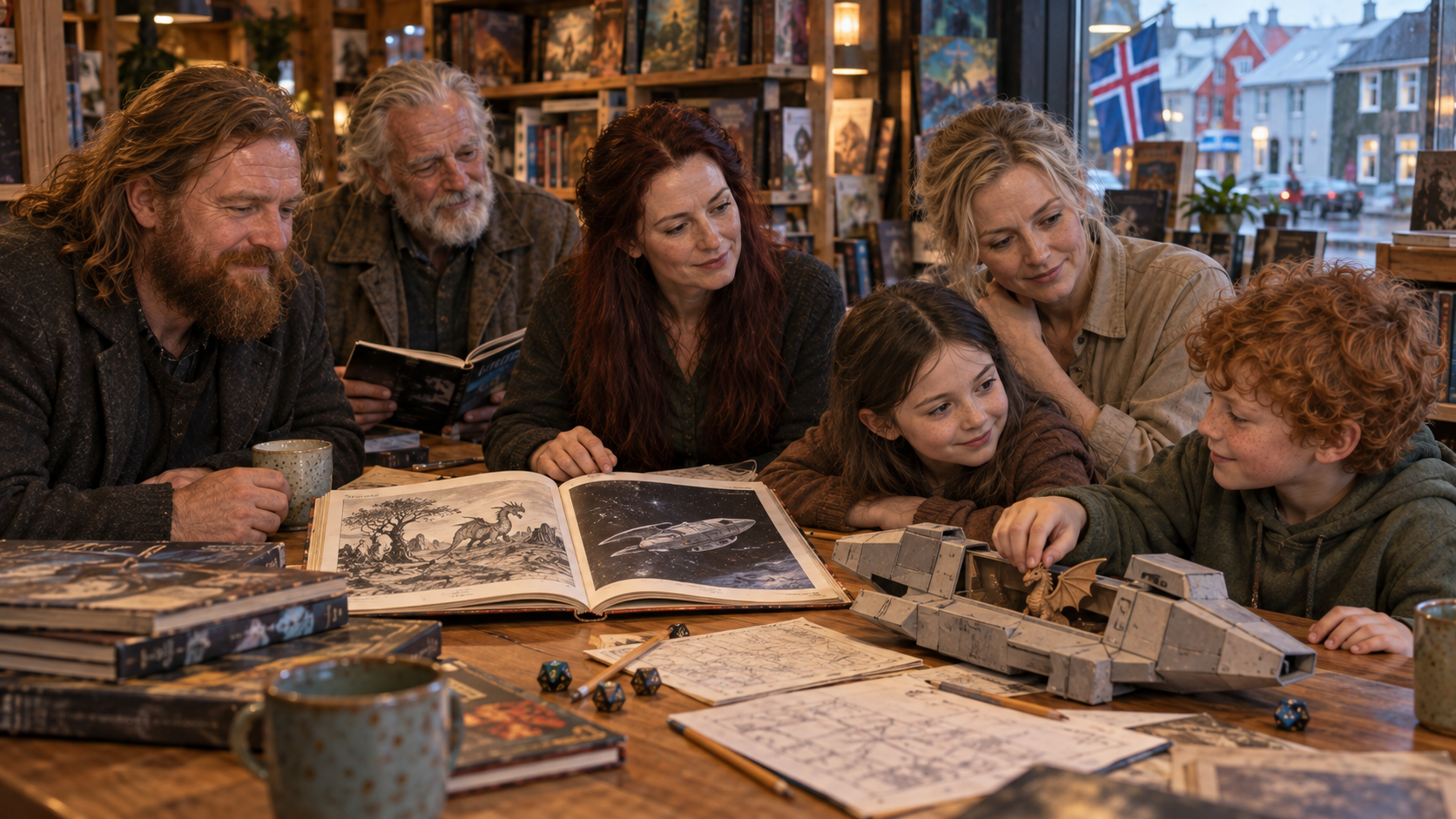
Stacy has placed two books beside each other.
One contains old stories. The other has a spacecraft on its cover.
Mara studies them.
“Which one are we taking to Iceland?”
“Both,” Stacy says.
Chibi immediately reaches for the spacecraft.
“Can this one have a dragon?”
Sean considers the question.
“We have not even left, and the cargo arrangements are already becoming difficult.”
My name is Eljara. Today, our family is following the history of tabletop RPGs in Iceland.
A familiar temptation waits for us: start with sagas, add some dice, and announce that an ancient storytelling people finally found its natural modern hobby.
It would make a pleasing sentence.
It would also explain very little about the people who bought books, organised games, invented terminology and argued over rules.
A cultural inheritance can offer possibilities. It does not decide what everybody must imagine.
Before the first box: the sagas are not a shortcut
Even the literary inheritance resists a simple account of isolated continuity. In his study The Self as Other: Iceland and Christian Europe in the Middle Ages, scholar Torfi H. Tulinius argues that medieval Icelandic literary culture developed through engagement with European culture. The relationship between Christian authors and the heathen past they described was already a process of interpretation. (gripla.arnastofnun.is)
That matters when we approach later games.
An adventure inspired by inherited stories is not an untouched remnant of an earlier society. Someone chooses which elements to emphasise, what to alter and how to make them playable.
Nor does the existence of an old narrative tradition establish the arrival date of a modern hobby.
For that, we need other evidence: shops, publications, memories of particular groups and records of events.
Our sources do not securely identify Iceland’s first tabletop role-playing session. Rather than inventing an origin, we can begin with a concrete commercial trace—and follow what people did from there.
1991–1992: twelve square metres of possibility
Nexus’s own history dates its beginnings to 1991, in a twelve-square-metre corner beneath the Eymundsson bookshop at Hlemm in Reykjavík. The selection included science fiction, fantasy, American superhero comics and Dungeons & Dragons. London’s Forbidden Planet provided an inspiration for the mixture. (nexus.is)
Around Christmas 1992, the corner became a separate shop on Rauðarárstígur, initially called Goðsögn/MYTH. The business subsequently passed through the names Fáfnir, Nexus VI and finally Nexus. These names should not automatically be counted as entirely separate, unrelated establishments. (nexus.is)
Twelve square metres cannot measure the size of a national imagination. They can, however, give it an address.
A specialist shop brings unfamiliar things into contact. Someone looking for a comic might notice a rulebook. A customer can ask what the dice are for without first knowing a Game Master.
Nexus also describes providing space to sit and play from its early days. The distinction between selling a game and helping people use it was therefore present within the business itself. (nexus.is)
This is a firm point in the available record, not proof that nobody played earlier.
A shop opening tells us when a particular doorway became visible. It does not tell us who had already found another way in.
1992–1994: a game begins on the road east
In a 2015 interview, Rúnar Þór Þórarinsson recalled discussing an Icelandic RPG with his brother Jón Helgi Þórarinsson while travelling from Reykjavík to Egilsstaðir in spring 1992. They had already spent many evenings playing. The journey became the beginning of a writing project. (spunaspil.wordpress.com)
Askur Yggdrasils appeared through Iðunn before Christmas 1994. Its publication in that year is also recorded in University of Iceland scholar Jón Karl Helgason’s bibliography of later works drawing on Eddas and sagas. (spunaspil.wordpress.com)
Rúnar additionally credited the brothers with creating the term spunaspil, recalling a small room at Skriðuklaustur. That is his account of the word’s origin, not an independently established history of every earlier usage. (spunaspil.wordpress.com)
The brothers wrote a further adventure, Augu Mímis, in 1995, and played it privately, but it was not published. Rúnar described personal setbacks, competing commitments and insufficient commercial momentum to sustain further releases. No audited sales figures accompany that explanation. (spunaspil.wordpress.com)
A publication history can end before the playing does.
The unpublished adventure is not evidence of an imaginary achievement. It marks the difference between something a group can create and something its authors can afford to place in other people’s hands.
What made Askur Yggdrasils more than translated terminology?
A later account by Icelandic gaming writer Thorsteinn Mar describes Askur as a game of the nine worlds of Norse mythology, using a skill-based percentile system. Magic required skill checks, while a subsystem for divine favour connected the gods to benefits affecting characters’ abilities. (questportal.com)
The numerical foundation was not an unprecedented invention. Its cultural importance does not require us to pretend otherwise.
For Mythveil, the more interesting question is what happens when the gods cease to be background names.
Does a character’s relationship with a divine power affect a decision? Can an advantage create a conflicting obligation? What happens when loyalty to a patron pulls against loyalty to another person?
Those are questions we can bring to the design, not claims that every group explored them identically.
“It is easy to put a god on the cover,” Stacy says.
“Harder to decide what the god expects on Tuesday,” Sean replies.
Readers did not respond uniformly. A preserved discussion on Hugi includes affection for the setting alongside frustration with explanations and mechanical complexity. The comments document individual reactions, not a representative verdict. (hugi.is)
That disagreement belongs in the story.
An important local game need not be a flawless game. People can value what a publication made possible while recognising the work it left them to do.
1994–1995: not everyone’s first character was a saga hero
Two recollections help prevent the published game from swallowing the history around it.
Writer Emil Hjörvar Petersen told DV in 2022 that he received Askur Yggdrasils at Christmas 1994, aged ten. Playing with siblings and friends led towards fantasy reading, mythology and creating worlds. He began experimenting with writing at around thirteen. (dv.is)
This is a specific account of influence, not a claim that one box single-handedly created a literary career.
Another player, Óli Gneisti Sóleyjarson, remembered his introduction differently. In a 2014 account, he tentatively dated his first games to autumn 1994. A cousin brought him into Cyberpunk 2020. Askur subsequently joined the group’s activities around Christmas rather than replacing everything else. (truflun.net)
During the 1995 teachers’ strike, he recalled playing almost daily and encountering Werewolf: The Apocalypse. A later school trip to Reykjavík included shopping for Vampire: The Masquerade and Dark Colony, helped by the information circulating around a knowledgeable salesperson. (truflun.net)
One child found a route into mythological fantasy. Another group moved between cyberpunk, Norse adventure and supernatural horror.
“Which one was properly Icelandic?” Mara asks.
“The people playing were not required to choose only one.”
That is the distinction our series keeps returning to.
The history of games made in a country and the history of games played there overlap. Neither can replace the other.
2006–2015: an Icelandic company enters the World of Darkness
There is another Icelandic connection to tabletop history that a saga-centred account would miss.
On 11 November 2006, CCP and White Wolf announced an agreement to merge. Their contemporary announcement, preserved by RPGWatch, described White Wolf becoming a wholly owned subsidiary of CCP. Plans included bringing World of Darkness into online gaming and developing physical products connected to EVE Online. Those were announced intentions, not a list of subsequently completed releases. (rpgwatch.com)
An Icelandic company was now involved in the ownership and development plans of internationally established tabletop properties.
This does not retroactively make Vampire an Icelandic invention. It does mean that Iceland’s place in role-playing history cannot be measured solely by counting Icelandic-language rulebooks.
The proposed World of Darkness MMO was cancelled in April 2014. Contemporary reporting reproduced CCP’s explanation that the project had not achieved the experience it intended to deliver. The cancellation concerned that online project, not the disappearance of the fictional setting or its tabletop players. (gamespot.com)
On 29 October 2015, Paradox Interactive announced its acquisition of White Wolf from CCP, including its portfolio of properties. (prnewswire.com)
For our history, these events expose several different kinds of continuity.
A setting can retain its players while its owner changes. A planned adaptation can fail while existing campaigns continue. Corporate control, authorship and affection are related, but they are not interchangeable.
A company can purchase rights to a world.
It cannot purchase the particular evening somebody remembers spending there.
2007: the game shop becomes a film setting
Astrópía premiered in Iceland on 22 August 2007, directed by Gunnar B. Guðmundsson, with a screenplay credited to Ottó Geir Borg and Jóhann Ævar Grímsson. The date and credits appear in a contemporary premiere announcement. (visir.is)
Its central character, Hildur, finds work in a shop devoted to comics, fantasy and role-playing after her previous life collapses. The Scandinavian House’s screening description presents that encounter with unfamiliar people and interests as the beginning of her transformation. (skandinavskydum.cz)
The film matters here because the community around imaginative play had become material for a public story of its own.
There is a difference between using fantasy imagery and depicting the people who spend evenings making fantasy together.
The latter invites an audience to look at the social world surrounding the adventure: who seems out of place, who possesses knowledge and who gets to reconsider an identity.
A fictional comedy is not a survey of actual players. Nor can its release prove that a particular number of viewers subsequently began playing.
Nevertheless, it changes what is being represented.
The imagined dungeon is no longer the only interesting location. So is the shop in which somebody first asks how the game works.
2012–2025: games about Iceland cross different borders
The distinction between a game’s subject, its author’s location and its publisher becomes especially important here.
Pedro Ziviani’s Mythic Iceland appeared in 2012 as a Basic Roleplaying supplement from Chaosium. In a 2025 account, Mark Morrison described Ziviani living in Reykjavík and investing his engagement with his adopted home in the book. This is not adequately described as either a purely domestic publication or a wholly disconnected foreign gaze. (chaosium.com)
Gregor Vuga’s Sagas of the Icelanders, crowdfunded and published in 2013, approached the subject through a game based on Apocalypse World. Its description foregrounds households, social expectations, honour and relationships rather than treating the setting merely as an opportunity for spectacular combat. (gregor-vuga.itch.io)
Age of Vikings followed from Chaosium in 2025, with Ziviani credited as author. Chaosium explicitly presents it as a complete game developed from the concepts of Mythic Iceland. It is not an English edition of Askur Yggdrasils. (chaosium.com)
These works do not all occupy the same place in Iceland’s domestic publishing history. They show different ways in which Iceland becomes a subject for play.
Our editorial question is what an adaptation asks participants to notice.
A landscape can become more than scenery when a farm, a relationship or a damaged reputation matters to the characters. But “inspired by the sagas” remains a beginning for analysis, not a guarantee that every historical or cultural choice has been settled.
2016: a successful convention still has questions to answer
A particularly useful source is not a grand retrospective. It is an organiser’s report written the morning after an event.
On 2 October 2016, Thorsteinn Mar reflected on an autumn role-playing convention. He praised its atmosphere and range of games, but also described changes and shortcomings. Game Masters had received Nexus credit vouchers, with a substantial part of the entry fees directed towards them, rather than only the pizza offered at previous events. (spunaspil.wordpress.com)
The report noted seven female participants, including Arnfríður, who ran a game, and one newcomer. The organiser wanted broader participation and considered dedicated introductory events. These are observations about that convention, not a national gender ratio or a count of Icelandic beginners. (spunaspil.wordpress.com)
Stacy pauses over the report.
“He enjoyed the event and still noticed who was missing.”
“Those are compatible,” Caelwyn says.
That is what makes the source valuable.
An event can work beautifully for the people who attend without having solved the problem of reaching others. Likewise, appreciating a Game Master’s contribution does not answer every question about sustainable compensation—but it makes the labour visible.
Community history becomes more revealing when it includes decisions that organisers had not yet resolved.
The local conversation was also about how to run the game
In a separate September 2016 article on sandbox play, Thorsteinn discussed the practical challenge of providing information, presenting multiple possibilities and responding when players pursue unexpected ideas. His account arose from attempting to run such an adventure, not from claiming to have discovered one universally correct method. (spunaspil.wordpress.com)
This is another form of local creative work.
A community contributes to the hobby not only by publishing a new system but also by testing ways of using existing ones, explaining problems and making those discussions available in its own language.
For Mythveil, the connection is direct.
A world does not become responsive merely because the Game Master calls it a sandbox. Players need enough understanding to make decisions, and the person running the game needs ways to recognise their consequences.
That is our reading of the practical problem. It should not be transformed into a claim that all Icelandic groups preferred sandbox play.
One published discussion is evidence that the question was being asked.
2017: Icelandic or English—and who gets to decide?
A March 2017 article, Íslenska eða enska?, addressed language explicitly. Thorsteinn described groups playing in Icelandic, English or a mixture, including English-speaking sessions among people whose first language was Icelandic. He also reported a collaborative terminology effort in Roleplayers á Íslandi. (spunaspil.wordpress.com)
His site used hetjur for player characters and staða for character class. He praised earlier terminology from Askur, including aðgerðaröð for initiative. These were examples and preferences, not proof of universally accepted national standards. (spunaspil.wordpress.com)
Crucially, the article distinguished public-language work from private play: a group choosing English for its enjoyment did not require outside permission. At the same time, an Icelandic-language resource could deliberately make more material available in Icelandic. (spunaspil.wordpress.com)
Both ideas deserve space.
Language preservation should not become a test of whether someone is playing patriotically enough. Equally, the availability of English material does not make the work of creating Icelandic alternatives pointless.
Mara looks at the unfamiliar terms.
“Does knowing the word mean you know what to do?”
“Not yet,” Stacy says. “Somebody still has to explain it.”
A vocabulary is useful when it enables a conversation.
Its achievement is not merely that a foreign word has been replaced. It is that another person can understand, propose, question and participate.
2025: the library offers a different entrance
An official Hafnarfjörður library notice dated 21 January 2025 advertised a club for children in fifth grade and above. Its changing programme included anime, card games, manga, costume-making and spunaspil, with participants invited to suggest subjects themselves. (hafnarfjordur.is)
This was not a promise that every weekly meeting would be a role-playing session. The variety was part of the invitation.
Historically, that offers a different point of contact from a specialist purchase.
A child need not arrive already knowing which system to buy or whether their interest qualifies as a hobby. They can come because one part of the programme is familiar and discover something alongside it.
The library notice cannot tell us what every participant went on to play. It does document an institution making room for the activity in its own programme.
Not every important development arrives as a new rulebook.
Sometimes it is a notice telling someone where they can go after school.
2025–2026: old boxes, new microphones
In March 2025, an unopened copy of Askur Yggdrasils reappeared in a different kind of story. Davíð Ingvi Snorrason, having found it in his grandmother’s attic, contacted the role-playing podcast Svörtu tungurnar about using it for a Mottumars charity auction. The contemporary report also described the podcast’s discussions and recorded play. (dv.is)
The box was not being used to announce that everybody should return to the same game.
It had become a recognisable object around which people could organise something together.
A newer public voice takes another direction. Blighthouse Studio’s VARÚÐ RPG presents English-language horror stories set in alternative versions of Iceland. Its Dead Ísland series uses an adapted Chaosium Basic Roleplaying system for a family surviving a zombie outbreak on the south coast. The official feed records a preview in July 2026 and the beginning of its announced regular October release with an episode dated 1 October 2026. (shows.acast.com)
Its published material also points listeners towards explanations of Icelandic language and locations. Playing in English need not require making the setting anonymous. (shows.acast.com)
We have not independently evaluated the series through a complete listening review. Its relevance here is the form of participation it documents: locally situated play reaching people who are not physically at the table.
Iceland can be a remembered past, an ordinary present or an invented catastrophe.
None needs to cancel the others.
What this history still cannot count
We have not established a reliable national player total, an audited lifetime sales figure for Askur, or a securely documented first Icelandic tabletop session.
Those gaps should remain visible.
Shop histories favour places that became enduring businesses. Published interviews favour people somebody thought to ask. Online discussions preserve some disagreements while leaving years of private campaigns almost silent.
Several detailed sources here also come from the same active writer and organiser. Their richness does not turn one perspective into a representative account of an entire country.
The experiences of women, rural groups, newcomers to Iceland and people playing in languages other than Icelandic or English deserve more testimony than this record currently provides.
Nor should newer online projects be made to stand for everybody simply because their descriptions are easy to find.
A country’s role-playing culture is larger than the part that has left searchable evidence.
The documented examples nevertheless establish a varied history: local authorship, imported systems, specialist retail, international ownership, language work, public events and recorded play.
That is more useful than a story in which the sagas inevitably grow character sheets.
Where did your Icelandic story begin?
Tell us where and approximately when you started.
Was it D&D, Askur Yggdrasils, Cyberpunk, a World of Darkness game or something made by your own group? Did you discover it in a shop, through a friend, at a convention or through a recording?
What language did the rulebook use? What language did you speak when you stopped discussing rules and began speaking as your character?
We would especially welcome memories that complicate this account: earlier groups, overlooked publications, activities outside Reykjavík and moments when somebody explained enough for the game to become yours.
Back at our table, Chibi has been thinking.
“The dragon is on the ship.”
Sean nods cautiously.
“And?”
“It doesn’t want the treasure.”
Mara leans closer.
“What does it want?”
Chibi hesitates, then smiles.
“It wants to go home.”
Caelwyn closes neither of the two books.
Stacy puts down her pencil. For a moment, nobody corrects the mixture or asks which tradition has authorised it.
We listen.
The old stories have given us plenty to work with. They have not supplied every answer, and they do not need to.
An inheritance becomes a living resource when people can do more than repeat it. They can answer it—in words of their own.
Continue One Hobby, Many Beginnings with our journeys through Germany, Italy, Spain, Norway, Denmark, Sweden and Finland.
Bring your own campaign questions to the Mythveil Seminar: Campaigns That Remember Your Players.
Read. Play. Watch. Support. Or collaborate.
Read Mythveil Chronicles · Join our campaigns · Support the research and stories · Collaborate with us
Every table has a beginning. Your next chapter could start with us. Find your next game in the Mythveil weekly schedule.