Looking for your next adventure? Explore our current campaigns and the Mythveil weekly schedule.
One Hobby, Many Beginnings — Ireland
An old convention programme and a professionally published rulebook preserve different parts of the same hobby. One tells us where people gathered and what they could play. The other records work that reached readers elsewhere. To understand Ireland’s tabletop role-playing history, we need both—and the less conspicuous material between them: club records, handwritten adventures, personal recollections and the decisions that kept another game possible.
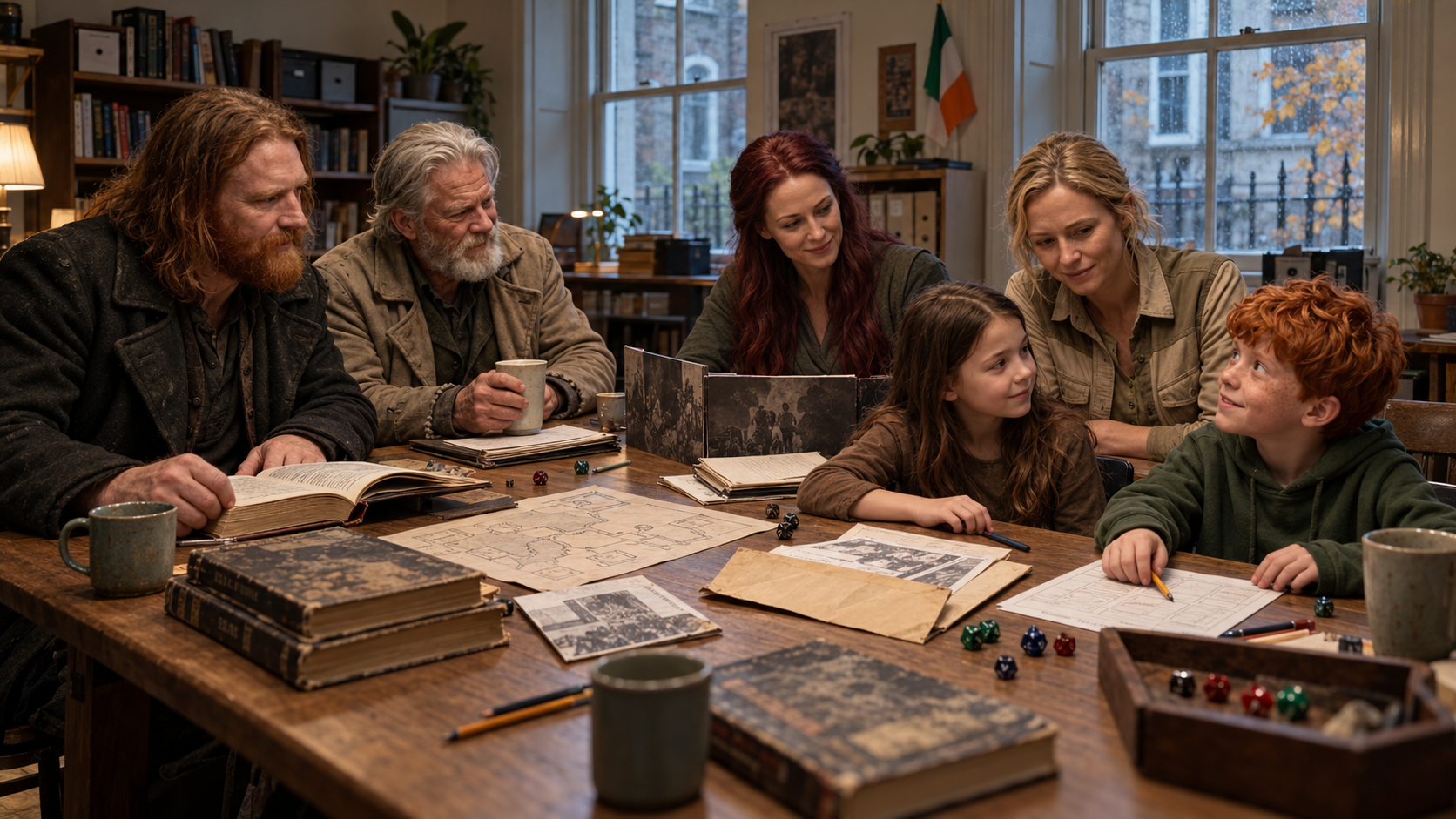
Mara has opened an envelope containing a convention adventure.
Inside are several character sheets, a map and instructions intended for the Game Master.
“Did these come with the rulebook?”
“No,” Stacy says. “Somebody wrote an adventure to use with it.”
Chibi searches through the remaining pages.
“Where’s their name?”
Sean turns over the envelope.
“A sensible question. Especially if we intend to blame them for what happens.”
My name is Eljara. Today, our family is following the history of tabletop RPGs in Ireland, from the early traces of play and publication to convention networks, international creative work and newer studios.
Our focus is the Republic of Ireland, while including documented connections with Northern Ireland. The history of those relationships belongs here without treating the two political jurisdictions as interchangeable.
The late 1970s: early traces, not a single founding evening
The earliest years remain less securely documented than the conventions and publishers that followed.
The role-playing archive Alexandria lists an Irish Leprecon I for 1979, followed by later editions during the 1980s. That provides a useful early reference, but an archive entry is not the same as having examined the original programme. We retain the date as an archival lead rather than declaring it the unquestioned beginning of Irish role-playing. (alexandria.dk)
Personal recollection offers another route into the period. In a 2020 interview, Herbie Brennan described discovering D&D, becoming deeply interested in it and subsequently designing role-playing games. Brennan had grown up in Northern Ireland and moved to Dublin during the 1960s. His experience connects early participation with later authorship, but does not identify the first Irish session. (irishexaminer.com)
The first securely established shipment, retailer and game at a private table remain open questions in our research.
That limits the precision of the opening chapter. It does not justify starting the story decades later, when more familiar company names make the evidence easier to find.
1982: Irish authorship already reaches an overseas publisher
Herbie Brennan’s Man, Myth & Magic appeared in 1982 through Yaquinto, as recorded in John Kim’s RPG bibliography. An Irish writer was therefore contributing an original role-playing game through an overseas publisher well before the more recent growth of publishing businesses based in Ireland. (darkshire.net)
Brennan also designed Timeship, a time-travel RPG from the early 1980s. The surviving bibliographic accounts require care over its exact initial dating; the game itself nevertheless demonstrates that his work extended beyond a single fantasy setting. (darkshire.net)
His later GrailQuest books belong beside this history, but with a clear distinction. They were solo gamebooks, not the same activity as a group playing with a Game Master. Brennan’s account describes a direct progression from enthusiasm for D&D to designing RPGs and then being encouraged by a publisher to write interactive adventure books. (irishexaminer.com)
This is already more complicated than a simple sequence of imports followed, much later, by original creation.
Irish authorship, publication in Ireland and an Irish setting are three different relationships. A book can belong to the country’s creative history without possessing all three.
1989: Gaelcon brings a larger gathering into being
The first Gaelcon took place over the October bank holiday weekend in 1989, in the RDS Industries Hall, Ballsbridge, Dublin. Its official archive names an organising committee comprising Noel Mitchell, Tom Roche, Joe Dineen, Jo Jaquinta and Flann O’Cleirigh. It does not confidently identify a single convention director or committee chair. (iga.ie)
That is a collective beginning, with the practical uncertainty still visible.
Participant Rob Brennan remembered a cold hall and fewer attendees than hoped. The established event familiar to later visitors should not be projected backwards onto its first weekend. The organisers were attempting something whose success was not guaranteed. (iga.ie)
For this history, Gaelcon provides a firm public milestone rather than a claim that nobody had previously played.
A convention can bring separate circles into contact. It offers a place to encounter unfamiliar games, meet people beyond a regular group and discover that another table approaches the same rules differently.
The year belongs on the timeline because this particular gathering happened—not because it makes every earlier, less documented table disappear.
The early 1990s: Cork and Galway develop their own centres
In Cork, Warpcon became associated with University College Cork’s Wargaming and Role Playing Society, WARPS. Alexandria records WarpCon I in 1991; differing retrospective accounts make the early 1990s the safer general description until the inaugural dating is fully reconciled with original documentation. UCC itself confirms the relationship between WARPS and the convention. (alexandria.dk)
In Galway, the Fantasy and Science Fiction Society, FanSci, dates its foundation to 1991. Its own history describes a group separating from the Computer Society to pursue different gaming interests and names Deirdre Thornton, Robert Neilson, Ian DeSouza and Kieran Turley among the early participants. (fansci.wordpress.com)
These developments widen the geography beyond Dublin.
They also reveal the importance of student organisations without making university membership a requirement for participation in the hobby. The surviving records tell us about particular institutional settings, not every person who played nearby.
Local scenes were acquiring recognisable meeting points. Their connections would become especially visible in the convention accounts that followed.
The mid-1990s: different games share the same scene
A personal role-playing page preserved on a Trinity College Dublin server discusses Gaelcon 1996 and preparations for Leprecon 1997. Its author lists AD&D, Call of Cthulhu, Castle Falkenstein, Paranoia and World of Darkness games. A Warpcon account adds GURPS and Pendragon. The writer also describes preparing Vampire and Discworld scenarios for Gaelcon. (maths.tcd.ie)
This is a contemporary glimpse of both playing and writing.
The page dates a strong local increase in Magic: The Gathering activity to spring 1994, describing competition for attention alongside people discovering role-playing through cards. That is one participant’s assessment, not a national market survey. (maths.tcd.ie)
What emerges is variety, not a scene confined to one system.
Mara compares two character sheets.
“These people aren’t even in the same kind of story.”
“They don’t have to be,” Caelwyn says.
Chibi considers the timetable.
“Can we play both?”
Sean checks the times.
“There is the first serious rules problem.”
The practical question was often which game to join, not whether every participant agreed on a single preferred style.
The 1990s: connections cross the island
The same Trinity page places Gaelcon, Leprecon, Warpcon, Vaticon, Dominicon, KevCon and Q-Con within a shared horizon of convention attendance. Its account of Q-Con II in Belfast in 1995 describes visitors travelling from Dublin and being welcomed by the Dragonslayers community. (maths.tcd.ie)
A separate institutional account supplies a connection in the other direction. Queen’s University Belfast recalls Alan Neill and Matt Johnson visiting Warpcon in Cork in 1993 and returning with the ambition to establish their own convention. This documents a specific exchange between communities, without resolving every disputed detail of Q-Con’s inaugural chronology. (qub.ac.uk)
These contacts matter because a national history can otherwise make scenes look more self-contained than they were.
An event in one city could provide another group with a model, contacts or encouragement. Participants could travel between gatherings while continuing to belong to their own local circles.
Here, the connection is documented through named people and remembered journeys. We do not need to invent a unified organisation to recognise an interconnected convention scene.
2005: Galway’s planned convention becomes a real event
FanSci’s history distinguishes earlier discussions about a Galway convention from the event that actually happened.
There had been proposals as far back as 1998, but Itzacon first took place in March 2005. The society credits Anita Murray, then its auditor, as the initiator and founding convention director. The University of Galway’s society directory independently confirms that the event has been hosted at the university since 2005. (fansci.wordpress.com)
The distinction between discussing an event and holding it is worth preserving.
For participants, a successful convention can feel like something that naturally belongs in the calendar. Its history reveals the choices and work required before that expectation could exist.
Itzacon also shows that the emergence of earlier conventions did not complete the process. Another city could still develop its own event, shaped by its local society and organisers.
The growth of a scene is not only the enlargement of its oldest gathering. Sometimes it means another group finally being able to hold a weekend of its own.
2006: convention work receives international recognition
The Diana Jones Award for 2006 went to the Irish Game Convention Charity Auctions, specifically recognising the auctions associated with Gaelcon and Warpcon. The award’s own announcement records the decision and explains the significance it attached to fundraising within those gaming communities. (dianajonesaward.org)
The presentation took place in Indianapolis on 9 August 2006. With no representatives of the Irish convention scene present, regular visitors Malcolm Craig and Gregor Hutton accepted the award on its behalf. (dianajonesaward.org)
This was international recognition for an activity around the games rather than a new set of rules.
It belongs in the history because conventions were more than containers into which publishers placed products. Their organisers and participants developed practices of their own, including events capable of supporting causes beyond the hobby.
The award does not measure the number of Irish role-players or establish a ranking of national scenes. It documents a particular contribution being recognised.
That is substantial enough without asking it to prove something larger.
2007–2009: the people writing the adventures receive recognition too
Itzacon introduced the National Irish Game Writer Award in 2007. FanSci’s record names Paddy Delaney as the 2007 winner, Cat Tobin in 2008 and Sandra Duggan in 2009. Its explanation explicitly sought recognition for the people preparing games, rather than reserving prizes for those playing them. (fansci.wordpress.com)
The distinction returns us to the envelope on our table.
A convention adventure requires someone to turn an idea into material that can be run: information for the GM, situations for the players and enough structure to make the allotted session workable.
Those tasks can remain out of sight when everything goes smoothly.
Chibi has finally found the writer’s name.
“Here.”
Mara adds it to our notes.
“Now they’re in the history.”
“They were already part of it,” Stacy says. “Now we’re less likely to leave them out.”
The awards provide a concrete record of local authorship. The convention scene was not merely receiving published adventures; it was recognising people who supplied its own.
2008 and after: Irish writers work within international game lines
Gareth Hanrahan’s Traveller Core Rulebook appeared through Mongoose Publishing in 2008. The bibliographic record identifies that particular edition—not the original creation of Traveller. It offers a clear example of Irish writing contributing to an established international game. (openlibrary.org)
In a 2023 Irish Times interview, the Cork-based author described how the internet made it practical for him to work from Ireland. He contrasted that with an earlier environment in which meeting publishers at British and American conventions had been much more important for obtaining work. The report also identifies contributions to RuneQuest, Conan and The One Ring. (irishtimes.com)
The working relationship had become less dependent on living near a publisher’s office.
That does not mean geography ceased to matter. It means that a foreign publisher’s address no longer tells us where every part of a book was written.
For this chapter, author, workplace, publisher and original game need to remain distinguishable. Otherwise, substantial contributions from Ireland become difficult to see precisely because they travelled successfully.
2015: publishing leadership operates from Ireland
On 25 February 2015, Simon Rogers announced that Cat Tobin would become his equal partner and the managing director of Pelgrane Press. His contemporary statement credited her existing organisational work and role in developing the company. (pelgranepress.com)
By April 2015, the publisher’s updates described Tobin settling back in Ireland. Her own edition of See Page XX discussed coordinating the newsletter from there while new material moved through the production process. These are dated records of publishing work being carried out, not merely a later biographical label. (pelgranepress.com)
Tobin had already appeared in the convention-writing record. Her later role brings a different kind of contribution into focus.
Pelgrane describes the managing director’s responsibilities as encompassing strategy and creative direction alongside development, production, finance, marketing and sales. The company remains identified as UK-based, while part of its work has been conducted from Ireland. (pelgranepress.com)
That connection belongs in both histories, accurately described.
The person writing an adventure is not the only person making its publication possible. Editorial and organisational labour help determine whether a manuscript becomes a book that others can actually obtain.
2018: Cubicle 7 establishes an Irish company and team
A different development followed when Cubicle 7 relocated its operation to Ireland in 2018.
Dominic McDowall later described the move as an opportunity to rebuild the company and establish an on-site team. Reporting on the business records that he formed the Irish company with his wife, Elaine, and based it in Stamullen, on the Dublin–Meath border. (irishtimes.com)
The same report documents assistance from the Meath Local Enterprise Office, including grant support and mentoring during the company’s growth. These were practical parts of building the business, alongside its creative programme. (independent.ie)
The date must not erase Cubicle 7’s earlier existence elsewhere. Nor does relocation retroactively make every previous publication an Irish production.
What changed was the presence of a publishing operation and local team in Ireland.
This adds another layer to the story. Alongside volunteers, convention writers and internationally commissioned authors, the record now includes the organisation of a workplace producing games for an overseas as well as domestic readership.
It is an economic development within the hobby, not a replacement for the playing communities that preceded it.
2020: Soulbound makes the stages of publication visible
Warhammer Age of Sigmar: Soulbound launched in PDF form in May 2020, with physical editions available to pre-order. Cubicle 7’s 10 May announcement distinguishes those two stages clearly: the digital rulebook was ready, while the printed book was still to follow. (cubicle7games.com)
In September 2020, producer Emmet Byrne reported receiving printed sheets for review before binding. By December, the publisher reported dispatching the relevant pre-orders from its Irish warehouse. These announcements give us a view of publication as a sequence of writing, production, checking and distribution rather than a single undifferentiated release date. (cubicle7games.com)
The game belongs to the company’s Irish period. The established Warhammer setting does not thereby become an originally Irish invention.
For our account, the significance lies in the identifiable work: a licensed world being developed into a tabletop RPG, with production and distribution connected to an Irish operation.
Such details are easy to omit from a history focused only on famous creators. They help explain what having a publishing industry in a place actually involves.
2020–2022: conventions and games acquire additional digital forms
During the pandemic, Gaelcon held two virtual-only editions, as recorded in the Irish Games Association’s archive. The convention subsequently returned to a physical venue on 28–31 October 2022, at the Crowne Plaza Blanchardstown, with Bella Storey Cosgrave as convention director. (iga.ie)
Publishing developed another digital connection in parallel. On 10 December 2021, Cubicle 7 announced the official Soulbound module for Foundry Virtual Tabletop. This was a digital implementation of the game, distinct from the earlier PDF and printed editions. (cubicle7games.com)
The two developments should not be collapsed into one.
A virtual convention changes how an event brings people together. A virtual-tabletop module changes the tools available for playing a particular game. Neither proves that all Irish groups abandoned physical tables.
The dated announcements instead show particular organisations responding through different forms of digital participation.
When physical meetings resumed, the history did not simply rewind. Another set of ways to organise and play had become part of the documented activity.
2025: a newer Irish studio develops its own setting
Old Oak Games identifies itself as an Irish-owned tabletop RPG studio founded by writer and designer Emmet Byrne. His previous work included Warhammer Age of Sigmar: Soulbound and Broken Weave. This connects a newer studio with experience gained through established publishing projects. (oldoak-games.com)
Its first Beyond the Woods Kickstarter campaign ran from 11 March to 10 April 2025, with Kildare, Ireland, given as the project’s location. The campaign presented a dark fantasy setting inspired by Irish mythology, together with exploration and survival material for a 5e-compatible game. (kickstarter.com)
Here, Irish cultural material belongs in the account because the designers explicitly made it part of a particular project.
That does not give us a single “Irish style” into which earlier science-fiction, horror or convention adventures must be fitted. The national history contains different subjects and approaches.
It does give us a further publishing model: an Irish-owned studio seeking direct financial support for a setting it was developing.
The campaign dates document financing. They should not be substituted for the separate dates on which every promised component was completed or delivered.
2026: the same setting moves into another system
A second Beyond the Woods campaign ran from 24 February to 26 March 2026, this time for Legend in the Mist. The project involved collaboration with Son of Oak Game Studio to adapt the setting to another role-playing system. (kickstarter.com)
That is a different development from simply reprinting the earlier 5e material.
A setting can become the basis for work across systems, requiring its creators to consider how another game’s procedures will support the intended experience. The historical record here concerns the announced adaptation and its funding—not an assumption that every book had already reached its readers.
From the early Brennan publications to this more recent collaboration, international relationships recur in different forms. An author could work through an overseas publisher; a publisher could operate partly from Ireland; a company could relocate; a newer Irish studio could partner with another developer.
Those are not interchangeable stories, and they do not form a compulsory ladder that every creator must climb.
They are distinct ways in which Irish participation became part of a wider publishing landscape.
What this history establishes—and what remains missing
The surviving record supports a history extending from early participation and original designs through convention networks, scenario writing, international employment and publishing operations based in Ireland.
It does not yet provide a securely established first Irish session, first retail import or complete map of the hobby’s earliest distribution.
Dublin, Cork and Galway are especially visible in the material assembled here. Smaller towns, non-university groups, Irish-language play, migrant communities and private campaigns need more evidence than these sources currently supply.
There is also no sound basis here for turning convention attendance, book sales and crowdfunding supporters into a single national player total.
The chronology nevertheless rules out one misleading account: Ireland did not merely consume imported games until a recent publisher arrived. Early original work and later local scenario writing are already documented within the history. (darkshire.net)
The task is to keep those different contributions visible without pretending the surviving records contain everybody.
Where did your Irish role-playing story begin?
Tell us where and approximately when you started.
Was it a borrowed D&D set, one of Brennan’s games, a school group, a university society or a shop that stocked something unfamiliar? Did Leprecon, Gaelcon, Warpcon, Itzacon or another gathering help you find players?
Which systems did your group use? Did you write adventures for a convention, help run an event or contribute to a publication whose readers never knew where the work was done?
We would particularly welcome early programmes, advertisements, shop catalogues, club newsletters and memories from places less visible in the surviving accounts.
Mara places the adventure back inside its envelope, with the author’s name facing upwards.
Chibi reaches for one of the character sheets.
“Can we play it now?”
Stacy checks that the GM’s pages are still separate.
Sean moves his mug away from the map.
Caelwyn opens the rulebook.
Our research has brought us through early games, university societies, convention halls, editorial offices and new studios. No single person or company accounts for the whole journey.
Now one of the things they made is ready to be used again.
Ireland’s tabletop RPG history belongs both to the work that reached international readers and to the people who kept games happening locally. The books, the scenarios and the tables all belong in the record.
Continue One Hobby, Many Beginnings with our journeys through Germany, Italy, Spain, Norway, Denmark, Sweden, Finland, Iceland, Australia, New Zealand and the United Kingdom.
Bring your own campaign questions to the Mythveil Seminar: Campaigns That Remember Your Players.
Read. Play. Watch. Support. Or collaborate.
Read Mythveil Chronicles · Join our campaigns · Support the research and stories · Collaborate with us
Every table has a beginning. Your next chapter could start with us. Find your next game in the Mythveil weekly schedule.