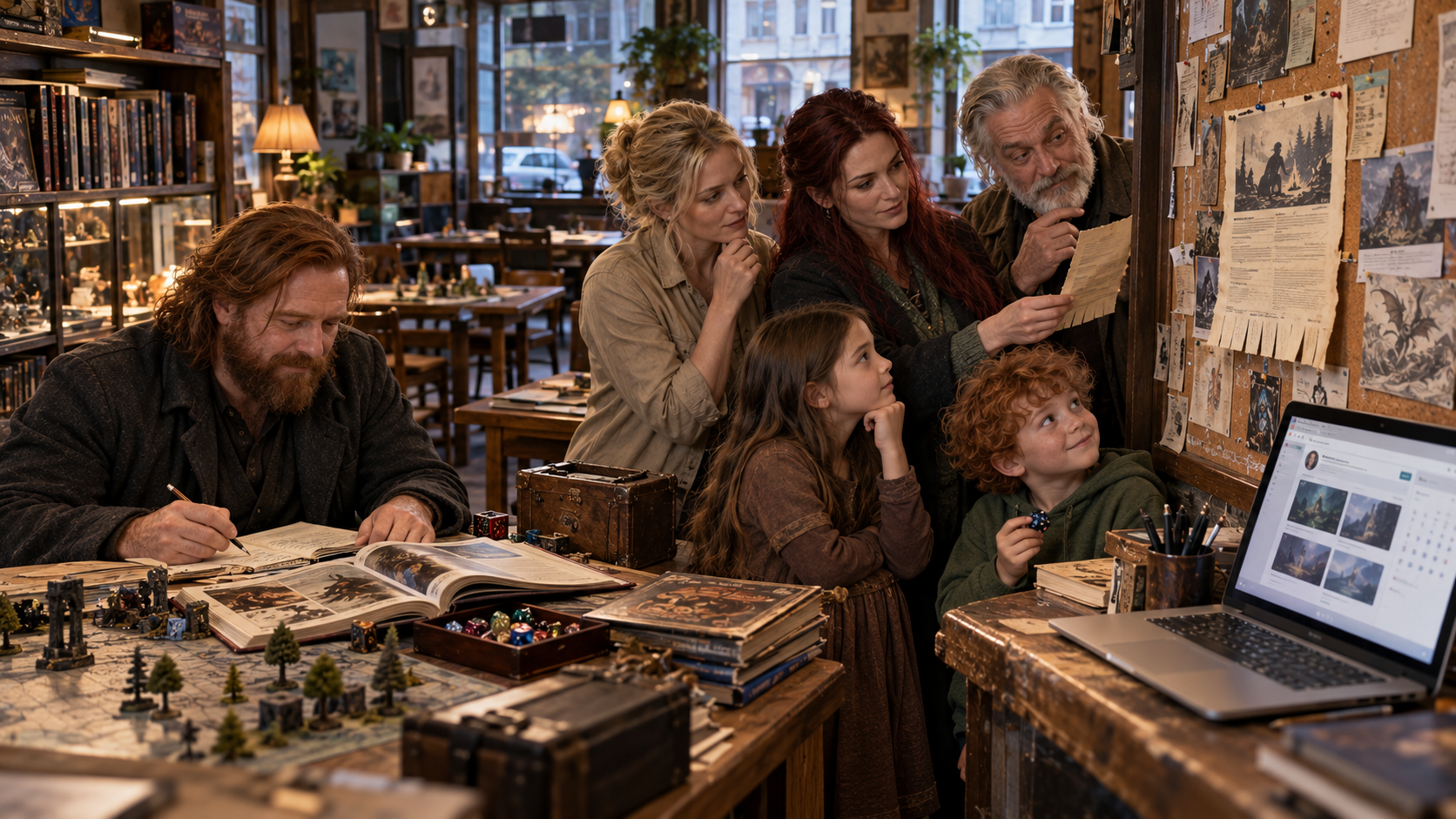
From the earliest paid tables to independent studios, gaming cafés, and global online communities
One Hobby, Many Beginnings — The History of Professional Game Mastering
Looking for a world worth exploring? Discover the current campaigns and weekly schedule at Mythveil Chronicles.
In September 2008, a role-playing enthusiast in Seattle noticed something familiar on a game store’s bulletin board. Several groups were searching for someone willing to run their games.
He offered an unusual solution: they could hire him.
Three days after posting his advertisement, somebody called. Within weeks, he was running paid sessions for two groups. He later described the experience on an internet forum, asking whether professional Game Mastering might become a viable source of income.
The advertisement offered four-hour sessions, provided rulebooks and gaming materials, explained travel arrangements, and distinguished between published adventures and individually prepared campaigns. It even addressed the awkward question of inviting a stranger into one’s home.
This was not an established booking platform. It was a person offering a service through a noticeboard.
And it happened twelve years before StartPlaying’s public launch.
The original September 2008 discussion survives, giving us a rare contemporary glimpse of paid Game Mastering before the profession developed much of its present-day infrastructure.
But even this is not where the story begins.
The history of professional Game Masters stretches further into the past, across different countries and several kinds of work. Community centres, private groups, parents, independent organisers, gaming venues, and eventually online marketplaces all played their parts.
To understand this history, we must investigate more than the moment somebody first charged admission to a fantasy adventure.
We need to ask how a shared hobby gradually developed a culture of paid creative work.
What makes someone a professional Game Master?
Mara has been studying the Seattle advertisement.
“He was already a Game Master?”
“Yes,” Stacy replies.
“And somebody paid him to keep doing it?”
“Essentially.”
Chibi looks at the stack of rulebooks.
“Do I get money if I roll a twenty?”
Sean examines the character sheet.
“Only if you’ve negotiated a remarkably good contract.”
My name is Eljara. Today, our family is exploring the history of professional Game Mastering.
Our first difficulty is deciding exactly what that means.
A professional Game Master, or GM, provides the preparation, organisation, facilitation, and direction of a tabletop role-playing experience in exchange for compensation.
That compensation may come directly from the participating players. It may also come from parents, an educational institution, a company, an event organiser, or another organisation commissioning the activity.
The distinction matters.
A paid Game Master does not necessarily work full-time. Someone running one paid session a month is engaged in compensated Game Mastering, even if their primary occupation is entirely different.
Conversely, a respected volunteer GM may demonstrate exceptional professional standards without accepting money.
We should also distinguish paid Game Mastering from other commercial activities within tabletop gaming.
Selling an adventure is paid writing. Publishing a rulebook is game development and publishing. Performing in a monetised Actual Play programme involves media production. Organising a convention is event management.
These activities may overlap with paid Game Mastering, but they are not automatically the same work.
Without this distinction, the history of professional GMs would become indistinguishable from the history of the role-playing industry itself.
Before tabletop RPGs: when people paid someone to manage a game
One of the earliest relevant developments occurred before the publication of Dungeons & Dragons.
In 1970, Rick Loomis created Nuclear Destruction, a multiplayer strategic game played through the postal service.
Participants submitted their orders by mail. The game’s operator processed those orders, determined what happened, and returned the results.
As participation increased, Loomis developed a commercial operation that became Flying Buffalo. Computer-assisted moderation helped the company manage games involving participants living far apart.
An especially valuable historical document survives in the Computer History Museum’s archive: an article written by Loomis for People’s Computer Company.
He explained the work of moderating multiplayer games and openly discussed the fees paid by participants.
This was an early example of something important: players paying an external organiser to maintain the continuity and functioning of a shared game.
Yet Nuclear Destruction was a strategic play-by-mail game, not a traditional tabletop role-playing campaign. Its operator was not functioning as a modern Dungeon Master.
We cannot reasonably declare Loomis the first professional tabletop RPG Game Master.
What his example demonstrates is that the commercial organisation of imaginative, continuing multiplayer experiences predates the profession we recognise today.
The earlier history of play-by-mail games deserves a place beside the story of paid tabletop sessions, while remaining distinct from it.
Sources: Rick Loomis and Nuclear Destruction · WIRED’s history of play-by-mail gaming · Computer History Museum archive
1974–1980s: a hobby grows, but its paid tables are harder to find
When Gary Gygax and Dave Arneson’s Dungeons & Dragons appeared in 1974, tabletop role-playing began developing into a recognisable commercial hobby.
Game publishers sold rules and adventures. Magazines circulated ideas. Conventions brought communities together. Shops and clubs gave players places to meet.
But commercial growth in the hobby does not automatically establish a parallel history of paid Game Masters.
A convention might charge admission without paying every person running a game.
A store might sell books and provide tables while its regular customers volunteered to GM.
An author might receive money for publishing an adventure, then run games for friends without charging anything.
All these arrangements could coexist.
For our research, this creates a substantial historical gap.
We know that tabletop RPGs became commercial products in the 1970s. We cannot yet identify, with comparable confidence, the very first person paid specifically to lead a tabletop RPG session.
That does not mean nobody was doing it.
It means that the evidence presently available is insufficient to establish a definitive beginning.
Informal arrangements leave little behind. A parent paying an experienced player to entertain children, a club giving someone a modest honorarium, or a group hiring a referee might produce no advertisement, invoice, or published account that survives decades later.
This is one reason why the history of everyday gaming culture is harder to reconstruct than the publication history of famous rulebooks.
The earliest commercial RPG products are relatively easy to date.
The first paid evening around somebody’s kitchen table is another matter.
The 1990s: professional Game Mastering before the platforms
By the mid-1990s, we can document paid Game Mastering through more specific accounts.
And those accounts challenge the assumption that professional GMs originally developed as entertainers hired exclusively by adult hobbyists.
Germany: a Game Master employed for youth activities
In January 2018, a contributor to the German tabletop RPG forum Tanelorn recalled work undertaken during the mid-1990s.
After conducting workshops introducing youth-centre staff to role-playing, the contributor was approached about running a regular RPG activity at a youth centre in Oldenburg.
The arrangement reportedly paid 16 Deutsche Mark per hour, for four hours each week.
The participating young people attended without paying. Funding came from the local youth authority.
The activity lasted approximately three or four months before changing attendance and declining interest brought it to an end.
This is a retrospective personal account, not a surviving employment contract. Its details should therefore be identified as the participant’s recollection.
Nevertheless, it gives us an unusually specific German example of compensated Game Mastering long before modern international booking platforms.
Source: Tanelorn discussion, January 2018
United States: Mark Abrams and the community-centre model
In a November 2015 interview, Mark Abrams described paid Game Mastering work beginning in 1996 at a community centre in Chappaqua, New York.
He later organised further paid sessions, including a 2004 engagement involving approximately twelve children whose parents financed the activity.
Abrams described the practical requirements of the work in terms familiar to contemporary professional GMs: the ability to run games, organise one’s time, and manage commitments to clients.
The interview is especially revealing because it predates the subsequent expansion of dedicated online booking marketplaces.
Abrams did not describe a profession waiting for a website to make it possible.
He described work that already existed.
Source: Michael J. Tresca’s 2015 interview with Mark Abrams
These two examples, one from Germany and one from the United States, do not establish the first professional Game Masters in either country.
They establish something more useful for our history.
By the 1990s, people were already being paid to provide tabletop role-playing as an organised activity.
In both cases, children and young people formed part of the audience. In both, an institution or another adult could finance the experience.
The profession’s early documented history therefore includes education, youth work, and organised recreation—not merely the commercial entertainment market.
Who is actually the customer?
Stacy closes the interview transcript.
“Look at the difference between the two arrangements.”
“In both cases somebody led the game,” Caelwyn observes.
“Yes. But the person receiving the experience wasn’t necessarily the person paying.”
That difference changes the entire business relationship.
If a group of adults hires a GM for an ongoing campaign, the players may collectively decide what they want from the service.
When parents commission a children’s game, the paying customers may expect reliability, appropriate organisation, and an enjoyable activity for the participants.
A community centre may be concerned with accessibility, scheduling, and the administration of a programme.
The GM must still make the adventure work at the table.
But the obligations surrounding the adventure can differ significantly.
This variety remains visible in professional Game Mastering today, where paid work may take place in private homes, schools, youth programmes, corporate events, gaming venues, or online campaigns.
The existence of different customers is not a minor economic detail.
It is part of how the profession developed different identities.
2008: the independent Game Master finds customers directly
The Seattle advertisement from our opening scene deserves another look.
Its importance is not that we can prove the author invented anything.
We cannot.
Its value lies in showing a complete, practical service offer at a time when professional Game Mastering was still relatively unusual.
The advertised price was 60 dollars for a four-hour session.
That included access to the necessary books, dice, maps, and miniatures. The first session was offered at a reduced price, and additional preparation for individually tailored campaigns could cost more.
The advertisement also discussed travel, arranging an introductory meeting, cancellation concerns, and the experience required to run different game systems.
Remarkably, the author offered not only D&D but also games including GURPS, Shadowrun, Exalted, World of Darkness, and Star Wars.
A prospective customer was not simply hiring a fantasy storyteller.
They were hiring someone with knowledge of several complicated systems, the equipment to run them, and experience managing groups.
The post also reveals one of the profession’s enduring difficulties.
Four hours at the table are not necessarily four hours of work.
Preparing an adventure, maintaining books and equipment, travelling to a venue, and communicating with players all consume time.
The advertised fee represented revenue for an engagement, not automatically a comfortable hourly wage.
And the arrangement required mutual trust. The GM was potentially entering a stranger’s home; the customer was inviting someone unknown into a private social gathering.
Professional Game Mastering had already developed practical questions about safety, reliability, pricing, and reputation.
It simply lacked much of today’s standardised infrastructure.
Source: Paid DMing/GMing? — contemporary forum post, September 2008
The early 2010s: professional Game Mastering becomes more visible
During the following years, professional Game Mastering became easier to encounter as a recognisable occupation.
One well-documented example is Timm Woods in New York.
In November 2017, WIRED published an extensive portrait of Woods, describing his work running games for private groups, families, and schools.
According to the report, he had been working professionally for approximately four years.
Woods had developed regular bookings and was running multiple sessions each week. His clients included adults and children, with games ranging from Dungeons & Dragons to Dungeon World.
The article described substantial preparation, custom-built materials, and prices that reflected a specialised service.
Most importantly, this was presented as his living rather than an occasional source of extra money.
The portrait helped make one version of the professional GM publicly understandable: an experienced creative worker whose primary job was providing role-playing experiences.
Yet even Woods should not be mistaken for the origin of the profession.
His career is evidence of a developing occupational model, not the date on which paid Game Mastering began.
Source: WIRED, 19 November 2017
2014: professional GMs begin discussing their own standards
The foundation of the Professional GameMaster Society in 2014 marks another revealing development.
A welcome message published in December of that year referred to conversations on Google+ and Roll20 about the idea of professional Game Mastering.
The society set out to discuss conduct, working practices, quality, and the wider recognition of paid GMs.
This matters because establishing a profession involves more than finding someone willing to pay.
People also begin discussing what the work should involve, what constitutes competence, and how a practitioner ought to behave.
A professional organisation does not prove that an occupation has suddenly become widespread.
It demonstrates that some practitioners now consider the activity a field of work worth organising and defining.
In 2017, the society’s founder discussed several possible business models, including educational games for children, private player-funded sessions, and audience-supported productions.
Even within the early conversation about professional GMs, there was no single agreed model for earning money.
Source: Professional GameMaster Society — historical articles
2016–2017: online communities begin formalising paid play
The growth of virtual tabletops created new possibilities, but playing online and finding paying customers were initially different problems.
Roll20 provides a useful example.
By July 2016, the platform had published specific rules addressing paid Game Mastering.
GMs advertising paid sessions were required to disclose that payment was involved and explain the arrangement.
A subsequent 2017 version of the rules referred to dedicated Pay to Play listings and clarified that Roll20 was not responsible for financial transactions between participants.
This distinction is important.
Roll20 provided an environment for running games and finding participants. It did not necessarily serve as the contractual or financial intermediary for every paid session.
The GM could still arrange payment independently.
We can see an important transition here: paid Game Mastering was no longer confined to personal recommendations, private advertisements, or informal conversations.
It had become common enough within an online gaming community to require explicit rules.
Sources: Roll20 paid GMing policy, 2016 · Roll20 policy update, 2017
Did money change the culture of the table?
Sean has been reading reactions to paid Game Mastering.
“Some people seem to think charging for it spoils the hobby.”
“Others think the work deserves compensation,” Stacy replies.
“Those claims aren’t opposites,” Caelwyn says.
He turns the page.
“They may describe different relationships.”
For much of tabletop role-playing’s history, Game Mastering has been performed within friendships, clubs, and voluntary communities.
The person preparing the adventure might spend hours studying a system, designing encounters, creating characters, and keeping track of previous sessions.
They generally did so because they enjoyed the activity and wanted to share it with other players.
In a voluntary group, that work can be an expression of friendship, enthusiasm, or creative collaboration.
Charging for the same activity changes the arrangement around it.
Expectations may become more explicit. Reliability, communication, preparation, and suitability to the advertised style can become parts of a service agreement.
Some players welcome this clarity.
Others are uncomfortable with the idea that a shared hobby might acquire the structure of a customer relationship.
Both reactions deserve examination.
Payment does not automatically make a Game Master better. Nor does refusing payment make the work less demanding.
A professional GM must manage obligations arising from the agreement. An unpaid GM may display equal or greater creative skill without adopting any commercial role.
The difference is not a universal ranking of quality.
It is the nature of the commitment.
Germany in early 2020: the debate is already underway
On 15 February 2020, the German role-playing magazine Teilzeithelden published an essay examining the perceived taboo around paid Game Mastering.
Its author described encountering a request from a parent looking for a suitable D&D group for her son, and reflected on offering a paid, child-friendly campaign.
The discussion centred on a familiar tension.
Why should preparation, teaching, and organising be considered meaningful work in one setting but inappropriate to charge for in another?
Only weeks later, on 29 March 2020, the German Eskapodcast published an interview with Christian Thier about earning money as a Game Master.
The interview examined customers, preparation, prices, professional requirements, and difficult player situations.
These publications matter chronologically.
The German debate was already visible at the beginning of 2020, before the widespread transformation of social activity during the COVID-19 pandemic.
Professional Game Mastering was not simply imported into public consciousness by one newly launched booking service.
It had an existing discussion culture.
Sources: Teilzeithelden, 15 February 2020 · Eskapodcast, 29 March 2020
2019–2020: booking services and agencies expand the possibilities
Several developments around 2019 and 2020 changed how professional Game Masters could present their services.
In the United Kingdom, Rolldark describes beginning in summer 2019 as a Facebook community connecting professional Dungeon Masters with players.
Its later services expanded into private bookings, ticketed events, online games, and corporate experiences.
This represents an agency-style approach: a recognisable organisation helping customers find suitable Game Masters.
Rolldark’s company history provides the relevant account.
In September 2020, StartPlaying publicly launched a platform specifically intended to connect players with professional GMs.
It brought together advertised sessions, player bookings, payment processing, and features intended to help GMs operate their businesses.
In July 2021, StartPlaying reported that Game Masters on its platform had generated more than 500,000 dollars in revenue since the public launch. That was the company’s reported figure, not a measurement of the entire professional GM economy.
StartPlaying’s July 2021 report documents its early development.
Demiplane was developing another approach.
Its December 2020 Adventure Portal combined game discovery, group organisation, communication, and collaborative tools. Its subsequent updates included support for identifying paid adventures.
Demiplane’s development record preserves these stages.
These businesses were not identical.
One could function as an agency, another as a dedicated booking marketplace, and a third as a combination of discovery and campaign-management infrastructure.
This distinction helps explain why the professional Game Mastering landscape did not grow from one platform alone.
Different services attempted to solve different problems.
The pandemic accelerated a profession it did not invent
The arrival of COVID-19 in 2020 transformed the circumstances under which many people gathered.
Groups that previously met in private homes, clubs, and stores increasingly relied on remote communication.
Online play offered a way to maintain established campaigns and meet new participants despite geographical separation.
For a paid Game Master, the potential audience no longer needed to live within travelling distance.
An experienced GM in one country could organise a campaign for players on another continent.
But online accessibility did not automatically solve the economic difficulties of professional work.
Time zones still mattered. Sessions required preparation. Players might leave. Groups could struggle to maintain consistent attendance.
And a full calendar of paid games did not necessarily mean a secure living.
A 2025 Wargamer investigation interviewed professional Dungeon Masters about their experiences, including people who developed paid work during the pandemic.
Their accounts describe opportunities created through online play, alongside difficulties involving income, preparation, and exhaustion.
The pandemic was therefore an accelerator in many individual careers.
It was not the birth of paid Game Mastering.
Source: Wargamer, The meteoric rise of the professional Dungeons and Dragons DM, June 2025
Beyond D&D: the professional GM market becomes more varied
A history of professional Game Mastering cannot be limited to Dungeons & Dragons.
In 2022, Germany’s Interessenverband Fantasy und Science Fiction examined nine different professional Game Mastering providers and services.
Its survey included independent practitioners and businesses such as Weltenweber, Miet’n Meister, Kainskind, Rent A Dungeonmaster, Masters of the Dice, EduTale, and others.
The selection revealed considerable variation.
Some providers specialised in D&D, while others offered systems including Das Schwarze Auge, Pathfinder, Starfinder, World of Darkness, Call of Cthulhu, Shadowrun, Warhammer Fantasy, and smaller role-playing games.
Some were prepared to learn unfamiliar systems for clients.
Others offered individually written adventures, character backgrounds, coaching, or assistance for existing groups.
This was not a representative census of every professional GM in Germany.
It was a documented survey of a selection of publicly visible services.
Nevertheless, it makes an important point.
Paid Game Mastering was developing into a collection of specialised creative services rather than a single product with one standard format.
The differences are substantial.
Running a four-hour introductory adventure is not the same work as maintaining a campaign over several years.
Teaching beginners differs from facilitating an experienced political-horror group.
Preparing a corporate event involves different expectations from supporting a private campaign whose participants already know one another.
These are not merely different prices attached to the same experience.
They are different ways of organising the profession.
Source: IVFSF, SL Mieten – Für Rollenspiel bezahlen?, 2022
The international picture: from agencies to gaming cafés
By the middle of the 2020s, paid Game Mastering had several visible organisational forms around the world.
In London, RPG Taverns launched in April 2024 as a dedicated role-playing venue.
Its business model offered organised sessions with Game Masters provided by the venue, allowing participants to join without assembling an entire private group themselves.
This is different from employing an independent GM for a long-term home campaign.
The venue supplies the space, scheduling, game infrastructure, and part of the social organisation.
A 2025 interview with the founders provides a detailed account of its origins and operation.
Source: Tabletop Gaming, RPG Taverns in London
Japan offers another relevant model.
Tokyo’s Monodraco operates as a venue dedicated to tabletop role-playing games and murder mysteries.
Its published information explains how customers can join scheduled games, reserve spaces, and request a GM from the venue’s staff.
The business combines a physical gathering place, equipment, organised sessions, and services associated with running games.
We should not assume that this establishes when paid Game Mastering first began in Japan.
It does demonstrate that professional facilitation can be part of a specialised local gaming venue rather than an internationally mediated online booking.
Source: Monodraco — venue and GM services
Other arrangements include private commissions, convention work, freelance marketplaces, community programmes, and direct bookings through individual Game Masters’ websites.
Even when two GMs use the same virtual tabletop, they may have entirely different business models.
One may work through a booking platform.
Another may maintain a private clientele.
A third may receive a fixed fee from an event organiser.
The technology through which the game is played does not necessarily determine who pays for it.
The platforms are part of the profession, not its whole history
Stacy has divided the names in our research into three groups.
“These help people find a Game Master,” she says.
“And those?” Mara asks.
“Those provide places or tools to play.”
Chibi points to a third group.
“These ones?”
“Those are people offering to run games themselves.”
Sean looks over the notes.
“Three different answers to a question everyone insists on asking as though it were only one.”
By 2026, the professional Game Mastering ecosystem includes several distinct kinds of service.
Dedicated marketplaces, including StartPlaying, bring players and GMs together around advertised sessions and booking arrangements.
Virtual tabletops and gaming tools, including Roll20, Foundry Virtual Tabletop, Fantasy Grounds, and Quest Portal, provide technological environments for playing or managing campaigns. Some also help with discovery, but using them does not necessarily mean that the GM charges money.
Independent practitioners and agencies arrange services directly through websites, communities, recommendations, and client relationships.
Physical venues and institutions provide game spaces, commissioned sessions, educational programmes, or facilitated events.
Services such as Discord, event-registration platforms, general freelance websites, and community forums may support some of these arrangements without being dedicated professional GM marketplaces themselves.
The boundaries can overlap.
A professional GM might advertise independently, use StartPlaying for selected campaigns, prepare material in Foundry, communicate through Discord, and accept separate commissions for private events.
That does not make all four services interchangeable.
The distinction matters both historically and economically.
A booking intermediary can influence how easily a GM is discovered, what information customers compare, and what fees apply.
A virtual tabletop affects how the session is delivered.
An independent studio may define its own standards, client relationships, pricing, and creative identity.
All belong in the history, but they belong in different places.
What are people paying for?
Perhaps the most important historical development is not technological.
It is the gradual clarification of what customers believe they are purchasing.
Research and interviews suggest several recurring reasons for hiring a Game Master.
Some groups contain people who all want to play characters rather than take responsibility for running the game.
Others have difficulty finding someone with the knowledge or time to prepare a particular system.
Beginners may want structured instruction.
Experienced players may be seeking a specific style, a dependable schedule, or a campaign they cannot readily find in their local community.
Parents, community organisations, and companies may have entirely different reasons for commissioning a role-playing experience.
None of these motives proves that a paid GM provides better play than a volunteer.
They explain why people might value the service.
A professional Game Master can promise preparation, organisation, attention, and an agreed form of delivery.
Depending on the engagement, that may also include research, virtual tabletop preparation, character assistance, campaign documentation, and communication between sessions.
But a paid session does not turn the participants into passive customers watching a completed story unfold.
Tabletop role-playing remains a collaborative activity.
The GM provides the conditions and facilitates the experience.
The players decide what their characters attempt, establish relationships, make choices, and contribute to the events that follow.
That shared authorship is one of the medium’s defining qualities.
A customer may pay for the session. They cannot reasonably purchase a guaranteed victory, immunity from fictional consequences, or control over every other player’s decisions unless the group has explicitly agreed to some unusual format.
Equally, a GM who charges for a service owes the participants clarity about what is being offered.
Professionalism is not simply the act of collecting payment.
It includes how the agreement is honoured.
The difficult economics of creative work
Professional Game Mastering can look deceptively simple from outside.
A group meets for three or four hours.
The players enjoy an adventure.
The GM receives payment.
But that visible session may be supported by many hours of other work.
Research, preparation, adapting adventures, maintaining character records, writing notes, troubleshooting software, corresponding with players, and managing cancellations can occupy considerable time.
There may also be platform fees, equipment costs, software subscriptions, taxes, and the financial uncertainty associated with irregular bookings.
Not every professional GM performs all these tasks. The amount of work varies with the game and the agreement.
That variation is precisely why comparing session prices without examining the service can be misleading.
A 2025 Wargamer investigation recorded a broad range of professional experiences, from occasional supplemental income to full-time businesses.
Interviewees also discussed creative exhaustion and the difficulty of maintaining enough bookings without turning the work they enjoyed into an unsustainable schedule.
Such interviews offer valuable individual testimony.
They do not establish a reliable global average income.
At present, the available historical and commercial sources do not provide a consistent worldwide count of professional Game Masters or a trustworthy percentage who earn their entire living from the occupation.
The profession is visible.
Its exact global scale remains harder to measure.
Source: Wargamer’s interviews with professional GMs
Can a hobby remain a hobby when someone makes a living from it?
Mara has been quiet for a while.
“Does everybody have to pay now?”
“No,” Caelwyn says.
“Why not?”
“Because people can still play together however they choose.”
Chibi considers this.
“So we can play for free?”
“Of course.”
“And a Game Master can have a job doing games?”
“Yes,” Stacy replies.
Chibi smiles.
“Good. Both.”
That is perhaps the simplest answer to one of the most persistent arguments surrounding professional Game Mastering.
The existence of a paid service does not eliminate the value of voluntary play.
A professional musician does not mean friends should stop making music together.
A paid sports instructor does not mean informal games must disappear.
Likewise, hiring a Game Master does not invalidate campaigns organised among friends.
The important questions concern suitability, fairness, expectations, and mutual respect.
A professional arrangement may solve problems for some groups.
For others, the relationships and informal collaboration surrounding an unpaid campaign are exactly what make the hobby meaningful.
Neither experience needs to claim superiority over the other.
The history of professional Game Mastering is not a story about replacing one with the other.
It is the development of an additional way to participate in tabletop role-playing.
Where does the history of professional GMs go next?
The available evidence does not support a neat origin myth.
We cannot identify one universally recognised first professional tabletop Game Master.
Nor can we point to a single company and declare that the profession began with its creation.
Instead, the record reveals several developments unfolding across decades.
Commercial game moderation existed before tabletop RPGs became a published hobby.
Paid tabletop Game Mastering is documented through retrospective accounts of the 1990s in both Germany and the United States.
By 2008, independent GMs were advertising services directly to private gaming groups.
During the 2010s, professional practitioners became more publicly visible, discussed occupational standards, and used online communities to find customers.
The pandemic accelerated the development of remote play and international booking opportunities.
By the mid-2020s, professional Game Mastering included independent studios, agencies, dedicated marketplaces, cafés, organised gaming venues, educational offers, and event-based services.
The profession had not followed a single straight line.
It had developed wherever people found value in paying someone to make a shared role-playing experience possible.
That does not settle the question of what professional Game Mastering will become.
New tools may change how GMs prepare and manage campaigns. Different forms of online communication may change how groups gather. Automated systems may assume some administrative tasks while creating new questions about the value of human facilitation.
Those possibilities deserve their own careful examination.
They should not distract us from the people whose work already exists.
Help us recover the missing history
This article is a documented historical overview, not a claim to have discovered every early paid Game Master.
The research still has significant gaps, particularly for the 1970s and 1980s and for countries whose local gaming histories are poorly represented in English-language sources.
We would welcome evidence that can help close them.
Did you ever receive payment for running a tabletop RPG before 2000?
Did your club, school, youth centre, game store, or convention employ Game Masters?
Do you remember early advertisements, invoices, event programmes, newsletters, or private commissions?
Were there paid Game Mastering traditions in your country that international discussions consistently overlook?
Personal memories are valuable starting points. Contemporary documents can help establish when and where those experiences occurred.
Our aim is not to crown the earliest person willing to accept a fee.
It is to understand how people gradually learned to recognise Game Mastering as work that could be offered, commissioned, and sustained.
The table still belongs to everyone
Mara places the old Seattle advertisement beside the later interviews.
“That person wanted somebody to play with them.”
“Yes,” I tell her.
“And the Game Master helped?”
“That’s what the arrangement was meant to do.”
Sean picks up the earliest document.
“Different decade. Different equipment. Same talent for making ordinary logistics complicated.”
Stacy smiles.
“Someone still has to organise the game.”
Caelwyn closes the folder.
The history we have followed does not belong exclusively to entrepreneurs, famous performers, or successful online platforms.
It also belongs to the Game Master who led a youth-centre programme in the 1990s, the person who advertised on a shop noticeboard, the organiser who made a gathering possible, and the practitioners who developed their own ways of serving different communities.
Some earned occasional fees.
Others built lasting businesses.
Many continued to work in a mixture of paid and voluntary settings.
Their contributions remind us that professional Game Mastering was not created by a payment system.
It emerged when people began recognising that helping others enter, inhabit, and sustain an imaginary world could be work worth paying for.
The rules made the game possible.
The community made it a hobby.
And, through many different beginnings, some of the people who kept those worlds alive made Game Mastering their profession.
This article is part of Mythveil Chronicles’ exploration of tabletop role-playing history, culture, and the people who shape it.
Continue our historical journeys through the United States, Germany, the United Kingdom, Italy, Spain, and Canada.
Bring your own campaign questions to the Mythveil Seminar: Campaigns That Remember Your Players, where Game Masters learn through discussion, shared experience, and practical work on real campaigns.
Read. Play. Watch. Support. Or collaborate.
Read Mythveil Chronicles · Join our campaigns · Support our research and stories · Collaborate with Mythveil
The people who make worlds possible deserve a place in their history.
Discover your next game in the Mythveil weekly schedule.