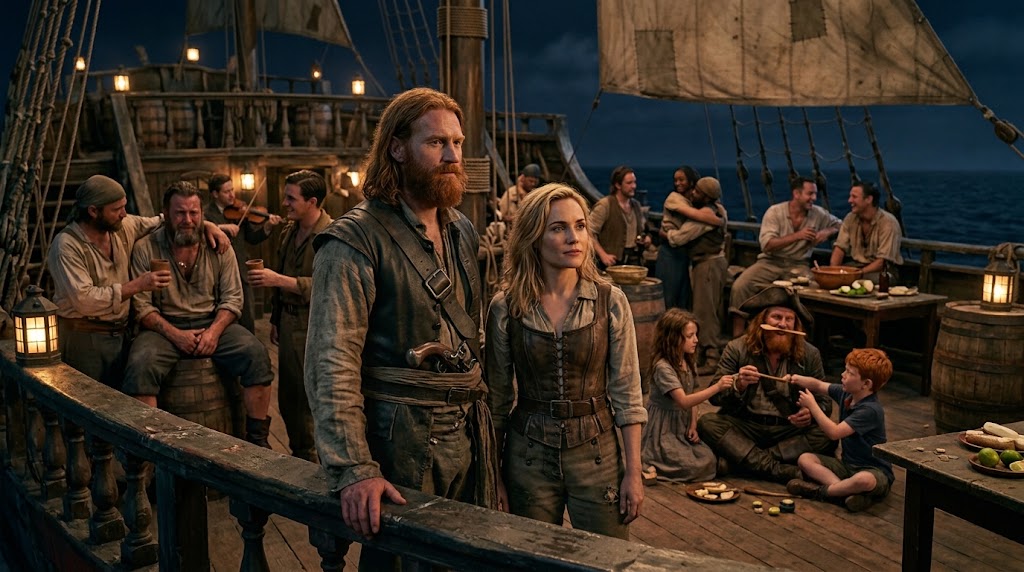
The first change was not the singing.
It was the shoulders.
At sunset, one of the sailors from the captured ship had sat with his back straight, watching everyone who passed behind him. His knife remained close enough to reach without looking.
Two hours later, the knife was still there.
But he had stopped checking it.
Another hour, and his elbows were on the table.
Now his boots were on it.
His head rested against the shoulder of a man he had threatened to kill before supper.
Neither seemed to find this remarkable.
Stacy closed her notebook.
CAELWYN: “Finished?”
STACY: “No.”
CAELWYN: “Then why did you close it?”
She looked across the deck.
STACY: “I think watching might be more useful.”
The feast had changed.
The first hunger was gone.
Nobody guarded the platters anymore.
Nobody worried that the last piece of fish might disappear.
The battered communal bowl still travelled between tables, but people were no longer drinking because they were thirsty.
They drank because somebody told a story.
Because somebody finished a song.
Because somebody lost at dice.
Because somebody won.
Because someone they liked held out a cup.
Because they were alive.
And increasingly, nobody seemed to need a reason.
Stacy watched a scarred sailor tell three strangers something that sent all four collapsing into laughter.
STACY: “They’re louder.”
CAELWYN: “Yes.”
STACY: “No. I mean themselves.”
Near the mast, a man who had barely spoken all evening was singing.
Badly.
Enthusiastically.
Someone joined him.
The second singer knew the melody but not the words.
A third knew the words but seemed personally opposed to the melody.
Together they created something catastrophic.
Then somebody started crying.
The man was enormous.
Stacy had watched him fight that afternoon with blood running from his mouth.
Now he sat on an overturned barrel, face buried in his hands, sobbing like a child.
Nobody laughed.
One sailor sat beside him.
Then another.
Eventually the man pointed towards the musicians.
A woman nearby understood.
“His mother used to sing it.”
The man cried harder.
One of the sailors put an arm around him.
Another offered him a cup.
He shook his head.
“No.”
The sailor shrugged and drank it himself.
STACY: “He didn’t cry when they stitched his arm.”
CAELWYN: “Perhaps his arm didn’t remind him of his mother.”
Stacy watched him.
STACY: “Why now?”
CAELWYN: “Perhaps yesterday he couldn’t.”
Before she could answer, a shout came from the dice table.
Two sailors were facing each other.
One from the old crew.
One from the captured ship.
A shove.
Another.
Then a punch.
They crashed onto the deck.
Someone cheered.
Someone else started taking bets.
Stacy watched carefully.
No knife.
No pistol.
Just fists, insults and considerably more enthusiasm than skill.
“YOU CALLED MY BROTHER A GOAT!”
“I CALLED YOUR GOAT YOUR BROTHER!”
Even Caelwyn blinked.
Thirty seconds later both men were exhausted.
One had a split lip.
The other had lost a shoe.
They lay staring at the stars.
Then one began laughing.
The other tried not to.
Failed.
A minute later they were sitting against the same barrel, sharing the communal bowl and continuing the argument about the goat much more peacefully.
STACY: “That could have become serious.”
CAELWYN: “Yes.”
STACY: “Why didn’t it?”
CAELWYN: “Perhaps neither wanted it to.”
Then laughter erupted behind them.
The captain was sitting on the deck.
Chibi sat opposite him.
Between them lay two spoons.
Mara stood nearby with the solemn expression of someone supervising an important scientific experiment.
The captain balanced a spoon against his nose.
It fell immediately.
Half the crew offered advice.
“Lean back!”
“Forward!”
“Use the big one!”
“That’s cheating!”
That afternoon these men had obeyed his orders without hesitation.
Now they were arguing about spoon technique.
On his fourth attempt, the captain managed two seconds.
The crew roared as though he had captured a Spanish treasure fleet.
His daughter stood nearby, watching.
Something softened in her face.
Perhaps she had never seen him like this.
Perhaps he had never allowed himself to be seen like this.
Stacy laughed until she had to cover her mouth.
Then she looked across the deck.
STACY: “Something is happening.”
CAELWYN: “A feast?”
STACY: “More than that.”
She pointed.
STACY: “At the beginning everyone knew who they were supposed to be.”
Captain.
Sailor.
Prisoner.
Victor.
Stranger.
Father.
Daughter.
Now the captain was losing a contest to a child.
A hardened sailor was crying about his mother.
Two enemies were sharing tobacco after punching each other.
A man who had spent dinner boasting that he feared nothing was quietly admitting that he had thought he would die that afternoon.
STACY: “They’re dropping the roles.”
CAELWYN: “Or adding others.”
She looked at him.
CAELWYN: “The captain is still the captain. He’s also a man sitting on the floor with a child.”
He nodded towards the crying sailor.
CAELWYN: “That man is still the one who fought through a wounded arm.”
The sailor wiped his face and began singing.
CAELWYN: “And he’s someone’s son.”
Stacy became quiet.
STACY: “People like to say moments like this show who someone really is.”
CAELWYN: “Do you?”
STACY: “No.”
CAELWYN: “Why?”
STACY: “Because restraint is part of us too.”
She watched the two men who had fought.
STACY: “If you’re angry and choose not to hit someone, that choice is real.”
She looked towards the frightened sailor.
“If you’re afraid and still do what needs doing, that is real.”
Then towards the man singing for his mother.
“And if you love someone without crying every time you remember them, the love isn’t false.”
CAELWYN: “Then what is falling away?”
Stacy watched the feast.
STACY: “The effort.”
CAELWYN: “Of what?”
STACY: “Holding everything in place.”
All day, people decided how loudly to speak.
How long to look.
When to touch.
Which memory to swallow.
Which fear to hide.
Which affection to disguise as mockery.
Which tears to postpone.
Which part of themselves the world was allowed to see.
Some of that restraint was necessary.
Some was kindness.
Some fear.
Some pride.
Some survival.
But maintaining it required effort.
Tonight there was food.
Warmth.
Music.
Exhaustion.
Rum.
And the strange security of belonging somewhere.
People were spending less effort keeping everything inside.
And through the gaps came everything.
Joy.
Grief.
Desire.
Anger.
Affection.
Fear.
Ridiculousness.
Tenderness.
STACY: “They’re not becoming someone else.”
CAELWYN: “No.”
STACY: “They’re becoming less guarded.”
CAELWYN: “Is guarded always the opposite of honest?”
Stacy sighed.
STACY: “You enjoy this.”
CAELWYN: “Very much.”
She thought.
STACY: “No. Sometimes the guard protects other people.”
She looked towards the fighters.
“I can honestly be angry and honestly choose not to hit someone.”
Then towards the people sitting close together.
“I can honestly desire someone and honestly decide that desire doesn’t give me a right to them.”
CAELWYN: “So removing restraint doesn’t reveal the truth?”
STACY: “Not necessarily.”
CAELWYN: “What does it reveal?”
She looked around.
STACY: “Whatever was pressing against it.”
At that moment, a sailor climbed onto a table.
“I LOVE EVERY BASTARD ON THIS SHIP!”
“You hated us this afternoon!”
“I WAS WRONG!”
“ABOUT WHICH PART?”
The sailor considered this carefully.
“All of it!”
The deck cheered.
Then he pointed at another man.
“Except you.”
“Why me?”
“You owe me six reales.”
“FIVE!”
“THIEF!”
The argument began.
Stacy smiled.
STACY: “That, apparently.”
Later, the captain’s daughter sat beside her father.
Their shoulders touched.
Nothing was forgiven.
Nothing was solved.
Twenty missing years had not disappeared.
But for once they did not try to repair them.
They simply sat together.
Nearby, the enormous sailor began singing the song about his mother.
Others learned the refrain.
They had never known her.
They did not know the house, harbour or kitchen he remembered.
But they could sing with him.
His voice broke.
Nobody pretended not to notice.
Nobody made it important either.
They simply continued.
STACY: “Maybe that’s part of it.”
CAELWYN: “What?”
STACY: “You can put something down because there are enough people to hold it for a while.”
This time Caelwyn did not answer with another question.
CAELWYN: “Yes.”
Tomorrow, the roles would return.
Captain.
Sailor.
Father.
Daughter.
Old crew.
New crew.
So would responsibility.
Restraint.
Embarrassment.
And almost certainly headaches.
But tonight, people allowed one another to become untidy.
Not better.
Not worse.
Not more real.
Simply less defended.
The frightened one.
The ridiculous one.
The grieving one.
The affectionate one.
The angry one.
The lonely one.
The child who once sang beside a mother who was gone.
The adult who had learned not to cry about her.
Both were real.
Perhaps growing up does not mean killing the child.
Perhaps it means building enough walls around it to survive.
And perhaps there are nights when, among people you trust, you can open the gate.
For a song.
For a confession.
For a stupid fight.
For a hand on a shoulder.
For two spoons balanced badly on a pirate captain’s nose.
The feast had not changed them.
It had simply made it harder to keep everything inside.
What do you keep behind your armour — and who do you trust enough to let it see the light?
If you remember what this felt like…
Join Black Flags, Deep Waters:
https://startplaying.games/adventure/cmdjv8r4p00adji04l6v8h4x7
For the stories, research and deeper worlds behind Mythveil Chronicles:
https://www.patreon.com/MythveilChronicles