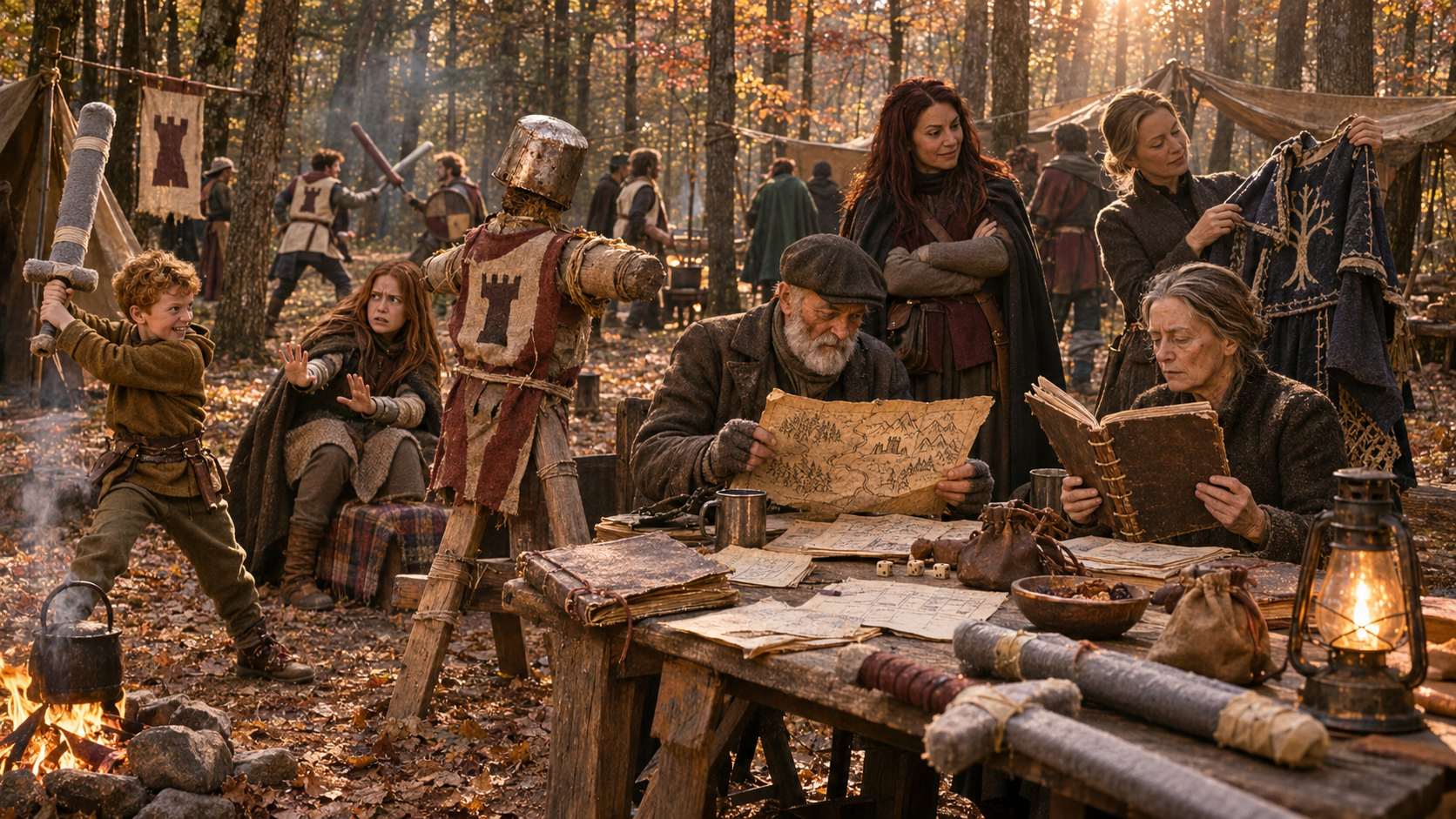
One Hobby, Many Beginnings — A History of Live Action Roleplaying
There was a time when a sword could be made from a wooden closet pole, furniture foam and an unreasonable quantity of enthusiasm.
In Maryland, people carried such weapons into the woods to fight battles that existed nowhere on a real map. In Colorado, another group tried to turn science-fiction literature into an outdoor adventure and discovered that the rules of an imaginary world had to survive contact with real bodies. In Massachusetts, people gathered inside convention hotels, carrying secret character information instead of swords, and found that a few determined conspirators could create as much drama as an entire battlefield.
These were not chapters in a single organisation’s master plan.
They were different answers to a question that many people had begun asking independently:
What if we stopped imagining ourselves inside the story and actually stepped into it?
The answer changed American gaming culture.
It produced fantasy battles, theatrical conspiracies, persistent fictional kingdoms, vampire courts, post-apocalyptic communities and elaborate immersive experiences. It also produced arguments about rules, ownership, authenticity, safety and whether hitting someone with a padded sword counts as acting.
Some of those arguments remain wonderfully unresolved.
Mara studies the documents scattered across our table.
“Which one started it?”
Stacy looks at the dates.
“That depends on what you mean by starting.”
Chibi picks up a wooden ruler.
“I found a sword.”
“That is a ruler,” Mara says.
“Not any more.”
Sean quietly moves the ink bottle out of reach.
My name is Eljara. Today, our family is following the history of live action roleplaying in the United States.
We will encounter founders, writers and designers, but also the people who built costumes, maintained camps, wrote character backgrounds, organised conventions, cooked meals, settled disputes and returned to the same imaginary places year after year.
Because the history of American LARP is not simply the history of people who invented games.
It is the history of people who made those games possible.
The history of American LARP has no single beginning
The first difficulty is deciding what counts as live action roleplaying.
A medieval tournament can involve costume, a historical persona, ritual and competitive combat. A game of Assassin can send participants through real buildings pursuing fictional objectives. An improvised theatrical game can give players secret motivations and ask them to negotiate their way through a crisis. A fantasy campaign can combine all these things with rules for magic, injury and character development.
Each resembles something we now recognise as LARP. They are not necessarily the same activity.
If we define LARP as any game in which people pretend to be somebody else, its ancestry stretches far beyond twentieth-century America. Children’s games, ritual performances, theatrical improvisation and historical spectacles all become possible relatives. If we define it exclusively through published fantasy rules, we overlook outdoor games that developed independently of Dungeons & Dragons.
If we insist on extensive theatrical characterisation, we risk dismissing battle-gaming communities whose participants invest years in developing personas, relationships and group identities through physical play.
The most useful approach is therefore to investigate each tradition on its own terms.
Scholarship on live action roleplaying has repeatedly warned against treating the hobby as the product of one invention. Markus Montola’s historical and theoretical work, alongside research by J. Tuomas Harviainen and other game scholars, identifies overlapping traditions rather than an uncomplicated family tree.
Participants themselves make similar distinctions. Some call what they do roleplaying. Others prefer battle gaming, interactive literature, living history or immersive theatre. These names describe differences in practice, but also differences in how communities wish to be understood.
The history becomes more interesting once we stop forcing everyone into the same definition.
1966: The medieval tournament that became the Society for Creative Anachronism
On 1 May 1966, a gathering in Berkeley, California, brought together people interested in history, fantasy literature and medieval culture.
The occasion was an outdoor tournament organised by Diana Paxson and her circle. Participants wore historically inspired clothing and took part in chivalric competition.
The event was successful enough that another gathering was planned. Reserving a public park required an organisational name, and the Society for Creative Anachronism — the SCA — emerged.
A temporary solution to a practical problem became the name of a lasting international community. That development is documented in the SCA’s own institutional history.
The organisation’s scope extended well beyond combat. Members researched historical clothing, heraldry, crafts, calligraphy, music, dance, food and the material practices of earlier societies. Courts, titles, tournaments and recurring events created a shared social framework in which historical personae could develop over time.
Participants were not merely watching a medieval spectacle. They were helping sustain one.
Yet describing the SCA as the first American LARP would simplify both its history and the history of subsequent fantasy gaming. The Society developed around historical recreation and a selective interpretation of pre-seventeenth-century culture. Its relationship to fantasy roleplaying is complicated by the fact that early participants often belonged to overlapping science-fiction, fantasy and historical-interest communities.
These connections made influence possible. They do not establish that every later American LARP descended directly from the SCA.
Medieval recreation creates different obligations from fantasy gaming. A participant researching fifteenth-century clothing may be concerned with historical materials, construction and social context. A fantasy player might use the same clothing as the foundation for an entirely invented culture.
The activities can enrich each other without becoming identical.
Caelwyn examines an illustration of an early tournament.
“A community can begin by recreating the past,” he says, “and then develop traditions that become part of its own history.”
Sean smiles.
“Especially once somebody invents a title and discovers everyone else would quite like one.”
There is an additional social-history lesson here. Women were present in the earliest organisational history, including Diana Paxson and Marion Zimmer Bradley. The development of historical recreation also depended on creative labour that disappears when a chronicle concentrates exclusively on martial winners and institutional officers.
Someone had to make the clothing, organise the gatherings, teach the crafts and preserve the records. The visible tournament was only one part of the community.
1973: A ring, a rulebook and an outdoor Middle-earth
Before the publication of Dungeons & Dragons in 1974, an American hobbyist named Wendell L. Hill Jr. published Rules for the Live Ring Game.
Dated 1973, the small booklet described an outdoor game based on the pursuit and possession of the Ring in Tolkien’s fictional world. It did not require a computer, a tabletop dungeon or a professional theatrical cast.
It required people, terrain, agreed rules and the willingness to treat a physical landscape as the geography of a fictional conflict. Participants were assigned opposing objectives. Movement, pursuit, concealment and the handling of the Ring became problems to solve through actual play.
The game was closer in some respects to a large-scale strategy contest than to what later players would recognise as a character-driven fantasy campaign. That does not make it historically insignificant.
It demonstrates that Tolkien-inspired live fantasy play was being codified through published rules before the tabletop roleplaying industry had fully emerged.
A surviving copy of the original booklet has been reproduced by the Wisconsin Ring Game archive.
The survival of this modest publication matters because early hobby history often depends on material never intended for museums. A cheaply produced rulebook might have been passed between friends, rewritten, mislaid or discarded. Its continued existence allows historians to investigate something more precise than an anniversary legend: what participants were actually instructed to do.
A separate Wisconsin Ring Game tradition developed through enthusiasts associated with a high-school chess and strategy club in the 1970s. Accounts preserved by the modern community connect its origins with Hill’s earlier publication.
A game can travel through a document without reproducing itself exactly. People interpret the rules, encounter problems and change the procedures. Eventually, the local version acquires its own history.
That is one recurring pattern of American LARP: communities inherited ideas, but also adapted them to the people and places available.
1977: Dagorhir and the invention of a battlefield
A second major tradition developed in the Maryland and Washington, D.C., region.
In 1977, Brian Wiese began experimenting with fantasy battle gaming. Tolkien’s literature, historical combat imagery and the 1976 film Robin and Marian formed part of his inspiration.
The idea was straightforward: people should be able to participate physically in the kind of battles they had previously encountered through books and films.
The practical difficulties were considerably less straightforward. Real swords were unsuitable. Wooden practice weapons could cause injuries. Costumes had to survive running, falling, weather and repeated use. Rules needed to distinguish a successful strike from an argument about whether somebody had been hit.
According to the early Dagorhir handbook preserved by its Aratari chapter, a prototype battle took place on 29 October 1977 at Riggs Farm in Montgomery County, Maryland.
The group developed rules governing padded weapons, battlefield objectives, injuries and simulated death. Wiese initially used the name Hobbit Wars. The organisation later became Dagorhir.
Its surviving history describes experimentation with readily available materials, including wooden cores, foam padding and improvised shields.
These are not trivial details. They reveal how a new form of play emerged from physical limitations.
A fantasy novel can describe a sword fight without worrying about the compressive properties of padding. A real player cannot. Equipment design therefore became part of game design.
Safety checks, accepted striking techniques and rules for incapacitation made sustained participation possible.
The early battles were not necessarily rich in dramatic dialogue. Their appeal often came from movement, improvisation, athletic ability and the immediate uncertainty of physical competition. A fighter who was faster, more attentive or better coordinated could influence the result directly.
Here, the relationship between player ability and character ability was unusually close.
Dagorhir also developed ways of recruiting and communicating before contemporary digital platforms existed. Wiese’s early circle expanded through personal contacts. A radio advertisement followed in June 1978, after the original prototype battles. The organisation appeared at the Maryland Renaissance Festival in 1979 and attracted broader attention through press and television coverage.
The history preserved by Dagorhir includes a particularly revealing innovation: an answering-machine hotline. Participants could telephone to discover when the next battle would take place.
An answering machine may not sound like a great technological breakthrough in the history of immersive entertainment. In the late 1970s, for a volunteer community coordinating outdoor activities, it could be enormously useful.
The point was not technological sophistication. It was making sure everyone knew where to appear.
Dagorhir eventually developed national events, including Ragnarok, and helped establish a distinctive American combat-gaming culture.
Its history also shows why battle gaming should not automatically be treated as an incomplete version of theatrical LARP. For some participants, physical combat was the principal creative experience.
They were not necessarily waiting for somebody to add complicated character sheets. They had already found what they wanted.
1981: Dream Park and the extraordinary power of a fictional idea
In 1981, Larry Niven and Steven Barnes published the science-fiction novel Dream Park.
The book imagined an entertainment complex in which technology enabled participants to experience elaborate live-action adventures. The fictional International Fantasy Gaming Society operated within that imagined entertainment industry.
Its games combined physical movement, staged environments, technological illusions and the organisational structure of a large production.
For readers who already knew tabletop fantasy gaming, the premise offered an intoxicating possibility.
What if the dungeon became an actual place? What if the monsters appeared in front of you? What if the quest no longer happened only through a referee’s description?
In Boulder, Colorado, John Cade and Mark Simmons were among the people who took the underlying idea seriously.
The International Fantasy Gaming Society’s official history records the organisation’s foundation in 1981 and an early game called The Truing.
This first experiment involved participants with fencing experience and the use of equipment that proved poorly suited to inclusive, repeatable fantasy combat. Padded weapons became part of the practical solution.
The IFGS adopted its name from Niven and Barnes’s fictional organisation with the authors’ permission. The Society’s own account also records that both writers later participated in IFGS events.
This is a particularly fascinating relationship between literature and lived culture. A fictional institution inspired the creation of a real institution.
But the new organisation did not simply reproduce the novel. The authors had imagined sophisticated technological environments. Real organisers had access to outdoor terrain, costumes, volunteers, props, rules and whatever their members could build.
They developed a style of adventure in which teams moved through prepared environments and encountered situations managed by referees or marshals.
The resulting games became associated with the line-course or module tradition.
A group followed an adventure route. At various points, it encountered monsters, obstacles, characters or problems. The marshals helped apply the rules and manage the situation.
This retained elements familiar from tabletop roleplaying: character abilities, equipment, magic and the distinction between player characters and non-player characters.
Yet it created problems no tabletop rulebook could fully anticipate. What happens when a player can physically reach a place the designers did not expect? How should magical abilities be represented? Can a dramatic encounter remain enjoyable if one participant is much more athletic than another? What happens when a marshalled party refuses the obvious route?
These questions turned an attractive fictional premise into a practical discipline.
By the late 1980s, the IFGS had expanded beyond Colorado, with chapters and a convention community. Science-fiction and fantasy conventions brought writers, readers and game designers into close contact.
The boundary between the people imagining immersive adventures and the people organising them was sometimes remarkably thin.
Mara considers the difference between the novel and the outdoor games.
“So the book had the wonderful technology?”
“Yes,” Stacy says.
“And the real players didn’t?”
“Not quite that sort.”
Chibi looks hopeful.
“Did they still have dragons?”
“They had people willing to play dragons.”
He thinks about this.
“That’s better. You can talk to them.”
An imaginary world does not become real through technology alone. It becomes playable when people agree to act as though its events matter.
Boston, 1983: The dangerous power of a secret character sheet
While outdoor fantasy games were developing in Maryland and Colorado, another tradition was taking shape in the science-fiction convention culture of New England.
Its participants wanted people to inhabit complicated characters, pursue conflicting objectives and create stories through social interaction.
The game did not need a battlefield.
A hotel could become a political summit, an interstellar gathering or the headquarters of a suspicious organisation. A conversation might be more dangerous than combat.
The Society for Interactive Literature, associated with the Boston and Cambridge convention community, helped develop this approach in the early 1980s.
In February 1983, an interactive game was organised at the Boskone science-fiction convention.
Andrew Looney later recorded his involvement in a personal retrospective, From SIL to LARP.
He describes himself as the first player in that early event and documents numerous subsequent games in which he participated, designed or helped organise.
His account is particularly valuable because it preserves names, dates, scenarios and individual experiences rather than offering only a retrospective description of an entire movement.
The original participants did not necessarily describe their activity using today’s terminology. Interactive literature was an important name.
The distinction reveals their artistic priorities. Characters might receive extensive personal histories, secret information, objectives and relationships. Players then negotiated, deceived, investigated and improvised their way through the situation.
Instead of physical attacks, a game could employ abstract procedures, referee decisions or agreed signals. Its drama depended on what participants knew, believed and chose to reveal.
This tradition was well suited to science-fiction conventions. Hotels already provided meeting rooms, corridors and large gatherings of people. Convention communities included writers, performers, designers and readers accustomed to discussing imagined worlds.
The format also produced a particular kind of historical evidence. Character documents survived in personal collections. Convention programmes recorded events. Designers retained notes. Participants wrote retrospectives.
These sources allow us to reconstruct aspects of early theatrical LARP that would otherwise be difficult to study.
Dedicated events and conventions developed, including SiLicon from 1986 and the later Intercon tradition.
The MIT Assassins’ Guild’s surviving game catalogue offers another fascinating view into the broader collegiate environment. Its records include early assassination-style games and later scenarios with science-fiction, political, historical and fantastical themes.
Assassin games were not identical to interactive literature, but they reveal how universities provided laboratories for live play beyond the fantasy battlefield. Participants experimented with objectives, information, alliances, schedules and real physical spaces.
Some games placed greater emphasis on pursuit and simulated elimination. Others developed elaborate fictional situations and social relationships.
The important point is not to force these traditions into one invented line of descent. It is to recognise that people were discovering different ways to use ordinary environments as the settings for extraordinary fictional events.
Texas and Maryland: When battle gaming developed different ambitions
By the middle of the 1980s, the American combat-gaming landscape was becoming more diverse.
Amtgard emerged in El Paso, Texas, in February 1983.
Early accounts describe an event advertised as Attila the Hun’s Birthday Brawl, associated with an organiser known as Peter La Grue.
The Kingdom of the Burning Lands, Amtgard’s original kingdom, preserves this beginning as part of its institutional history.
The early game drew on existing battle-gaming practices, but it developed its own rules, identities and organisation.
Amtgard incorporated fantasy character classes and magical abilities alongside physical combat. This created a different balance from systems in which combat was determined mainly by the participants’ physical skills.
A player could represent someone whose capabilities extended beyond what their body could perform. A fighter might be a skilled athlete. A spellcaster might need to understand timing, positioning and the rules governing imaginary magical effects.
The resulting game became both a physical activity and a more explicitly fantasy-oriented rules system.
Meanwhile, Darkon developed in the Maryland and Washington, D.C., area.
Founded in 1985 and based on earlier Emarthnguarth rules, the Darkon Wargaming Club combined padded-weapon combat with a continuing fictional political world.
Participants belonged to countries, fought battles, made alliances and competed over territory represented through an ongoing campaign structure.
A battle no longer needed to be an isolated contest. It could alter the position of a fictional nation.
Players might remember a defeat because it changed a political relationship, not merely because their side had lost. A victory could become part of a group’s collective history.
That connection between immediate action and persistent consequence would later become central to many forms of American LARP.
Amtgard, Dagorhir, Darkon and other battle games maintained their own identities, rules and community expectations. Some placed more emphasis on physical competition. Others gave greater importance to character abilities, politics or fantasy settings.
Their differences were part of the hobby’s development, not evidence that one had failed to understand the others.
NERO: The weekend when the fantasy world did not stop
A different problem faced the organisers of fantasy adventure games in New England during the late 1980s.
A prepared module could be exciting. Players followed an adventure, encountered monsters, solved problems and completed objectives. Then the adventure ended.
What would happen if the world continued? What if the tavern stayed open? What if a character returned months later and discovered that an old enemy had not forgotten their actions?
Ford Ivey and the early organisers who developed the New England Roleplaying Organization — NERO — experimented with approaches that allowed characters to exist in a persistent fictional environment.
A game could last through an entire weekend.
Instead of placing every group on a tightly controlled route, organisers could populate an ongoing setting with other participants, non-player characters, factions, rumours and events.
Players might join an adventure or decide to pursue something else entirely. This altered the relationship between participants and the story.
A prepared scenario still existed, but the game did not necessarily end at the edge of the scenario. The surrounding community became part of the fiction.
Michael A. Ventrella, Heidi Hooper and other early contributors helped develop the organisation that formally emerged as NERO in 1989.
The precise sequence of the late-1980s prototype events deserves care. Retrospective accounts differ on some dates, including those associated with Shandlin’s Ferry. Their common significance is clearer than every detail of their chronology: the organisers were moving towards continuous, character-driven fantasy campaign play.
NERO’s approach drew on tabletop roleplaying while confronting the realities of a physical camp. Players advanced characters over time, used padded weapons and represented magical attacks through agreed mechanics.
They participated in fictional commerce, political relationships and recurring encounters. The setting could develop its own collective memory.
One of the most revealing contemporary accounts appeared in September 1991.
Ventrella’s article Out of Your Chair, Into the Action!, published in Dragon magazine issue 173, introduced readers to the experience of live roleplaying through NERO.
A large tabletop roleplaying audience could now encounter a detailed description of an organised live-action campaign.
The fictional activities familiar from rulebooks were no longer confined to a conversation around a table. They could be experienced collectively across a physical environment.
But NERO was not merely a triumph of ingenious game rules. It required substantial organisational work.
Someone had to maintain the game site, inspect equipment, manage registration, prepare food, organise non-player characters, repair costumes and respond when weather or a participant’s health changed the plan.
This is where the founder-centred version of gaming history becomes inadequate.
Heidi Hooper, named in early organisational accounts, represents one part of a larger creative and logistical contribution made by people whose labour is rarely visible in published rules.
Artists, organisers, costume makers, marshals and volunteers were not supporting an imaginary world from outside it. They were helping create the conditions under which that world could exist.
Eljara closes a folder of early campaign material.
“A kingdom cannot survive on sword fights alone.”
“Certainly not,” Sean replies. “Somebody has to organise the supper.”
Caelwyn considers the records.
“And decide what happens when the players do something nobody planned.”
That is the lasting innovation of a persistent campaign. The players begin creating history that the organisers must then remember.
The Gothic turn: Vampire and the changing face of American LARP
In 1991, White Wolf published Vampire: The Masquerade, a tabletop roleplaying game that helped bring contemporary Gothic horror, political intrigue and personal moral conflict to a new gaming audience.
Two years later, Mind’s Eye Theatre: The Masquerade offered a live-action approach to that fictional world.
Its mechanics differed from those of outdoor fantasy combat. A vampire’s supernatural powers could not be resolved by striking someone with a padded sword in a nightclub.
The game relied on abstract procedures, including modified rock-paper-scissors challenges and character traits. Physical proximity and performance still mattered, but the fictional action did not require participants to enact dangerous behaviour.
Players could gather in halls, club spaces, convention venues and other interiors. They portrayed members of a hidden supernatural society whose politics, hierarchies and personal rivalries were central to the game.
A character’s clothing, speech, manner and relationships helped establish their identity.
The visual culture around these events shared much with Gothic fiction and alternative music scenes. Black clothing, theatrical elegance, vampire imagery and nocturnal urban settings were already part of a wider cultural language.
That does not mean every Mind’s Eye Theatre participant belonged to a Gothic subculture. Nor does it establish that particular novels or musicians directly inspired every local chronicle.
What can be documented is the growth of a distinctive live-action vampire community.
The organisation originally known as the Camarilla was established in 1992, before the first Mind’s Eye Theatre rulebook appeared. Its history is preserved by today’s Modern Enigma Society.
This distinction corrects a repeated chronological simplification: fan organisation and published live-action rules were related developments, but their beginnings should not be collapsed into a single 1993 event.
The Camarilla created a structure through which local chronicles could participate in a larger connected fictional world. Characters could move between games. Information travelled. A political decision in one city might matter somewhere else.
The fictional society became a network inhabited and maintained by players.
In March 1996, another major network, One World by Night, was formally established at the Concentric convention. Its official history describes interconnected chronicles and eventual international expansion.
The reasons individual groups chose one organisation over another varied. Institutional disagreements, creative priorities, administrative arrangements and local relationships all mattered. History should not be flattened into a single morality tale about corporate control or fan rebellion.
A vampire character might possess friendships, enemies, obligations and political influence extending beyond one local game. That continuity could make the world feel substantial. It also introduced new difficulties.
Who had authority to change a shared setting? Could local storytellers contradict national decisions? Who owned the creative material generated by participants? How should a community respond when game conflicts became entangled with real disagreements?
These questions remain relevant far beyond vampire roleplaying.
What Gothic LARP offered that fantasy combat did not
The cultural importance of Mind’s Eye Theatre was not limited to its mechanics.
It offered a setting in which people could explore identity, power, desire, status, loyalty and moral compromise through performance.
A player might portray a character more confident, manipulative, socially influential or vulnerable than they felt able to be in everyday life.
Such experiences can create opportunities for personal reflection. Research into roleplaying and identity, including Sarah Lynne Bowman’s work on the social and psychological functions of roleplaying games, provides a useful framework for discussing these possibilities.
The distinction between player and character could also provide room for exploring gender presentation, relationships and different ways of belonging.
Some Gothic and alternative gaming communities became meaningful social spaces for LGBTQ+ participants.
But a fictional society is not automatically an inclusive real-world community. A game that permits unconventional characters may still reproduce exclusion, harassment or unequal authority among participants.
We should investigate individual experiences rather than present every vampire chronicle as a universally safe refuge.
That also means remembering local organisers. The people who welcomed newcomers, moderated conflicts, challenged discriminatory behaviour and kept a chronicle running helped determine what its community actually became.
A rulebook could establish the fictional rights of a vampire prince. Only the real people in the room could decide how respectfully they treated one another.
How American nerd culture built an underground communication network
Before websites and social media platforms made communities searchable, discovering a live-action game could be remarkably difficult.
An interested person might have to encounter a demonstration at a convention, notice a flyer in a local game shop or hear about a gathering through a friend.
Early organisations relied on newsletters, postal correspondence, telephone chains, convention announcements and personal introductions.
A small local group might remain unknown outside its region for years. A participant who moved across the country could discover that an apparently similar game used completely different rules. A convention encounter could introduce players to techniques their community had never considered.
This network explains why some of the most significant evidence survives in unusual places. A photocopied rulebook may be more informative than a later commercial publication. An old convention programme may reveal who organised an otherwise forgotten event. A personal notebook may preserve the names of collaborators omitted from anniversary accounts.
The internet changed this process, but not instantaneously.
Usenet discussions, mailing lists, personal websites and early digital archives allowed participants to compare rules and experiences across geographic boundaries.
The terminology itself evolved. People who had previously described themselves as interactive-literature players, outdoor wargamers or members of a local fantasy game increasingly encountered the broader term LARP.
We should be cautious about identifying a single person or online discussion as the moment when the word was invented. A surviving early use establishes that somebody used it by that date, not that nobody had used it before.
The change was nevertheless important. Different communities gradually acquired a shared vocabulary through which they could recognise, compare and debate their activities.
That did not eliminate their differences. It made the differences easier to discuss.
Pulp fiction, Tolkien, horror and the American imagination
American LARP developed within a much wider culture of speculative storytelling.
Tolkien provided one of the clearest imaginative foundations for early fantasy games. His work offered languages, cultures, conflicts and landscapes that participants could reinterpret through physical play.
Yet Tolkien was not the only literary presence. The sword-and-sorcery traditions associated with Robert E. Howard, Fritz Leiber and other pulp writers offered different models of adventure, emphasising dangerous journeys, mercenaries, strange magic, criminal schemes and individuals operating outside respectable society.
Such themes became familiar parts of fantasy gaming culture.
Direct influence must still be demonstrated rather than assumed. An American game containing rogues or barbarians is not automatically proof that its organisers borrowed directly from a particular story. Influence often travels through intermediate forms: tabletop games, films, comics, conversations and other players.
Science fiction was equally significant. Dream Park provides an unusually well-documented example of a literary work helping inspire a real organisation. Other science-fiction traditions contributed settings, political models, technological speculation and character concepts to convention-based live games.
By the 1990s, horror and urban fantasy offered additional possibilities. Gothic imagination already included vampire literature, supernatural conspiracy, haunted cities, forbidden knowledge and morally ambiguous protagonists.
Roleplaying did not invent these ideas. It allowed people to participate in them.
A vampire court could combine an aristocratic drama with the secrecy of a conspiracy thriller and the emotional tensions of personal horror.
A supernatural investigation game could borrow from detective fiction, television mysteries or Lovecraftian cosmic horror. A post-apocalyptic campaign might draw on survival stories, zombie films and the politics of communities rebuilding after catastrophe.
The relationship between fiction and play was reciprocal. Popular culture provided imagery and narrative expectations. Players transformed those ideas through performance. Their games then produced stories, photographs, memories and local legends that circulated beyond the original event.
That circulation is where the history begins to overlap with folklore.
The haunted campground and the folklore of imaginary worlds
Live-action roleplaying can create unusually powerful local storytelling traditions.
A recurring character may become legendary because participants remember what happened when they encountered them. A particular location may acquire a reputation through repeated fictional events. A failed battle may turn into a cautionary story told to newcomers.
The story may grow with each retelling. A harmless encounter becomes a disaster. A minor villain becomes the terror of an entire generation. A player remembers an event differently from the person who organised it.
Eventually, the community possesses several versions of the same incident. This is ordinary folklore at work. It does not require a supernatural explanation.
The distinction becomes particularly important when investigating ghost stories and rumours associated with gaming sites.
Claims of unexplained figures in the woods, uncanny encounters or people becoming unable to distinguish themselves from their characters can be culturally revealing. But they are not historical facts merely because somebody repeated them online.
We must ask who first told the story, when it appeared, how it changed and whether independent evidence supports the events described.
Creepypasta adds a later dimension. As online horror communities developed, fictional accounts could be written to resemble personal testimony, recovered documents or fragments of an unexplained incident.
This internet storytelling can share techniques with LARP: collaborative narrative, uncertainty, invented records and the deliberate crossing of fictional boundaries.
It would be misleading, however, to describe a 1970s Dagorhir campfire rumour as creepypasta. The earlier story belongs to oral and local fan folklore; its later online descendants may belong to a different media culture.
For Mythveil, this raises a fascinating question.
What happens when the story told by the players becomes more influential than the original event?
An imaginary monster can acquire a real cultural history, not because the monster existed, but because people remember encountering it.
When America became afraid of roleplaying
The American history of fantasy gaming includes periods when outsiders interpreted the hobby through fear.
During the late 1970s and 1980s, newspaper stories, television programmes and religious campaigns associated tabletop roleplaying with psychological danger, occult practices and moral corruption.
Many allegations were unsupported. Nevertheless, they became part of the public environment in which the emerging hobby developed.
The case of James Dallas Egbert III and the sensational accounts surrounding his disappearance contributed to a misunderstanding of Dungeons & Dragons.
Rona Jaffe’s novel Mazes and Monsters appeared in 1981, followed by a television adaptation in 1982 starring Tom Hanks. The fictional story portrayed roleplaying in ways that encouraged fears about players losing their grip on reality.
The wider controversy was primarily concerned with tabletop games, especially Dungeons & Dragons. It would be inaccurate to treat the entire Satanic Panic as a response specifically to LARP.
But public confusion rarely respected distinctions that mattered to participants. People dressed in unusual clothing, carrying fantasy weapons or playing vampires could become targets of suspicion from observers who did not understand what the activity involved.
The history of the D&D moral panic is relevant to American LARP, though it does not establish that every local group faced the same pressures.
The relationship became especially sensitive where horror games and sensational crime reporting overlapped.
In 1996, the murders of a couple in Florida by members of a self-described vampire group attracted national attention. Journalistic accounts explored the perpetrators’ involvement in alternative subcultures and vampire imagery.
That reporting must not be used as evidence that a roleplaying game caused the crimes. Nor should an individual’s claimed supernatural identity be casually equated with membership in an organised Mind’s Eye Theatre chronicle.
These distinctions matter because the victims were real, the crimes were real and the effects of misleading public narratives were real.
Historical responsibility demands that we separate documented conduct from speculative cultural blame.
Stacy looks over an old headline.
“A dramatic explanation is not automatically a correct one.”
Sean nods.
“Unfortunately, it tends to sell rather well.”
Popular narratives could influence how participants were treated by families, institutions and communities. The history of LARP must therefore include the stories told about players, as well as the stories they chose to perform.
From ridicule to recognition: LARP on film
American film and television developed a more varied relationship with live-action roleplaying.
Some portrayals treated players as socially awkward eccentrics; others recognised the creativity, commitment and emotional complexity of the hobby.
The documentary Darkon, directed by Andrew Neel and Luke Meyer and released in 2006, followed members of the Maryland battle-gaming community.
Rather than presenting an imaginary war as merely an amusing spectacle, the film examined participants’ relationships, ambitions and everyday lives.
It received the Audience Award for Best Documentary Feature at the 2006 South by Southwest festival, as recorded by the International Documentary Association.
The documentary is valuable as a cultural artefact. It shows how participants explained their involvement at a particular historical moment and how filmmakers translated that involvement for a wider audience.
It is not a neutral record of every aspect of Darkon. Editing, narrative structure and the selection of subjects shape any documentary.
The same principle applies to Monster Camp, Cullen Hoback’s documentary about the Seattle-area NERO community. The film records the complexity of running immersive events and the personal commitment of participants and organisers.
It also belongs to a period when increasingly visible communities were negotiating growth, resources and organisational continuity.
The 2008 comedy Role Models brought a fictionalised version of fantasy battle gaming into mainstream cinema.
Its humour depended partly on the apparent absurdity of adults treating foam-weapon conflicts with great seriousness. Yet the film also allowed the fictional community to become emotionally meaningful.
The audience is invited to laugh at the activity while gradually recognising that participants have built relationships and identities worth respecting.
Other documentaries, television appearances, online videos and convention recordings created a growing visual archive.
For historians, these materials offer what written rules cannot always preserve: movement, costume, social interaction and the ways participants presented their activities to outsiders.
But they also require ordinary media criticism. Who controlled the camera? Which participants were chosen to speak? What was omitted? Was a scene filmed during actual play, or recreated for the audience?
The most useful history asks these questions rather than accepting the camera as an unquestionable witness.
The other history: Who made the costumes, built the worlds and kept the lights on?
Founder histories are often easier to write than community histories.
Founders leave names on documents. Companies publish announcements. Rules carry authorship credits.
The labour that sustains an event is frequently more difficult to reconstruct.
A weekend LARP requires equipment, preparation, scheduling, communication, registration, food, medical procedures, venue access, weather planning and people willing to perform characters who may be defeated repeatedly.
Costume makers and prop builders transform fictional descriptions into objects. Marshals enforce rules and manage risks. Writers produce characters, mysteries and relationships. Volunteers may give up their own opportunity to play to support somebody else’s adventure.
These contributions deserve historical recognition in their own right.
The same applies to the organisational work of women whose roles have sometimes been overshadowed by the stories of prominent male founders.
Diana Paxson’s place in the SCA’s beginnings reminds us that women were present from the earliest stages.
Sheila Massimilla and other contributors to interactive literature complicate accounts that concentrate on a handful of recognisable designers.
The history of campaign LARP requires careful attention to contributors such as Heidi Hooper and the larger networks of organisers and creative workers who made repeated events possible.
Later productions provide more extensive documentation. A contemporary account of New World Magischola records detailed credits for costume makers, prop designers, musicians, workshop facilitators and production personnel.
Sarah Lynne Bowman’s 2016 report makes this collaborative structure unusually visible.
Such credits are not peripheral. They reveal the people who made the experience function.
Economic differences also shaped participation. Low-cost public-park combat could offer one kind of accessibility, particularly when participants could construct equipment from ordinary materials.
But inexpensive games still require time, transport, physical capacity and access to a welcoming community.
Residential weekend events introduce registration fees, costumes, camping equipment, travel money and time away from work or family. High-production destination LARPs can create extraordinary environments while raising the financial threshold.
No single model solves every problem. A public-park battle game may be affordable but inaccessible to somebody unable to engage in physical combat. An indoor theatrical game may be easier physically but depend on social confidence, travel or venue access.
An expensive immersive event may provide professional production and safety support while remaining beyond the budget of many interested players.
A responsible social history examines the trade-offs rather than declaring one tradition superior.
America is not one landscape, and American LARP is not one culture
Geography helped shape the hobby.
The forests and public parks around Maryland and northern Virginia supported outdoor battle gaming. In Colorado, mountainous landscape became part of the practical environment in which IFGS adventures were designed.
The Boston and Cambridge convention scene provided hotels, university spaces and a concentrated community of science-fiction enthusiasts.
In El Paso, Amtgard developed a local rhythm of recurring park-based activity. New England camping environments supported long-running weekend fantasy campaigns. Midwestern campgrounds became associated with large battle-gaming gatherings and national events.
The Pacific Northwest developed communities through forests, residential camps and local organisers.
These regional patterns should not be turned into rigid rules. There were theatrical games outside New England and combat games outside Maryland. People moved, conventions brought communities together and organisations expanded.
The significance of geography lies in the opportunities and constraints it provided.
A game in a hotel must negotiate other guests, limited rooms and venue rules. A game in a public park must consider bystanders, weather, permits and safety. A game held on private rural property may have freedom to build permanent structures but face substantial maintenance costs.
A group meeting weekly develops different rhythms from one that gathers annually.
Distances, travel costs and local institutional arrangements meant that players in different regions could spend years developing their own methods without encountering one another.
That helps explain why American LARP does not possess one uniform rules tradition.
The geographical diversity is not a complication to be edited away. It is part of the explanation.
When imaginary worlds became real organisational property
As communities grew, disagreements about ownership and control became consequential.
The fictional worlds existed through shared imagination, but organisations supporting them dealt with real money, legal rights, venues, contracts and authority.
This created tensions between central administration and local chapters.
The history of NERO offers one example. In 1998, Joseph Valenti acquired the organisation from Ford Ivey. Subsequent disagreements contributed to a complicated period of organisational division, independent campaigns and the development of Alliance LARP.
Michael A. Ventrella’s involvement in both NERO’s early history and the later Alliance tradition gives him an important perspective. Valenti’s role is equally relevant to the institutional history.
Legal and commercial issues cannot be resolved responsibly by accepting only one party’s retrospective interpretation. A complete account requires dated documents, organisational records and testimony from people with differing experiences.
The central issue extends beyond one dispute.
A roleplaying organisation may own a trademark or published rules. But what happens to fictional experiences that participants have developed together?
What about friendships, character histories, local customs and stories that existed before a legal disagreement?
A similar question appeared in the development of Belegarth, which emerged from divisions within the Dagorhir community around 2001 and developed its identity as a combat-gaming society.
Its history demonstrates how disagreements over governance and intellectual property can produce new communities rather than merely destroy old ones.
Even here, descriptions such as sport versus storytelling can obscure individual experiences. A battle-focused organisation may have little formal narrative structure while possessing rich traditions, personas and collective memory.
The distinction between an activity’s rules and the meanings participants find within it remains important.
Caelwyn examines the records of a dispute.
“They were arguing over something they had built together.”
Sean folds his arms.
“That does seem to be a very human tradition.”
The history of LARP is full of imaginary kingdoms. Some of their most serious conflicts occurred outside the fiction.
The twenty-first century: Post-apocalyptic worlds and new kinds of immersion
American LARP continued diversifying after the millennium.
Combat-gaming communities grew and organised new events. Theatrical traditions developed experimental forms. Long-running campaigns continued to create persistent fictional societies.
New genres offered alternatives to traditional medieval fantasy.
Dystopia Rising, established around the end of the 2000s, developed a post-apocalyptic roleplaying environment centred on survival, community and the consequences of catastrophe.
It drew on zombie horror, survival fiction, social conflict and the practical problems of sustaining a community under pressure. It also became part of discussions about commercial LARP networks.
A world after disaster invites questions about authority, resources, mutual dependence and the kind of society people might construct when familiar institutions collapse.
Players may fight monsters, but also decide who receives scarce supplies, whom to trust and what obligations a community owes its least powerful members.
Meanwhile, organisers increasingly exchanged ideas across national borders.
American traditions influenced international gaming, but exchange moved in both directions. European and Nordic LARP communities developed approaches to collaborative character creation, emotional intensity, workshops and management of fictional relationships.
American organisers encountered and adapted some of these practices.
One visible example was New World Magischola, produced by Maury Brown and Benjamin Morrow of Learn Larp and inspired by the European College of Wizardry experience.
Its successful crowdfunding campaign raised more than $300,000; the first events took place at the University of Richmond in 2016.
The production combined an immersive fictional institution with workshops, collaborative play and elaborate practical organisation.
Its importance was not simply that participants wore robes inside a university. It reflected interest in carefully designing social and emotional experiences.
Designers considered how participants entered the fiction, developed relationships, managed difficult themes and returned to ordinary life afterwards.
These techniques were not invented entirely by one event, country or designer. They developed through international exchange and decades of practical experience.
The history is best understood as collaboration rather than cultural conquest.
Safety changed because the questions changed
Safety has always mattered to physical live-action games.
Early combat organisations needed rules for weapon construction, acceptable strikes, equipment checks and emergency interruptions.
In theatrical games, risks were different: physical boundaries, the behaviour of participants in public spaces and the consequences of fictional conflict.
As the hobby developed, attention expanded to emotional and interpersonal safety.
Players might encounter violence, trauma, discrimination or intimate relationships. A character could experience something intense without the player wanting the same experience.
Organisers developed and shared tools for negotiating boundaries.
Workshops, check-ins, agreed stop signals, debriefing and other calibration techniques became visible in experimental and immersive traditions.
Research by Sarah Lynne Bowman and practical work within Nordic and international LARP communities helped articulate these issues.
But there is no single safety system used by every American game. A high-contact battle sport and a quiet political chamber game have different risk profiles. Educational LARP with children requires different procedures from an adult residential horror event.
The important historical development is a growing willingness in many communities to treat safety as part of design rather than merely a restriction imposed on play.
Emotional intensity is not automatically harmful. People may enjoy fear, grief, confrontation or difficult moral choices within an agreed fictional environment.
Problems arise when consent, boundaries and the distinction between character and player are ignored.
Good design protects meaningful experiences without assuming every participant wants the same level of intensity.
Studying LARP became part of its history
The growth of American LARP produced scholarship in game studies, performance studies, sociology, psychology and related fields.
Researchers asked: How do participants create temporary social worlds? How does performance affect identity? What distinguishes an imagined character from the person portraying them? How are communities formed and maintained? Why can openly fictional experiences produce genuine emotion?
Scholars such as Sarah Lynne Bowman helped bring these discussions into wider academic and design conversations.
The Living Games Conference, first held at New York University in March 2014, brought together researchers, organisers and designers.
The NYU Game Center’s record identifies Shoshana Kessock as a central figure in its original organisation.
Institutional histories can easily misattribute collective projects to their most visible later representatives. Research should document who organised the actual event, not merely who later became associated with its subject.
Scholarship did not suddenly transform LARP into a serious activity. Participants had already invested years of work and emotional commitment. Academic recognition provided additional methods for understanding and documenting it.
But researchers need knowledge preserved within communities themselves.
A university publication may explain immersion theory. An organiser may know why a particular group adopted a rule after somebody was hurt. A veteran player may remember how an informal practice developed before anyone gave it a theoretical name.
Neither source should automatically replace the other. The strongest history listens to both.
2020–2026: What survives when people cannot gather?
The COVID-19 pandemic disrupted live-action roleplaying because gathering in physical spaces is central to much of the hobby.
Events were postponed or cancelled. Venues became unavailable. Organisers faced financial and logistical uncertainty.
Communities experimented with online alternatives, remote character interaction and digital events.
These adaptations preserved some elements of play, but exposed what could not easily be transferred to a screen.
Physical movement, shared weather, costumes, communal meals, improvised encounters and occupying the same place are important to many participants.
The period encouraged reflection on which parts of an event were necessary and which could be redesigned.
As gatherings resumed, American LARP continued encompassing a wide range of activities. Some communities retained local traditions. Others pursued immersive productions. Research, safety practices and digital communication evolved.
There is no evidence that the entire hobby has moved towards one inevitable future, nor should the most expensive and visible events be mistaken for the whole field.
A small group meeting in a local park may be participating in a tradition as historically significant to its members as a major destination event.
The scale is different. The human commitment need not be.
The American LARP archive is still incomplete
Our research has followed several major traditions, but important gaps remain.
The documentary record is uneven. Organisations that maintained websites and published anniversary histories are easier to study than groups whose records disappeared.
Founders and company owners are often more visible than early players, volunteers and those who performed essential logistical work.
Regional communities may have preserved histories through oral accounts rather than institutional archives.
Personal recollections are invaluable, but memories change. Dates become uncertain. Later terminology is applied to earlier events. A small contribution may grow into a founding legend. A difficult disagreement may be remembered differently by each participant.
This does not make eyewitness testimony worthless. It makes careful interviewing essential.
Mythveil Chronicles has invited several people associated with American traditions to participate in written historical interviews, including Michael A. Ventrella, Andrew Looney, Joseph Valenti, Diana L. Paxson, Steven Barnes and Larry Niven.
At the time of writing, these invitations should not be confused with completed interviews or endorsed historical conclusions.
We intend to ask about events people experienced, overlooked contributors, surviving documents and points where published histories have simplified the past.
We welcome corrections from early organisers, participants, scholars and collectors.
Our aim is not to establish a definitive list of people who deserve credit for inventing the hobby. It is to recover as much of the historical record as possible before more disappears.
The most important historical achievement was not a rulebook
It is tempting to end this history with technological progression.
First there were crude padded weapons. Then organised rulebooks. Then national organisations, interconnected chronicles, elaborate venues and professional productions.
That progression contains some truth, but misses the central development.
The essential change was social.
People created situations in which imaginary identities could produce genuine relationships and shared memories.
A group might begin with one afternoon of battle. If enough people returned, it could develop customs, rivalries, friendships, institutions and a history of its own.
A theatrical game might last only a few hours. Participants could nevertheless remember a conversation or betrayal for decades.
A persistent fantasy campaign might continue across many seasons, accumulating events no single designer anticipated. Its fictional world grew because people inhabited it together.
The medium also developed through disagreement. Some wanted physical skill to determine success; others preferred abstract rules, emotional performance or dramatic negotiation. Some sought historical authenticity; others wanted impossible magic. Some valued competitive victory; others wanted tragedy, political compromise or personal transformation.
There was never one correct answer. Different traditions created a wider field of possibilities.
The history of American LARP cannot be reduced to a single inventor, city, company or published game. Its many beginnings are not a weakness in its historical identity. They are its most distinctive feature.
Mara looks up from the final page.
“So who does the story belong to?”
Sean considers the question.
“To the people who kept coming back.”
Caelwyn adds, “And to those who made sure there was something to come back to.”
Chibi places his ruler beside the documents.
“Can we play now?”
Stacy checks the table.
“After you put that sword away.”
He looks at it.
“It’s a ruler again.”
For once, everybody is relieved.
American live action roleplaying began through separate experiments in imagination, performance, competition and shared play. It became the history of a culture when people built communities around those experiments.
And it continues whenever someone opens a rulebook, prepares a costume, welcomes a newcomer or walks into a place that has become something more than its ordinary geography.
The woodland is still a woodland. The hotel is still a hotel. The fictional kingdom does not exist on any real political map.
Yet the friendships, conflicts, labour, memories and choices of the people who inhabited it were real.
That is why the history matters.
Not because everybody believed the fantasy.
Because they built something together while knowing it was one.
Historical sources and further reading
This article draws on the Mythveil Chronicles US LARP History Research Dossier (10 November 2026), checked against organisational histories, surviving publications, historical records, scholarly research and contemporary accounts. Institutional histories and personal recollections are not independent verification of every detail they contain.
Foundations and early traditions
- Society for Creative Anachronism — institutional history. Official account of the 1966 Berkeley beginning.
- Wendell L. Hill Jr. — Rules for the Live Ring Game (1973). Reproduction of the historical rulebook.
- Dagorhir — official historical account. Organisational account of early battles, equipment and expansion.
- Dagorhir Aratari — early handbook. Additional details of prototype events.
- International Fantasy Gaming Society — history. Official account of its beginnings in Boulder.
- International Fantasy Gaming Society — about IFGS. Discusses its relationship with Dream Park.
- Andrew Looney — From SIL to LARP. First-person retrospective and chronology.
- MIT Assassins’ Guild — past games. Preserved institutional game records.
- Kingdom of the Burning Lands — Amtgard history. Local organisational history.
- Darkon Wargaming Club — Crownlands history. Official early history.
Campaigns, chronicles and communities
- Michael A. Ventrella, “Out of Your Chair, Into the Action!”, Dragon, no. 173, September 1991.
- Michael A. Ventrella — biography. Participant’s account.
- Modern Enigma Society — institutional history. Camarilla’s 1992 origins.
- One World by Night — official history. March 1996 foundation.
- Texas A&M University — Camarilla archival collection. Documents from 1993–2002.
- Belegarth Medieval Combat Society. Contemporary organisational information.
Scholarship, media and modern developments
- NYU Game Center — Living Games Conference 2014. Institutional record.
- Sarah Lynne Bowman — New World Magischola Revolution. Contemporary report and production credits.
- New World Magischola — Kickstarter. Crowdfunding record.
- International Documentary Association — SXSW 2006. Contemporary reporting on Darkon.
- Atlas Obscura — 1980s media panic over D&D. Context for moral panic.
Several claims, particularly about founding dates, unpublished rulebooks, legal disputes and memories of early events, still deserve comparison with original documents and additional witnesses. Where those records are unavailable, uncertainty should remain visible.
Continue One Hobby, Many Beginnings
Explore the wider history of roleplaying through our international research series, including tabletop RPGs in the United States and live action roleplaying in Britain, Ireland, Italy, Australia, New Zealand and Canada.
The History of Tabletop RPGs in the USA — From the First Tables to Many Voices
The History of LARP in Canada — From Forest Adventures to Worlds Across a Continent
We welcome historical corrections, surviving event programmes, early rulebooks, photographs, oral histories and written interviews from people who helped build these communities.
Read. Play. Watch. Support. Or Collaborate.
Read Mythveil Chronicles · Play with Mythveil · Watch Mythveil · Support the work · Collaborate on LinkedIn
Worlds That Remember. Stories That Matter.
Discover your next adventure in the Mythveil Weekly Schedule.