Languages / Sprachen / Lingue / Idiomas: English · Deutsch · Italiano · Español
How Italian live action roleplaying grew from independent experiments in the 1980s into fantasy worlds, theatrical movements, historical experiences, and an international creative culture.
One Hobby, Many Beginnings — A History of Live Action Roleplaying
Imagine an Italian village after sunset.
There are no television cameras, no audience waiting for a performance, and no director calling for the next scene.
In one street, a group of people dressed as medieval soldiers prepares for a confrontation. Elsewhere, a physician is trying to save somebody whose fate may already be decided. Behind a closed door, two people negotiate an agreement neither entirely trusts.
Every participant knows something the others do not.
Every character wants something.
And somewhere among the organisers, someone is discovering that the story has just taken a direction nobody planned.
This could be a fantasy campaign. It might be a historical drama about wartime Italy, a contemporary political thriller, or an experiment in which fictional events quietly intrude upon everyday life.
All of these belong to the history of LARP in Italy.
The interesting question is not simply when Italians began dressing as fictional characters and playing games.
People have performed roles for centuries. Carnival, religious processions, popular theatre, historical festivals and local traditions have long provided occasions for temporary identities, costumes and collective performance.
But these are not automatically live action roleplaying.
Modern LARP introduces something different: participants enter a shared fictional situation as characters whose decisions may change what happens next.
That distinction matters.
Italy did not merely inherit a recreational activity from abroad. Different communities discovered, adapted and sometimes independently developed ways of turning imaginary situations into lived experiences.
Their stories are surprisingly difficult to reconstruct.
The surviving documents are incomplete. Some pioneering groups disappeared. Memories disagree about dates. A remarkable amount of early material never entered a permanent archive.
And yet the history is there, waiting to be assembled.
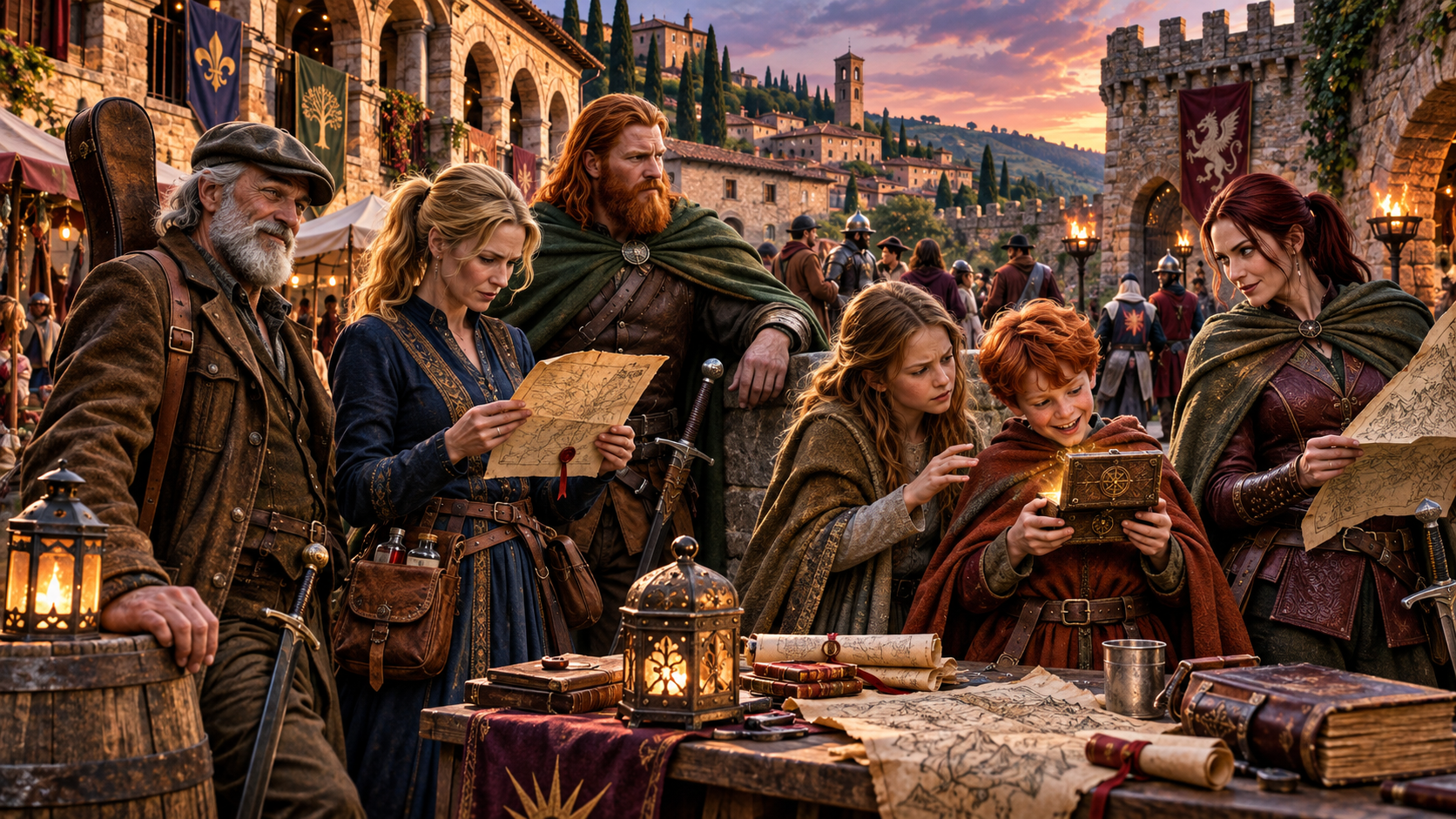
Mara studies the first pages of our research.
“Which group started it?”
Stacy considers the question.
“That depends on whether we mean the first group, the first documented event, or the first people who recognised what they were doing as LARP.”
Loki looks disappointed.
“Can’t we just pick the one with the biggest sword?”
“No,” says Kelvin.
Sean leans back.
“Welcome to history.”
Before the beginning: what counts as the first Italian LARP?
The historian Ivano Piva provides one of the most important starting points.
His master’s thesis, Live Action Role Play: Un trentennio di storia dimenticata, completed at Ca’ Foscari University of Venice in 2014, investigates the development of live action roleplaying through documentary research and interviews with early Italian organisers.
The title translates approximately as Thirty Years of Forgotten History.
It is an appropriate description.
Piva identifies evidence of active murder-party games predating 1987 and places the earliest documented Italian events explicitly identifiable as gioco di ruolo dal vivo, or GRV, around 1988.
Three early centres appear in his account:
Raanan Live, Gilda Anacronisti and Le Spire del Drago.
They did not all emerge through the same process.
One had a strong connection with medieval fencing and historical equipment. Another was influenced by British fantasy LARP. A third represented a developing Tuscan tradition.
This is the first important correction to any simplified history of Italian LARP.
There was no single British visitor who introduced the hobby to an otherwise empty country. Nor was there one Italian inventor whose discovery immediately created a national movement.
Instead, we find several experiments developing within a relatively short period.
We must also distinguish between founding an association and organising a recognisable LARP.
For example, Le Spire del Drago describes its origins as dating to 1986, with formal legal establishment in 1991. Piva, however, identifies 1988 as the date of the earliest demonstrably documented GRV events.
Those statements are not necessarily incompatible. A group can exist before organising its first recorded live game.
Other dates remain more troublesome.
Piva’s overview places Gilda Anacronisti in 1987–88. Yet Davide La Greca, one of its central figures, remembers discovering British LARP in London in 1989 and founding the Italian group after returning home.
A historian should not quietly erase such a contradiction.
The correct response is to identify it, explain its significance and continue searching for contemporary records.
It may be possible to reconstruct a sequence of precursor activities, informal organisation and later formal establishment. At present, the documents examined do not settle that question beyond doubt.
The uncertainty is itself part of the story.
Raanan Live: a fantasy world begins with a television programme
One of the most entertaining early accounts comes from Ulisse Provolo.
In his interview with Piva, Provolo recalls watching an episode of the American television series The Greatest American Hero. A scene involving apparent violence, people playing roles and the eventual discovery that events were not what they seemed caught his imagination.
He began considering how fantasy adventure might be performed rather than merely described.
This was not an inexperienced newcomer discovering roleplaying for the first time.
Provolo had already been involved in tabletop games and belonged to a Milanese association with a substantial membership. He also possessed experience and equipment connected with medieval fencing and historical recreation.
That combination was particularly useful.
Fantasy gaming provided characters, imagined worlds and dramatic conflicts. Historical fencing provided an understanding of physical action, costumes and weapons. The association offered people willing to experiment.
From those ingredients emerged the Raanan Live tradition.
Its name was connected with the Cavalieri di Raanan, Provolo’s medieval fencing group.
Piva’s interviews describe the practical problems these pioneers confronted. A tabletop rule might declare that a wizard throws a fireball. In a live game, somebody must decide what that means physically and safely.
How does magic work when players stand several metres apart?
How do participants recognise damage?
What counts as a wound?
How can a battle remain convincing without becoming dangerous?
These questions may sound familiar to anyone who has organised a modern LARP. In the late 1980s, however, the Italian pioneers could not simply download a standardised event handbook.
They had to invent procedures, test equipment and discover which assumptions survived contact with actual human beings.
Some solutions came from tabletop roleplaying. Others drew upon reenactment and medieval combat practices.
Provolo later became increasingly involved in historical fencing and reenactment. His recollections suggest a continuing exchange between fantasy LARP and historical martial culture rather than an exclusively one-way influence.
This is worth remembering whenever early Italian LARP is presented as little more than people pretending to fight with swords.
For the organisers, the challenge was not simply to reproduce imaginary combat.
It was to create a world in which people could act.
Kelvin regards that part of the historical record with professional interest.
“A good shield is useful. Knowing when not to swing it is rather more important.”
“Especially indoors,” Stacy adds.
Loki quietly returns a wooden sword to the table.
Nobody asks where he found it.
Gilda Anacronisti: the British connection reaches Rome
Another influential tradition developed around Davide La Greca and Piermaria Maraziti.
La Greca’s account begins in London.
Already experienced in tabletop roleplaying, he encountered the British Labyrinthe Club and participated in its form of live fantasy adventure.
The connection matters because Labyrinthe belonged to a recognisably game-oriented British tradition. Character classes, levels, combat rules and injury systems helped translate the structure of tabletop fantasy into physical play.
La Greca brought that experience and a copy of the British rules back to Italy.
Working with Maraziti and others, he helped establish Gilda Anacronisti and develop an Italian rules tradition.
The precise founding date remains uncertain, as discussed above. What is much clearer is the group’s influence during the early 1990s.
From 1992, Maraziti’s rules were published and circulated beyond the immediate association.
That distribution was important.
An isolated club can organise successful adventures without substantially changing the wider hobby. A rules system that travels allows other people to begin their own games.
Groups can adopt it, modify it, reject parts of it or build entirely different campaigns upon it.
The result is not simply more players.
It is the emergence of a broader creative community.
Maraziti’s interview with Piva also records experimentation beyond conventional fantasy adventures, including investigative games and photographic-killer formats.
In 1994, Gilda Anacronisti organised a fantasy battle involving two forces remembered as numbering roughly 80–100 people each.
The numbers come from a participant’s recollection rather than an independently audited attendance register. Nevertheless, they indicate the scale of ambition already present.
This was no longer a handful of friends experimenting in somebody’s garden.
Italian LARP was becoming capable of organising sizeable encounters with shared rules, equipment and expectations.
The Gilda also became visible at conventions, particularly Lucca Comics & Games.
Before websites, social media and searchable event calendars, a convention appearance could introduce hundreds of curious visitors to an activity they had never encountered.
An event did more than recruit players.
It demonstrated that this strange hobby existed.
By the middle of the decade, former participants were establishing independent groups. Some retained elements of the Gilda rules. Others modified or replaced them.
Maraziti recalls the original experience ending around 1998, with subsequent activities continuing through other organisations.
This is a familiar pattern in the history of creative communities.
A pioneering organisation eventually changes, divides or disappears.
Its methods and people continue elsewhere.
Tuscany, the Abruzzi and the danger of a history centred on one city
Italian LARP did not develop exclusively in Milan and Rome.
The Tuscan association Le Spire del Drago provides another early example. Its historical description claims origins in 1986 and legal establishment in 1991, with medieval-fantasy games forming a central part of its activities.
The organisation also promoted communal activities associated with medieval culture, including themed gatherings, tournaments and related events.
Its early chronology remains a subject for further archival work, but the broader significance is clear: the history of LARP in Italy cannot be reconstructed from one organisation’s genealogy alone.
Nor can it be limited to the country’s largest metropolitan centres.
In the Abruzzi, Chaos League traces its origins to 1992.
The organisation would eventually become internationally known for elaborate immersive productions, but its roots belong to the regional Italian scene of the early 1990s.
That geographical diversity matters.
Local culture shapes the practical possibilities of LARP.
A group near historical villages may approach locations differently from one based around a city convention. An association with experienced reenactors has different resources from a theatre collective. Access to countryside, old buildings, volunteers, costume makers and technical expertise influences what can be created.
Italy offers an unusually rich range of historical environments.
That does not mean Renaissance towns automatically produce excellent LARPs. Architecture alone cannot provide character motivation, meaningful decisions or an organisation capable of supporting participants.
Nevertheless, place can become more than scenery.
It can shape how a story feels and how people move through it.
Over the following decades, Italian organisers would increasingly explore that relationship.
1993: Lucca brings live roleplaying into public view
The official history of Lucca Games records an important moment in November 1993.
During the first edition of Lucca Games, a Vampire live game took place in the rooms of Villa Bottini.
The significance should not be exaggerated into the claim that this was Italy’s first LARP. Earlier fantasy and experimental activities already existed.
What the event demonstrates is something else: live action roleplaying had become visible within an important national gathering devoted to games and imaginative culture.
Lucca offered an unusual meeting point.
Tabletop roleplayers encountered costume makers. Miniature painters met game designers. Publishers, illustrators and clubs gathered in one place.
The borders between different creative hobbies were unusually porous.
In 1996, Gilda Anacronisti displayed Star Trek costumes at the convention. Later, Pathos would be presented there as another form of live roleplaying.
Events like these helped introduce LARP to people who might never have attended a dedicated fantasy gathering.
They also exposed the community to wider public scrutiny.
And that scrutiny was not always friendly.
The 1990s: when roleplaying became a public controversy
The development of Italian roleplaying during the 1990s was accompanied by public anxieties about the hobby.
Following the tragic death of a young man in Spinea in 1996, sections of the media and public commentary attempted to associate roleplaying with dangerous psychological or moral influences.
The accusations attracted considerable attention.
The tragedy itself deserves respectful treatment. It should not be reduced to a convenient anecdote in a history of gaming.
Nor should unsupported accusations about roleplaying be presented as established explanations for what happened.
What matters for our purposes is how the gaming community responded.
Researchers, enthusiasts and organisers sought to counter sensationalism with documentation, discussion and public engagement.
In March 1997, the GdR2 initiative began collecting and examining material concerning roleplaying and the surrounding controversy.
Lucca Comics & Games also provided a stage for a satirical response.
The festival’s official chronology records the Processo ai Giochi di Ruolo, a theatrical mock trial of roleplaying games, during its November 1996 edition.
Humour was being employed to challenge an argument.
The community was effectively placing the accusations themselves on trial.
There is a distinction here between mocking public prejudice and mocking genuine human suffering.
The former can be constructive. The latter would have been deeply inappropriate.
The episode also reminds us that organised LARP communities existed within a wider social environment. Their development depended not only on rules and events but on whether participants felt comfortable admitting what they enjoyed.
Italy’s changing relationship with roleplaying became part of the history of LARP itself.
Pathos, 1997: the game enters everyday life
A particularly unusual experiment emerged in 1997.
Its name was Pathos.
Most conventional fantasy LARPs had a clear beginning and ending. Participants entered a defined play area, became their characters and eventually returned to ordinary life.
Pathos challenged that structure.
It was designed as a pervasive game in which the fictional world could overlap with everyday surroundings.
A meeting in a café might become part of the story. A conversation during an ordinary afternoon could acquire a second meaning. Events in the real world might be interpreted through the game’s supernatural fiction.
The project distinguished different levels of reality, labelled R1 through R4.
At the centre of that model was the recognition that the actual world and the participant’s personal emotional life were not simply available for the game to consume.
The simulated reality had to be recognised as such.
A visible marker, described by Piva as a pin, indicated participation in the fictional layer.
That may appear a small practical detail.
It is actually rather revealing.
When a game is no longer confined to an obvious stage or field, participants need reliable ways to distinguish performance from ordinary interaction.
They must also remain capable of stepping away.
The game’s ambitions were unusual for the period. Rather than creating a fantasy location for a few hours, it explored how fictional events might accompany the rhythms of normal existence.
Piva connects Pathos with the wider response to negative public representations of roleplaying. It also became an important example in later Italian contributions to international LARP discussions.
Elshara considers the principle.
“A fictional secret becomes considerably more interesting when it follows you out of the castle.”
“Provided everyone knows when they are playing,” Stacy replies.
“Precisely. Mystery is attractive. Confusion about consent is not.”
That distinction remains relevant.
Modern LARP designers may speak about immersion, boundaries, calibration, emotional safety and bleed between player and character.
Pathos did not establish every later technique, and we should not pretend otherwise. But it belongs to the history of people asking how the relationship between fictional and ordinary experience could be deliberately designed.
Italy was participating in that conversation earlier than many simplified histories acknowledge.
Murder parties and the theatrical tradition
Not every Italian live roleplaying tradition descended from medieval-fantasy combat.
Interactive murder mysteries also formed an important part of the landscape.
A murder party gives participants fictional identities, information, relationships and a mystery to investigate. The experience may incorporate actors, prepared characters, clues and improvisational dialogue.
Depending on its design, it can overlap significantly with what is now recognised as chamber LARP.
Remo Chiosso became an important figure in Italian murder-party development during the 1990s.
From 1994, he wrote and directed interactive murder mysteries. In 1998, he was involved in establishing Murderparty.it with Antonello Lotronto.
His later book Murder Party: Crimini divertenti appeared in 2003.
These activities also extended into training and educational applications.
The historical importance lies in the coexistence of different approaches.
A fantasy event might require weapons, armour and rules for physical conflict. An investigative chamber game might need nothing more than carefully designed relationships, concealed information and an environment that encourages people to talk.
Both can create meaningful choices.
Neither is automatically a lesser form of LARP.
Loki raises a hand.
“So you can play without a sword?”
“Yes,” says Mara.
“And still win?”
“Sometimes nobody wins.”
He looks genuinely concerned.
“That sounds difficult.”
Sean smiles.
“Now you’re beginning to understand theatre.”
2001: Flying Circus and the artists of play
The theatrical and experimental tradition gained another important expression in Padua.
In 2001, during the convention Teatro della Mente, the informal movement Flying Circus emerged around figures including Teo Mora, Lorenzo Trenti and Marzia Possenti.
Its participants embraced ideas associated with freeform games, experimental roleplaying and murder parties.
Rather than building a traditional organisation around a single campaign, Flying Circus developed around a manifesto and shared creative principles.
Its language was deliberately distinctive.
Participants were not simply concerned with how to run an adventure. They were interested in what games could achieve as an expressive medium.
That did not mean tabletop roleplaying disappeared from their work.
Piva’s account makes clear that the movement had roots in the broader roleplaying community and sometimes produced tabletop material as well.
But Flying Circus sought to distinguish its approach from the more physically oriented traditions commonly associated with the Italian term GRV.
This was more than an argument about labels.
Words reveal what communities believe they are creating.
Gioco di ruolo dal vivo could describe an activity recognisable as fantasy roleplaying performed physically.
Freeform and LARP could offer a broader vocabulary for theatrical experimentation, character relationships and unconventional structures.
The boundaries were never perfectly rigid.
People travelled between communities, and ideas moved with them.
Flying Circus also helped strengthen connections with international discussions, especially those emerging from northern Europe.
The movement’s history was not free from internal disagreement. Andrea Castellani, interviewed by Piva, described the eventual decline of its original informal structure and the movement of participants into other creative activities.
Yet a movement need not survive unchanged to influence the future.
Its members, publications and experiments can continue shaping games long after the original organisation has disappeared.
GRVItalia: the dream of a national fantasy world
While experimental designers explored the possibilities of shorter and more theatrical formats, other Italian organisers pursued a different ambition.
They wanted a world large enough to bring together participants from across the country.
The British Gathering provided an important example.
Italian players had travelled to Britain and experienced large events built around shared settings, factions, societies and collective action.
Could something similar be created in Italy?
That question helped give rise to GRVItalia.
The association’s own history dates its founding to 1998, although some archival listings place formal establishment in 1999. The difference deserves further clarification rather than an invented certainty.
GRVItalia identifies five founders: Davide La Greca, Francesca Viganò, Riccardo Zerbo, Lorenzo Folco Costa and Stefania Tallone.
The initial project was multi-associative.
Organisers from different communities wanted to create a national campaign that could connect Italian participants to the larger experience associated with Britain’s Gathering.
The campaign became Adunanza.
What began with an international inspiration gradually developed a distinct identity.
Its fictional world, Elavia, expanded through collective writing and long-term participation.
GRVItalia reports that Adunanza eventually involved more than 6,000 players across its history and over 500 days of play.
Those are cumulative organisational figures, not the attendance at a single event.
Their significance is nevertheless substantial.
A campaign that runs for many years must manage a remarkable amount of continuity.
Characters enter and leave the world. Alliances form and collapse. Organisations change leadership. Participants create histories that may remain relevant long after the original decision-makers have departed.
Newcomers arrive in a setting that already possesses a past.
That is a very different challenge from writing an individual weekend adventure.
Elavia and the architecture of a living campaign
The appeal of a long-running campaign is not simply that it lasts.
A fictional world can continue for years while changing very little.
The deeper possibility emerges when participants develop a sense of shared history.
An alliance negotiated at one event may affect decisions at the next. A conflict between factions can become a continuing political struggle. A character remembered by one generation may become an almost legendary figure to another.
It is difficult to establish the precise degree of player influence in any individual campaign without consulting event records and participants.
But GRVItalia’s organisational model demonstrates the scale of the problem.
Events took place across different Italian regions. A common setting had to remain coherent while many people contributed to it.
That required writing, preparation, communication, adjudication and practical organisation.
It also required volunteers.
GRVItalia explicitly describes association work as a means of learning shared responsibility. Participants can help organise events and eventually become part of the staff responsible for their creation.
This element deserves more historical attention than it usually receives.
The people who build sets, arrange facilities, prepare costumes, organise food, handle registrations and make sure an event can safely continue are not merely supporting somebody else’s art.
They are helping make the art possible.
Kelvin looks at the scale of the undertaking.
“Six thousand participants over the life of a campaign. Five hundred days of play.”
“And a great deal of work nobody sees,” Stacy observes.
“Precisely.”
Sean gestures towards the imagined battlefield.
“Someone writes the war. Someone else makes certain the toilets work.”
Neither contribution is optional.
Long-running LARP communities are social institutions as well as fictional worlds.
They can outlive individual characters, campaigns and even their original organisers.
The difficulty of bringing everyone together
The attempt to create a shared national LARP environment was ambitious.
It was also complicated.
Piva’s research describes tensions among early Italian organisations, including disagreements over rules, leadership, style and the idea of a single national campaign.
His thesis uses the expression guerre associative — association wars — to describe periods of intense rivalry.
That language should be handled carefully.
It does not mean that every Italian LARP organisation was permanently hostile to every other group.
It reflects conflicts documented or remembered by particular participants.
Some organisers wanted large, structured fantasy campaigns. Others preferred independent worlds or experimental approaches. Different people held different ideas about what good LARP should be.
Those disagreements were not unique to Italy.
Similar tensions appeared in other national scenes as organisers debated scale, rules, combat, storytelling and the relationship between central control and player freedom.
Nevertheless, Italy’s developing national ambitions made these questions especially important.
Who decides how the shared world works?
Can different regional traditions coexist inside one campaign?
What happens when organisers disagree about the kind of experience they want to offer?
And is unity always desirable?
The last question is perhaps the most interesting.
A single national organisation may simplify communication and resources.
But independent communities can develop different forms of creativity.
Variety is not necessarily a failure of cooperation.
Sometimes it is evidence of a healthy artistic medium.
The original Adunanza campaign concluded in 2016.
GRVItalia subsequently developed Vaniria, a new fantasy world with different regions, conflicts and creative possibilities.
The organisation remains active in 2026, with events continuing to develop that setting.
The story therefore did not end when Adunanza did.
One fictional history closed.
Another began.
Connections with northern Europe: influence without surrendering identity
The development of Italian LARP was never entirely isolated.
British fantasy events provided important early models. Later, exchange with northern European communities introduced additional ideas about design, participation and artistic practice.
Piva describes Italian participation in events such as Dragonbane in 2006 and the growing significance of the international Knutepunkt network.
These exchanges involved relatively small groups of people at first.
That limitation matters.
An international conference may influence designers and organisers without immediately changing the experiences of thousands of ordinary participants.
Ideas spread unevenly.
Some are adopted enthusiastically. Others are modified or resisted. Certain techniques remain confined to small communities for years.
Italy’s relationship with Nordic LARP should therefore not be presented as a simple process in which foreign designers arrived with the correct answers.
Italian experimental traditions already existed.
Pathos and Flying Circus had developed distinctive approaches to identity, performance and the boundaries of play.
International exchange offered additional concepts, language, practical techniques and opportunities for collaboration.
The result was a conversation.
And conversations between different traditions are often more productive than attempts to replace one with another.
The Larp Symposium: when Italian organisers began writing down their ideas
A major development came with the Italian Larp Symposium movement around 2010–2011.
The gatherings offered opportunities for organisers, players and designers to meet, compare experiences and discuss their craft.
The accompanying publications became especially important.
Across the period from 2010 to 2015, volumes such as Larp Graffiti, Larp Frescos, Ragionando di Larp, Ruoli Vivi and Il Larp in Realtà collected Italian contributions alongside ideas from other traditions.
Why does this matter?
Because LARP possesses an unusual historical weakness.
A novel remains available after its author finishes writing. A film can be watched again. A published tabletop roleplaying game preserves at least its rules and setting.
A LARP event often disappears almost completely when the participants go home.
A few photographs remain. Someone may preserve a character sheet. An organiser might retain a document describing the scenario.
But the actual experience existed in the interaction between people.
If nobody writes about it, future historians may struggle to establish what happened, let alone what it meant.
The Symposium publications attempted to preserve more than dates and event titles.
They recorded ways of thinking.
They allowed organisers to explain why certain techniques were used, how participants responded and what might be improved.
They also helped establish a shared vocabulary.
This is an important step in the development of any creative field.
A community begins not merely to produce work, but to discuss and examine its own methods.
Terre Spezzate: seven years in one fantasy world
Another major Italian tradition developed through Terre Spezzate.
Established in 2006, the group initially concentrated on a continuing fantasy campaign.
According to its own historical account, from 2006 to 2013 it organised approximately one LARP each month.
The events took participants through parks, castles, medieval villages, forests and other atmospheric locations.
Over seven years, a regular campaign can become a substantial part of a community’s life.
Participants become familiar with recurring characters and organisations. Friendships develop outside the game. New organisers emerge from among the players.
But successful traditions can also become restrictive.
When an organisation has invested years in one approach, changing direction is difficult.
Terre Spezzate describes 2013 as a deliberate turning point.
After the success of La Fortezza dei Vinti, the group began developing standalone productions across different genres.
Fantasy remained possible, but it was no longer the only framework.
Historical drama, contemporary thrillers, science fiction and other forms of immersive storytelling became increasingly important.
This was not simply diversification for its own sake.
Different subjects demand different methods.
A fantasy campaign may benefit from progression, factions and recurring battles.
A historical drama may require extensive research, carefully constructed social relationships and a very different understanding of player success.
A psychological thriller can place information, uncertainty and moral pressure at its centre.
The transition illustrates how experienced organisers can reconsider assumptions that once appeared inseparable from LARP.
Black Friday, 2014: a collaboration across Italian traditions
One of the most significant examples of Italian LARP collaboration emerged from discussions at the 2013 Larp Symposium.
Organisers associated with Chaos League, Cronosfera, Terre Spezzate and other creative circles began considering a joint production.
The result was Black Friday.
Performed in two runs in November 2014, the event brought together approximately 140 participants across both runs.
Its setting was a fictional contemporary American mining town.
The location was Italian, but the story was designed around a tightly controlled atmosphere of modern crisis.
The organisers combined different kinds of gameplay.
Miners, scientists and law-enforcement characters experienced distinct pressures, possessed different information and confronted different moral choices.
Technology formed part of the fictional environment, including video recording and specially designed software.
The game addressed questions about civil liberties, political authority, fear, security and individual responsibility.
Its historical importance extends beyond its production values.
The organising team brought together people from different Italian LARP traditions.
That collaboration was not inevitable.
For years, sections of the scene had experienced organisational rivalries and competing ideas about design.
Black Friday demonstrated that organisers with different methods could create a single experience without simply erasing those differences.
The most valuable evidence comes from the participants themselves.
In a 2016 retrospective published by Nordic Larp, Lorenzo Trenti assembled the recollections of members of the organising team, including Francesco Pregliasco, Alessandro Giovannucci and other contributors.
Their accounts show that collaboration required negotiation, practical compromise and shared artistic ambition.
It was not always effortless.
But the result demonstrated the creative possibilities of working across organisational boundaries.
Sean looks over the production notes.
“A town full of secrets, surveillance equipment, authority figures and people who don’t trust one another.”
“Sounds exhausting,” says Loki.
“It probably was.”
“Did they have to build the whole town?”
“Not quite,” Stacy explains. “But a great deal had to work together.”
Elshara smiles.
“The most difficult illusion is rarely the scenery. It is persuading everyone that the world continues beyond their own story.”
I Ribelli della Montagna: when Italian history becomes lived drama
In 2015, Terre Spezzate produced I Ribelli della Montagna: L’ultima notte di Montelupo.
It deserves particular attention.
The game was inspired by the Italian Resistance during the Second World War and by the terrible events around Monte Sole in 1944.
The fictional village of Montelupo provided the setting for a story about civilians, partisans and forces associated with Nazi-Fascist occupation.
This was not an attempt to reproduce one historical event with documentary precision.
The organisers created a fictional situation rooted in historical research.
That distinction was essential.
Their aim was to allow participants to confront difficult human decisions without claiming that the game could reproduce the lived experience of actual victims.
The production involved support from historical and commemorative organisations.
It was organised under the aegis of ANPI, the National Association of Italian Partisans. ISTORETO, the Piedmontese Institute for the History of the Resistance and Contemporary Society, assisted with historical photographic research.
The organisers also described the importance of connecting the game with living historical memory.
After one of the original runs, Maria Airaudo, who had served as a partisan dispatch rider, met participants and spoke about her wartime experience.
That encounter is especially meaningful.
A participant may spend several days playing somebody confronted by violence, fear and impossible choices.
But the historical experience of a person who actually lived through that period remains something different.
The presence of a real witness makes the distinction unavoidable.
History is not merely a collection of dramatic possibilities.
It concerns people whose lives were shaped by real actions and consequences.
The ethical difficulty of historical LARP
Historical roleplaying can offer powerful opportunities for reflection.
It can also produce serious ethical problems.
What happens when participants portray perpetrators of political violence?
How should organisers approach situations inspired by documented atrocities?
Can emotional intensity encourage historical understanding, or does it risk producing an illusion of knowledge that participants have not earned?
There are no easy answers.
The organisers of I Ribelli della Montagna acknowledged concerns among potential participants about the appropriateness of representing such events.
Their published account describes the effort to create a historically grounded atmosphere while allowing fictional characters to make consequential choices.
Players were not simply told how the story had to end.
Their decisions shaped the outcome within the constructed scenario.
This is where historical LARP differs fundamentally from a straightforward commemorative reenactment.
The aim is not necessarily to reproduce a predetermined sequence.
It is to investigate human relationships and choices within an environment informed by history.
Yet the freedom of the player does not remove the responsibility of the organiser.
Research, context, consent, emotional support and respect for historical suffering become central design concerns.
Stacy closes the historical account.
“This is the point where we should stop asking whether the costumes looked convincing.”
Kelvin nods.
“The question is whether people understood the responsibility.”
“And whether they understood the difference between experiencing a fictional situation and understanding the real past,” Elshara adds.
Mara remains quiet for a moment.
“Did the people who were really there get to tell their stories?”
“Yes,” Stacy says. “At least one of them did.”
That may be the most important detail in the entire production.
I Ribelli della Montagna was later revived in 2024, demonstrating the continued interest in revisiting historically informed LARP through a contemporary perspective.
Italy’s past becomes part of its creative language
The relationship between Italian history and LARP continued to develop.
The country’s cultural heritage offers enormous possibilities.
Ancient ruins, medieval towns, Renaissance architecture, religious traditions, regional folklore, music and modern political history can all provide material for immersive storytelling.
But the best historical productions do not rely upon attractive locations alone.
They ask what those places mean.
One example is Eryados’ Puccini: Tramontate, stelle!, staged in Pescaglia in March 2024 as part of activities associated with the centenary of Giacomo Puccini’s death.
The production brought the characters and imagination of Puccini’s operas into a fictional experience connected with the composer’s family landscape.
Its premise was fantastical rather than a literal reconstruction of his biography.
That is part of its interest.
Italian musical heritage became the foundation for an interactive story in which participants could engage with familiar artistic material from a different perspective.
Instead of merely watching an opera, participants entered a world shaped by operatic characters and dramatic conventions.
The project was also supported by local institutions and cultural partners.
This represents another direction for Italian LARP: connecting interactive fiction with the interpretation and promotion of cultural heritage.
Tarantolate, 2026: folklore, faith and the language of the body
An especially revealing contemporary example is Eryados’ Tarantolate – Il morso della terra.
Its 2026 programme places the story in rural Salento in 1959.
The setting draws upon the historical phenomenon of tarantism and the research associated with the anthropologist Ernesto De Martino.
Tarantism involved complex relationships among ritual, music, dancing, distress, social expectations and interpretations of illness or possession.
De Martino’s investigations, including the work later published as La terra del rimorso, examined those practices within their wider cultural context.
The LARP uses that historical setting to explore a fictional rural community.
The participants’ relationships involve families, local expectations, religion, secrecy, suffering and the encounter between traditional explanations and outside investigation.
Music and ritual are not merely decorative features.
They belong to the structure of the imagined social world.
This is particularly interesting from a historical and religious-studies perspective.
A community’s practices are not adequately understood by asking whether its members possessed a scientifically correct explanation of what they experienced.
Belief, bodily expression, collective ritual and social relationships can all play important roles in shaping human responses to suffering.
A historically informed LARP can investigate those relationships.
But it must resist the temptation to reduce complex traditions to exotic spectacle.
The organisers’ published material explicitly emphasises respect for local culture, historical context and the emotional safety of participants.
The programme was scheduled for September 2026.
It would be irresponsible to claim conclusions about participants’ experiences without independent evidence or first-hand testimony.
Nevertheless, the design materials demonstrate how far the ambitions of Italian historical and cultural LARP have developed.
The country that once experimented with translating fantasy combat into live performance now also produces games concerned with anthropology, collective memory and the interpretation of social experience.
Eryados and the growing professional field
Eryados traces its activity to 2010.
Its creative background brings together LARP organisers, artists, designers, theatrical practitioners and people working in audiovisual production.
Its portfolio includes fantasy and supernatural experiences such as Arcaniversitas, Magicampus, Stranger Town and Projekt K.L.A.R.A., alongside educational and culturally oriented projects.
This range demonstrates how Italian LARP can operate across different formats.
A large fantasy production and a carefully designed educational scenario may share principles of character, participation and consequence.
But their purposes are not identical.
Entertainment does not become inferior because it exists primarily to entertain.
An educational event is not automatically successful because its organisers describe it as educational.
The value of a format depends upon what it sets out to accomplish and whether its design supports that purpose.
Professionalisation also creates new pressures.
A volunteer association can sometimes tolerate improvisation and last-minute solutions because participants collectively accept those limitations.
A commercially organised experience carries different expectations.
Players may pay substantial fees for accommodation, catering, location access and production.
They reasonably expect clarity, organisation, safety and a coherent experience.
The organisers must balance artistic ambition against budgets, staffing, venue requirements and the practical needs of participants.
These are not unromantic distractions from storytelling.
They are part of what makes the storytelling possible.
Chaos League: from the Abruzzi to international immersive worlds
Chaos League provides another example of the long development of Italian LARP.
The organisation identifies its origins in 1992 and has since developed an international portfolio of immersive experiences.
Among its best-known projects are productions drawing upon Lovecraftian cosmic horror.
Miskatonic University places participants within an imagined academic institution where knowledge, ambition, relationships and supernatural danger interact.
Sahara Expedition relocates the fictional experience to the actual Sahara Desert.
Set in 1934 and inspired by Lovecraftian themes, it follows an expedition seeking the legendary city of Zerzura.
The distinction between a tabletop adventure and this kind of production is substantial.
A tabletop group can imagine desert heat, exhaustion and distance.
In a location-based LARP, the environment itself becomes part of the participant’s physical experience.
The landscape changes how people move, communicate and perceive the fictional situation.
That does not automatically make the resulting story more meaningful.
A beautiful location can still contain an empty narrative.
But the possibilities are different.
The setting becomes an active design resource rather than a painted background.
Chaos League has also developed international productions, including versions of Miskatonic University in North America.
This demonstrates a further stage in the Italian scene’s evolution.
Ideas that once arrived in Italy through foreign rulebooks and international events now travel outward through Italian productions.
The movement of influence has become reciprocal.
Battle for Vilegis: the large-scale fantasy tradition survives
The growth of professional and experimental LARP has not displaced traditional large-scale fantasy.
Battle for Vilegis remains an important example.
The organisers describe a continuing medieval-fantasy setting built around factions, political relationships, exploration, rituals and warfare.
Their published information refers to events involving up to 1,400 players.
This is a figure supplied by the organisers, not an independently verified national participation statistic.
The distinction matters, but the scale remains remarkable.
A gathering of that size requires a great deal of coordination.
Participants do not all engage in the same activity.
Some may seek military conflict. Others become involved in diplomacy, religious ceremonies, trading, exploration or the internal politics of their factions.
The result is a temporary society.
Its inhabitants share a fictional location and history, but their immediate goals differ.
A participant might spend an afternoon preparing for a battle while another is attempting to prevent that battle through negotiation.
Both contribute to the world.
The existence of large fantasy events in 2026 also helps correct another simplistic narrative.
Italian LARP has not progressed from crude fantasy combat into enlightened theatrical experiences, leaving its earlier forms behind.
Different approaches continue to coexist.
An enormous battle event, a chamber drama, an educational workshop and an immersive historical production can all offer distinct forms of meaningful participation.
The development of the medium lies partly in that plurality.
Larp Italia, 2018: cooperation without one shared campaign
The need for communication across different Italian communities eventually produced another important initiative.
In July 2018, Larp Italia emerged as an informal coordination network.
Its purpose differed from the original national fantasy-campaign ambitions associated with GRVItalia.
Rather than bringing all participants into a common fictional world, Larp Italia sought to connect the people and organisations already creating their own experiences.
The International Larp Database identifies Alessandro Giovannucci, Francesco Pregliasco and Laura Dolla among its coordinators.
The initiative offered a shared space for discussion, mutual support, exchanging methods and developing cooperation.
According to its historical entry, more than 60 organisations joined during the first year.
The organisation’s own 2024 information referred to a network of more than 70 participating groups.
Those figures concern participating organisations, not the total number of Italian LARP players.
The underlying idea was nevertheless important.
A national community does not require one central campaign.
It can be built through communication among independent traditions.
Different organisations may retain their own styles while exchanging practical knowledge about event design, accessibility, participant safety, logistics and recruitment.
The Larp Italia coordination structure is documented as active from 2018 to 2024.
Its precise organisational legacy and any continuing successor relationships require further confirmation.
We have invited former coordinators to contribute to our historical research precisely because their first-hand perspective may clarify what happened.
LarpIT and the importance of meeting one another
The LarpIT gatherings of 2022, 2023 and 2024 continued the broader effort to create spaces for discussion.
These meetings offered opportunities to compare practices, establish relationships and discuss questions that extend beyond any single event.
That activity is especially valuable in a geographically and creatively diverse country.
A fantasy organiser from central Italy may have little direct experience with educational LARP in another region.
A producer accustomed to elaborate locations may discover useful methods from a small chamber-LARP designer.
Volunteers working within established associations can learn from independent authors.
The reverse is equally true.
Small experimental productions have much to learn from people who regularly organise hundreds of participants.
One of the most important lessons in the history of LARP is that technical knowledge is not confined to organisations with the largest budgets.
Sometimes a simple exercise in character relationships can solve a problem that expensive scenery cannot.
The Italian scene’s increasingly visible discussion culture creates the conditions for those ideas to circulate.
Larpbook: a community begins preserving its own memory
Another essential project is the Annuario del Larp Italiano, commonly known as Larpbook.
The yearbook began documenting Italian LARP events from the mid-2010s.
Its publications combine descriptions, photographs and practical information about productions.
The material is useful to players and organisers, but its historical importance is greater.
It creates records.
A photograph may preserve a costume or a particular location. An event description can explain the setting and artistic intention. Dates, organisational names and participant numbers help future researchers identify what occurred.
Without such records, even substantial events can become difficult to reconstruct after a few years.
The project has also explicitly sought material from the earlier history of Italian LARP.
Old photographs, programmes, forgotten digital files and personal collections are all potential sources.
That effort reveals something uncomfortable.
Much of the pioneering period survives in private hands.
A historical document can exist for decades in a drawer without anybody recognising its value.
A rulebook may be preserved by one former organiser. A photograph may survive on an obsolete hard drive. An event programme might be the only remaining evidence of a campaign.
Historical research depends upon finding those fragments before they disappear.
The Covid-19 period also appears in the Larpbook material, including attempts to continue participation through online live action games.
These experiences demonstrate how communities adapted when physical gathering became difficult.
They also raise questions about what makes an activity LARP when traditional locations and bodily interaction are transformed by digital communication.
The historical record will need to account for those experiments too.
The International Larp Database: preserving a disappearing art
In September 2024, Umberto Francia published a reflection on the state of Italian LARP documentation.
His central concern was the fragility of a medium whose experiences frequently vanish when an event ends.
A film can be preserved. A book can be stored. A game may retain its published rules.
But what remains of a LARP when the people have gone home?
The participants remember different things.
Organisers preserve selected documents.
Photographs show only fragments.
The actual event cannot simply be replayed.
Francia argued for the importance of recording not only what happened but the discussions, methods and ideas behind Italian productions.
The International Larp Database is part of that response.
The project received funding from Italy’s Ministry of Culture in 2023 and was developed through cooperation involving Progetto Goldstein, Federludo, Eryados and La Città Ideale.
Its ambition is to collect information about past and present LARPs, their organisations, designers, events and related documentation.
The value of such a database extends beyond administrative convenience.
It makes research possible.
Future historians can compare dates, trace organisational connections and identify people whose work would otherwise be forgotten.
They can also discover where the record remains incomplete.
Elshara considers the problem.
“A performance leaves an impression. An archive leaves evidence.”
“Not always enough evidence,” Stacy replies.
“No. But without it, memory becomes increasingly dependent upon whoever tells the best story.”
Sean looks at the collection of old event programmes.
“Which is a dangerous state of affairs when half the people involved are storytellers.”
He has a point.
2025–2026: LARP reaches the university
Another milestone arrived in December 2025.
The Scuola IMT Alti Studi Lucca hosted the first Italian Larp Forum conference.
According to the institution, the programme involved approximately 40 speakers, 30 presentations, round tables and poster sessions.
The participants included researchers, educators, organisers and professionals exploring LARP’s applications across different fields.
The discussions addressed topics such as education, social awareness, simulation and artistic practice.
This does not mean universities had previously ignored LARP entirely.
Piva’s thesis, the earlier academic publications of Luca Giuliano and other scholarly work demonstrate that Italian researchers had already been studying the subject.
What changed was the institutional visibility of the conversation.
An event devoted specifically to LARP as a field of research and practice provided an opportunity to connect academic investigation with the expertise of organisers and participants.
The second Larp Forum is scheduled for 11–13 December 2026.
At the time of this article, that event lies in the future.
Its published programme includes discussions of artistic expression, transformative learning, participant agency, safety, bleed and debriefing.
These subjects reflect questions increasingly important to contemporary LARP design.
They also reveal the medium’s growing range.
LARP can support entertainment, historical interpretation and education.
Research may investigate whether particular designs help participants understand complex situations or develop useful skills.
Such claims require proper evaluation.
An immersive experience is not automatically educational merely because it produces strong emotions.
Nor does emotional intensity prove psychological benefit.
Careful research needs to distinguish between what organisers intend, what participants report and what independent studies can demonstrate.
That is precisely why cooperation between universities and experienced practitioners matters.
What makes the Italian tradition distinctive?
By 2026, the Italian LARP landscape contains several different traditions.
There are long-running fantasy campaigns sustained by associations and volunteers.
Large events create temporary societies through politics, ritual, commerce and conflict.
Experimental designers develop chamber games, freeform experiences and narrative structures in which physical combat may be absent.
Professional studios create immersive productions using elaborate locations, technical resources and international casts.
Historical and cultural LARPs investigate subjects drawn from Italian society, music, anthropology and collective memory.
Educational projects explore practical applications beyond recreation.
These traditions overlap, but they are not identical.
It would be misleading to describe them all as part of a straightforward progression towards one superior form of LARP.
The history is richer than that.
Several creative approaches emerged independently. Others developed through direct contact with foreign scenes. Some organisations adapted methods from theatre and historical recreation.
Connections with Britain helped establish early fantasy conventions and large-event ambitions.
Exchanges with Nordic communities expanded the conversation about narrative design and the purpose of live roleplaying.
Italy’s own artistic and historical traditions offered different creative materials.
The resulting diversity is perhaps the most important characteristic of the national scene.
Its strength does not lie in producing one universally accepted style.
It lies in the number of different answers Italian creators have offered to the question of what LARP can be.
The people who built the worlds
Large festivals and prestigious productions receive attention because they are visible.
They leave photographs, promotional material and impressive figures.
But an international history of LARP cannot be written exclusively through the largest events.
It must also recognise the people whose work made those events possible.
The early organisers who developed rules before the internet made sharing easy.
The costume makers who gave imaginary worlds physical form.
The volunteers who prepared locations and helped newcomers feel welcome.
The writers who designed characters and conflicts.
The players who brought those characters to life.
The researchers who preserved documents.
The people who kept small local groups alive when they lacked the money or resources to attempt anything larger.
Women and other contributors whose work may not be fully reflected in surviving records deserve particular attention.
The founding members of GRVItalia already demonstrate that the history was never simply the work of a succession of prominent male organisers.
Figures such as Francesca Viganò, Stefania Tallone, Marzia Possenti, Laura Dolla and many others belong to the documented development of Italian LARP.
Yet their experiences, responsibilities and contributions require fuller investigation rather than assumptions based on titles alone.
The same applies to less visible regional groups.
A historical narrative can easily reproduce the biases of its surviving sources.
If the largest organisations preserved the most documents, they will naturally occupy more space in the resulting history.
That does not prove that smaller groups were unimportant.
It proves that evidence is unevenly distributed.
Our responsibility is to make those limitations visible.
The questions that remain unanswered
A responsible history must sometimes end with questions rather than conclusions.
Several are particularly important for the Italian record.
Exactly when did the earliest Gilda Anacronisti events occur, and how should we reconcile the different dates preserved in Piva’s research?
What documentary evidence survives from the earliest activities of Le Spire del Drago?
How extensively did independent regional communities communicate before national conventions became major meeting places?
What happened to early groups whose documents were never published?
How did the practical responsibilities of organisers, volunteers and players change as events became larger?
What was the full relationship between the original GRVItalia project, its associated communities and the organisations that subsequently developed independently?
How did Larp Italia’s coordination structure change after 2024?
And which people involved in these developments have never been asked to tell their stories?
We have invited Ivano Piva and representatives of GRVItalia and Larp Italia to contribute interviews or written observations to our continuing research.
No replies are represented in this article as completed interviews.
Their potential contributions may help clarify disputed dates, locate forgotten sources and identify additional witnesses.
Historical research should remain open to correction.
An article that changes in response to better evidence is not weaker for doing so.
It is doing its job.
2026: not one Italian LARP scene, but many communities
The contemporary scene is diverse enough that national statistics alone would tell us relatively little.
Even if we could produce a reliable total number of participants, what would that figure describe?
People who attend one major annual festival?
Members of established associations?
Participants in educational projects?
Professional productions?
Occasional chamber-game players?
The answer depends upon how the population is defined.
Current figures from individual organisers therefore cannot be added together to produce a trustworthy national participation total.
A better picture comes from the range of experiences available.
In 2026, Battle for Vilegis continues its large fantasy-event tradition.
GRVItalia develops its Vaniria campaign.
Chaos League produces immersive international experiences and has announced its Italian Larp Festival for December.
Eryados explores theatrical, historical and educational formats.
Independent organisations and smaller communities continue developing their own work.
Larpbook and the International Larp Database preserve the record.
The Larp Forum brings research, professional practice and artistic discussion into closer contact.
This is not a complete census of Italian LARP.
It is a collection of examples illustrating how varied the field has become.
The distinction is important.
The future of Italian LARP will not be determined solely by the largest companies or most visible festivals.
It will also depend upon whether local communities remain able to experiment, welcome newcomers, preserve their identities and share what they learn.
A history worth remembering
A few decades ago, a small group of Italian enthusiasts began asking what would happen if the imaginary adventures they enjoyed could be played physically.
They borrowed ideas.
They invented rules.
They travelled abroad, discovered unfamiliar approaches and returned with new possibilities.
Some founded associations.
Others experimented with theatre, murder mysteries and games that entered everyday life.
Entire fantasy worlds developed through years of shared participation.
Organisers disagreed, divided and sometimes learned to collaborate again.
Italian history itself became material for difficult and ambitious immersive experiences.
The scene grew large enough to support professional productions, international events, dedicated archives and academic conferences.
Yet the most important element remained remarkably consistent.
People entered an imaginary situation together and changed what happened through their choices.
The settings became more elaborate.
The production methods changed.
The vocabulary expanded.
But the creative act at the centre survived.
Mara looks at an old photograph from an early game.
“Do we know who everybody is?”
“Not yet,” Stacy answers.
“Will we find out?”
“We can try.”
Loki studies the photograph too.
“What happens if nobody remembers them?”
Sean does not answer immediately.
Across the table, Kelvin carefully places the photograph beside the surviving programmes and notes.
Elshara watches him.
“That,” she says, “is why we keep the records.”
Outside, another generation is already preparing its costumes, building its scenery and creating stories that do not yet exist.
Somewhere in Italy, somebody is about to enter a fictional world for the first time.
They may become a warrior, a diplomat, a scholar, a frightened villager or a person whose choices will alter the lives of others.
The event will eventually end.
The costumes will be packed away.
The location will return to ordinary life.
But something may remain.
A friendship.
A decision.
A memory.
Perhaps even the beginning of a new tradition.
The history of Italian LARP is not the story of one invention spreading across a country.
It is the history of many communities learning, in different ways, how to bring imaginary worlds to life.
And discovering that those worlds can acquire histories of their own.
Historical sources and further reading
Our research draws on academic work, organisers’ historical accounts, primary interviews, event records, and publications documenting Italian LARP. Organisational statistics and dates are attributed to their sources where appropriate.
Early history and primary testimonies
- Ivano Piva — Live Action Role Play: Un trentennio di storia dimenticata (Ca’ Foscari University, 2014)
- Le Spire del Drago — Historical Association Profile
- Lucca Comics & Games — Official History of Lucca Games
- GRVItalia — Association History and Founders
Italian design, collaboration and historical LARP
- Lorenzo Trenti — The Whole Is Greater than the Sum of Its Parts: Voices from Black Friday (Nordic Larp, 2016)
- Aladino Amantini and Matteo Miceli — Rebels on the Mountain: The Last Night of Montelupo (Nordic Larp, 2016)
- Terre Spezzate — History and Organisation
- Chaos League — Official Website and Project Portfolio
- Eryados — About the Studio
- Eryados — Puccini: Tramontate, stelle!
- Eryados — Tarantolate: Il morso della terra
Networks, archives and contemporary research
- Larp Italia — International Larp Database Historical Entry
- Larpbook — Annuario del Larp Italiano
- Umberto Francia — La tradizione larp italiana: Documentazione, letteratura e discorso (2024)
- International Larp Database
- Scuola IMT Alti Studi Lucca — Larp Forum 2025
- Larp Forum 2026
- Battle for Vilegis — Official Event History
Continue your journey with Mythveil Chronicles
This article is part of One Hobby, Many Beginnings, our international historical exploration of live action roleplaying, its creators, communities, organisations and traditions.
Our aim is not to crown one country as the inventor of modern LARP, nor to identify a single correct way of playing.
We want to understand how people in different places developed imaginative communities of their own, how ideas crossed borders and how those experiences became part of a shared creative history.
Continue with The History of LARP in the UK — From Treasure Trap to Worlds of Thousands and The History of LARP in Ireland — From Convention Rooms to Living Worlds.
At Mythveil Chronicles, our work in historical research, narrative design and living-world roleplaying follows the same principle: stories matter most when people are allowed to change them.
Read. Play. Watch. Support. Or Collaborate.
Read Mythveil Chronicles · Play with Mythveil · Watch Mythveil · Support our work · Collaborate with Mythveil
Worlds That Remember. Stories That Matter.
Discover your next adventure in the Mythveil Weekly Schedule.