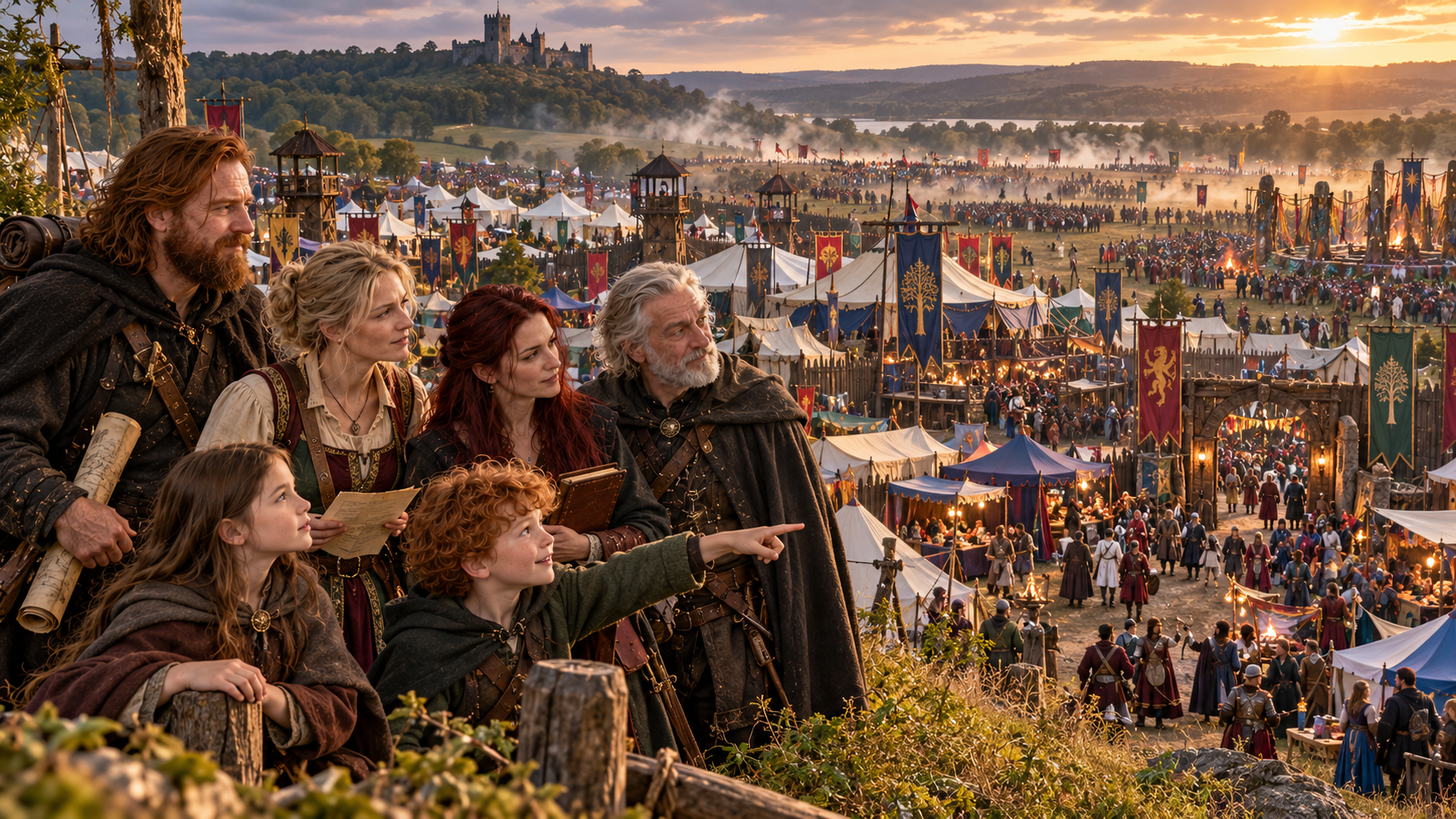
How British live action roleplaying grew from adventures in a Cheshire castle into vast fantasy festivals, living societies, and internationally recognised worlds.
One Hobby, Many Beginnings — A History of Live Action Roleplaying
Looking for a world that remembers your choices? Explore the current campaigns and weekly schedule at Mythveil Chronicles.
Imagine standing at the edge of a vast field somewhere in England.
Beyond the entrance, canvas tents stretch into the distance. Banners rise above the encampments. Armoured warriors move between wooden structures while merchants prepare their stalls, priests gather their followers, and political representatives argue over decisions that may affect thousands of people.
Somewhere beyond the camp, an army is preparing for battle.
Inside a large tent, a far less spectacular confrontation is taking place.
Two diplomats are negotiating an agreement neither side fully intends to honour.
A messenger arrives with information that changes everything.
The war may already have begun.
This is not the filming of a fantasy television series. There is no audience watching a predetermined script unfold.
The people occupying this world are its participants.
They have created characters, built relationships, developed institutions, and invested years in a shared fictional history. Their decisions may alter the direction of events long after the current gathering ends.
Welcome to British festival LARP.
Today, events such as the Lorien Trust’s The Gathering, Curious Pastimes’ Renewal, and Profound Decisions’ Empire demonstrate just how far live action roleplaying has travelled.
Their histories reach back through decades of experimentation, organisational ambition, creative rivalry, and communities determined to make imaginary worlds physically inhabitable.
And one of the most influential chapters began inside a Victorian castle in Cheshire.
Before the castle: the many beginnings of live action roleplaying
“Wait,” Mara interrupts. “Did somebody invent LARP in England?”
“Not exactly,” Stacy replies.
“Then why are we starting here?”
“Because we’re following the history of British LARP,” I explain. “Not claiming that the whole world began playing at the same moment.”
Chibi looks disappointed.
“No first king of LARP?”
Sean folds his arms.
“Not unless someone has been hiding a crown.”
My name is Eljara, and today the Mythveil Family begins a new historical journey.
Our subject is live action roleplaying, usually shortened to LARP or, in much British terminology, LRP: live roleplay.
Unlike tabletop roleplaying, where participants usually describe their characters’ actions, LARP invites them to perform those actions within a shared physical environment.
A character may negotiate directly with another character, walk through a fictional settlement, participate in a ritual, or fight using specially designed safe equipment.
Not every LARP involves combat. Some emphasise social relationships, political conflict, historical interpretation, horror, or intimate emotional experiences.
The idea of taking on another identity through physical performance is much older than modern roleplaying games.
Historical reenactment, improvisational theatre, parlour games, costume gatherings, military simulations, and children’s imaginative play all provide relevant precedents.
Modern LARP did not emerge from a single universally recognised inventor.
Different communities in North America, Europe, and elsewhere developed related approaches during the 1970s and early 1980s.
In the United States, Dagorhir began in 1977, while other groups experimented with fantasy adventures and theatrical roleplaying.
British developments formed part of this wider international movement.
Yet Britain’s particular combination of tabletop-inspired rules, physical combat, shared campaign worlds, and eventually enormous outdoor festivals would establish a distinctive tradition.
To understand that tradition, we must return to 1982.
1982: Treasure Trap and the castle that changed British roleplaying
Peckforton Castle stands in the Cheshire countryside.
Despite its medieval appearance, it was constructed during the nineteenth century. Its towers, courtyards, gatehouse, and narrow passages were designed to resemble an older kind of fortified residence.
For fantasy roleplayers, the difference hardly mattered.
Here was an extraordinary opportunity.
Rather than imagining a castle through a map and a Game Master’s description, participants could walk through something that looked and felt like one.
During 1981, Robert Donaldson and the Carey brothers, Peter and John, developed a commercial live roleplaying venture known as Treasure Trap.
Advertisements appeared in the British gaming magazine White Dwarf during the winter of 1981–82.
The first public adventures followed in April 1982.
The basic premise was immediately understandable to tabletop players.
Instead of sitting around a table while a Game Master described the dungeon, participants physically entered the adventure.
They encountered monsters played by other participants, explored passages, searched for treasure, and fought using padded weapons.
Character classes, advancement, magic, and rules for combat reflected the influence of early tabletop fantasy roleplaying.
There were even different experiences for characters of different levels.
Players could return repeatedly, developing their characters and becoming part of an ongoing community.
It was not merely an isolated theatrical performance. It was organised, continuing fantasy roleplay.
The distinction mattered enormously.
A world that people wanted to enter
Conor Kostick, who worked at Treasure Trap during 1982–83, later described the extraordinary atmosphere of Peckforton Castle.
The building itself played a central role in making the experience believable.
Its physical architecture supplied something that even an elaborate tabletop setting could not provide: the immediate feeling of being somewhere else.
Early participants remembered entering dark passages, hearing monsters nearby, and discovering that the apparently harmless environment could suddenly become threatening.
The practical equipment was often crude by modern standards.
Foam, tape, improvised costumes, simple helmets, and handmade shields helped establish the illusion.
Yet the emotional experience was powerful enough to create a devoted community.
Treasure Trap attracted substantial attention from within the developing hobby.
It also reached mainstream British audiences through television coverage, including the BBC children’s programme Blue Peter.
Historian Nathan Hook reported that Treasure Trap’s records claimed more than 5,000 members at its height, including participants from continental Europe and the United States.
That number referred to accumulated membership, not 5,000 people attending a single event.
The distinction is important.
Treasure Trap was influential and internationally noticed, but it was not yet a festival of thousands gathering simultaneously.
Its significance lay elsewhere.
Treasure Trap demonstrated that a continuing fantasy campaign could exist as a physical place, populated and developed by real participants.
The original operation ended in 1984 amid financial difficulties and the loss of access to the castle.
But the community and its ideas survived.
Sources: Conor Kostick, Treasure Trap and LARP · Nathan Hook, The Children of Treasure Trap, 2008
1984–1989: from one castle to a national network
The closure of Treasure Trap could have ended the experiment.
Instead, its participants carried their enthusiasm elsewhere.
Some established new games. Others founded university societies or developed different rules and campaign settings.
Durham University Treasure Trap, formed in 1983, became one of the important inheritors of the tradition.
Labyrinthe developed a distinct style of adventure-based LARP, using underground caves and other locations to create immersive environments.
Other organisations, including Mythlore and Heroquest, experimented with professional organisation, elaborate equipment, and longer adventures.
But the development that would eventually produce Britain’s great LARP festivals came from a different organisational idea.
What if players in several towns and regions belonged to one common game world?
What if their local adventures contributed to a larger shared history?
And what if those scattered communities could gather together?
Fools & Heroes and the creation of Summerfest
Fools & Heroes emerged during the mid-1980s, with its earliest events taking place in 1986.
Rather than organising everything through one permanent site, it developed a network of regional branches.
Each branch could run adventures in its own area of a common fantasy setting.
Local events contributed to a wider campaign.
Characters belonged to institutions, guilds, religious communities, and other organisations with their own interests.
Participants were no longer simply adventurers travelling from one dungeon to another.
They were becoming members of a society.
The regional model created a practical problem with an exciting solution.
Players who belonged to the same fictional world might spend most of their year in different parts of Britain.
A national gathering could bring them together.
Summerfest became that gathering.
By approximately 1990, according to Nathan Hook’s historical research, Summerfest had grown beyond one thousand participants.
This was a turning point.
It demonstrated that British LARP could attract sufficient numbers to support an entirely different kind of event.
The logistical demands were considerable.
Organisers needed extensive camping space, safe combat arrangements, larger teams of referees and volunteers, and rules that could function when hundreds of people interacted simultaneously.
The fictional world also needed structures capable of accommodating that scale.
A dungeon adventure with ten participants was one problem.
A confrontation between rival groups involving hundreds was something else entirely.
Summerfest helped establish the British festival-LARP model: large gatherings built around continuing worlds, organised communities, and shared events.
The next generation would expand that model dramatically.
Sources: Fools & Heroes · Nathan Hook, The Children of Treasure Trap
1992: The Gathering and the rise of the British megafestival
A sea of tents covers the landscape.
Factions have established their camps. Representatives carry messages between them. Merchants sell clothing, equipment, and supplies.
Within the fictional world, alliances are forming and collapsing.
Elsewhere, preparations are underway for a mass battle.
The scale is far beyond the traditional adventure party.
This is the world of The Gathering.
The Lorien Trust was established in 1992 and held its first Gathering that year.
The organisation’s principal setting, Erdreja, offered a broad fantasy environment in which characters from different backgrounds could participate in continuing events.
The Gathering developed into one of the defining institutions of British LARP.
Its major annual event became closely associated with Locko Park in Derbyshire and the August Bank Holiday weekend.
During its historical peak, the Gathering attracted several thousand participants.
In his 2008 study, Nathan Hook described attendance of approximately 4,000 players at the time. Such figures should be treated as historical estimates, not automatically as current attendance numbers.
But the importance of The Gathering was never purely numerical.
It helped demonstrate how an entire fantasy society could function as a large-scale event.
Factions, battles, and the architecture of a living world
The Gathering organised participants through factions, guilds, and other institutions.
These structures gave people reasons to interact beyond individual adventures.
Characters could pursue political objectives, acquire influence, negotiate alliances, participate in magical rituals, or become involved in conflicts affecting whole communities.
One of the most memorable elements was the ritual circle.
Magic could become a dramatic public performance, involving multiple participants, theatrical effects, and the possibility of unpredictable consequences.
Mass battles provided another attraction.
Instead of a small group confronting a handful of monsters, armies assembled for conflicts involving large numbers of participants.
Yet the battles were only one part of the experience.
The social and political game surrounding them could be just as important.
A military victory might become meaningless if an alliance failed.
A faction might gain power through negotiation rather than combat.
An apparently minor agreement could produce consequences for later events.
The fictional world of Erdreja accumulated history through successive gatherings.
Its official chronology preserves years of events, conflicts, rituals, and changes to the setting.
A world that had once existed primarily through written background material was now being developed through collective activity.
More than an event
The Gathering also supported a developing commercial environment.
Costume makers, equipment suppliers, prop creators, and traders found opportunities within the expanding LARP community.
Organisers developed expertise in event infrastructure, participant coordination, crowd management, and large-scale fictional storytelling.
The Gathering became an annual destination as well as a game.
For many participants, returning meant renewing relationships formed across years of shared adventures.
This community dimension would become one of the defining characteristics of the British festival tradition.
The Gathering’s influence also reached beyond Britain through international participants, reports, and the exchange of organisational ideas.
It was not the only large fantasy LARP in the world.
But it helped establish what large-scale British fantasy LARP could become.
Sources: Lorien Trust · Erdreja’s historical record · Nathan Hook’s historical study
1995–1996: Curious Pastimes and the birth of Renewal
“Was everybody happy playing the same game?” Mara asks.
Sean gives her a look.
“Several thousand roleplayers?”
Stacy smiles.
“Different people wanted different experiences.”
“So they made another world?”
“Exactly,” Caelwyn replies.
The success of The Gathering did not produce a single unified British LARP culture.
It also encouraged competition, disagreement, and new experiments.
During the mid-1990s, a split within the Lorien Trust community contributed to the formation of Curious Pastimes.
Curious Pastimes dates its foundation to 1996.
Its continuing campaign, Renewal, developed into another of the great British fantasy LARP institutions.
The relationship between The Gathering and Renewal is historically important.
They emerged from overlapping traditions and shared some design ancestry, but developed distinct communities and approaches.
Renewal retained major elements of festival roleplay: factions, politics, battles, continuing stories, and a world shaped by participant actions.
Its rules and combat style developed differently.
Historical accounts describe Renewal as simplifying parts of the earlier festival systems while introducing a more dangerous approach to combat and character survival.
The atmosphere of a game changes when injury and death become more immediate possibilities.
So does its political culture.
A character’s choices may become more consequential when defeat cannot be treated as a temporary inconvenience.
Thirty years of stories
Curious Pastimes gradually expanded its event programme.
By 1999, the organisation had established four mainline events.
Over the following decades, the campaign developed an extensive body of fictional history.
Factions rose and fell. Wars reshaped relationships. Rituals created stories remembered long after the participants had returned home.
The annual Ritual of Renewal became a defining spectacle, formally established in that role in 2008 according to the organisation’s own timeline.
In 2026, Curious Pastimes celebrates thirty years of its continuing community.
That anniversary is significant.
A campaign sustained across three decades is no longer merely a sequence of adventures.
It becomes a shared cultural inheritance.
Players who arrive today enter a setting whose history includes the decisions of people who participated years before them.
A different philosophy of participation
Curious Pastimes places strong emphasis on community, collaborative storytelling, and the idea of helping other participants have meaningful experiences.
Its modern description uses the expression play to lift.
This refers to supporting the enjoyment and dramatic opportunities of other players rather than treating every interaction as a contest to be won.
The organisation also emphasises that participants can contribute to the history of the world.
Victory is not guaranteed.
Actions have consequences, and characters may die.
Renewal thus illustrates another important aspect of British festival LARP: longevity does not require a world to remain unchanged.
It requires the world to survive change.
Sources: Curious Pastimes — About and Thirty Years of Story · Renewal Second Edition Rules
The late 1990s: from battles to player-controlled societies
By the late 1990s, Britain’s major festival LARPs had demonstrated that thousands of people could inhabit a shared fantasy setting.
But another question was emerging.
How much power should the participants have over the world itself?
A character could win a battle, become involved in a political dispute, or acquire an important object.
But what happened after everyone went home?
Would the next event simply present another adventure prepared by the organisers?
Or could the actions taken by players reshape the wider world between gatherings?
This question would become central to one of the most influential developments in British LARP design.
1998–2003: Omega and the world between events
Omega began in 1998.
Its organisers included Matthew Pennington and others with experience in earlier festival LARP systems.
Where some large games offered relatively open fantasy environments, Omega adopted a more tightly defined setting.
Participants had to work within recognisable cultural and visual boundaries.
This helped create a more coherent appearance and identity for the fictional world.
Yet Omega’s most influential innovation concerned something that happened when the participants were no longer physically together.
Downtime.
In tabletop roleplaying, downtime can describe a period between adventures during which characters pursue personal activities.
Omega expanded the principle into large-scale LARP.
Players described what their characters and communities intended to do between events.
The organisers processed these actions and incorporated the outcomes into later games.
A community might develop politically.
An organisation could pursue a long-term objective.
Relationships and conflicts could continue beyond the visible event weekend.
The world’s history was not limited to what happened in the field.
A different relationship between organisers and players
Omega encouraged player-created groups and conflicts.
Its organisers sought to reduce dependence on powerful non-player characters directing every major storyline.
Players were expected to initiate developments.
They could make plans, build organisations, create conflicts, and pursue goals that affected others.
The approach demanded substantial work from the organisers.
Hundreds of participants could generate enormous quantities of information.
Processing their actions meant considering how different plans interacted and how the fictional world should respond.
It was a demanding attempt to simulate a living society.
Omega ran until 2003.
Its final event brought the campaign to a dramatic conclusion: the fictional world was destroyed through the events of play.
But its design ideas continued.
Omega demonstrated that large-scale LARP could treat the time between events as an active part of the campaign rather than an empty interval.
This would become even more important in the next generation.
Source: Nathan Hook, The Children of Treasure Trap
2004–2012: Maelstrom and the simulation of a living world
A merchant negotiates a trade agreement.
A colonial governor prepares an expedition.
Religious leaders seek influence among their followers.
Elsewhere, a group plans piracy against a rival settlement.
The participants discuss these matters face to face during an event.
But the consequences may unfold over weeks or months.
This was part of the experience offered by Maelstrom.
In 2004, Matthew Pennington established Profound Decisions as a professional LARP organiser.
Maelstrom became its first major campaign.
Rather than relying on conventional medieval fantasy, it presented a fictional world influenced by early modern history, exploration, trade, colonial conflict, and the aesthetics of the flintlock era.
Its setting included difficult themes such as slavery, religious conflict, political exploitation, and competition between colonial powers.
The game was intended for adults.
It was also designed around a particularly ambitious concept.
The fictional world should continue functioning between events, and player decisions should influence its development.
The importance of downtime simulation
Maelstrom developed an elaborate computer-supported downtime system.
Players could participate in economic, political, military, and social activities that extended beyond the gathering itself.
Colonies could be developed.
Trade routes could be established.
Military expeditions could be planned.
Resources could be acquired and exchanged.
The results influenced subsequent events.
For the participants, this created a powerful connection between immediate roleplay and long-term strategy.
A promise made during an event might become the basis of a trading relationship.
A political arrangement could reshape the balance of power.
A failed expedition might leave a community facing shortages or new enemies.
The system gave the fictional world a sense of continuity beyond the organisers’ prepared scenes.
Religion, politics, and consequences
Maelstrom also experimented with the way supernatural institutions operated.
Religious characters could submit prayers and petitions.
Organisers processed those requests and, in some circumstances, introduced consequences through characters representing supernatural agents.
The result was a form of interaction between player behaviour, the fictional world’s metaphysics, and the organisers’ ongoing simulation.
The game did not simply present religion as background decoration.
It allowed religious practice to become part of the world’s functioning systems.
By 2007, Maelstrom had reached approximately 900 participants at a major event, according to Nathan Hook’s contemporary study.
In a 2012 interview with the German ConQuest community, Pennington described Maelstrom as having exceeded one thousand players at its largest gathering, supported by a substantial volunteer crew.
The campaign concluded in 2012.
Its importance extended beyond its attendance figures.
Maelstrom demonstrated how economic simulation, long-term political development, and player agency could be combined on a festival scale.
It also showed the considerable organisational effort required to sustain such complexity.
Sources: Nathan Hook’s 2008 analysis · Interview with Matthew Pennington, ConQuest Blog, July 2012 · Profound Decisions — Maelstrom Epilogue
Odyssey: another expression of the large-event tradition
While Maelstrom was reaching its conclusion, Profound Decisions was also operating Odyssey.
The campaign drew on the imagery and mythology of the ancient Mediterranean world.
In a 2012 interview, Pennington described an event with approximately 450 players and 150 crew members.
One of its distinctive features was a specially constructed gladiatorial arena, more than fifty metres long and thirty metres wide, with seating for spectators.
Odyssey was smaller than Britain’s largest festival systems, but ambitious in physical presentation.
Its inclusion in this history matters because large-scale LARP did not simply develop along a single path toward increasing participant numbers.
Organisers also experimented with spectacle, specialised settings, and theatrical infrastructure.
A game could distinguish itself through the kind of world it created rather than the number of people attending.
The British festival scene had become capable of supporting several different models.
And in 2013, Profound Decisions would begin its most ambitious project.
2013: Empire and the politics of thousands
“Another new world?” Mara asks.
“Yes,” Stacy replies.
“What happened to the old one?”
“Maelstrom reached its ending.”
Chibi considers the problem.
“Did they put the whole world in a box?”
Sean smiles.
“Not quite. But the paperwork probably filled several.”
Empire began at Easter 2013.
Created by Profound Decisions, it built on lessons learned from earlier festival campaigns while introducing a highly structured vision of a player-governed fantasy society.
The setting consisted of multiple nations united within a fictional empire.
Each nation possessed its own culture, traditions, and political interests.
Players did not merely belong to military factions.
They participated in institutions through which the world was governed.
The difference was substantial.
A great battle might decide the outcome of a military campaign.
But other decisions could arise from political negotiations, religious disputes, economic competition, magical councils, or arguments over law.
The institutions of Empire
Empire’s political structure includes five major institutions.
The Senate creates laws, controls the imperial treasury, and authorises major undertakings.
The Synod serves as a religious and moral authority, able to challenge and influence political leadership.
The Military Council coordinates strategy and the actions of imperial armies.
The Conclave governs important matters concerning magic.
The Bourse controls access to valuable resources and creates opportunities for economic influence.
These institutions are not merely described in a fictional sourcebook.
Players actively participate in them.
They negotiate, vote, compete for offices, allocate resources, and attempt to persuade others to support their plans.
The organisers provide the structure and consequences, but many major decisions arise from participant activity.
An army cannot always receive everything it wants.
A religious institution may oppose political ambitions.
Economic interests can become obstacles to military strategy.
A successful campaign may create new disputes about the territory acquired.
In this way, political and economic roleplay becomes as significant as combat.
A world governed by its participants
Empire represents a mature form of player-driven festival LARP.
The participants exercise meaningful authority within the fictional society.
Organisers maintain the setting, adjudicate outcomes, and introduce developments that create opportunities and challenges.
But the direction of the empire is not simply determined by a central storyteller.
The players themselves must respond.
This creates a distinctive form of shared authorship.
Different groups may possess conflicting information.
Personal ambitions may clash with national interests.
Decisions taken by one institution can create problems for another.
And the consequences can persist.
The world accumulates its own political history.
A new player entering the campaign does not encounter a setting in which nothing has happened.
They enter a society already shaped by the people who came before them.
Sources: Empire — Official Wiki · The political institutions of Empire
Empire becomes an international destination
When Empire was being developed, its organisers were already thinking about international participation.
In July 2012, the German ConQuest Blog published an interview with Matthew Pennington.
He discussed the new campaign and the intention to make it accessible to players travelling from other European countries.
The plans included assistance with practical arrangements and a fictional setting in which participants could incorporate different languages into their roleplay.
This provides unusually direct evidence of international ambition.
British LARP was not merely attracting attention from abroad.
Its organisers were actively thinking about how participants from different countries could become part of their worlds.
The same interview connected British LARP production with the German ConQuest community.
Such exchanges remind us that European LARP history is not a series of isolated national stories.
Organisers and players travelled, exchanged ideas, observed other events, and adapted techniques to suit their own communities.
Empire developed into one of Britain’s most prominent large-scale LARP experiences.
Profound Decisions has reported attendance exceeding 3,500 players at major events, alongside hundreds of crew members.
Contemporary reporting in 2026 has described gatherings approaching 4,000 participants.
These figures are associated with specific reporting periods and should not be treated as a fixed attendance number for every event.
Nevertheless, they demonstrate the extraordinary scale of the undertaking.
In 2026, Empire began operating at its new Steeplechase site near Cottenham in Cambridgeshire.
The new venue represents a major investment in the long-term infrastructure of the game.
The transition is historically appropriate.
More than forty years after players travelled to a rented castle in Cheshire, one of Britain’s largest LARP organisations was developing a dedicated home for its continuing fictional society.
Sources: ConQuest interview, 2012 · Profound Decisions · Empire’s first 2026 event at Steeplechase
What made British festival LARP internationally distinctive?
Large LARP events developed elsewhere in Europe and North America.
Germany established its own major festival traditions, including ConQuest of Mythodea and Drachenfest.
The Nordic countries became internationally influential through experimental design, emotional immersion, and different approaches to roleplaying as an artistic and social experience.
Britain did not invent all these traditions.
Nor should the development of large German festivals be treated as a simple consequence of British games.
The historical relationships are more complicated.
What Britain contributed was a particularly influential approach to continuing, action-oriented festival roleplay.
Several characteristics became closely associated with its major events.
The continuing campaign
Rather than presenting isolated adventures, many British systems maintain settings across multiple events and years.
Characters establish reputations.
Institutions develop histories.
Political alliances and rivalries can persist.
Organised player communities
Factions, guilds, religious groups, nations, military companies, and other institutions give participants an identity beyond their individual characters.
A newcomer can join an established community instead of facing the entire fictional world alone.
Mass participation
Large gatherings allow political disputes, rituals, battles, and public ceremonies to involve substantial numbers of participants.
The resulting spectacle is created collectively rather than performed for a passive audience.
Player agency
Participants are not expected merely to follow every storyline prepared by the organisers.
In many systems, they can initiate their own goals, form organisations, and influence the future of the setting.
Professional production and volunteer culture
Major festivals require infrastructure, planning, technical equipment, administration, and often extensive volunteer involvement.
The professionalisation of event organisation has therefore developed alongside a strong tradition of community participation.
These characteristics are not exclusive to Britain.
Their combination, however, helps explain why British festival LARP became recognisable as a distinct tradition within the international hobby.
Not every important British LARP was a megafestival
The great festivals form the centre of our history, but they never represented the whole of British live roleplaying.
A separate freeform tradition developed around convention games, university communities, and events emphasising relationships, secrets, and dramatic interactions.
The York University Fantasy Party events, beginning in 1988, were an important part of this development.
Later, live-action adaptations associated with Vampire: The Masquerade and Mind’s Eye Theatre contributed to another tradition of modern supernatural roleplay.
These games often relied less on battlefield combat and more on social manoeuvring, personal conflict, and political intrigue.
Science fiction and horror also found their own forms.
British laser-tag LARP developed from the late 1980s, eventually producing dedicated events such as Dropzone.
The United Kingdom Laser-Tag Alliance traces its community’s history through clubs, magazines, specialised equipment, and nationally organised gatherings.
These developments remind us that British LARP was never simply medieval fantasy with padded swords.
Different communities developed different answers to the same creative question.
What happens when we stop describing a fictional character’s actions and begin performing them?
Sources: The Peckforton Papers, 2018 · United Kingdom Laser-Tag Alliance
The 2000s and 2010s: a festival culture for different kinds of participants
The expansion of British LARP also created opportunities for events with different priorities.
Some players wanted enormous battles.
Others preferred a stronger emphasis on character development, personal relationships, or exploration.
Families presented another challenge.
A festival that was suitable for adult enthusiasts did not automatically provide a welcoming experience for children or participants with limited prior knowledge.
Organisers increasingly experimented with accessibility, introductory systems, and different levels of complexity.
Herofest, which emerged in the late 2000s, developed a smaller festival model with simplified rules, faction-based adventures, and an emphasis on making participation approachable.
Its organisers also promoted opportunities for families and younger players.
Other events pursued different genres or levels of immersion.
By the 2020s, the United Kingdom possessed a broad LARP landscape, ranging from established fantasy festivals to more specialised campaigns.
Newer events such as Beyond Ragnarok also demonstrated continuing interest in mythology-based settings, while other organisers explored science fiction, historical themes, horror, and unconventional forms of roleplay.
Not all these events rivalled The Gathering or Empire in scale.
Their importance lies in showing that the festival model could support different kinds of experiences.
Sources: Herofest · Beyond Ragnarok and Meta Games Studios
2020–2022: when the fields fell silent
The COVID-19 pandemic created one of the most difficult interruptions in the history of modern LARP.
Unlike tabletop roleplaying, which could often continue through online communication and virtual tabletops, large-scale live action events depend on physical gathering.
Their defining activities involve shared spaces, movement, personal interaction, and sometimes physical contact.
Restrictions on public gatherings made the normal operation of festival LARP impossible or severely limited.
Organisations faced financial uncertainty.
Players lost opportunities to meet communities that had become important parts of their lives.
The interruption also exposed how much of the hobby depended on experienced volunteers, organisers, site owners, traders, and equipment suppliers.
A fantasy world might survive within written records and the memories of its participants.
The physical community needed to find a way back together.
Many organisers developed alternative forms of communication and community interaction during the interruption.
But remote conversation could not entirely reproduce the experience of entering a large fictional settlement or standing among hundreds of participants beneath the same banners.
The return of major events was therefore more than a reopening of entertainment venues.
For many players, it meant returning to a community.
The great British LARP festivals in 2026
By 2026, the UK’s major festival-LARP tradition remained active.
The Lorien Trust continued operating events in the world of Erdreja, including The Gathering.
Curious Pastimes celebrated thirty years of continuing stories.
Empire entered a new phase with its dedicated Steeplechase venue in Cambridgeshire.
Alongside them, other established and newer organisers maintained different forms of festival roleplay.
The contemporary scene was not without competition.
Large events required significant financial and practical commitments from participants and organisers alike.
Different systems offered competing visions of fantasy, combat, politics, inclusivity, accessibility, and player agency.
The UK LARP Awards provide one snapshot of this variety.
In the 2025 awards, the shortlist for large LARP of the year included Beyond Ragnarok, Lorien Trust, Curious Pastimes, Empire, and Herofest.
Curious Pastimes won the category.
Empire had won the corresponding large-event award in 2024.
Awards do not establish a definitive historical ranking.
They do show which organisations remained prominent within the contemporary British community.
Sources: UK LARP Awards 2025 · UK LARP Awards 2024
The hidden work behind the spectacle
Sean looks over the photographs of a festival encampment.
“Thousands of people pretending to live in a fantasy world.”
“Yes,” Stacy says.
“And somebody had to arrange the toilets.”
“The roads, water, electricity, medical support, tickets, equipment, and emergency procedures,” she continues.
Chibi looks at the photograph.
“Who puts up all the tents?”
Caelwyn smiles.
“Quite a lot of people.”
There is an important history behind the spectacle that visitors encounter.
Large LARP festivals do not simply appear in a field.
They require extraordinary coordination.
The organisers must manage infrastructure, safety, finances, administration, staff, volunteer teams, and relationships with landowners and local communities.
The game itself brings further demands.
A fictional world inhabited by thousands of participants must operate through rules that people can understand and apply.
Major political decisions require adjudication.
Battles need supervision.
Magical effects must function consistently.
New players need opportunities to enter an established community without having to learn decades of history before their first event.
The organisers must also respond when players do something unexpected.
This is where the distinction between a written story and a living event becomes essential.
A novelist can decide what happens next.
A LARP organiser must prepare a world in which participants are capable of making decisions that may disrupt the original plan.
The more meaningful that freedom becomes, the more demanding the organisation can be.
Behind every great battle stands an extraordinary amount of invisible work.
A world that remembers: the real legacy of British festival LARP
The most significant development in this history is not simply increasing attendance.
It is the changing relationship between participants and fictional worlds.
Treasure Trap allowed players to enter a continuing fantasy adventure.
Summerfest demonstrated that regional communities could gather within a shared campaign.
The Gathering developed an expansive fantasy society with factions, public rituals, and major political and military conflicts.
Renewal showed how a community could sustain its own world for decades.
Omega explored how player decisions might reshape a setting between events.
Maelstrom combined that idea with more elaborate economic and political simulation.
Empire developed a society in which participants exercise power through institutions governing law, religion, magic, warfare, and trade.
These developments were not always linear.
New games did not simply replace older ones.
Some design ideas were abandoned, others revised, and many coexisted.
Nevertheless, a common question runs through the history.
What would happen if the world did not exist merely to provide adventures, but continued to change because of the people who inhabited it?
That question connects the great British festival LARPs to a much wider discussion about roleplaying.
It is also central to how Mythveil Chronicles approaches campaign design.
A world becomes more meaningful when choices carry consequences beyond the immediate scene.
Relationships acquire history.
Institutions develop interests.
Promises create obligations.
Defeats change the balance of power.
Victories produce new problems.
In a large LARP, these developments may involve thousands of participants.
Around a tabletop, the same principles can operate on a smaller scale.
The essential idea is not the size of the event.
It is the continuity of the world.
How far did British LARP influence the world?
The international history requires some care.
Treasure Trap attracted participants from outside Britain during its early years.
The Gathering and other major festivals helped establish British LARP as a visible large-scale tradition.
Organisers such as Profound Decisions engaged directly with European communities and considered international participation part of their future.
Historical studies of British live roleplaying also appeared in international publications, helping explain its distinctive practices to designers and researchers elsewhere.
But influence should not be exaggerated.
Germany’s enormous fantasy festivals developed their own traditions.
Nordic LARP followed different creative and theoretical directions.
North American communities had their own histories and innovations.
The world’s LARP cultures developed through parallel experimentation, local circumstances, travel, and exchange.
There was no single country from which every modern system descended.
Britain’s contribution is substantial precisely because it was distinctive.
It showed that continuing campaigns could become large communal events, sustained over decades and supported by complex organisations.
Some of those events became internationally recognised destinations.
Others contributed design ideas that travelled through participants, publications, and professional relationships.
The story is one of exchange rather than exclusive ownership.
The problem of preserving a living history
A written roleplaying game leaves behind books.
A computer game may preserve its software.
A film can be watched again.
A LARP exists most fully while its participants are experiencing it.
When the event ends, the world survives through records, photographs, personal memories, campaign documents, and the consequences incorporated into later games.
Much of the original experience cannot be reconstructed.
That is why the history of British LARP presents particular challenges.
In 2008, Nathan Hook published The Children of Treasure Trap: History and Trends of British Live Action Role-Play in the international collection Playground Worlds.
His study remains a valuable account of the development from Treasure Trap through Summerfest, The Gathering, Renewal, Omega, and Maelstrom.
In 2018, The Peckforton Papers gathered essays and memories from decades of British LARP.
Its contributors were concerned that too much of the hobby’s history existed only in the memories of participants.
The problem remains relevant.
A festival can attract thousands of people while leaving behind surprisingly little accessible historical documentation.
Attendance figures may refer to different measures.
Founding dates may be confused with the dates of first public events.
A campaign may change organisers, locations, or rules while retaining the same name.
Memories can differ.
Reconstructing the history therefore requires a combination of contemporary records, independent research, organiser documentation, and personal testimony.
It also requires the willingness to admit when evidence is incomplete.
Sources: Playground Worlds, 2008 · The Peckforton Papers, 2018
Help us preserve the history of British LARP
Were you present at Treasure Trap, Summerfest, The Gathering, Renewal, Omega, Maelstrom, Odyssey, or the early years of Empire?
Did you organise events, create costumes, build props, perform rituals, lead factions, or volunteer as part of the crew?
Do you remember a major event that deserves greater recognition?
We would particularly welcome historical programmes, photographs, contemporary reports, rulebooks, event records, and first-hand accounts that can help establish dates and developments accurately.
The history of LARP belongs to more than its organisers.
It also belongs to the people who made those worlds believable.
The players who developed characters over years.
The volunteers who gave life to monsters and messengers.
The craftspeople who built objects that helped everyone imagine another reality.
The communities that continued returning even when the weather was dreadful, the logistics complicated, and the fictional future uncertain.
Their contributions deserve to be remembered.
The world remains after the battle
Mara has been studying a photograph of a vast fantasy encampment.
“All those people are playing together?”
“Yes,” I answer.
“Even if they don’t know each other?”
“Many of them become friends.”
She looks at another photograph.
“And next year they come back?”
“Often.”
“Are they still the same people?”
Caelwyn considers the question.
“Sometimes the same characters. Sometimes new ones.”
“But they remember what happened?”
“That’s the idea.”
Chibi points at a banner.
“I want a flag.”
Sean raises an eyebrow.
“For which army?”
“My army.”
“How many soldiers?”
Chibi looks around the room.
“Five.”
Stacy smiles.
“A promising beginning.”
The history of British live action roleplaying began long before its greatest festivals reached international recognition.
Its early pioneers transformed tabletop adventures into physical experiences.
Their successors established clubs, societies, and national communities.
The great festival organisers developed worlds that could contain entire societies.
And generations of participants discovered that a fictional world could become something larger than any single adventure.
Not because it was real.
But because the people who inhabited it gave it meaning.
The castle at Peckforton no longer hosts the original Treasure Trap.
Many of the early campaigns have ended.
Some organisations disappeared, while others evolved into new forms.
Yet the ideas survived.
They continued through Summerfest, The Gathering, Renewal, Omega, Maelstrom, Empire, and countless other worlds.
Across forty years and more, British LARP demonstrated something remarkable.
An imaginary world can become a shared history when enough people are allowed to help create its future.
The battlefield eventually falls silent.
The banners are packed away.
The tents disappear from the landscape.
But the decisions remain.
And when the participants return, the story continues.
This article begins Mythveil Chronicles’ historical exploration of Live Action Roleplaying, its communities, its landmark events, and the different cultures that developed around the world.
Our historical approach follows the philosophy of One Hobby, Many Beginnings: no single country, organiser, or event owns the history of a worldwide creative community.
Historical sources and further reading
- Nathan Hook — The Children of Treasure Trap: History and Trends of British Live Action Role-Play (2008)
- The Peckforton Papers — Essays from Four Decades of UK LARP (2018)
- Conor Kostick — Treasure Trap and LARP
- Fools & Heroes — Official Website
- Lorien Trust — Official Website and Historical Records
- Curious Pastimes — Thirty Years of Story
- Profound Decisions — Empire LRP
- Interview with Matthew Pennington — ConQuest Blog, 2012
- UK LARP Awards — Historical Results
Continue your journey with Mythveil Chronicles
At Mythveil Chronicles, we explore what makes imaginary worlds meaningful: continuity, living societies, historical research, and decisions with lasting consequences.
Whether you are creating a tabletop campaign, exploring the history of roleplaying, or looking for a world in which your choices genuinely matter, there is always another story waiting.
Explore our current weekly campaign schedule, including our noir-infused Pulp Cthulhu campaign, Horror on the Orient Express.
If you are a Game Master interested in developing campaigns that remember their players, join the Mythveil Seminar: Campaigns That Remember Your Players.
Our mentoring philosophy is built around respectful discussion, shared experience, and practical work on real campaigns.
Read. Play. Watch. Support. Or collaborate.
Read Mythveil Chronicles · Play with Mythveil · Support our work · Collaborate with Mythveil
Worlds That Remember. Stories That Matter.
Discover your next adventure in the Mythveil Weekly Schedule.