Languages / Sprachen / Lingue / Idiomas: English · Deutsch · Español · Italiano
An independent Mythveil Chronicles review of Arkham Horror: The Roleplaying Game and Songs of New Orleans.
31 October 2026 · Mythveil Chronicles | Soro Editorial
Acknowledgement and review disclosure
Our sincere thanks to EDGE Studio for working with Mythveil Chronicles and providing digital PDF review copies of the Arkham Horror: The Roleplaying Game Core Rulebook and Songs of New Orleans. Having access to both original books allowed us to examine their rules, setting material, adventures and illustrations in detail. We appreciate the trust and the opportunity. The assessment that follows is entirely our own: EDGE Studio has neither determined nor influenced our conclusions.
A trumpet sounds beyond a shuttered theatre. Someone pauses to listen. The melody feels familiar, although they cannot quite remember where they heard it.
New Orleans is good at that sort of thing. It is a city where memory has weight: in a street name, a procession, a vanished building, a song passed from one musician to another. The past is not conveniently past simply because somebody has changed the date on the calendar.
Now imagine that the thing answering the trumpet is not a musician at all.
That is an inviting place to begin an Arkham Horror RPG review. EDGE Studio’s roleplaying game offers investigators something unusual for cosmic horror: the chance to stand their ground without guaranteeing that doing so is wise. Songs of New Orleans adds a city whose history gives that bargain genuine emotional force.
The Mythveil Family found several things to admire. We found matters worth arguing about, too. A good review ought to manage both. Otherwise, it is merely a very long way of saying that the cover looks lovely.
Two books, two very different streets
The 256-page Core Rulebook takes us into 1920s Arkham and the Miskatonic region. It contains character creation, the Dynamic Pool System, equipment, supernatural abilities, rules for investigation and combat, guidance for Game Masters, adversaries, the Ancient Ones and the introductory adventure Terror at the Tick-Tock Club. Eight starting archetypes give players a useful sense of identity: Adventurer, Believer, Guardian, Hunter, Mystic, Rogue, Seeker and Survivor.
These are starting directions, not narrow fantasy job descriptions. A Seeker can be brave. A Guardian can be scholarly. And a Believer is not obliged to become the person who says something terribly ominous whenever the lights go out. Though the opportunity is certainly there.
The 144-page Songs of New Orleans, released on 30 October 2026, moves the game south. Its setting chapters explore neighbourhoods, communities, Carnival traditions, social institutions, music and the city’s tangled relationship with the supernatural. It introduces the Musician archetype, ritual and occult material, new resources, six shorter mysteries and the longer adventure The Krewe in Yellow.
The supplement is doing several jobs at once. It offers a place to investigate, tools for investigators, mysteries for the GM and a strong thematic connection between New Orleans and Carcosa. Some parts deserve more room than they receive, but its ambition is welcome.
More importantly, this is not Arkham with a different street sign.
Six dice are enough to make a very bad decision
EDGE’s Dynamic Pool System, or DPS, begins with an attractive idea: the dice you spend to act are also the dice that measure how much punishment you can withstand.
A normal investigator has a pool of six six-sided dice. For an uncertain action, the player chooses how many to commit. Skill competence determines the result that counts as a success: 6+, 5+, 4+, 3+ or 2+, from weakest to strongest. Ordinary actions generally require one success; more demanding tasks may require two or three.
On paper, that looks simple. At the table, the interesting question arrives one step later.
How many dice do you dare spend?
Suppose you have six dice available and a ghoul is approaching. Four dice may give you a reassuring chance of landing the shot. Unfortunately, four dice spent now are four dice no longer available for other immediate demands. You can be confident, unlucky and badly positioned in a single action. A heroic investigator can achieve all three before breakfast.
There is rhythm to the replenishment. In narrative scenes, pools refill at the beginning of a new scene. In structured scenes, such as combat, they refill when the character’s side begins its turn. You do not receive six new dice after every individual roll. Damage, meanwhile, can reduce the amount to which the pool refills.
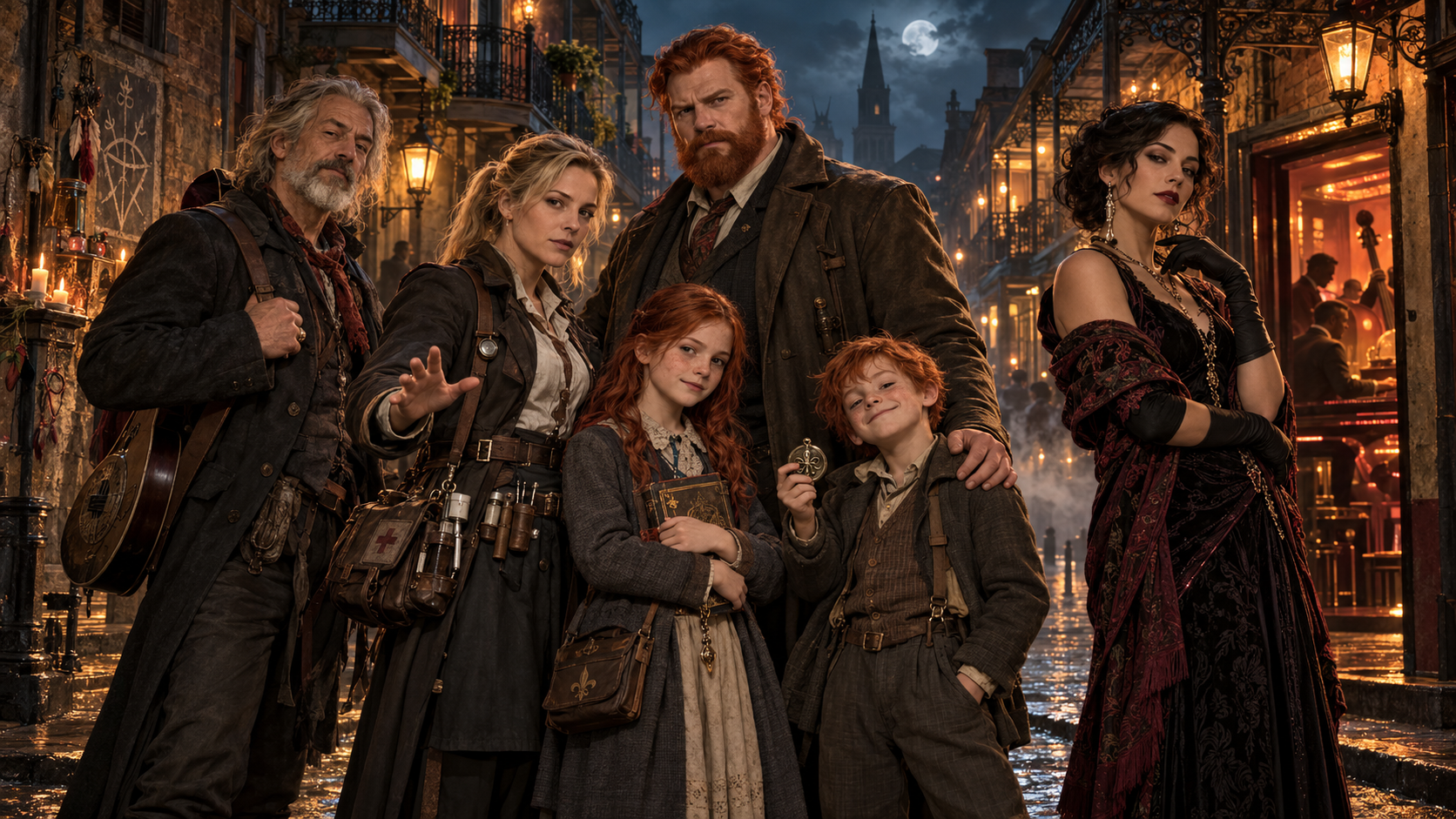
Kelvin, the Family’s Guardian, approaches the question sensibly: Can we still protect each other after taking the action?
Loki has a different concern: Can I roll all six?
He can. That is not the same as saying he should.
Both questions reveal the strength of DPS. The system makes commitment, timing and vulnerability part of the same decision. It works for a desperate sprint, an argument, a careful investigation or a gunfight without asking the group to learn a wholly new mechanical language for each.
The trade-off is that the system’s elegance depends on a GM who understands scene boundaries and communicates them clearly. If players do not understand when their pool returns, they cannot judge the risk they are being asked to take.
Investigation: clues should open doors, not become the door
An investigation game needs more than a decent detective premise. It needs procedures that let an investigation continue when somebody rolls badly or asks a question the writer did not anticipate.
Arkham Horror provides useful help through Insight. Investigators can spend it to improve their chances, discover clues or establish a plausible detail within a scene. A remembered item, an alternative route or a timely piece of knowledge may change how the group approaches the problem.
That is meaningful player contribution. It is not unrestricted permission to rewrite the scenario; the GM still judges plausibility and consequences. But investigators are allowed to be resourceful rather than merely obedient.
The rules also discourage repeated attempts at precisely the same failed action. If the first plan does not work, the interesting move is to change the plan. Try the cellar. Ask somebody else. Find the caretaker. Distract the guard. Return after dark.
Stacy’s practical question is the right one: If the investigators miss the roll, do we still have a story?
A well-built mystery should answer yes.
That said, systemic freedom and adventure structure are different things. The Krewe in Yellow provides several ways to approach obstacles, but it remains a directed investigation with a strong dramatic destination. The investigators can infiltrate, deceive, sabotage, fight, rescue or withdraw; earlier choices change the pressure and outcomes. Nevertheless, the adventure expects its principal threads to lead towards a prepared climax.
We do not object to a dramatic spine. Pulp adventure often benefits from one. But a GM who wants a completely open conspiracy sandbox will need to loosen the links, provide alternative clue paths and decide how the antagonists behave when the party walks away from the expected route.
At Mythveil, our preference is straightforward: preserve the causes; let players change the route. The rulebook gives a GM some of the tools required to do exactly that.
Fighting back does not mean fighting safely
The combat rules are one of the strongest arguments for Arkham Horror as a pulp-horror game.
Consider an ordinary investigator with a six-die maximum. Damage reduces that maximum pool limit. Take two damage, and the next full pool is four dice. Take another two, and it becomes two. Another two can leave the investigator at zero.
Three hits. Six points of damage. A character who was entirely functional a moment ago is now out of the fight.
That is quick, and it creates a very particular kind of fear: not just that an enemy will kill you, but that each injury takes away your capacity to respond. A successful attack can make the next decision harder before it makes anything else impossible.
The bestiary understands the implications. Ghouls are unpleasant individually and more dangerous together, particularly when they exploit abilities that reward attacking in numbers. A Byakhee can deliver an alarming amount of damage with its claws. More formidable entities combine frightening attacks with resistances, weaknesses and supernatural effects.
Research therefore has a tactical purpose. Knowing what the creature is, what it fears and whether a bullet is likely to matter may be more important than owning another bullet.
Sean has been around long enough to distrust any plan beginning with We’ll shoot it and see.
His suggested improvement is equally brief: Find out what it is first. Then decide whether the bloody gun helps.
It is sound advice, though not always welcome in a room full of loaded firearms.
Zero dice is not automatically a funeral
Here the system becomes rather more forgiving than its first impression suggests.
Reaching zero dice incapacitates a character; it does not automatically mean death. An investigator can also Strain Yourself, restoring a damaged pool limit for a moment of defiant action at the cost of suffering an injury afterwards.
That can produce tremendous scenes. A wounded investigator drags a friend clear, closes a door or gets one last shot before the body presents its invoice.
The invoice matters. Injuries have consequences beyond ordinary damage, and previous injuries increase the severity of later ones. Repeatedly refusing to fall is heroic only until it becomes a rather efficient way to accumulate permanent problems.
There is a further escape valve: an investigator can permanently reduce their Insight limit by two to survive an otherwise fatal result. Survival remains possible, but the character relinquishes something meaningful for the future.
This gives Arkham Horror an interesting identity. It makes investigators vulnerable very quickly while offering more ways to remain alive than the small pool might suggest.
In feel, rather than in identical mechanics or calculated death rates, the game occupies territory between classic Call of Cthulhu and Pulp Cthulhu. People can fight back. They can win. The price is rarely forgotten.
Mara asks what any sensible child would ask: If we beat the monster, why is everybody still scared?
Because winning the fight and surviving the story are not always the same thing.
Wounds heal. Horror has a longer memory
The rules distinguish damage, injuries and horror. That distinction helps give adventures an aftermath.
Ordinary damage can recover through rest or suitable medical attention. Eight hours of sleep, or a longer stretch of safe rest and light activity, can restore a character’s damage-limited pool. Medical knowledge can help the process along. Injuries generally take longer; some need extensive treatment or a meaningful period of recovery.
Horror follows a different path. As it accumulates, horror dice replace part of the ordinary pool. They still contribute to actions, but a result of one can inflict trauma. A character can remain active, capable and apparently successful while the psychological cost quietly rises.
That is excellent horror design because the character’s distress is not merely a warning light labelled SANITY. It changes the experience of attempting ordinary things.
Recovery is possible through time, support and appropriate care, yet it does not necessarily fit within the convenient boundaries of the current adventure.
Stacy would insist that this distinction be respected. Treating a wound is not the same as helping someone live with what happened. A game does not need a clinical textbook to understand that much.
For campaign play, this opens a valuable door. The creature may be gone. The investigator has returned home. The neighbours have no idea why the sound of a distant song now makes them stop washing the dishes.
No monster needs to enter the room for the scene to matter.
Progression: competence grows, but slowly
The archetypes provide a starting shape, with skills and Knacks offering ways to develop it. Experience advances competence in meaningful steps, and even a threshold change from 5+ to 4+ alters a character’s odds across many situations.
The Core Rulebook suggests approximately one XP per real-world hour of play, with some flexibility for additional awards. That is measured advancement, not a shower of levels after every dramatic evening.
Multiclassing is deliberately distant: a character must already have spent at least 125 XP, after which gaining a second archetype costs another 20 XP. In a regular campaign, that is a significant commitment.
We appreciate the restraint. A horror campaign suffers when its protagonists become so powerful that a threatening encounter requires the GM to introduce a larger creature every Thursday. Eventually the universe runs out of suitably large creatures and the furniture becomes nervous.
Still, the long horizon is worth explaining to players. Groups who want rapid changes in character identity or short, dramatically transformative arcs may need to adjust the pace. The system is better suited to gradual growth than to an endless procession of new powers.
Magic: good ideas that deserved a longer conversation
Magic is where our enthusiasm becomes more qualified.
The Core Rulebook uses the familiar skill framework for much of its supernatural action. Characters can encounter mystical abilities, tomes, relics and other strange resources without having to learn an entirely separate miniature game.
Some powers have excellent consequences. Azure Flame risks burning its caster; Banish can bring horror and, in extreme circumstances, leave the caster somewhere altogether less hospitable than intended.
These are compelling prices for reaching beyond the ordinary world.
Other powers are more straightforward. Haunting Whispers, for example, can weaken an opponent’s dice pool without specifying a comparable personal backlash. That is not inherently unbalanced or wrong. It simply means the sense of magical danger varies considerably between abilities.
Our objection is not that every spell should injure its caster. It is that supernatural power could have carried a more consistent sense of context, temptation and consequence.
Songs of New Orleans improves matters through rituals: time, materials, preparation and sometimes other participants make an occult act into an event rather than a convenient button on a character sheet. That is a better fit for mystery, negotiation and long-form storytelling.
It also creates an editorial responsibility. Religious practice is not the same thing as fantasy spellcasting. The supplement’s rituals are game adaptations, not a guide to performing the living traditions that inspire parts of its setting. A respectful GM should keep that distinction clear.
We would have welcomed more depth here: more meaningful ritual decisions, more coherent magical costs and more guidance for building investigations around the social and spiritual consequences of occult action.
The Musician changes the entire conversation
The supplement’s Musician archetype is an inspired addition. Its special music dice let performance support other investigators across a range of tasks, from social interaction and knowledge to movement and resistance to horror.
A six on a music die can explode, providing an additional die. A one may cancel a success. The mechanic expresses a delightful uncertainty: a performance may lift everyone in the room, or a single unfortunate note may undermine the whole effort.
And music becomes something a character does to affect the world, rather than an audio track the GM remembers to turn on.
Sean approves of any game that understands music can change a room before anyone speaks. He is rather less convinced by the prospect of carefully quantifying the moment a guitarist misses a chord.
Loki, meanwhile, has discovered that one bad note can ruin an otherwise excellent plan. We have asked him not to regard this as a research opportunity.
The Musician is proof that DPS can express a setting’s personality through mechanics. We want more design thinking of this calibre.
The Mythos: some things should remain beyond a health bar
The Arkham Horror franchise has an awkward inheritance. Board games need threats players can overcome. Cosmic horror depends, at least partly, on the possibility that the universe is not waiting to be overcome at all.
A roleplaying game has room to hold both ideas.
The Core Rulebook treats the Ancient Ones as forces of cosmic magnitude rather than conventional opponents with a respectable number of hit points. Investigators may disrupt a ritual, defeat a servant, protect a community or stop a catastrophe without somehow putting Cthulhu in a coffin and declaring the matter settled.
That boundary suits the material.
A ghoul can be fought. A terrifying servant might be defeated with intelligence, sacrifice and preparation. The powers behind them should remain capable of making the victory feel very small indeed.
Songs of New Orleans is especially persuasive in its treatment of Hastur, the King in Yellow, and Carcosa.
Here the horror is more than the spectacle of an impossible entity. It is nostalgia, regret, performance, faded splendour and the temptation to restore something that has been lost. The past becomes an invitation. The invitation is beautifully written. Nobody sensible has checked the return address.
Elshara notices the dangerous part immediately: Who benefits when people are persuaded that yesterday was perfect?
Quite. The desire to restore a vanished golden age can make people remarkably careless about whom they sacrifice to get it back.
That makes Hastur an exceptionally good fit for New Orleans. Not because the real city is cursed, but because memory, identity, architecture, music and social change provide powerful human material for a fictional horror story.
New Orleans is a city, not a collection of spooky props
The setting guide earns much of its praise by taking the Crescent City seriously as a place with distinct neighbourhoods, communities and institutions.
The French Quarter, Tremé, Marigny, Garden District and Algiers do not become interchangeable backdrops. The book considers music, migration, religion, commerce, class, Carnival culture and the different forms of belonging that shape a city.
That matters for more than atmosphere.
A jazz musician, a social club organiser, a priest, a shopkeeper and a member of a Carnival krewe should not all be reduced to the same convenient source of exposition. They have different relationships, interests, prejudices, loyalties and ways of understanding an event.
When a setting gives those people room to exist, the investigation gains genuine routes through society. One person knows the venue. Another knows who owns it. Someone else remembers what happened there twenty years ago. The person with the most useful information may have no intention of speaking to the investigators until they earn a little trust.
That is where setting research becomes playable worldbuilding.
The book is particularly effective when it brings together the city’s music, Congo Square, African American cultural history, Tremé, social organisations and the competing traditions of Carnival. Its attention to groups such as Rex, Zulu and the Mardi Gras Indians — also discussed today as Black Masking Indians — offers more than an easy parade of colourful masks.
There is real human history here. It deserves to be represented as such.
An opera house, a fire and an excellent premise
One of the supplement’s most effective historical anchors is the French Opera House, destroyed by fire on 4 December 1919. The loss was cultural as well as architectural. Hopes for rebuilding persisted, but the original theatre was never restored.
The Krewe in Yellow turns that absence into dramatic material. Its Mardi Gras setting, theatrical connections and escalating influence from the King in Yellow make longing for the past part of the danger.
Without spoiling the conclusion, the investigators have a reason to ask whether getting back something cherished is always worth the cost.
That is exactly the sort of historical-fantasy premise we admire: the supernatural story does not erase the documented event. It finds a new question inside it.
The adventure itself is still more guided than open. It has an identifiable sequence, a time-sensitive destination and a major set-piece finale. But infiltration, deception, sabotage, rescue, confrontation and failure all matter. For a ready-to-run pulp mystery, that is a useful balance. For our kind of living-world campaign, we would let the antagonists and the city keep moving if the investigators take an entirely unexpected route.
History matters most when the book asks us to trust it
Now for the part of the review where we become less agreeable.
This is not because historical fiction must be a documentary. There should be room for invention, anachronism chosen deliberately, and the occasional impossible city reflected in a black lake.
But when a book introduces historical information as fact, ordinary historical claims should survive ordinary fact-checking.
Storyville and the invention of jazz
The guide’s account of Storyville leans too heavily on the familiar story of the district as the birthplace of jazz. Storyville certainly helped musicians find work and introduced listeners to new sounds. Yet jazz developed across New Orleans, through many communities, venues and musical influences.
The US National Park Service’s history of jazz neighbourhoods is explicit: jazz was not born solely in Storyville.
Dates matter here as well. Storyville’s regulated district operated from 1897 to 1917. Its closure is not the same event as the destruction of much of its surviving built environment for public housing in the 1940s. Those are different chapters of the city’s history and should not be folded into one convenient farewell scene.
There is also an awkward reference to Louis Armstrong in the book’s Storyville discussion (p. 31). Whatever the intended impression, the chronology needs care. Armstrong went to Chicago in 1922 to join King Oliver; he was not a regular fixture of an operating Storyville district throughout the later 1920s. The Louis Armstrong House Museum’s biography makes that career timeline readily available.
These are not exotic scholarly disputes. They are the kind of details readers reasonably expect a historically anchored setting guide to check.
Louisiana Voodoo deserves distinctions, not a single origin story
The supplement’s treatment of Louisiana Voodoo is substantially more respectful than the cheap occult caricatures the subject has often attracted. That deserves credit. But respect also requires historical precision.
Haitian Vodou, Louisiana Voodoo and Hoodoo or rootwork are connected in complex ways; they should not be treated as interchangeable labels. Nor should Louisiana Voodoo be explained simply as a finished religious system carried from Haiti to New Orleans after the Haitian Revolution.
The Louisiana State Museum describes African-rooted traditions in Louisiana by the late eighteenth century, while also stressing the limits and uncertainties of the historical record. Haitian influences are important, but the history is not a neat one-way journey.
A similar compression affects the Haitian refugee timeline. The Louisiana Purchase of 1803 is not the same event as the major arrival of Saint-Domingue refugees via Cuba in 1809–1810. The Historic New Orleans Collection documents the latter migration and its enormous impact on the city.
The book’s presentation of Toussaint Louverture at the very beginning of the 1791 uprising also requires nuance. He became one of the revolution’s most important leaders, but depicting him as the straightforward organiser of the uprising from its first moment oversimplifies a contested early history. Historian Jeremy Popkin’s account helps clarify why the chronology matters.
None of these mistakes makes Songs of New Orleans unusable. Indeed, they stand out because the surrounding material is often thoughtful. But the deeper a game draws upon real communities and history, the more carefully it ought to handle the facts it borrows.
Stacy’s reaction is practical: check the dates. Sean’s is rather less delicate: if the facts are a ten-minute search away, there is no prize for getting them wrong.
They are both right.
Inclusion, historical injustice and the kind of 1920s we choose
There is another historical question, and it should not be confused with a factual error.
The Core Rulebook deliberately softens or removes some of the social barriers that racism, sexism and other forms of discrimination imposed in the real 1920s. This allows a wider range of investigators to occupy roles and professions without forcing every group to reproduce historical exclusion.
That is a legitimate creative decision, and we understand the aim. Players should not be required to endure fictional discrimination simply because a setting draws from a discriminatory period. No one should have to defend their right to participate in a game.
But the decision has narrative consequences, too.
In the historical world, prejudice affected who could enter a building, testify with credibility, hold authority, receive protection from the law or obtain help from an institution. Those inequalities created relationships of power that shaped everyday life. Remove them completely, and a campaign may lose not only cruelty but also historical tension, moral complexity and the possibility of stories about people confronting injustice.
The solution is not to pile suffering into every scene and call it authenticity. A game is not made more mature by ensuring everybody is miserable before the first tentacle appears.
The better approach is an informed choice made with the group.
One table may want deliberately inclusive pulp adventure with few historical barriers. Another may want careful engagement with the period’s injustice, handled with consent, research and narrative purpose. A third may find a middle course, preserving historical structures without directing abusive experiences at players.
The books strongly support the first approach. The others require more work from the GM.
Elshara’s question is the one worth keeping: Whose freedom becomes invisible when we change the history, and whose experience becomes unbearable if we do not?
There is no clever one-line answer. That is precisely why the question belongs in a serious review.
Historical credibility and a welcoming table need not be enemies. But a modernised 1920s and an accurate account of the 1920s are different creative projects. We should be clear about which one we are undertaking.
Art, maps and a setting you can put on the table
Both books are beautifully presented, but they do not look identical.
The Core Rulebook favours the shadowed tones of New England horror. Songs of New Orleans feels warmer, busier and more public: streets, performers, interiors and a city alive with people before its impossible elements arrive.
That visual distinction is a real achievement. Location should alter the emotional temperature of an RPG, and here it does.
The New Orleans tourist map is one of our favourite practical pieces. It has the character of a period artefact rather than the anonymous efficiency of a modern navigation app. It invites players to examine districts, imagine journeys and decide where they want to go.
The French Opera House map serves a different purpose. It provides a readable environment for staging action. One map encourages exploration; the other gives a dramatic scene somewhere tangible to happen.
The digital resources matter as well. Character and NPC sheets, Knack references, maps and handouts can spare a GM a good deal of preparation. EDGE maintains an official Arkham Horror RPG resources page that includes downloadable support material.
The six shorter mysteries deserve one qualification: they are foundations and compact scenarios, not six equally detailed, full-length adventures. There is plenty to develop if you enjoy making a city react to the investigators. If you prefer everything prepared down to the last witness statement, expect to do some extra work.
With a US list price of $49.99 for Songs of New Orleans, the question of value is fair. This is a premium supplement, and its worth comes from the density of usable local material, the Musician, occult options, artwork, maps and central adventure, not from page count alone.
For a GM who intends to spend serious time in New Orleans, we think the material earns attention. For someone who only wants another stack of ready-to-run one-shots, the bargain is less obvious.
So who is Arkham Horror RPG really for?
It suits players who want to investigate mysteries while retaining the ability to do something decisive when the doors break open. Its dice economy is easy to teach yet rewards judgement. Combat can incapacitate quickly without demanding automatic death. Horror has lingering effects, and character growth preserves vulnerability.
It also suits GMs who want a strong published foundation and are happy to make its people, institutions and consequences live beyond the printed scene.
If you want an elaborate and consistently dangerous system of occult magic, these books may leave you wanting more. If you insist on a completely open investigative sandbox, The Krewe in Yellow needs adjustment. If you want painstaking historical realism, you will need both supplementary research and a deliberate conversation about EDGE’s alternate-history choices.
These are not contradictions in the product. They are its boundaries. Knowing them beforehand is part of choosing the right game.
At Mythveil, we value a world that remembers what its inhabitants have done. Arkham Horror gives the GM a strong immediate language for sacrifice and risk; Songs of New Orleans gives those actions a city in which they might matter. Connecting the two over the length of a campaign is where the richest possibilities begin.
Continue the conversation with Mythveil Chronicles
We explore tabletop roleplaying through research, living-world design, editorial reviews and professional games. If your own campaign needs to breathe beyond the published page, there are several ways to join us.
Read. Play. Watch. Support. Or collaborate.
Read: Mythveil Chronicles — Articles, reviews and research
Play: Join our professional games on StartPlaying
Watch: Mythveil Chronicles on YouTube
Support: Mythveil on Patreon
Collaborate: Connect with Mythveil on LinkedIn
Real TTRPG. Real story. Real choices. Real consequences.
Editorial method: This review is based on close reading of the digital review copies and associated materials, with external checks against the historical sources linked above. It is not represented as a complete campaign playtest or a physical-print quality assessment. The Mythveil Family’s exchanges are editorial storytelling voices, not accounts of an actual play session.
Final verdict: when the music ends, the consequences remain
Arkham Horror: The Roleplaying Game knows what sort of horror it wants to be. It gives investigators competence without immunity, quick rules without trivial decisions and ways to survive without pretending that survival is free.
Songs of New Orleans is more than a change of scenery. At its best, it connects music, place, loss and the psychological seduction of Hastur into a setting that deserves sustained play. The Musician is a particularly smart addition, the art and maps are practical as well as evocative, and The Krewe in Yellow offers a fine dramatic foundation.
Our reservations are substantial enough to mention plainly. Magic could be deeper and more coherent. Several historical details, particularly around jazz, Storyville and Louisiana Voodoo, needed stronger editorial checking. The consciously modernised social history is defensible but changes the kinds of stories the books most naturally support. And the flagship adventure, for all its choices, is still guided rather than completely open.
Even with those reservations, we find a great deal to recommend.
There is something wonderfully human about walking towards the impossible with six dice, a useful clue, the wrong weapon and friends who are doing their best to look confident.
Mara would ask whether we ought to open the door.
Kelvin would check that everyone can get out again.
Loki has probably opened it already.
Somewhere beyond the threshold, the music continues.
Mythveil Chronicles rating: 8.5/10.