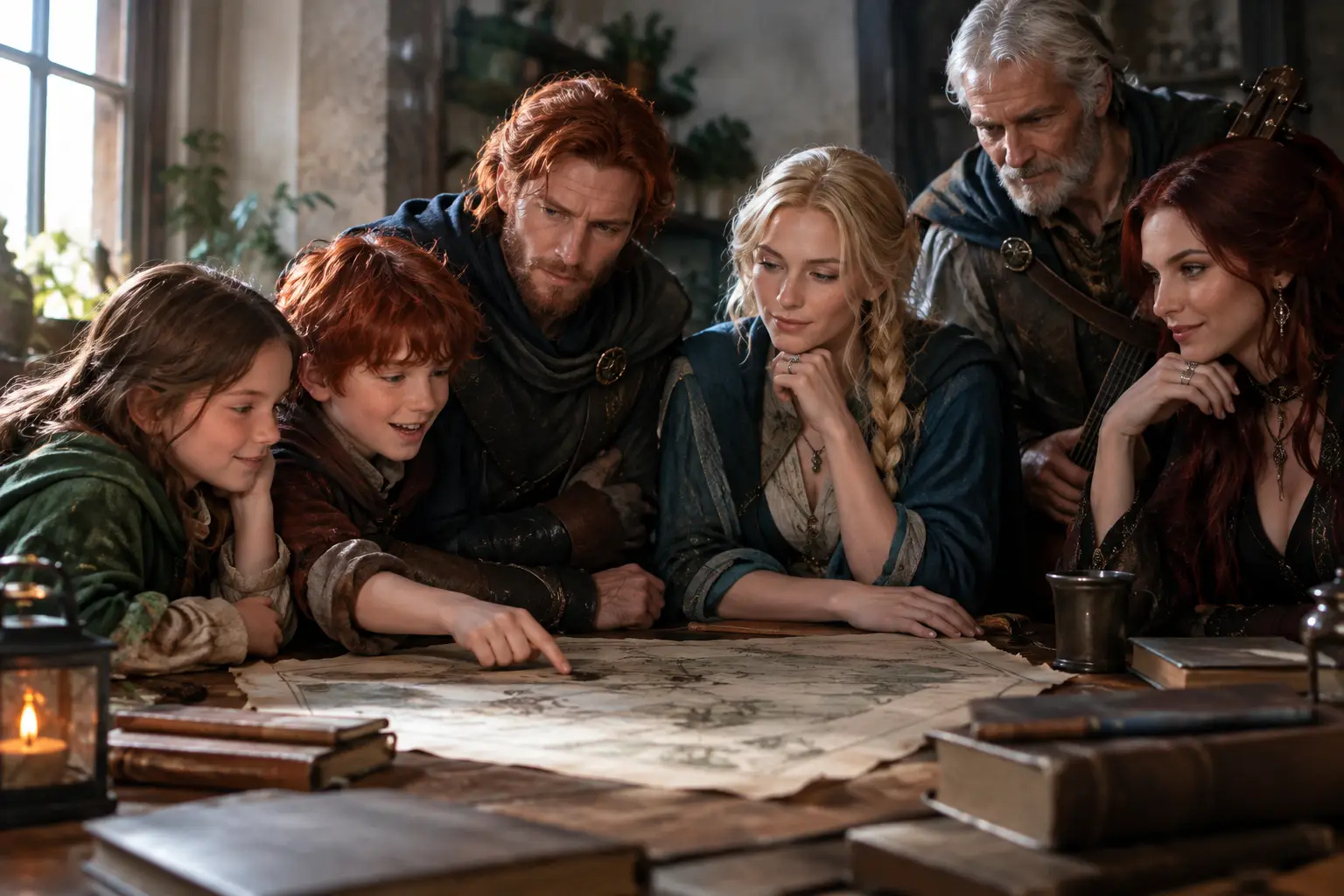
The bell in the drowned chapel rings once, although no hand has touched it for a century. One player decides their grandmother warned them never to answer its call. Another says the village still leaves bread at its doors each new moon. A third asks who built the chapel beneath the water in the first place.
That is the promise of a guide to collaborative setting creation: not a world assembled behind a screen and presented as finished, but a place whose secrets, wounds and rituals emerge through shared attention. The Game Master still provides direction, judgement and atmosphere. Yet the players help create the emotional terrain in which their characters must live.
For narrative-focused roleplaying, this is more than a preparatory exercise. It is a way to create investment before the first threat appears. When players have helped name the river, define the local superstition or establish what their community fears losing, danger gains a human scale. The setting no longer exists merely to host an adventure. It becomes something the table can betray, protect, mourn and remember.
Why collaborative worlds stay with players
A conventional setting can be beautifully written and still feel distant. Players may admire its maps, histories and factions, but admiration is not the same as belonging. Collaborative creation closes that distance by asking a more intimate question: what does this place mean to your character?
The answer need not be grand. A player might establish that the city watch refuses to patrol an old market after sunset because an officer vanished there years ago. Another might add that their character’s family owns a failing bookshop on that street. Suddenly the market has social pressure, history and a personal stake. It can return months later with greater force because the table understands what it has become.
This approach also distributes creative energy. The Game Master is not required to invent every custom, roadside shrine and political grievance alone. Players supply material that reflects the kinds of stories they want to encounter, while the Game Master shapes that material into a coherent world with tension, causality and consequence.
There is a trade-off. Shared authorship can weaken a setting if every contribution is immediately accepted, equally prominent and perfectly convenient. A living world needs friction. It needs facts that do not fit together yet, traditions people misunderstand, and institutions that resist the heroes’ preferred version of events. Collaboration works best when it creates possibilities rather than granting automatic control.
A guide to collaborative setting creation with boundaries
The most useful invitation is not, “Tell me anything about the world.” It is a focused prompt with a clear creative boundary. Constraints give imagination something to press against.
Begin by deciding what belongs to the table and what remains under Game Master stewardship. Players might define their homes, relationships, rumours, cultural practices and former allegiances. The Game Master may reserve hidden antagonists, the deeper truth behind supernatural events, the long-term movement of factions and the origins of a central mystery. These boundaries are not a defence of authority for its own sake. They preserve discovery.
Before character creation, establish four anchors together:
- The pressure: What is changing or breaking in this place right now?
- The attachment: What would ordinary people fight to preserve?
- The taboo: What is never discussed openly, and what happens when it is?
- The promise: What kind of experience has brought this group here: investigation, tragedy, rebellion, survival, wonder or moral compromise?
These anchors do more than provide flavour. They create a shared dramatic contract. A campaign of gothic investigation may need inherited guilt, unreliable institutions and a community with much to hide. A war-torn fantasy campaign may need divided loyalties, scarce safety and a cause worth doubting. The setting begins with an emotional climate, not a catalogue of facts.
Ask questions that create usable pressure
Good collaborative questions produce material that can be acted upon. “What is the capital famous for?” may yield an attractive answer, but it can remain decorative. “What does the capital celebrate while quietly making someone else pay the price?” creates immediate tension.
Frame questions around belief, cost and contradiction. Ask where a character feels safe, then ask who is excluded from that safety. Ask which local holiday they hate, and why they still attend. Ask what their mentor taught them about the old ruins, then privately decide whether the mentor was mistaken, lying or protecting them.
Not every answer must become literal truth. A player can establish what their character believes without defining objective reality. This distinction is especially valuable in horror, mystery and mythic campaigns. The fisherman who insists the lake remembers names may be correct, deluded, or correct in a far more terrible way than anyone expects.
Build from the near, then let the horizon darken
Groups often try to create continents, dynasties and creation myths before they know where their characters buy food. This can be enjoyable, but it does not always serve a campaign. Start with the immediate sphere: a district, ship, village, academic department, military unit or haunted estate.
Give that small place enough texture to generate scenes. Who holds informal power? Where do people gather when they cannot be overheard? What recent event has left a visible scar? Which building is avoided, and which is overcrowded despite its dangers?
Then allow the wider world to arrive through consequences. A trade dispute becomes a border crisis. A missing local priest reveals a struggle within a distant religious order. A family debt draws the characters into a conflict between factions they had only heard named in passing. This method keeps the world legible while allowing it to grow with the story.
Turn contributions into a world that responds
Collaborative setting creation fails when ideas are collected but never revisited. A player mentions an estranged sibling in session zero; twelve sessions pass; the sibling remains a forgotten note. The table learns, understandably, that its contributions carry no weight.
Treat every strong contribution as a potential thread with a future cost, gift or complication. If a player creates a river guild, decide what the guild wants, what it fears and what it can do when threatened. If someone defines a local funeral rite, consider who profits by breaking it. If a character claims allegiance to an old house, let that allegiance open one door and close another.
This is where a living-world approach matters. In the Rexborn Framework, factions, influence, history and player choices are tracked as moving forces rather than static background. You do not need complex software to adopt the principle. Keep a modest record of promises made, reputations altered, resources damaged, debts incurred and people who now have reason to act.
Between sessions, ask one quiet question: what changed because the characters were here? The answer may be a shopkeeper losing faith in the watch, a cult moving its meeting place, a union gaining courage, or a friend deciding the heroes cannot be trusted. Change does not always need to be dramatic. Small alterations accumulate into the feeling that the world breathes beyond the moment of play.
Preserve mystery without shutting players out
Some Game Masters worry that collaboration spoils surprises. It can, if players are asked to invent the solution to the mystery they are meant to investigate. But mystery does not require secrecy about everything. It requires uncertainty about what matters most.
Let players create the known shape of a legend: the name of the vanished queen, the song children sing about her return, the locked room in the museum dedicated to her relics. Keep the hidden shape for yourself: what really happened, who benefits from the legend, and what will awaken if the characters pursue it.
A useful rule is this: players can author context; the Game Master authors revelation. The boundary will shift from campaign to campaign, and some groups prefer greater shared authority. Discuss it openly. Consent and expectation are part of atmosphere, particularly when a setting touches grief, body horror, faith, oppression or personal betrayal.
Make space for revision
The first version of a setting is not sacred. A player may later realise that a detail they offered does not suit the character they are discovering. The group may find that a supposedly comic town custom undercuts the campaign’s tone. Revision is not failure. It is editorial craft.
Allow retcons for minor details, but treat major changes as events within the fiction when possible. If the map says the forest lies east and later needs to lie north, change the map. If a revered founder is suddenly revealed to have been a fraud, let the revelation reshape loyalties, ceremonies and grief. The distinction preserves trust while making the world more interesting.
Collaborative creation is not about surrendering the campaign to improvisation. It is about inviting players to place their fingerprints on the stone before the storm arrives. Give them real influence, keep enough unknown to kindle wonder, and let every meaningful choice leave an echo. A setting becomes unforgettable when the table can look back at its oldest scars and say, with equal parts pride and regret, we were there when that happened.