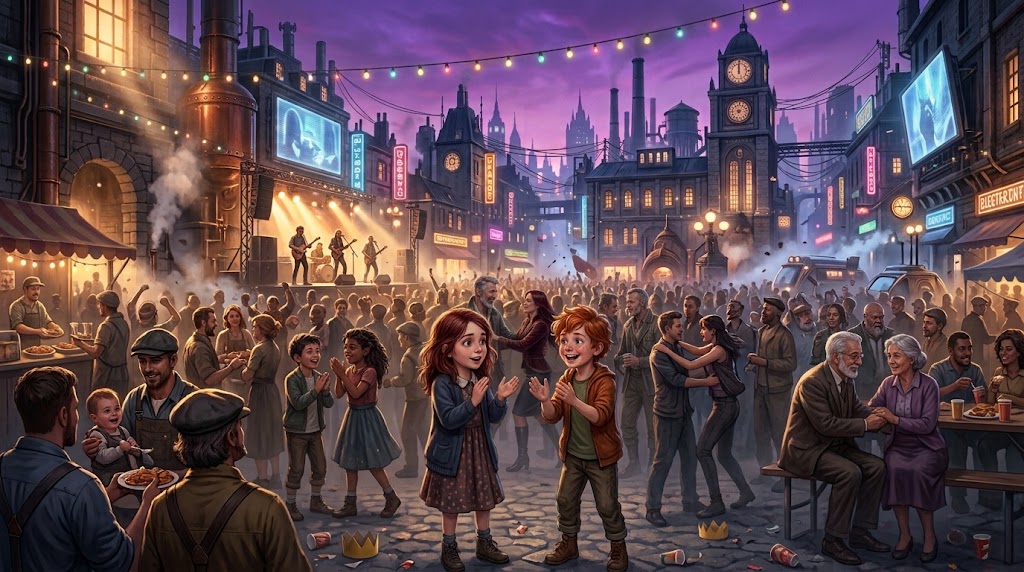
Mara stopped in front of the line of coloured lights.
They stretched from one side of the square to the other, hanging above the crowd in loops.
Red.
Blue.
Gold.
Green.
Not the hard electric glow of streetlamps.
Not Plasmovision.
Not the cold practical light of corridors and stairwells.
These lights existed for no useful reason.
That was probably why Mara liked them.
Chibi walked straight into her.
“Ow.”
“You stopped.”
“I was looking.”
“You can look while moving.”
“You can fall over while moving.”
“I can fall over standing still.”
“That isn’t something to be proud of.”
“It means I’m versatile.”
Mara ignored him.
Around them, the celebration had changed again.
Bluetime was almost gone now.
Families were beginning to collect coats and children.
Other people were only just arriving.
The music had become louder.
The lights brighter.
The adults stranger.
Mara pointed towards a man standing on a table.
“He’s going to fall.”
Chibi looked.
The man had one arm around his friend and the other holding a drink above his head while singing something with enormous confidence and very little accuracy.
“He might.”
“Someone should tell him.”
“Why?”
“So he doesn’t fall.”
“If he falls, someone will catch him.”
“You don’t know that.”
Chibi pointed.
Four people were already standing around the table, watching him.
“They know.”
Mara considered this.
The man nearly slipped.
All four reached for him.
He recovered.
Nobody stopped singing.
Chibi smiled.
“Told you.”
“That still doesn’t make standing on tables sensible.”
“No.”
“Good.”
“But tonight it’s allowed.”
Mara looked at him.
“Why?”
Chibi shrugged.
“Party.”
“That isn’t an answer.”
“It is tonight.”
—
They walked on.
A woman had kicked off her shoes and was dancing barefoot.
Two teenagers were wearing sunglasses even though Bluetime was nearly finished.
A group of workers were singing louder than the band.
An old couple sat at a table holding hands without saying anything.
Three children had created a race using empty paper cups, two spoons and a piece of string.
Mara watched them.
“What are the rules?”
Chibi listened.
“I don’t think they know.”
“Then how do they know who wins?”
“They argue.”
“That’s not a rule.”
“It’s the oldest rule.”
One of the children shouted that another had cheated.
The accused child shouted that the rule had only been invented after he had won.
Chibi nodded approvingly.
“See?”
Mara smiled.
A few minutes earlier, she had been part of a completely different game with children whose names she still did not know.
For fifteen minutes they had been teammates.
Then the game ended.
And that was that.
She found this strangely fascinating.
“Chibi.”
“Hm?”
“Were those children our friends?”
“Which?”
“The ones from the ball game.”
“For the game.”
“That’s not what I asked.”
Chibi thought.
“Maybe.”
“We don’t know their names.”
“So?”
“You usually know your friends’ names.”
“You know mine.”
“Unfortunately.”
“See? Friendship.”
Mara elbowed him.
“I mean it.”
“So do I.”
He looked back towards the crowd.
“Maybe you don’t always need the whole person.”
Mara frowned.
“What does that mean?”
“Maybe sometimes you just need the bit that’s doing the same thing as you.”
“That sounds horrible.”
“No, listen.”
Chibi pointed towards a group singing.
“You don’t know them.”
“No.”
“If you know the song?”
“I know the chorus.”
“Then for the chorus you know what they’re doing.”
Mara watched.
A woman lifted her hand.
Everyone around her did the same.
The chorus came.
They sang together.
Same words.
Same moment.
Same rhythm.
Then they separated again into conversations.
Chibi pointed.
“See?”
Mara was quiet.
“So we’re friends for one chorus?”
“Maybe.”
“That’s stupid.”
“Maybe stupid things still work.”
—
A new song began.
Simpler.
Faster.
Children near the edge of the crowd started clapping along.
Clap.
Clap.
Clap.
Pause.
Clap.
Clap.
Clap.
Pause.
Chibi joined in.
Mara didn’t.
He looked at her.
“No.”
He clapped again.
“No.”
Another child added a stamp between the claps.
Clap-clap-clap.
Stamp.
Someone added a shout.
Clap-clap-clap.
Stamp.
Hey!
Chibi grinned.
Mara tried not to.
Clap-clap-clap.
Stamp.
Hey!
More people joined.
Not everyone.
Enough.
The rhythm spread through the children first.
Then a few adults copied it.
The band noticed and changed something in the music to fit them.
Mara’s eyes widened.
“They heard us.”
“Obviously.”
“No, the band.”
“I know.”
“They changed the song.”
Chibi puffed out his chest.
“We improved it.”
“You did not improve it.”
“We are now co-composers.”
“You clapped three times.”
“Every great career begins somewhere.”
Mara laughed.
Then the pattern came again.
She joined.
Clap-clap-clap.
Stamp.
Hey!
Again.
Clap-clap-clap.
Stamp.
Hey!
She could feel the rhythm through the floor.
Through her hands.
Through the people around her.
Something about it made thinking unnecessary.
Not impossible.
Just unnecessary for a few seconds.
She knew what came next.
Everyone did.
Clap.
Clap.
Clap.
Stamp.
Shout.
Again.
Mara stopped after several rounds.
Chibi kept going.
“What?” he asked.
She looked around.
“I know what they’re going to do.”
“Who?”
“Everyone.”
“That’s the point.”
“No, really.”
She pointed.
“That girl is going to clap.”
She did.
“That man is going to stamp.”
He did.
“That boy is going to shout too early.”
He did.
Chibi laughed.
Mara didn’t.
Not yet.
“It’s strange.”
“What is?”
“At school I never know what people are going to do.”
“Teachers do.”
“No, they think they do.”
“Fair.”
“At home I don’t always know what adults are going to do.”
“Especially Sean.”
“Exactly.”
“But here?”
Mara watched the next pattern.
“Here I know.”
Chibi shrugged.
“So?”
“So maybe that feels nice.”
For once, Chibi did not immediately make a joke.
“Yeah.”
They listened.
Mara said it quietly.
“You don’t have to wonder if you belong.”
Chibi looked at her.
“Because you know the next clap.”
“That sounds silly.”
“It is silly.”
She smiled.
“But maybe it’s enough.”
—
They moved towards the food stalls.
Chibi had acquired another sweet thing.
Mara was still eating the first one.
Slowly.
Mostly because she refused to give it to him.
“You said you hated it,” Chibi reminded her.
“I do.”
“You’ve eaten nearly all of it.”
“I’m checking.”
“For what?”
“If I still hate it.”
“And?”
She took another bite.
“Yes.”
Chibi stared.
“You’re very committed.”
“I’m scientific.”
“You’re stubborn.”
“That too.”
They passed a table where adults were laughing.
Mara didn’t know why.
One man was telling a story.
She could only hear bits of it.
Something about an Autopod.
Something about trousers.
Something about a bridge.
Everyone at the table clearly already knew the story.
One woman was laughing before the funny part even arrived.
Mara stopped.
“They already know it.”
Chibi looked.
“Know what?”
“The story.”
“So?”
“Why is he telling it again?”
“Because it’s funny.”
“But they already know.”
“Maybe that’s why.”
Mara frowned.
“That makes no sense.”
Chibi shrugged.
“You watch the same Plasmovision programme again.”
“Not if I know what happens.”
“You absolutely do.”
“That’s different.”
“How?”
Mara thought.
She didn’t have an answer.
The table erupted in laughter.
The storyteller laughed too.
Harder than anyone.
Mara watched them.
“They’re not laughing because they’re surprised.”
“No.”
“What are they laughing at then?”
Chibi looked at the table.
“Each other?”
Mara glanced at him.
That was unexpectedly good.
The man started telling another story.
Everyone groaned.
Nobody left.
—
Near the far side of the square, Sean was dancing.
Mara noticed first.
She grabbed Chibi’s sleeve.
“Look.”
Chibi looked.
His expression changed slowly from confusion to concern.
“Is something wrong with him?”
Mara giggled.
“I think he’s dancing.”
“No.”
“He is.”
“Sean doesn’t dance.”
“He does now.”
Eljara was dancing opposite him.
She was clearly much better.
She was also clearly enjoying Sean’s suffering.
Chibi watched for a while.
“Why is he doing that?”
“Maybe because tonight is different.”
“Different how?”
Mara looked around.
People were wearing clothes they didn’t wear to work.
Eating things they didn’t eat every day.
Staying out later.
Talking to strangers.
Singing too loudly.
Standing on furniture.
Dancing badly.
Even the square itself had changed.
The same stone.
The same buildings.
Different lights.
Different sound.
Different rules.
She thought about school holidays.
Birthdays.
Being allowed to stay awake after bedtime.
Eating somewhere unusual.
A room decorated for one day and ordinary again the next.
“Maybe a celebration is when everyone agrees normal can wait.”
Chibi stared at her.
“That sounds like Caelwyn.”
“No, it doesn’t.”
“It does.”
“It’s not slow enough.”
Chibi laughed.
Mara continued.
“Think about it.”
“I am.”
“Normally Sean doesn’t dance.”
“Correct.”
“Tonight he does.”
“Unfortunately.”
“Normally adults tell us not to be loud.”
“They still do.”
“Not as much.”
“Fair.”
“Normally you don’t talk to strangers.”
“You do.”
“You’re not helping.”
“Sorry.”
She pointed towards the games.
“Normally that bit of pavement is just pavement.”
“Tonight it was a kingdom.”
“And a racetrack.”
“And a battlefield.”
“It was not a battlefield.”
“There were casualties.”
“One cup fell over.”
“Exactly.”
Mara rolled her eyes.
“But tomorrow it will just be pavement again.”
Chibi nodded.
“So?”
“So maybe the important part is that everyone knows that.”
“That it ends?”
“Yes.”
Chibi looked around.
“That’s sad.”
“Maybe.”
The music continued.
“But maybe if it didn’t end, it wouldn’t be special.”
That silenced him.
For approximately three seconds.
“So Tuesday is important because Friday exists?”
“That isn’t what I said.”
“Tuesday gives Friday meaning.”
“No.”
“We should tell Stacy.”
“Absolutely not.”
—
Bluetime finally disappeared.
For a moment, the square seemed to inhale.
The artificial sky was gone.
Darkness returned above Doskvol.
Then every electric light around them seemed brighter.
Neon.
Plasmovision.
Strings of coloured bulbs.
Food stalls.
Headlights.
Windows.
The night did not end the celebration.
It transformed it.
Mara looked up.
“Do you remember when Sean said it used to be dark all the time?”
“Yes.”
“That’s weird.”
“It would’ve been normal.”
“No.”
“To them.”
Mara thought about the old people she had seen watching Bluetime.
For children her age, the blue sky was ordinary.
For someone born long before the B.L.U.E. Array, perhaps it never could be.
“You know what’s strange?” Mara said.
“Yes.”
“I haven’t said it yet.”
“Still yes.”
She ignored him.
“When grown-ups talk about the old days, they make it sound like everyone knew what things meant.”
Chibi nodded thoughtfully.
“They didn’t.”
“How do you know?”
“Because adults don’t know now.”
Mara smiled.
“That’s true.”
“Also Sean told me.”
“That’s less convincing.”
“He’s old.”
“He’s not that old.”
“Don’t tell him I said that.”
“I’m definitely telling him.”
—
Someone called their names.
Stacy.
Mara looked towards her.
Time to go.
Chibi groaned.
“No.”
“Yes.”
“We’ve barely started.”
“We’ve been here for hours.”
“That’s hardly anything.”
“For you.”
“It’s discrimination against children.”
Mara began walking.
He followed reluctantly.
They passed the dancers again.
The people who had been playing games earlier were gone.
New people had taken their place.
The celebration was changing into something that belonged more to adults now.
More drinks.
Louder music.
Fewer children.
Different clothes.
Different energy.
Mara looked back.
“Is it still the same party?”
Chibi shrugged.
“Same place.”
“Different people.”
“Some.”
“Different music.”
“Better music.”
“Different rules.”
He thought.
“Maybe parties have stages.”
“Like what?”
“Stage one: food.”
“That’s not a stage.”
“Stage two: games.”
“No.”
“Stage three: Sean embarrasses himself.”
Mara laughed.
“That’s the final boss.”
Sean heard them as they approached.
“What’s funny?”
“Nothing,” Mara said.
Chibi pointed.
“Your dancing.”
Sean stared at him.
“Careful.”
Eljara appeared behind Sean.
“He’s right.”
Sean looked betrayed.
“You as well?”
“Especially me.”
—
Caelwyn was waiting with Stacy.
He looked down at Mara.
“Good evening?”
She nodded.
“The best.”
“What was the best part?”
Mara opened her mouth.
The lights.
The food.
The game.
The strange children.
The clapping.
Seeing Sean dance.
She looked back at the crowd.
“I don’t know.”
Chibi answered immediately.
“The sweets.”
Mara sighed.
Caelwyn smiled.
“Nothing else?”
Mara thought.
Then she pointed towards the square.
“The bits where everybody knew what happened next.”
Caelwyn tilted his head.
“What do you mean?”
“The song.”
She clapped the pattern.
Clap-clap-clap.
Pause.
“And the game.”
She looked towards where her temporary teammates had been.
“And when the man told the story everyone already knew.”
Stacy watched her.
Mara struggled to explain.
“It’s like…”
She frowned.
“When everyone is doing different things, you have to work out where you fit.”
Nobody interrupted.
“But sometimes tonight everybody was doing the same thing.”
“The same song.”
“The same game.”
“The same joke.”
“And then you didn’t have to work it out.”
Caelwyn’s expression softened.
“You already knew you belonged.”
Mara thought.
“Yes.”
Chibi frowned.
“Only until the song ended.”
Mara looked at him.
“That still counts.”
He considered it.
Then nodded.
“Yeah.”
Sean put a hand on Chibi’s shoulder.
“Come on. Home.”
Chibi sighed.
“Tomorrow is rubbish.”
Eljara smiled.
“Tomorrow is why tonight works.”
Chibi looked suspiciously at her.
“You’ve been talking to Mara.”
Mara looked offended.
“I said that first.”
“No, you didn’t.”
“I nearly did.”
“That doesn’t count.”
They started walking.
Behind them the celebration continued.
The lights stayed bright.
The music became louder.
Other people took their places.
Tomorrow the square would be ordinary again.
Tables removed.
Decorations gone.
People back at work.
Bluetime returning on schedule.
Maybe that was exactly why tonight mattered.
A celebration was not another world.
Not really.
It was the same world with different rules for a little while.
A place where a stranger could become your teammate.
Where an old story could still make everyone laugh.
Where adults remembered how to play.
Where children could feel part of a crowd without knowing anyone’s name.
Where everyone knew the next clap.
And sometimes that was enough.
What made celebrations feel different when you were a child: the lights, the food, the games, staying up late, seeing adults behave differently — or simply knowing that, for one night, the usual rules had changed?
Tell us about a celebration you still remember from childhood, and the small detail that made it feel enormous.
Explore Blades ’68 with Mythveil Chronicles.