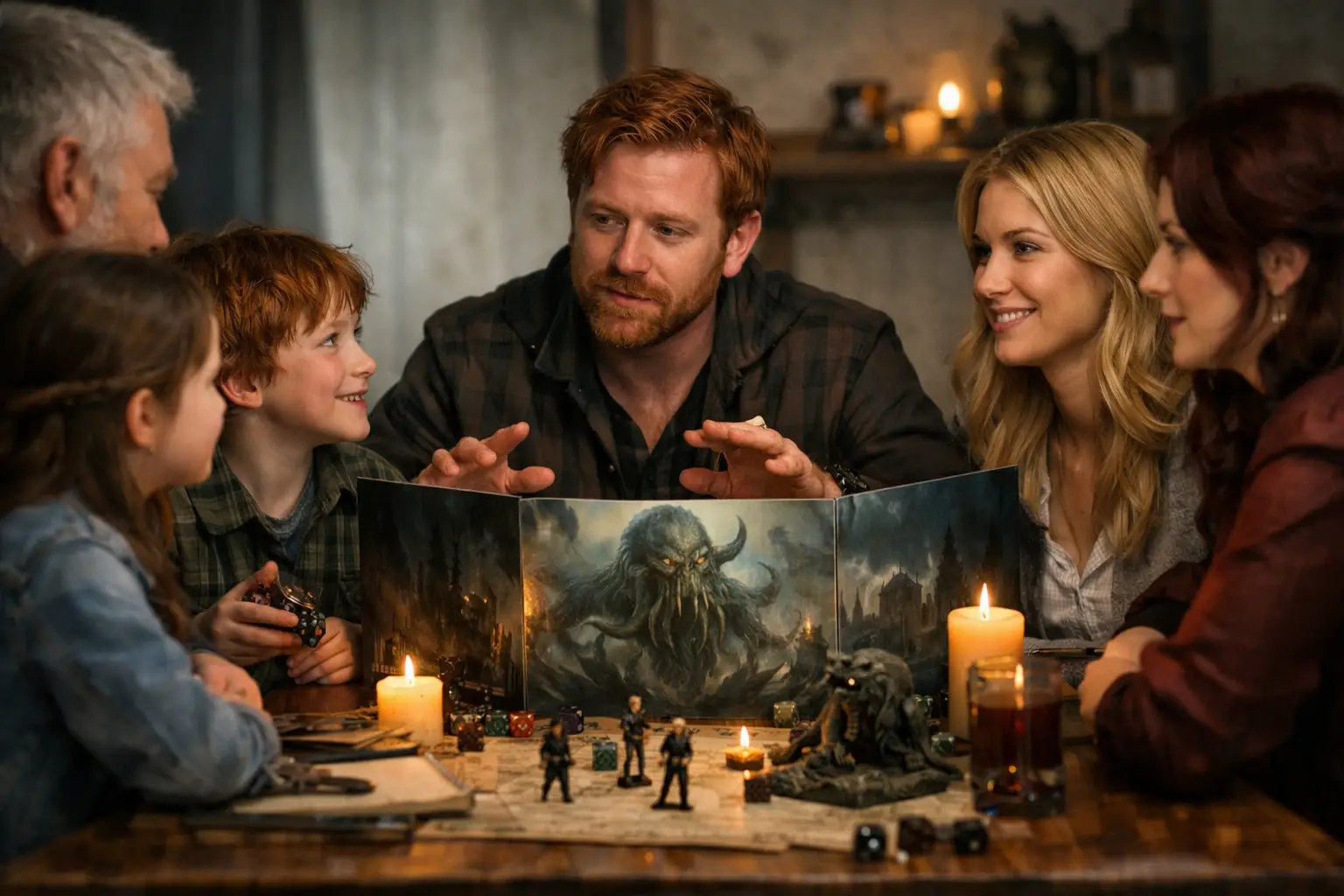
The first body is found in a locked room. Rain needles the windows. Your investigator has a notebook, a borrowed revolver, and the unnerving sense that the police constable is withholding something.
For a new player, this is where Call of Cthulhu either becomes unforgettable or quietly slips away.
The best GM for new Call of Cthulhu players is not simply the person who knows every rule or owns every sourcebook. They are the Keeper who can make uncertainty feel inviting, horror feel purposeful, and every choice feel as though the world has heard it.
Call of Cthulhu asks for a different rhythm from many tabletop games. Characters are not expected to win every fight, solve every mystery, or emerge unchanged. They investigate, interpret fragments, form uneasy alliances, and decide what they are willing to lose in pursuit of the truth. A first-time group needs a GM who understands that this difference should be taught through play, not delivered as a lecture before the first clue appears.
New players do not need a simplified world. They need a Keeper who reveals its complexity at the pace of their decisions.
What New Call of Cthulhu Players Need From a GM
Newcomers need clarity, but not over-explanation. A good Keeper establishes the basic social contract early: this is a game of investigation and mounting dread; violence is dangerous; failure can move the story in compelling directions; and nobody is expected to perform perfectly or possess encyclopaedic knowledge of the period.
That last point matters. Historical atmosphere gives Call of Cthulhu much of its power, whether the setting is 1920s London, a remote New England town, or a contemporary city with old secrets beneath its pavements. But history should be a doorway, not an examination. The right GM offers sensory details, social context, and gentle guidance when needed, allowing players to inhabit the era without fearing they have said the wrong thing.
They also understand the distinction between horror and helplessness. Cosmic horror can involve smallness, uncertainty, and the limits of human understanding. It should not mean that players have no meaningful decisions to make. A memorable campaign gives investigators difficult choices: protect a friend or preserve evidence, expose a truth or contain it, flee the house or descend one floor further.
Agency is not the promise that every decision succeeds. It is the assurance that decisions leave marks.
Trust Comes Before Terror
Before searching for a cult, opening a forbidden journal, or hearing a sound from beneath the floorboards, a new group needs to know what kind of table it is entering. This is especially true in horror, where themes can touch fear, grief, coercion, violence, illness, and loss of control.
An excellent Keeper holds a proper conversation about boundaries and desired tone. Some groups want a classic gothic investigation with candlelight and crumbling estates. Others prefer a pulpy, adventurous tempo. Some want psychological unease and moral pressure; others would rather keep disturbing material at a distance. There is no single correct answer, but there must be an answer shared by the table.
Safety tools are not an interruption to immersion. They are what make deeper immersion possible. When players trust that they can pause, redirect, or step back from material that crosses a line, they can engage with the fiction more freely. A skilled GM treats this as quiet professional craft, not as a burden or a theatrical announcement.
Consistency matters as well. If the Keeper presents a grim, grounded mystery one week and turns every scene into broad comedy the next, newcomers may struggle to understand what sort of story they are building together. Humour belongs at horror tables. People under pressure have always made jokes, occasionally even good ones. But the GM should protect the campaign’s emotional centre so that terror, grief, and relief are each allowed to land.
Investigation Must Create Movement
The most common early frustration in Call of Cthulhu is not a failed Sanity roll. It is a stalled investigation.
Players new to mystery games can become convinced that they missed the one vital clue, guessed the wrong answer, or ruined the session because they did not search a desk in precisely the correct manner. The corpse has already suffered enough. It should not also have to wait for someone to roll well.
A strong Keeper distinguishes between discovering essential information and understanding what it means. The information needed to continue should be available when the investigators meaningfully look for it. Skills, backgrounds, and methods determine the form in which it appears.
A doctor may recognise that water entered the victim’s lungs after death. A police officer may notice that the medical report was altered. An occultist may identify that the water did not come from the nearby river. A childhood friend may know that the victim had refused to go near water for twenty years.
The same mystery moves forward, but every investigator encounters it through a different relationship with the world.
A roll becomes meaningful when it changes time, risk, cost, or consequence. Failure might reveal the forgery only after its owner returns home. A pushed roll might uncover the missing page while alerting the person who removed it. The Keeper is not protecting a prewritten route. They are allowing discovery to produce pressure.
How the Elements Work Together in One Campaign
It is easy to describe a good Keeper by listing separate virtues: they research well, encourage agency, understand factions, track consequences, and make the world remember. At the table, however, these are not separate departments. They operate at the same time.
A useful example is The Two-Headed Serpent, Chaosium’s globe-spanning 1930s campaign for Pulp Cthulhu. Its heroes work for the medical-aid organisation Caduceus while moving through international crises, rival conspiracies, strange science, and increasingly dangerous questions about the people giving the orders.
The campaign is pulpy, but the lesson applies just as well to quieter Call of Cthulhu play. Its structure gives new players an immediate reason to act while allowing the Keeper to reveal a much larger world behind the assignment.
Consider a spoiler-light situation of the kind such a campaign can support.
The investigators are sent to a remote district where a medical team has disappeared. The mission sounds clear. Find the team. Recover its research. Assist the local population. Report to Caduceus.
A weak introduction would begin with seven pages of organisational history, a detailed account of regional politics, and three secret factions the players are not yet equipped to understand.
A strong Keeper begins with the heat.
Then the transport papers bearing the wrong names. The driver who recognises the Caduceus symbol but refuses to explain why. The clinic whose patients share symptoms that should not occur together. The medical report that seems plausible until someone notices it was dated two days before the outbreak began.
The players understand what they can do now. The deeper structure waits behind their decisions.
Research Makes the Situation Believable
Deep research does not mean requiring players to pass a history examination before they may enter the village. It means that the village behaves as though it has a history.
The Keeper understands who holds authority, what medical knowledge is available, how supplies arrive, which political wounds remain open, what outsiders routinely misunderstand, and how local people explain events that official institutions dismiss. That understanding shapes every conversation and obstacle.
The players are not required to know the history of the region. The world is required to behave as though it has one.
Research then becomes practical. It tells the investigators whom they can approach, which records exist, why a witness refuses them, and what may be lost if they choose the fastest solution. Atmosphere does not sit on top of the scene. It emerges from the conditions under which people live.
Clues Offer Knowledge, Not Instructions
The Keeper makes certain that the investigation can move. The missing team left traces. The clinic records contain inconsistencies. Someone saw vehicles leaving after dark. A damaged radio still holds part of a transmission.
But clues do not tell the group what they must do.
One investigator may want to report everything to Caduceus. Another may suspect that the organisation already knows. A third may trust a local doctor more than the people who supplied the expedition. The group can recover the research, destroy it, conceal it, expose it, or attempt to use it.
A good Keeper does not hide the door. They make the players decide whether opening it is wise.
Player Agency Changes the Mission
This is where genuine agency begins.
The investigators may save the medical team but refuse to surrender its research. They may expose Caduceus to a local authority. They may destroy a facility that their employers wanted preserved. They may cooperate with a faction they were warned to avoid because its explanation fits the evidence better than the official one.
In a fixed campaign, these choices eventually bend back towards the next prepared assignment.
In a living campaign, they change which assignment can exist next.
Caduceus may reduce support, increase surveillance, send a different handler, or attempt to recover the information by other means. A local group may become an ally. A rival organisation may recognise the investigators as useful, dangerous, or both. Resources, trust, and access shift because the players altered the conditions of the world.
Agency is not choosing how to complete the mission. It is deciding what kind of mission remains possible afterwards.
Factions Carry the Choice Beyond the Scene
A good Keeper does not treat factions as queues of NPCs waiting to provide dialogue.
Each group possesses interests, resources, dependencies, and fears. Caduceus wants the mission contained. Local authorities want stability. A rival network wants the research. Survivors want safety, revenge, recognition, silence, or some inconvenient combination of the four.
When the investigators choose one side, no faction simply records the result and waits for the next chapter. Information travels. Relationships change. People reinterpret what happened according to what they need from it.
The group sends evidence to Caduceus. The organisation gains knowledge and influence. Its rivals notice the imbalance. Local allies realise that the truth has left their control. Someone inside Caduceus decides that the investigators now know too much to remain unsupervised.
The decision has become part of a network.
Success Produces Counterforces and Successors
Suppose the investigators destroy the operation behind the outbreak.
That is a real victory. The Keeper should not erase it by quietly restoring the same threat under another name. But the victory has consequences because the defeated operation possessed knowledge, equipment, personnel, contacts, and a position within the larger struggle.
Other powers react to the new balance. Some fear the investigators. Some court them. Some imitate the methods they used. Others move to secure whatever remains.
The investigators destroyed the operation. The surviving organisations have begun discussing the inheritance.
This is where the Guardian and Nemesis principles become visible without requiring a lecture about campaign architecture. Growing power creates counterforces. Empty positions attract successors. Removing an enemy does not remove the conditions that allowed that enemy to act.
A strong Keeper takes victory seriously enough to ask what it has made possible.
The World Tick Connects One Session to the Next
Between sessions, the Keeper does not merely prepare another location.
They ask what moves now.
Who received the investigators’ report? Who intercepted it? Which faction changes strategy? Which witness disappears? Which resource becomes unavailable? Which ally gains courage? Which enemy learns from the group’s methods? What continues because the investigators never discovered it?
This does not require an enormous simulation or a novel written between every game. A few deliberate changes are enough, provided they follow from established pressures.
When the next session begins, the world is not reset to the moment when the players left it. Their handler sounds different. The newspaper uses a phrase from a supposedly confidential report. A survivor has become a public witness. A rival arrives with an offer that would have made no sense before the previous mission.
The campaign has remembered to keep breathing.
Bardic Resonance Lets Players Experience What Their Choice Became
Consequences matter most when they return to the table in human form.
The players may read an official report that reduces their rescue to an equipment malfunction. They may hear a survivor describe them as heroes, although they remember how uncertain and compromised the decision actually was. A hostile organisation may repeat the group’s tactics. A community may name the disaster after the wrong person because that version is easier to live with.
The players remember saving forty people. The official report remembers an unfortunate equipment failure.
That is more than bureaucratic humour. It shows that the world has processed their actions and turned them into memory, propaganda, rumour, gratitude, resentment, and policy.
Bardic Resonance is the moment players realise that their choice did not end when the scene did. It entered the stories other people tell.
Rules Knowledge Helps, but Judgement Matters More
A Keeper should know the system well enough to keep the table moving. New players should not spend their first evening watching someone search through pages while the atmosphere quietly leaves by the nearest window.
But rules expertise alone does not make someone the best fit.
Call of Cthulhu has mechanics for skills, combat, Sanity, luck, and sudden danger. Those mechanics serve a dramatic purpose. A seasoned Keeper knows when to slow down and explain an unfamiliar rule, when to make a ruling and check it later, and when not to call for dice at all.
Sanity deserves particular care. It should not become an excuse to seize a character and turn distress into spectacle. Its strongest use is as pressure: a record of what an investigator has witnessed, endured, and perhaps begun to understand. A good GM invites players to interpret those consequences in ways that remain respectful, playable, and true to the tone agreed by the group.
For players entirely new to tabletop roleplaying, look for a Keeper who enjoys teaching through questions rather than commands:
What does your investigator notice first?
Why does this letter matter to you?
Who do you call when the police refuse to listen?
Such questions provide a handhold without scripting the climb.
Questions Worth Asking Before You Join
When choosing a GM, ask how they introduce new players, how they handle boundaries, and what style of horror they enjoy running. Ask whether missed rolls can stall an investigation, whether character histories matter, and whether the game is a one-shot, a limited series, or the beginning of a longer chronicle.
Then ask one more revealing question:
What happens to the world after the investigators leave the room?
Listen not only for the answer, but for the spirit behind it. A thoughtful Keeper will be interested in what you want from the experience. They may have a strong creative vision, but they will make room for your curiosity within it. They will not promise a consequence-free story. They will promise that consequences mean something.
The best GM for new Call of Cthulhu players builds trust so the group can take risks. Research makes the situation believable. Investigation gives players something meaningful to understand. Agency lets them change the conditions. Factions carry those changes beyond the scene. The world continues moving. Memory brings the result back.
The first time an investigator realises that the clue on the mantelpiece connects to the name whispered in a dream, something shifts. The table falls quiet. A world that seemed strange becomes larger, older, and suddenly personal.
Choose the Keeper who can hold that silence, let it breathe, and ask what you do next.
Read. Play. Watch. Support. Or Collaborate.
Read: https://mythveilchronicles.com/
Play: https://startplaying.games/gm/dunchan
Watch: https://www.youtube.com/@MythveilChronicles
Support: https://www.patreon.com/mythveilchronicles_bydunchanhuntergames
Collaborate: https://www.linkedin.com/in/francisco-jos%C3%A9-z-b05aab371/
MYTHVEIL
We create worlds you want to live in.
Stories that remember. Worlds that change.