Andaluria: Blood & Desire · Monster, Myth & Humanity · Spooky October · Week 4 — Beyond the Veil

Explore Andaluria: Blood & Desire · Join the campaign on StartPlaying
Three Roads to the Iberian Otherworld · Beyond the Veil — When the Other World Answers · An Andaluria Essay with Caelwyn & Stacy
The ship arrived in Jesaña on a perfectly clear morning.
Its sails were intact. Its hull showed no damage. There was enough fresh water aboard for another week at sea, and the cargo had hardly been touched.
According to the harbor records, the vessel had been missing for thirty-seven years.
The captain insisted he had left three days earlier.
He was not particularly concerned about the discrepancy. Ships lost their way. Storms could drive them far off course. An unfamiliar current might carry a vessel into waters no navigator recognized.
What troubled him was the coastline.
He remembered sailing past a white cliff, then entering a sheltered bay where a woman stood among flowering trees.
She had offered his crew food and a place to rest.
When they departed the following morning, they found themselves approaching Jesaña.
He remembered the woman’s face perfectly.
He could even describe the little silver bells woven into her hair.
But he could not remember the name of his wife.
Or his children.
He knew he had loved them. He understood that much.
The names had simply disappeared.
STACY: “Thirty-seven years missing, three days experienced, and selective memory loss. That’s quite a collection of problems.”
CAELWYN: “You sound almost impressed.”
STACY: “I’m interested in the captain’s charts. And whether anyone has verified his age.”
CAELWYN: “There’s one detail you’ve overlooked.”
STACY: “Which one?”
CAELWYN: “He wasn’t afraid of the woman who welcomed him.”
Stacy considered that.
STACY: “Perhaps he should have been.”
The Triangle That Shouldn’t Exist
Along the Mediterranean coast of Spain, there is a modern mystery story sometimes called El Triángulo del Silencio — the Triangle of Silence.
Its commonly described boundaries lie between the Peñón de Ifach near Calpe, Es Vedrà off Ibiza, and the southwestern coast of Mallorca.
Stories surrounding the region involve unusual lights, missing vessels, disoriented travellers and alleged navigational disturbances.
It is an appealing mystery.
There is also an important distinction to make: the Triangle of Silence is a modern piece of mystery folklore, not an established ancient Celtic tradition. Claims of a paranormal zone have not been supported by convincing evidence.
Yet its geography invites a much older kind of question.
Why are certain places imagined as boundaries between worlds?
A great rock rises unexpectedly from the sea. A small island stands apart from its neighbors. A mountain appears to float above the horizon in the evening haze.
The landscape seems ordinary until, at the right moment, it doesn’t.
We have spent centuries telling stories about such places.
Modern legends might speak of magnetic anomalies, unusual energies or unexplained phenomena. Earlier generations had other languages for the same uncertainty: spirits, enchantment, hidden kingdoms, gods or the inhabitants of the Otherworld.
The explanations are different, and we should not pretend they describe the same documented events.
But their imaginative starting point is familiar.
Someone reaches a place they know.
And discovers that it is no longer quite the same.
For Andaluria, we can take the modern Mediterranean triangle as inspiration and transform it into something older and stranger: not a maritime danger zone, but a region containing several entrances to a hidden realm.
One lies beside the sea.
Another beneath an ancient hill.
The third opens at a spring whose waters sometimes reflect a sky that is not our own.
They are not three separate mysteries.
They are three ways of arriving in the same impossible country.
STACY: “So your theory is that the ship didn’t get lost.”
CAELWYN: “Not exactly.”
STACY: “It entered another world.”
CAELWYN: “And came back.”
STACY: “Without most of its passengers noticing they had been gone.”
CAELWYN: “Would you believe them if they told you?”
STACY: “I’d believe they experienced something. I wouldn’t yet know what.”
CAELWYN: “That’s a fair distinction.”
STACY: “Keep it in mind. We’ll need it.”
Spain Had Its Own Celts
When people think about Celtic mythology, their imagination often travels immediately to Ireland.
They picture the hollow hills of the Aos Sí, the islands of the blessed, the beautiful and treacherous kingdoms beyond the mortal world.
Sometimes Scotland or Wales enters the conversation.
Spain rarely does.
That is a remarkable omission.
During the Iron Age, large parts of the Iberian Peninsula were home to peoples whose languages and cultures belonged to, or interacted with, the wider Celtic world.
The Celtiberians occupied substantial areas of the central and northeastern interior. In the northwest, the communities associated with the castro culture developed their own regional traditions, social structures and religious practices. Celtic languages and religious names are attested in different parts of ancient Iberia.
There was never one single, uniform Celtic Spain.
Nor can we simply transfer every Irish myth to Celtiberia and declare it an ancient Spanish belief.
The surviving evidence does not support that.
Archaeology, inscriptions, ancient accounts and later folklore offer fragments of a complex picture rather than a complete map of an Iberian Otherworld.
But those fragments matter.
They remind us that the ancient religious history of Iberia was never limited to the familiar succession of Roman, Christian and Islamic traditions.
Before and alongside those transformations, people lived among sacred waters, remarkable stones, hilltop settlements and places associated with divine or supernatural power.
The names and meanings changed as centuries passed.
Some disappeared entirely.
Others survived in altered forms, woven into the stories of later communities.
And some places remained important long after everyone had forgotten why.
CAELWYN: “Imagine living beside a spring your grandparents regarded as sacred.”
STACY: “That doesn’t establish what they believed about it.”
CAELWYN: “No. But suppose a thousand years pass, and people still leave offerings there.”
STACY: “We’d have to determine whether the practices were continuous or independently developed.”
CAELWYN: “Naturally.”
STACY: “You’re enjoying this.”
CAELWYN: “A little.”
STACY: “Continuity is tempting. Especially when the story is beautiful.”
CAELWYN: “And skepticism is necessary. Especially then.”
Neither disagreed.
The past is not obliged to preserve itself for our convenience.
A legend recorded centuries after a civilization vanished cannot automatically tell us what that civilization believed.
But it can tell us something about the people who inherited its landscape.
And that is where our second doorway begins.
The People Beneath the Stones
In Galicia and neighboring parts of northwestern Iberia, folklore frequently associates ancient ruins, burial mounds, caves and other remarkable places with beings called mouros and mouras.
Despite the similarity of the names to words for historical Moors, these folkloric beings should not simply be confused with the Muslim inhabitants of medieval Iberia.
In many stories, they belong to a mysterious, enchanted population associated with ancient places and hidden treasures.
A moura may appear beside a spring, inside a cave or near an old hillfort.
Sometimes she is beautiful. Sometimes she guards treasure. She may appear in an altered form, including that of a serpent.
There may be an enchantment that can be broken.
There may be an offer.
There is often a condition.
What makes these traditions particularly interesting is the way they attach supernatural inhabitants to real places.
An abandoned settlement does not remain empty in the imagination of those who live nearby.
Someone must have built those walls.
Someone must have hidden the treasure.
Someone must still be there.
The mouros become one way of explaining the presence of an unfamiliar past within a familiar landscape.
This does not prove that the stories preserve an uninterrupted prehistoric religion. Folklore scholars have repeatedly cautioned against that assumption.
Instead, they show how later communities made sense of ruins, monuments and places whose original purposes had become obscure.
The ancient inhabitants became the hidden people.
The forgotten settlement became an enchanted one.
And a doorway in the rock might lead somewhere that human beings had no right to enter.
It is a remarkably fertile foundation for Andaluria.
Not because we can reconstruct a lost Celtic fairy kingdom with historical certainty.
Because we can create a fictional Iberian Otherworld that draws on genuine regional traditions without pretending that every detail is ancient fact.
A Well in the Serracorte
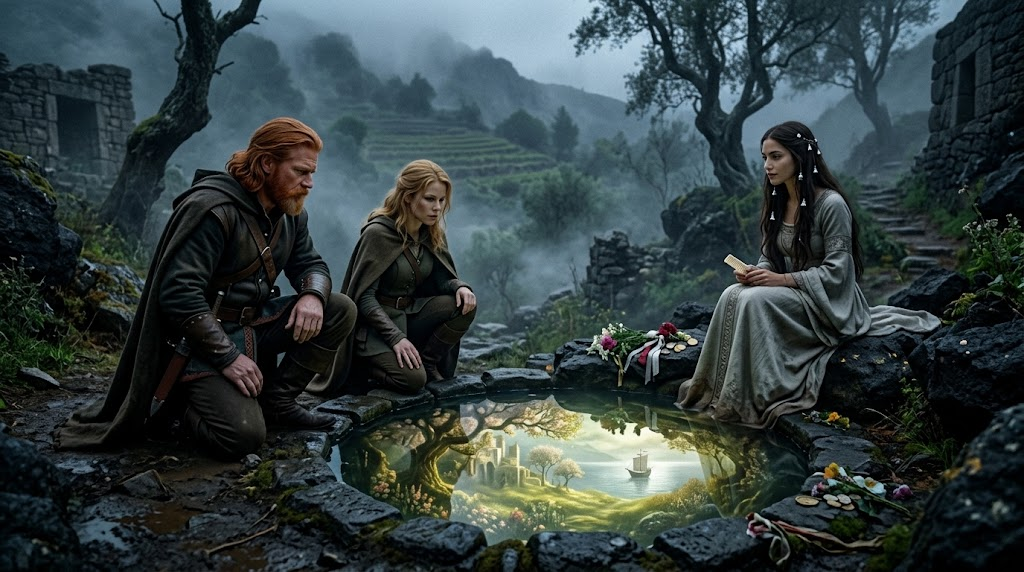
The woman was waiting beside the spring when Caelwyn and Stacy arrived.
She was sitting on a flat stone, combing her dark hair with a small ivory comb.
The spring emerged from a crack in the volcanic rock and gathered in a shallow basin beneath an ash tree.
Someone had tied strips of colored cloth to its branches.
There were old coins in the water, along with a few offerings of dried flowers and grain.
STACY: “Someone still maintains this place.”
CAELWYN: “The Caio, perhaps.”
In Andaluria, Caio folk traditions preserve an assortment of protective practices, spirit offerings and orally transmitted knowledge.
The Church of the Golden Eminence regards many of those practices with suspicion. Yet both church rituals and Caio protections have genuine power within the setting, and ordinary people frequently draw upon both.
That distinction matters.
The Caio are not a disguised historical Celtic people. Their culture belongs to Andaluria’s own fictional history.
But their respect for old places and unseen spirits gives us a natural way to introduce the kind of encounter that Iberian folklore has long associated with wells, hills and ruins.
The woman at the spring looked up.
“You have come to ask about the lost sailors.”
Stacy stopped.
STACY: “We haven’t introduced ourselves.”
The woman smiled.
“No.”
CAELWYN: “Do you know where they’ve been?”
“Yes.”
“Will you tell us?”
“Certainly. But first, you must give me something.”
STACY: “There it is.”
The woman tilted her head.
“Something?”
STACY: “The condition.”
“I ask very little.”
STACY: “That’s rarely reassuring.”
The woman laughed.
It was a pleasant sound.
For a moment, the spring seemed warmer and the mountain air sweeter.
“What would you give to understand a thing that has puzzled you all your life?” she asked.
Caelwyn considered the question.
Stacy did not.
STACY: “Nothing until I know the terms.”
The woman regarded her with renewed interest.
“Very sensible.”
She pointed to the water.
“Look.”
At first, Stacy saw only her reflection.
Then the sky behind it changed.
The familiar grey-blue of a late Andalurian afternoon became a deep, luminous green.
The ash tree above the spring was still there.
But in the water’s reflection, it stood at the center of a wide garden filled with flowering trees.
Somewhere, someone was singing.
Stacy stepped back.
The song continued.
CAELWYN: “Is that where the sailors went?”
The woman looked at him.
“They came through the sea.”
STACY: “And this spring leads to the same place?”
“All three roads do.”
“Three?”
“The sea. The stone. The water.”
She laid her comb across her knees.
“Your people remember the roads. They have forgotten how to travel them.”
The Otherworld Is Not Heaven
The Irish Otherworld offers a useful comparison.
In medieval Irish literature and later folklore, places associated with the síd and their inhabitants may be reached through hills, hidden entrances or journeys beyond ordinary geography.
Other stories lead across the sea to extraordinary islands.
Time can behave differently there.
A visitor may spend what seems like an evening among supernatural hosts and return to discover that years have passed.
Some encounters bring gifts, healing or love.
Others end in captivity, loss or death.
The Otherworld is not simply heaven.
Nor is it necessarily hell.
Its inhabitants are not reliably equivalent to angels, demons or the souls of the departed.
They possess their own desires, relationships and expectations.
And that independence is what makes them so interesting.
If a creature wants to eat you, the danger is comparatively straightforward.
If a supernatural host invites you to dinner, offers you comfort and asks only that you stay until morning, the situation is considerably more difficult.
Especially if morning means something different to the host.
Stories of enchanted places frequently turn ordinary social behavior into something perilous.
Hospitality.
Gift-giving.
A promise.
A shared meal.
The difficulty lies not always in the demand itself, but in the rules that govern it.
In everyday human society, accepting a cup of wine might mean little more than thanking your host.
In another world, it could mean accepting a place at their table.
Perhaps forever.
STACY: “There’s a problem with calling this a fairy realm.”
CAELWYN: “Only one?”
STACY: “At least three. First, we’re importing an Irish interpretive framework into an Iberian setting. Second, we’ve no evidence that the ancient Celtiberians imagined exactly this kind of kingdom.”
“And third?”
“Fairy suggests something charming. Small creatures with wings.”
Caelwyn smiled.
CAELWYN: “The older stories are considerably less charming.”
“Precisely.”
“Then what would you call it?”
Stacy looked down into the spring.
The impossible garden remained visible.
STACY: “For the moment? Somewhere else.”
It was not a particularly poetic answer.
It was a useful one.
A Country Without a Map
The woman at the spring rose to her feet.
“You may enter,” she told them.
Stacy glanced at Caelwyn.
STACY: “We haven’t agreed to anything.”
“You have not.”
“Will entering place us under an obligation?”
“Only if you accept one.”
“Will time pass differently?”
“Sometimes.”
“Will we be able to leave?”
“That depends.”
STACY: “On what?”
“Whether you remember where you belong.”
Caelwyn studied her.
“Is that what happened to the captain?”
The woman said nothing.
The garden in the water stirred.
For an instant, the surface showed something else.
A long table stood beneath flowering branches. Men and women were eating together. A sailor in a weathered coat sat among them, laughing.
He looked remarkably like the missing captain.
At his side sat a woman with silver bells in her hair.
Around the table were other guests.
Some wore clothes that looked centuries old.
Others dressed like contemporary merchants, farmers and travelers.
One elderly man was wearing an old-fashioned Caio charm around his neck.
At the far end sat a child, no older than ten.
She looked toward the spring.
Directly toward Stacy.
Then the image vanished.
STACY: “Those people. Are they prisoners?”
The woman frowned.
“Some came willingly.”
“That wasn’t my question.”
“Some have forgotten why they came.”
“And the rest?”
“They remember.”
CAELWYN: “Why don’t they leave?”
The woman touched the ivory comb.
“Perhaps they are happy.”
Stacy looked at her for a long moment.
STACY: “You could have answered that more clearly.”
“Would you have believed me?”
Stacy did not respond.
There was no cruelty in the woman’s expression.
That made the encounter harder.
If she had threatened them, they would have known where they stood.
Instead, she seemed genuinely puzzled that anyone might refuse the hospitality of her world.
Perhaps she was lying.
Perhaps she was entirely sincere.
Neither possibility was comforting.
The Problem with Calling Them Monsters
In Dark Heart of Andaluria, the nights are growing unnaturally long. Ghosts, vampires, ghouls and other creatures threaten the population, while monster hunters struggle to protect communities whose traditional defenses are failing.
The campaign’s great tension is not simply that monsters exist.
It is that the line between protector, predator and monster can become difficult to maintain.
That question becomes especially compelling when we introduce beings who do not share human expectations.
Consider the woman at the spring.
She has not attacked anyone.
She has offered information.
She has warned that accepting an invitation may have consequences.
From her perspective, perhaps she has been perfectly fair.
Yet people who enter her world may lose years of their lives. They may forget those they love. They might be unable to return.
Does that make her evil?
A human guest might say yes.
She might regard the same arrangement as ordinary hospitality.
This is not an excuse for whatever harm she causes.
Different customs do not erase suffering.
But it changes the nature of the encounter.
A vampire in Andaluria may be driven by a hunger that demands blood. An entity from the Otherworld may be driven by rules that make sense within its own society but become devastating when imposed upon mortals.
The danger is not necessarily a desire to destroy.
It can be indifference to the things human beings cannot afford to lose.
Time.
Family.
Memory.
The right to leave.
And sometimes, the danger lies in our own desires.
Imagine a grieving parent who discovers a place where the dead seem young again.
A lonely person offered a feast that never ends.
An aging ruler promised a kingdom where no one grows old.
Not every visitor would need to be tricked.
Some would walk through the doorway gladly.
CAELWYN: “The captain may have accepted the bargain.”
STACY: “Without understanding it.”
“Perhaps he understood more than we think.”
“You believe he chose to forget his family?”
“I wonder whether he chose something else and discovered the cost afterward.”
Stacy watched the spring.
STACY: “Then there’s a difference between consent and an informed choice.”
“A rather important one.”
“And between a generous offer and one designed to exploit someone’s weakness.”
Caelwyn nodded.
“That sounds familiar.”
“In Andaluria?”
“In most places where power meets desire.”
The Three Roads
The woman drew three lines in the dust with the end of her comb.
The first curved like a coastline.
The second rose into a pointed hill.
The third wound between them like a river.
“The sea remembers every shore,” she said. “Even those that no longer exist.”
She touched the second line.
“The stones remember those who built beneath them.”
Then the third.
“The water remembers every name spoken over it.”
Stacy crouched beside the drawing.
STACY: “And what does your world remember?”
The woman looked surprised.
“Everything that is given to it.”
CAELWYN: “Including the captain’s memories?”
“Yes.”
“Can he have them back?”
“Of course.”
Stacy looked up sharply.
STACY: “How?”
The woman smiled.
“Someone must come and collect them.”
There it was again.
The bargain.
A perfectly reasonable request, depending on who made it.
A terrible prospect, depending on who had to fulfill it.
STACY: “And what would that person have to give you?”
“Nothing.”
Stacy waited.
The woman continued.
“Unless they wished to take something that did not belong to them.”
STACY: “His memories belong to him.”
“Do they?”
The woman gestured toward the water.
“He told us stories of his home. We listened. We welcomed him. He left us those memories when he departed.”
Caelwyn understood then.
To the woman, memory was not something stored safely inside a person’s mind.
It was a gift that could be offered.
A possession that could change hands.
Perhaps even a form of payment.
And if that was true, recovering the captain’s past might require persuading someone who believed they already owned it.
CAELWYN: “You have very different ideas about what a gift means.”
“Do we?”
“Yes.”
The woman regarded him thoughtfully.
“Your people give promises they do not keep. You offer love and take it back. You sell land where your grandparents are buried. You trade the work of others for gold.”
She looked from Caelwyn to Stacy.
“Are you certain your rules are easier to understand?”
Neither answered immediately.
It was not because she had proved her point.
She hadn’t.
It was because she had asked a question neither could dismiss.
The Land Remembers
Folklore often reveals how communities understand the places around them.
A spring may be a source of drinking water, a place of healing, a sacred site or the home of a dangerous supernatural presence.
An ancient hillfort can be an archaeological monument and, at the same time, the setting of stories about hidden inhabitants.
A stretch of coastline can be an ordinary route for fishermen while also attracting tales of lights, vanished ships and impossible islands.
These meanings can coexist.
They need not all be factually true to shape how people behave.
In Galicia, stories of mouros and mouras offer a particularly rich example of how the imagination inhabits an archaeological landscape.
In Ireland, stories of the síd express another relationship between place and the unseen.
In modern Mediterranean mystery folklore, the Triangle of Silence gives a supernatural meaning to a familiar stretch of sea.
We should be careful not to collapse these traditions into a single supposed ancient belief.
Their histories are different.
Yet placing them alongside one another allows us to explore a compelling possibility for Andaluria.
What if its old folk traditions preserve not a complete description of the Otherworld, but practical warnings about dealing with it?
Perhaps the Caio know that certain springs should not be disturbed.
Perhaps a particular hill is avoided after sunset.
Perhaps families still leave offerings beside a road because something there expects to be acknowledged.
No one needs to understand the entire cosmology for the custom to matter.
The practice may outlive the explanation.
A child learns not to accept food from a stranger beside the well.
A farmer knows which path to avoid on a particular night.
A traveler is told to remember the names of everyone waiting at home.
These warnings may sound like superstition to those who have forgotten their origins.
Until the old paths open again.
And the people who ignored them begin to disappear.
The Name He Could Not Remember
Before leaving the spring, Stacy asked one final question.
STACY: “The captain’s wife. Can you tell us her name?”
The woman looked puzzled.
“Why?”
“Because he cannot remember it.”
“And you wish to tell him?”
“Yes.”
“Would that help him?”
Stacy took a moment.
STACY: “I think it might.”
The woman considered this.
Then she spoke a name.
It was an ordinary name.
The kind spoken a thousand times every day across Andaluria.
Stacy repeated it carefully.
The woman smiled.
“You see? I have given you something, and asked for nothing in return.”
STACY: “Thank you.”
“You’re welcome.”
Caelwyn bowed his head.
As they turned away, the woman spoke again.
“You should visit us sometime.”
Stacy did not look back.
STACY: “Not without better information.”
The woman laughed.
Then the spring was only a spring.
The water reflected the ordinary Andalurian sky.
The ivory comb lay on the stone where she had been sitting.
Caelwyn picked it up.
STACY: “I wouldn’t.”
“Why?”
“It may be a gift.”
He put it down again.
They began the long walk toward Jesaña.
For some distance, neither spoke.
Then Caelwyn asked:
“Did you notice what she didn’t tell us?”
Stacy nodded.
“The captain’s memories might be recoverable. But she never promised he would survive the journey.”
“Or that he would want to return afterward.”
“There’s another possibility.”
“What’s that?”
Stacy looked back toward the hills.
“Perhaps the most dangerous part of her world is how beautiful it is.”
Beyond the Veil
In our imaginative Andalurian adaptation, the Triangle of Silence is no longer merely a stretch of treacherous sea.
It is a region where three kinds of landscape — coast, ancient stone and sacred water — touch the same hidden world.
The idea draws inspiration from the modern Mediterranean mystery, from the documented Celtic presence in ancient Iberia, from Galician traditions of enchanted beings, and from the rich literary Otherworlds of Ireland.
But the realm itself is our creation.
It belongs to Andaluria, not to a reconstructed historical religion.
Its inhabitants are not simply Irish fairies wearing Iberian clothes.
Their world reflects the region around them: volcanic stone, old settlements, springs, vineyards, trade, hospitality, memory and the uneasy relationship between people and the land.
Some of its inhabitants may be cruel.
Others may be generous.
Most are likely to be more complicated.
What makes them frightening is not that they are secretly demons.
It is that their promises can be genuine, their hospitality sincere, and their understanding of the world utterly incompatible with ours.
For the captain, the voyage cost thirty-seven years.
He returned with his ship, his cargo and a memory of extraordinary beauty.
He had forgotten the people who once made his life worth living.
When Stacy finally found him in Jesaña, she spoke his wife’s name.
For a moment, he looked blank.
Then he began to weep.
He remembered her face.
He remembered their first meeting.
He remembered holding their daughter when she was born.
The memories returned so quickly that he struggled to speak.
When he could finally manage a question, it was the simplest one imaginable.
“Where is she?”
Stacy did not answer at once.
She had spent the afternoon examining the old harbor records.
She knew what thirty-seven years meant.
And she knew that the captain was about to discover it.
CAELWYN: “There are doors we open because we are afraid of what lies beyond them.”
STACY: “And others because we hope to find something wonderful.”
CAELWYN: “Which is more dangerous?”
Stacy looked at the captain, who was still waiting for an answer.
STACY: “The door isn’t the problem.”
“Then what is?”
“Believing we can cross it without leaving anything behind.”
Beyond Jesaña, the Valmorria continued toward the sea.
High above the vineyards, the Serracorte stood silent in the fading light.
Somewhere among those hills, a woman with silver bells in her hair was waiting for another visitor.
And perhaps, far beyond the visible coast, a ship was just now arriving at a shore that did not exist on any human map.
Its passengers would be welcomed.
They would be offered food, music and a place to rest.
And none of them would think to ask how long the night might last.
WORLDS THAT REMEMBER — CTA
In Mythveil Chronicles, memory and hospitality can change the fate of a community. In Daggerheart: Andaluria — Blood & Desire, accepting a gift can change a life forever.
Real TTRPG. Real story. Real choices. Real consequences. A living world that moves on — with or without you.
Explore Andaluria: Blood & Desire
Join Andaluria on StartPlaying
Mythveil Chronicles — Worlds That Remember.