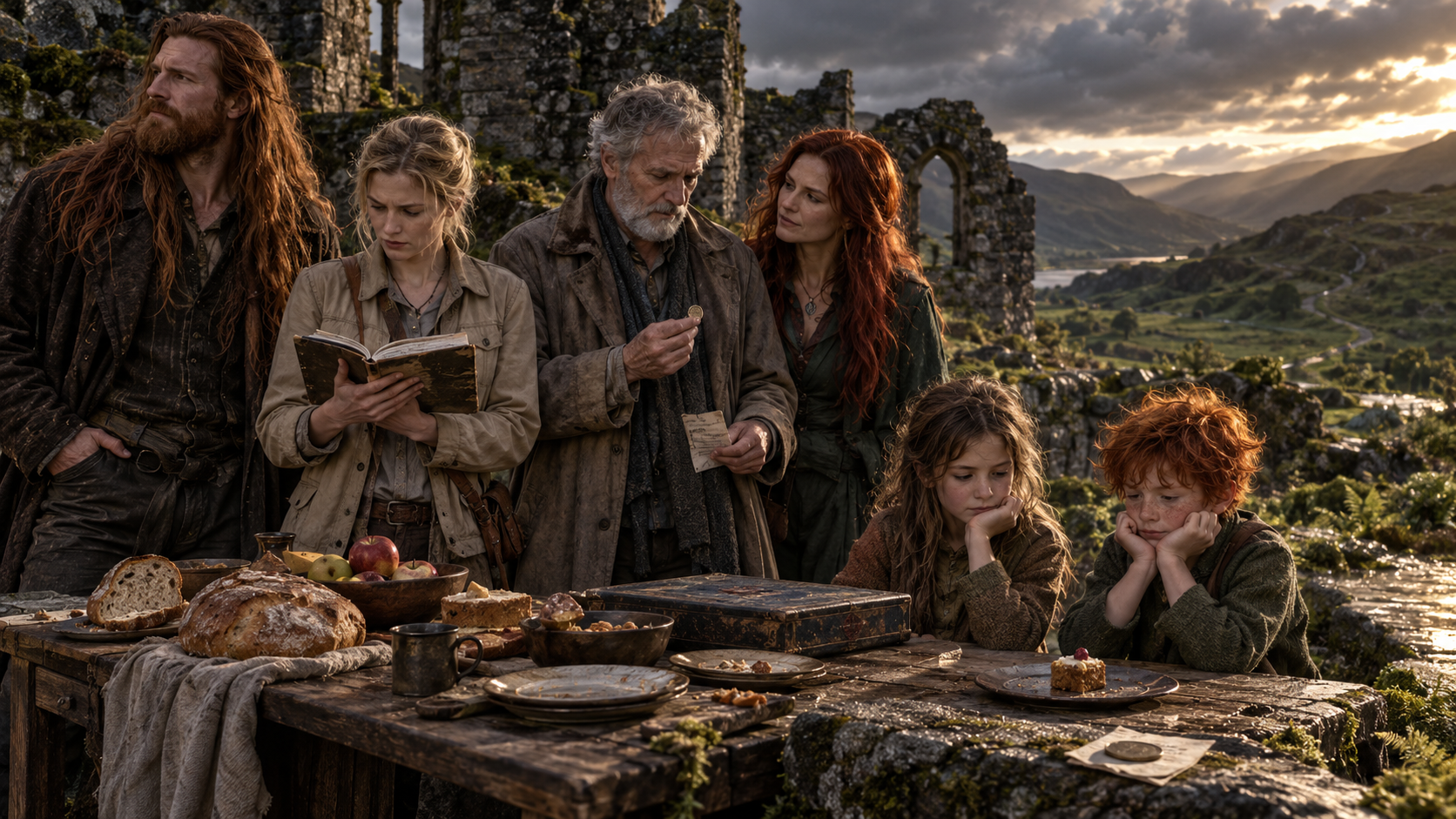
A good RPG expansion gives you more things.
More classes. More monsters. More equipment. More pages.
Daggerheart: Hope & Fear certainly does that.
The 196-page hardcover contains four new classes with eight subclasses, a completely new Dread Domain, six Transformations, six Ancestries, six Communities, more than 130 adversaries, 28 environments, more than 100 weapons, armour pieces, items and consumables, and four Campaign Frames. The physical package adds the cards required for the new character options and an adversary rip pad. The Deluxe Edition goes further with a GM screen, Fear tokens, dice and additional physical accessories.
That is a lot of Daggerheart.
It is also the least interesting thing about Hope & Fear.
Because after reading it, building characters with it and beginning to use Dark Heart of Andaluria as the foundation of our own campaign, a more interesting question emerged:
What kind of Daggerheart does this expansion make possible?
That requires more than counting cards.
So this is not going to be a short buyer’s guide.
We are going through Hope & Fear from the perspective that matters to us at Mythveil Chronicles: what happens when these mechanics reach an actual table, what kinds of characters and stories they encourage, where they work beautifully, where they demand more from players or Game Masters, and what other games have already taught us about some of the territory Daggerheart is entering.
And occasionally the Mythveil Family will disagree about it.
They usually do.
That is useful.
## Before Hope & Fear: what kind of game is Daggerheart?
Hope & Fear does not repair Daggerheart.
It expands it.
That distinction matters because anyone hoping that the first major expansion would turn Daggerheart into a more conventional tactical fantasy RPG is going to be disappointed.
Daggerheart remains Daggerheart.
It is built for long-form, character-focused fantasy campaigns and explicitly expects the group to participate in creating the world. Its central resolution system uses two d12s: Hope and Fear. Their total helps determine whether an action succeeds, while the higher die tells us something equally important about what that success or failure leaves behind.
Success with Hope is not the same dramatic event as success with Fear.
Failure with Hope does not need to feel like failure with Fear.
That gives Daggerheart a different rhythm from a conventional binary task-resolution system.
The dice are not only asking:
Did you do it?
They are also asking:
What did doing it put into motion?
That is where Daggerheart is strongest.
A locked door does not necessarily produce the old sequence of one character failing, another trying, somebody adding a bonus, another roll failing and eventually somebody wondering whether the barbarian can simply remove the wall.
The scene is encouraged to move.
Failure can reveal something.
Success can create pressure.
Hope can become a resource.
Fear can become a GM resource.
The situation changes.
For cinematic fantasy this works extremely well.
For investigation it can be excellent because a failed roll does not have to murder the investigation in a corridor before the characters find the interesting room.
For social play it creates room for imperfect victories.
You convinced him.
Unfortunately, somebody else was listening.
That is fertile ground.
It also means the system asks something of the people playing it.
Daggerheart frequently provides a dramatic instruction rather than a complete dramatic answer.
What does Fear mean here?
What does this failure change?
When should the GM move?
How much narrative contribution does the table want?
A confident group can turn that openness into extraordinary momentum.
A group that wants procedures to settle most questions may occasionally feel as though Daggerheart has handed them a very attractive toolbox and neglected to include the foreman.
Stacy noticed this almost immediately when we began looking more closely at the system.
Daggerheart is not actually rules-light in the sense of having very few mechanics. There are Domains, cards, Hope, Fear, Stress, armour, thresholds, Experiences, conditions, class resources and character abilities.
What it often is, however, is procedure-light.
That is different.
The mechanics give you many ways to affect what is happening, while the table retains considerable responsibility for deciding exactly what that happening means.
Caelwyn likes that distinction.
Stacy immediately asked who has to do the extra work.
Both questions are valid.
And Hope & Fear makes both more important.
## Combat without waiting for your number to be called
Daggerheart’s combat is another place where its identity becomes obvious.
There is no conventional fixed initiative order. The game instead works with a fluid spotlight, with the fiction, player actions and GM moves determining the rhythm of a confrontation. The final Core rules removed the earlier action tracker and retained an optional spotlight tracker instead.
When this works, combat can feel wonderfully alive.
The Warrior drives an enemy backwards.
The Ranger sees the opening and acts.
Someone notices the bridge collapsing and abandons the attack to grab a companion.
The GM introduces pressure.
The scene flows.
Nobody has to say:
“Sorry, you cannot save him yet. You are initiative 17.”
That cinematic freedom is one of Daggerheart’s genuine strengths.
It is also socially demanding.
A fixed initiative system performs a mundane but valuable service: eventually it tells the loud player to stop and the quiet player that it is their turn.
Daggerheart expects the people at the table to share that responsibility.
Experienced groups and attentive GMs may barely notice.
At tables with large differences in confidence, speed or personality, spotlight management becomes an actual GM skill.
Mara’s question was simpler:
“But what if somebody never says they want to go?”
Exactly.
The rules cannot entirely solve that.
The table has to notice.
That tension between freedom and responsibility runs through almost everything in Daggerheart.
Hope & Fear embraces it rather than retreating from it.
## What is actually in the Hope & Fear box?
The standard edition contains the 196-page hardcover and a substantial physical card package.
There are cards for the complete Dread Domain, all eight new subclasses, six Transformations, six Communities and six Ancestries. There is also a rip pad of blank adversary sheets.
The book itself contains the rules for Witch, Warlock, Assassin and Brawler, more than 130 adversaries, 28 environments, over 100 pieces of equipment and consumables, and four Campaign Frames: Castle High, Journey to Horizon, Reign of the Weredragon and Dark Heart of Andaluria.
Darrington has also made Hope & Fear character sheets, multiclass sheets, equipment references, print-and-play cards and materials for all four Campaign Frames available digitally. The updated SRD 2.0 incorporates the classes, Dread Domain, Transformations, adversaries, environments, Ancestries, Communities, equipment and setting-neutral versions of Campaign Frame mechanics.
That last point matters more than it first appears.
Hope & Fear is not a sealed expansion.
A surprising amount of its mechanical architecture is available for people to study, adapt and build upon.
For Game Masters, designers and inveterate tinkerers, that is excellent.
For Chibi, it is presumably a licence to commit crimes.
We have hidden the scissors.
## Four new classes – and they actually fill different spaces
The headline player addition is obvious:
Witch.
Warlock.
Assassin.
Brawler.
The good news is that these are not four costumes draped over existing classes.
Each introduces a recognisable gameplay identity.
The more interesting news is that they are not equally simple.
### The Brawler: yes, you punch people – but that is only the beginning
The Brawler is the easiest class to misunderstand from its elevator pitch.
It is the unarmed fighter.
Fine.
Daggerheart already has a Warrior and Guardian. Why do we need somebody whose defining contribution is apparently forgetting to buy a sword?
Because the actual class is built around momentum and escalation.
The Brawler combines the Bone and Valor Domains. It begins with Evasion 10 and six Hit Points. While fighting without another active weapon, its Brawler’s Strike uses a trait chosen by the player, works at Melee range and deals d8+d6 physical damage using Proficiency. Both dice scale with Proficiency, and fighting this way grants +1 Evasion.
That already does something clever.
The Brawler is not punished for refusing conventional equipment.
His body genuinely is his weapon.
Then comes Combo Strike.
After dealing damage with a successful Melee attack, the Brawler can mark Stress and begin rolling a Combo Die. He continues rolling until the latest result is lower than the previous one, adding the accumulated results to the attack’s damage. The die begins as a d4 and can be increased once per tier through advancement.
That creates a little push-your-luck game inside the attack.
Sometimes it ends immediately.
Sometimes it keeps going.
And suddenly everybody at the table is watching a d4.
Sean understood the appeal instantly.
“You’re telling me I hit him and then find out how long I continue hitting him?”
More or less.
“Good.”
There is something almost arcade-like about it. The mechanical pleasure is not simply high damage. It is watching a combination continue.
That also means the Brawler contains more randomness in his signature damage mechanic than players who prefer predictable optimisation may enjoy.
The Warrior feels trained.
The Guardian feels defensive.
The Brawler feels explosive.
And the subclasses split that identity in two very different directions.
### Juggernaut: make the battlefield regret standing near you
The Juggernaut is the simpler of the two concepts, but simple does not mean empty.
Its Foundation abilities make it harder to put down and allow successful attacks to reposition or pressure enemies. Later abilities let it attack multiple nearby creatures, retaliate when injured and extract more value from critical Melee attacks.
This is not merely “Brawler but tougher.”
It changes the Brawler from a single-target combo fighter into a physical battlefield problem.
Enemies close to the Juggernaut have to care about where they stand.
Being surrounded can become an opportunity.
Being hit can provoke retaliation.
Movement becomes a weapon.
That is important in Daggerheart because the system does not want tactical combat to depend entirely on grids and five-foot increments.
The Juggernaut creates tactical meaning through fictional positioning.
Sean likes it.
Eljara pointed out that this may be the least surprising thing about him.
### Martial Artist: considerably more game inside the game
The Martial Artist is much more elaborate.
It introduces Stances and Focus.
The character begins by learning two Tier 1 Stances and acquires more while levelling. Focus represents poise and control; it is generated during rest and spent to move between Stances and fuel abilities. Higher-level features can turn Focus into defence, ranged magical force, spectacular physical feats and eventually allow Stress and Focus to substitute for one another in parts of the Brawler’s engine.
This is a fundamentally different experience from Juggernaut.
Juggernaut says:
Get in there.
Martial Artist asks:
How do I want to fight this particular problem?
That gives the subclass considerably more flexibility but also more cognitive load.
You have your ordinary Daggerheart resources.
Your Domain cards.
Stress.
Hope.
And now Stances and Focus.
For a player who enjoys manipulating a small tactical engine, that is excellent.
For someone who selected Brawler because “I don’t want to read spells; I want to punch the ogre,” Juggernaut is probably the more natural expression of that fantasy.
Mara eventually asked whether a Brawler always had to solve things by fighting.
No.
And that is actually one of Daggerheart’s strengths.
The class tells us how the character is exceptional in violence.
It does not tell us what the character believes violence is for.
That remains roleplaying.
Chibi suggested throwing the table before starting the fight.
We have not found a rule explicitly prohibiting this.
This concerns Stacy.
## Assassin: the murder happens before the attack roll
The Assassin combines Midnight and Blade, starts at Evasion 12 with five Hit Points and is built around identifying a target and making that target’s immediate future extremely unpleasant.
Its signature ability, Marked for Death, lets the Assassin mark Stress after a successful weapon attack to designate one adversary. Damage against that target gains additional d4s according to tier. Only one target can normally be marked, and the GM can spend Fear to remove the condition.
That makes the class a focused predator.
But the ability that tells us more about the Assassin’s actual design philosophy is Get In & Get Out.
By spending Hope, the player can ask the GM for a quick or inconspicuous route into or out of a visible location, with advantage on the next roll exploiting that information.
That is excellent.
Because assassination should not begin when initiative starts.
It begins with access.
Routes.
Observation.
Timing.
Information.
Escape.
Daggerheart turns part of that fantasy into a narrative permission rather than requiring the player to pixel-hunt the GM’s description for the one climbable drainpipe.
Some players will love that.
Others may prefer games in which reconnaissance is itself the puzzle.
Neither approach is inherently superior.
They create different fantasies of competence.
Blades in the Dark often lets capable criminals establish preparedness through its own narrative structures. Hitman makes reconnaissance and environmental manipulation the central play space. Traditional fantasy RPGs may make infiltration a sequence of discrete skill checks.
Daggerheart’s Assassin says, in effect:
You are an Assassin. You know how to look for a way in.
Now let us find out what happens when you use it.
That is a very Daggerheart solution.
### Executioner’s Guild: choose somebody who really needs to die
The Executioner’s Guild develops the precision-killer side of the class.
Its Foundation abilities reward the Assassin’s first successful strike and improve Marked for Death, pushing the character towards decisive attacks against selected targets.
This is the fantasy of the professional killer.
Identify.
Approach.
Strike.
Finish.
Mechanically satisfying, certainly.
But at Mythveil the interesting question begins one step earlier:
Who put the name on the list?
Eljara immediately wanted to know that.
An Assassin becomes dramatically much more interesting when killing is not merely an efficient combat action.
Who pays?
Who benefits?
Who inherits?
Who investigates?
Who wanted the target alive?
Who was told that the target deserved to die?
The class does not need to answer those questions.
A living campaign should.
### Poisoner’s Guild: killing is only one possible outcome
The Poisoner’s Guild shifts the Assassin towards afflictions, preparation and debilitating enemies rather than simply maximizing the decisive strike. Official descriptions frame it around punishing afflictions, contrasting it with the Executioner’s lethal precision.
That immediately broadens the fantasy.
Poison can kill.
It can also weaken, incapacitate, terrify, embarrass or create a window for somebody else.
And socially, poison has a completely different texture from stabbing somebody in an alley.
A blade creates a corpse.
Poison can create a mystery.
For an intrigue-heavy campaign, that difference matters.
## Witch: perhaps the class that best understands Hope & Fear
The Witch combines Sage and the new Dread Domain.
And one of its defining abilities contains a wonderfully Daggerheart idea:
failure does not necessarily have to remain failure.
The Witch can manipulate an unsuccessful result into success with Fear.
That sounds like a mechanical rescue button.
Narratively it is much more interesting.
You succeed.
But Fear comes with you.
That is almost a miniature statement of what Daggerheart wants its dice to do.
The Witch also brings Hexes and occult utility, while the two subclasses approach witchcraft very differently. Contemporary analysis of the final class has highlighted the Witch’s unusually broad toolkit: support, healing, defence, debuffing and narrative utility all sit within reach.
That versatility is a strength.
It is also the first thing we would watch carefully at a real table.
A character who can contribute meaningfully in almost every category can feel wonderful to play.
They can also accidentally become the person who always has an answer.
Stacy likes versatile characters.
She is less enthusiastic about characters that make other people’s specialities irrelevant.
That distinction will need actual long-term play to judge properly.
### Hedge Witch: craft rather than fireworks
The Hedge Witch leans into practical witchcraft.
Consumables become part of healing and damage prevention, and later abilities develop its defensive utility.
This is a nice interpretation of the archetype because it does not reduce witchcraft to another flavour of artillery.
Preparation matters.
Things matter.
Knowledge matters.
The Witch has made something.
And now, at exactly the right moment, that little bundle of herbs, charm, bottle or unpleasant-smelling substance becomes important.
Aquelarre approaches magic from a radically different rules tradition, but there is a philosophical point of contact here: supernatural practice feels more convincing when it belongs to a worldview and a practice rather than existing only as a menu of combat effects.
For us, that is fertile territory.
### Moon Witch: celestial rhythm and changing conditions
The Moon Witch is more overtly mystical, using Instinct rather than the Hedge Witch’s Knowledge orientation and working with celestial power, glamour, party support and defensive abilities.
Its appeal is atmospheric as much as mechanical.
And this is one of those places where Daggerheart’s cards help.
A subclass with a changing internal state is much easier to understand when the relevant information is physically in front of the player.
The trade-off is again complexity.
Hope & Fear repeatedly offers character options that are more mechanically involved than their one-sentence fantasy suggests.
That is not a complaint.
It is something prospective players should know.
## Warlock: your Patron should be more than a rechargeable battery
The Warlock combines Dread and Grace and is built around a Patron and a resource called Favor.
This immediately differentiates it from the Witch.
The Witch’s darkness comes through practice and magic.
The Warlock’s power is relational.
There is somebody – or something – on the other end.
Favor can be used in connection with the Patron’s spheres of influence and recovered through the character’s relationship with that Patron. The class therefore puts an explicit mechanical resource on a supernatural relationship.
That is dangerous territory in the best way.
Dungeons & Dragons has spent decades wrestling with the question of what exactly a Warlock patron means after character creation. Some tables make the patron central. Others effectively treat it as the narrative explanation for a class feature.
Daggerheart gives the relationship more mechanical presence.
But no resource economy can make a Patron interesting by itself.
This is where we diverge from purely mechanical character analysis.
For us, a Patron is an NPC.
An NPC wants something.
If the Patron exists only when the Warlock presses the Favor button, it is not really a relationship.
It is a vending machine with theological branding.
Caelwyn was rather interested in the question of whether power given through a relationship can ever be separated from obligation.
Stacy asked whether the rules actually require the GM to answer that.
They do not completely.
And perhaps they should not.
But a campaign that ignores the question is leaving some of the Warlock’s best material untouched.
### Pact of the Endless: refusing to die politely
Pact of the Endless turns the Warlock towards survival, protection and control.
Patron’s Mantle can increase durability and support intimidation; other abilities heal, interfere with enemy attacks, reduce incoming damage and eventually provide formidable ways to remain standing.
This is not the fragile occult caster one might expect from the name Warlock.
It can become remarkably durable.
That makes for an appealing inversion:
the person who made the terrible bargain may be the one who simply refuses to die.
Mechanically, this creates an interesting competitor to more conventional defensive archetypes without simply reproducing the Guardian.
Narratively, we immediately want to know why the Patron is so determined to keep this person alive.
Because “the build needs survivability” is rarely the most interesting answer.
### Pact of the Wrathful: retaliation as a character engine
Wrathful goes the other way.
Its Patron’s Fury can substantially increase damage, while later features punish attackers, extend offensive reach, manipulate Stress and turn Favor into further destructive potential.
This can produce frightening offensive output.
It also has a coherent emotional identity:
You hurt me.
Something answers.
That is good class design.
Mechanics and fiction are pulling in the same direction.
It is also exactly the sort of design where balance will become clearer after months of tables using it rather than days of spreadsheet inspection. Early community analysis has already debated just how powerful Wrathful’s damage engine is.
Our reaction is therefore positive but provisional.
Powerful is not automatically broken.
Especially in a game where encounter pressure is not measured only by hit points.
## Dread: the most important addition may not be a class at all
Hope & Fear introduces the Dread Domain for Witch and Warlock.
Its importance goes beyond providing appropriately macabre spell names.
Dread gives Daggerheart a mechanical vocabulary for darker magic, fear and occult power, and some of its abilities can interact with the GM’s Fear economy itself.
That is fascinating.
Fear normally sits on the GM side of Daggerheart’s conversation.
It represents potential pressure.
Dread allows characters to reach towards that economy.
Suddenly darkness is not simply visual flavour.
It touches one of the game’s central currencies.
This does not turn Daggerheart into Call of Cthulhu.
It does not create sanity mechanics.
It does not make the game nihilistic.
It broadens the emotional register available to heroic fantasy.
That distinction is important.
Call of Cthulhu often asks what knowledge and contact with horror do to fragile human beings.
Warhammer asks what people become while surviving an ugly world.
Vampire asks what happens when the monster is also the protagonist.
Daggerheart still begins somewhere more hopeful.
Dread lets shadows enter that world without requiring the game to become something else.
For us, that is considerably more interesting than simply announcing that Daggerheart can now be “dark.”
## Transformations: Hope & Fear’s most exciting long-campaign mechanic
There are six:
Vampire.
Werewolf.
Ghost.
Reanimated.
Shapeshifter.
Demigod.
Transformations can be part of character creation, but crucially they can also emerge through play. Darrington explicitly presents them as opportunities carrying both narrative and mechanical circumstances and consequences.
That second use is where they become genuinely exciting.
A character is bitten.
A character dies with unfinished business.
A character encounters something divine.
A character is remade.
Traditional RPGs have often handled these moments awkwardly.
Sometimes they are effectively death sentences.
Sometimes they require a template from another book.
Sometimes the GM quietly invents something.
Sometimes the transformation becomes a pile of bonuses and everybody suddenly wonders why they are not also vampires.
Hope & Fear formalises the change.
That gives the campaign permission to say:
No. This character does not disappear because something enormous happened to them.
We continue.
Mara liked that immediately.
“But they’re still the same person?”
Maybe.
That is the interesting part.
A Transformation card can tell us what happens mechanically.
It cannot tell us whether your mother still recognises you.
It cannot tell us whether the church that once sheltered you now considers you an abomination.
It cannot tell us whether another vampire regards you as kin, competition or lunch.
It cannot tell us whether you still believe you are the same person.
Those are campaign questions.
And this is where Hope & Fear becomes extremely compatible with the way we already think about persistent worlds.
Transformation should not merely change the character sheet.
It should change relationships.
### Vampire and Werewolf: familiar monsters, different question
Vampire and Werewolf are old RPG territory.
Vampire: The Masquerade and Werewolf have entire games built around identities that Daggerheart can now place on top of an existing heroic character.
That means comparison must be fair.
Hope & Fear is not trying to reproduce the psychological, political or social machinery of a full World of Darkness game.
It is asking a different question:
What if this happened to your existing Daggerheart character and the campaign continued?
That is a powerful proposition precisely because it is smaller.
### Ghost and Reanimated: death no longer has only one door
Ghost and Reanimated make death itself more negotiable.
Again, that does not mean death becomes meaningless.
It means death can change the story instead of necessarily ending participation in it.
The danger is obvious.
If every death simply unlocks a cooler character state, mortality loses weight.
The solution is not necessarily harsher mechanics.
It is consequence.
Coming back should mean something.
Who buried you?
Who inherited your belongings?
Who mourned you?
What did they do while believing you were gone?
What does being back cost them?
Success must remain success.
And death, if it happened, must remain something that happened.
### Shapeshifter and Demigod: identity from the other direction
Shapeshifter and Demigod push identity differently.
One destabilises form.
The other changes the character’s relationship with power, myth and potentially worship.
Again, the mechanical transformation is only half the story.
A Demigod walking into a village where people recognise what they are should not necessarily experience the same scene as an ordinary adventurer.
The world has seen them.
The world should react.
That is where a card becomes campaign material.
## Ancestries: six new ways to embody the world
Hope & Fear adds Skykin, Tidekin, Earthkin, Emberkin, Gnome and Aetheris.
Four of these immediately expand elemental character fantasies, while Gnome fills a conspicuous traditional fantasy niche and Aetheris opens a more celestial direction.
Mechanically, more Ancestries mean more combinations.
But Daggerheart’s separation of Ancestry and Community remains the more interesting design decision.
Ancestry says something about lineage and physicality.
Community says something about culture and upbringing.
Those are not the same thing.
That sounds obvious.
Fantasy RPGs have nevertheless spent decades bundling them together.
Hope & Fear continues Daggerheart’s attempt to separate them.
That gives characters more room to belong somewhere unexpected.
And belonging is where characters start becoming useful to a setting.
## Communities may matter more than Ancestries
The six new Communities are Duneborne, Hearthborne, Frostborne, Warborne, Freeborne and Reborne.
This is one of those apparently modest additions that can matter enormously in campaign play.
A Community does not merely answer:
What are you?
It begins answering:
What kind of people raised you?
What was normal there?
What did you learn?
What do you carry from that place?
For Mythveil, that is gold.
Because a background should not merely grant flavour text.
It should create roots.
If you are Warborne, where is the war?
Who survived it?
Who did not?
Who was the enemy?
Who thinks they won?
If you are Hearthborne, what hearth?
Who is waiting there?
If you are Reborne, what happened before the rebirth?
A player does not need authority over the entire setting to contribute something important to it.
They can create someone who belongs to it.
That is collaborative worldbuilding without requiring six people to design the kingdom’s tax law during Session Zero.
Sean was relieved.
## Equipment: Hope & Fear remembers that finding things is fun
More than 100 weapons, armour pieces, items and consumables sounds like the least glamorous part of the expansion beside vampires and magical schools.
It may prove more useful over a long campaign.
Equipment creates rewards.
Rewards create exploration.
Interesting equipment can also create decisions.
The important distinction is between a new object that merely increases a number and one that changes what a character can attempt.
Hope & Fear contains enough new equipment to broaden builds and give GMs considerably more material to place in the world.
For us, the best loot always creates a second question.
Where did this come from?
Who made it?
Who wants it?
Does somebody recognise it?
A +1 sword is mathematics.
The sword of a murdered prince is a problem.
Ideally it is both.
## More than 130 adversaries: finally, something for the GM to play with
Hope & Fear is unusually generous to the GM.
More than 130 adversaries and 28 environments is not a token bestiary chapter. The expansion also introduces mechanics such as Evolutions, designed to let threats change and force tactical adaptation during encounters.
Daggerheart adversaries are useful because they are not built like complete player characters.
They are designed around their function in a scene.
What do they do?
How do they pressure the characters?
How do they behave?
That is generally faster for a GM to understand than receiving another twenty-line character sheet and being expected to discover which three abilities actually matter.
The trade-off is abstraction.
A GM who loves constructing NPCs with exactly the same rules as PCs may miss that symmetry.
We do not.
For us, an NPC’s mechanical sheet and an NPC’s existence in the world are different things.
The combat profile tells us how the creature functions when swords come out.
It does not tell us what it wants on Tuesday.
That still needs a person behind it.
## Environments: the room finally gets a turn
The 28 environments deserve attention precisely because they are less exciting on the back of the box.
An environment gives the scene mechanical presence.
That is important in Daggerheart.
A fight in a burning monastery should not be the same encounter as a fight in an empty field with different wallpaper.
A supernatural forest should do something.
A collapsing bridge should matter.
A ballroom full of terrified nobles should matter.
The environment can create pressure that is not another adversary.
This is one of the areas where Daggerheart’s cinematic instincts work particularly well.
The GM is not only operating monsters.
The situation itself can move.
For our style of play, this connects beautifully with the idea that locations have histories and conditions.
A place should not merely be where something happens.
Sometimes the place is part of what is happening.
## Evolutions: monsters that refuse to remain solved
Evolutions extend that idea to adversaries.
A threat can develop in ways that force the players to reconsider their approach rather than simply repeat the action with the best expected damage.
Darrington explicitly describes Evolutions as a way of introducing developments that surprise players and encourage tactical changes.
That is good encounter design.
It also reflects a broader principle we care about:
Information changes action.
If the players learn something new about the monster and continue doing exactly the same thing, either the information was irrelevant or the players have made a choice.
Both can be meaningful.
But a monster that reveals a new capability can turn an encounter from damage arithmetic into adaptation.
That is far more interesting.
## And then Hope & Fear changes scale: four Campaign Frames
This is the point where the expansion becomes more ambitious.
Castle High.
Journey to Horizon.
Reign of the Weredragon.
Dark Heart of Andaluria.
These are not four adventures.
They are Campaign Frames: structures designed to establish tone, principles, world elements, character relationships, campaign questions and special mechanics while deliberately leaving space for the table to create its own version.
Officially, the four range from magical-school mystery through a hex-crawl odyssey and dark fairy tale to a deadly, decadent world of monster hunting.
In practice, they demonstrate something more important.
Daggerheart is testing how far its core engine can stretch.
## Castle High: what if adolescence had flying rocks?
Castle High takes place around a prestigious magical school built on a floating island.
Students attend an ancient castle whose faculty have their own ambitions and research, while the school itself travels through the sky. Skyshards power flight throughout the setting, and each student possesses a personalised Skyshard Artifact that allows them to fly.
That last part is important.
Flight is not a high-level reward.
It is part of everyday life.
The question therefore stops being:
Can we fly?
It becomes:
What does a society look like when this group of teenagers can?
That is much more interesting.
A broom is possible.
So is a cloak.
Or winged shoes.
Or a mobility aid.
The magical technology becomes personal expression.
And Castle High immediately reveals the strength of Campaign Frames.
It gives enough specificity to produce identity without writing the next twelve months of sessions.
### How does Castle High actually want to play?
Socially.
That is the key.
Teachers matter.
Peers matter.
Rivalries matter.
Mysteries matter.
Adolescent catastrophes that feel like the end of civilisation at seventeen and slightly embarrassing at thirty-five matter.
The obvious comparison is not only Harry Potter.
Games such as Kids on Brooms have already explored collaborative magical-school play more directly, while Tales from the Loop demonstrates how powerful it can be when extraordinary events exist beside ordinary young lives.
Castle High brings that territory into Daggerheart’s heroic fantasy engine.
That is both its attraction and its risk.
Daggerheart already handles relationships and collaborative creation well.
But if a group expects a detailed school simulator – lessons, grades, term structures, clubs and academic advancement all mechanised – a Campaign Frame is deliberately lighter than that.
The table has to provide life between the mysteries.
Mara loved the idea immediately.
Sean had one question.
“Do I actually have to go to class?”
Stacy looked at him.
Sean is fifty years too late for this argument.
### Mythveil would not begin with the mystery
We would begin with the school.
Which teacher wants tenure?
Which student is terrified of being sent home?
Who is cheating?
Which research project should never have been approved?
What does the school do while the player characters are somewhere else?
Then the mystery happens inside an institution that was already alive.
Castle High provides an excellent stage.
We would simply make sure somebody was already arguing backstage.
## Journey to Horizon: Daggerheart discovers the map
Journey to Horizon is the most structurally interesting Campaign Frame for anyone who associates Daggerheart primarily with narrative, scene-driven fantasy.
It is a hex crawl.
That means the map matters.
Direction matters.
Distance matters.
What you do not explore matters.
This places Daggerheart in conversation with a much older style of roleplaying.
Forbidden Lands builds substantial gameplay around travelling through dangerous territory.
The One Ring makes journeys part of the emotional and mechanical experience of crossing Middle-earth.
Old-school hex crawls can make a blank piece of map one of the most compelling things at the table.
Journey to Horizon asks what happens when Daggerheart does that.
### The important resource is not movement. It is choice.
The boring version of travel is:
Roll.
Nothing happens.
Roll.
Random monster.
Roll.
Camp.
Journey to Horizon has to avoid turning exploration into administrative wallpaper.
Its strength is that Daggerheart’s existing philosophy already wants actions to change situations.
A route therefore becomes a decision.
Go north.
You do not go east.
Spend time here.
Something elsewhere continues.
Investigate this place.
Another place remains unknown.
That is where hex crawling becomes compatible with a living world.
The map records not merely where you have been.
It records what you chose to care about.
Caelwyn liked that.
Chibi wanted to know what happens if everyone deliberately walks off the map.
Of course he did.
### Where Journey to Horizon may divide tables
Some people love exploration.
They want to see the next hex.
They want to find something nobody told them was important.
Other players consider travel the loading screen between the tavern and the dungeon.
Journey to Horizon cannot solve that preference difference.
Nor should it.
What it can do is make exploration meaningful for people who already enjoy discovery.
For Mythveil, the obvious extension is time.
If the party spends three weeks travelling west, what happened in the east?
The world should not freeze because the camera moved.
That single question can turn exploration into consequence.
## Reign of the Weredragon: fairy tales are not polite fantasy
Reign of the Weredragon enters another tradition entirely.
Darrington describes it as grim, whimsical dark fairy tale, and the frame includes curse mechanics important enough that setting-neutral curse rules have been extracted into Daggerheart’s supplemental campaign mechanics.
That matters.
Fairy-tale fantasy is often mistaken for fantasy with talking animals and slightly stranger forests.
It is much more dangerous than that.
Promises matter.
Names matter.
Hospitality matters.
Rules matter.
Unfortunately, nobody is required to explain the rules before you break them.
That gives Reign of the Weredragon a different logic from conventional heroic fantasy.
A monster is not always a combat problem.
A curse is not necessarily removed by reducing something to zero Hit Points.
Why was the curse spoken?
Who deserved it?
Who did not?
What sustains it?
What would breaking it restore?
What would breaking it destroy?
Those are excellent campaign questions.
### Similar territory, different engines
Vaesen understands that supernatural beings belong to folklore and therefore to relationships, customs and violations rather than merely ecology.
The Wild Beyond the Witchlight plays with fairy-tale bargains and whimsy through D&D.
Changeling has spent decades exploring faerie through identity, beauty and terror.
Reign of the Weredragon approaches adjacent territory through Daggerheart’s collaborative heroic framework.
That means we would not expect the same experience from any of them.
The useful comparison is not which is better.
It is what each believes a fairy tale is for.
Eljara likes fairy tales precisely because everybody remembers the pretty version.
Then somebody opens the older book.
## Dark Heart of Andaluria: this one followed us home
And then there is Dark Heart of Andaluria.
This is the Campaign Frame that became our own Andaluria: Blood & Desire.
But before Mythveil gets anywhere near it, the frame deserves to be considered on its own terms.
Dark Heart of Andaluria is Daggerheart doing decadent Gothic monster hunting.
And it is not shy about it.
The Campaign Frame includes specialised monster-hunting equipment. Blessed brass knuckles deal magical damage. There is a holy shotgun. A repeating crossbow can attack an additional target by marking Stress. Wooden stakes, hallowed shields and chain whips all give the equipment an immediate genre identity.
Yes.
There is a holy shotgun.
Sean required considerably less convincing after this discovery.
### How Andaluria wants to play
The fundamental rhythm is hunt-driven.
Something is wrong.
Evidence appears.
People have stories.
The hunters investigate.
They work out what they are dealing with.
They prepare.
Then they confront it.
That is a very strong loop.
It combines investigation with eventual release.
Call of Cthulhu often makes understanding the horror a path towards discovering how badly outmatched you are.
The Witcher frequently turns monster hunting into a combination of evidence, folklore, preparation and moral ambiguity.
Vaesen asks what supernatural tradition has been disturbed.
HEXxen pushes monster hunting much further towards energetic action.
Dark Heart of Andaluria has room to touch several of those pleasures while remaining recognisably Daggerheart.
And its specialised equipment reinforces the fantasy that preparation matters.
A wooden stake is much more satisfying when you first had to discover why you need one.
### The danger: monster of the week
There is an obvious structural risk.
Find monster.
Research monster.
Prepare.
Kill monster.
Repeat.
That can be fantastic for ten sessions.
At session thirty, the monster had better have friends.
Or family.
Or creditors.
Or political influence.
Or somebody who is extremely annoyed that you killed it.
This is where Dark Heart of Andaluria stopped being merely interesting to us.
Because we started asking:
What happens after the hunt?
And that question opened the door.
## From Dark Heart of Andaluria to Blood & Desire
We did not replace Andaluria.
We started listening to it.
The Campaign Frame gave us monster hunting, decadence, Gothic danger and a strong Iberian direction.
Then we looked sideways.
Not because Daggerheart had failed to provide something.
Because no single RPG should be expected to contain every useful idea ever written.
### Other RPGs become an ideas library
Aquelarre offers a completely different route into Iberian supernatural imagination: medieval society, religion, folklore, belief and the supernatural belong to the same cultural landscape.
Vampire: The Dark Ages gives us questions about blood, old families, obligation, desire and predators living inside society.
Ravenloft offers decades of thinking about Gothic spaces, curses and the relationship between a place and its horror.
Brancalonia reminds us that southern fantasy also needs ordinary life: food, dirt, labour, arguments, laughter and people who have no intention of becoming protagonists.
HEXxen shows another solution to the problem of combining historical texture with energetic monster hunting.
We do not import these games into Daggerheart.
We ask them questions.
How did you solve this?
What did you care about?
What did your mechanics make important?
Then we return to Daggerheart.
### And then we leave RPG books entirely
Folklore is not a monster catalogue.
History is not scenery.
For Andaluria: Blood & Desire, Iberian folklore and history became another research layer.
Stories surrounding enchanted women, water, caves, ruins and lost places lead towards traditions such as the Encantada and related Iberian figures.
The cultural memory of al-Andalus opens another enormous field.
But research requires a different discipline from borrowing a useful mechanic.
Where does a story come from?
Who recorded it?
Who told it?
When?
How did later authors change it?
What part is local tradition?
What part is Romantic reinvention?
What part is modern pop culture confidently telling us something is medieval because somebody once put it on a website?
That last category is larger than humanity deserves.
The point is not historical purity.
We are making fantasy.
The point is knowing what we are changing.
## Blood and Wine: horror looks excellent in sunlight
The Witcher 3: Blood and Wine gave us another useful comparison.
Not because Toussaint is Andaluria.
It is not.
But because it understands contrast.
Wine.
Sunlight.
Beautiful estates.
Ceremony.
Colour.
Courtesy.
Blood.
Violence.
Things underneath.
Gothic horror does not require permanent rain.
Sometimes horror looks better under a blue sky.
That became important to us.
Our Andaluria should be somewhere people might genuinely want to live.
Otherwise corruption has nothing beautiful to corrupt.
## The Mummy, Van Helsing and the missing ingredient: momentum
Then we found the other half.
The Mummy.
Van Helsing.
Not as historical sources.
Certainly not.
As tonal engineering.
Both understand that ancient evil, curses, ruins, monsters and forbidden knowledge can coexist with momentum.
You can investigate something terrible and still jump through a window.
You can uncover an ancient mystery and still have somebody arrive with a crossbow.
You can have Gothic imagery without requiring everybody to spend four sessions staring mournfully through rain.
That finally gave us our shorthand for Andaluria: Blood & Desire:
**Van Helsing meets The Mummy — in Spain.**
Not Gothic Romance.
Gothic Pulp Adventure.
That is not what Dark Heart of Andaluria objectively “is.”
It is what our table discovered we wanted to make from it.
That distinction is important.
## The Mythveil Family enters Andaluria
This is also where the Family becomes useful to us as more than article decoration.
Caelwyn looks at Andaluria and asks what its monsters mean.
Not merely what they do.
If a village has lived beside a creature for two hundred years, is the creature an intrusion?
Or is it part of the village’s history?
Stacy wants evidence.
If everybody says silver kills the creature, who tested that?
Was it silver?
Was it the blessing?
Was it the wound?
Was the story wrong?
Sean wants to know whether the bloody shotgun works.
Eljara wants to know who profits from everybody believing the monster is responsible.
Mara asks whether the monster knows it is a monster.
And Chibi inevitably asks what happens if they feed it somebody worse.
This is not six review categories.
It is six people looking at the same problem.
Sometimes one of them asks the question that changes the campaign.
That is why they belong here.
## A Campaign Frame becomes a world when people stop waiting for the players
This is the point where our own Rexborn architecture begins to matter.
Not as a replacement for Daggerheart.
As something underneath our campaign.
A noble family does not remain motionless until the players knock on its door.
A monster hunter has debts.
A priest has doubts.
A merchant has competitors.
A vampire has needs.
A village has memories.
A faction has goals.
They act.
The players act.
Then somebody reacts.
Suppose the hunters discover a creature preying on a village.
They investigate it.
They prepare properly.
They kill it.
Good.
The creature is dead.
Success must remain success.
But perhaps the creature controlled territory that something worse now enters.
Perhaps a noble family was secretly feeding it.
Perhaps the villagers considered it sacred.
Perhaps another hunter needed it alive because it was the only thing capable of locating a larger threat.
None of these consequences means:
Ha! You should not have succeeded.
The players succeeded.
The world changed.
That is the difference.
## Action and counteraction
This is the engine we want underneath Blood & Desire.
Player Action.
Immediate Consequence.
Faction or NPC Counteraction.
World movement.
New conditions.
New information.
Next Player Action.
The campaign does not reset after the adventure.
It absorbs it.
Daggerheart is already unusually compatible with this because Hope and Fear continually ask what an action leaves behind.
We simply extend that question beyond the scene.
What does it leave behind tomorrow?
Next month?
Three years later?
## And then people start talking
This may be our favourite part.
The hunters save a village.
Someone sees it.
Someone hears about it.
Someone misunderstands it.
Someone deliberately lies.
A priest tells one version.
A tavern tells another.
A newspaper prints a third.
A noble family pays for a fourth.
The event becomes reputation.
Reputation becomes story.
Story becomes memory.
We call that process Bardic Resonance.
When those rumours, letters, songs, sermons, proclamations or reports return to the players as information about what the world has been doing with their actions, they become Bardic News.
And eventually something wonderful can happen.
The players hear a story about themselves.
And it is wrong.
Not because the GM changed history.
Because people did.
That is when a campaign begins to feel older than the session in which it is currently being played.
## So what does Hope & Fear actually achieve?
Quite a lot.
It expands Daggerheart without apologising for what Daggerheart already is.
That is its greatest strength.
And potentially its greatest weakness.
If you dislike fluid spotlight combat, Hope & Fear does not give you conventional initiative.
If you dislike collaborative worldbuilding, it does not quietly move authority back behind the GM screen.
If you want exhaustive simulation, it does not suddenly start modelling every ten-foot corridor.
If Campaign Frames felt too open for you before, four more Campaign Frames will not solve that.
Hope & Fear does not try to convert people who fundamentally want another game.
Good.
There are other games.
Play them.
What Hope & Fear does instead is broaden the territory Daggerheart can occupy.
The Assassin makes focused infiltration and elimination mechanically distinct.
The Brawler turns unarmed combat into an escalating game of momentum, with Juggernaut and Martial Artist providing genuinely different levels of tactical complexity.
The Witch uses Dread to make darkness flexible, supportive and strange.
The Warlock turns supernatural obligation into a resource relationship and can become either remarkably resilient or frighteningly destructive.
Dread opens a darker emotional register.
Transformations allow enormous fictional events to alter a character without automatically removing that character from play.
New Ancestries expand embodiment.
Communities expand belonging.
Equipment gives GMs more rewards and players more toys.
The adversaries and environments dramatically enlarge the GM toolbox.
Evolutions make encounters less static.
And the Campaign Frames demonstrate four strikingly different things Daggerheart can become.
Castle High asks whether Daggerheart can sustain magical-school relationships and mystery.
Journey to Horizon asks whether its narrative engine can coexist with the old pleasure of looking at an unexplored map.
Reign of the Weredragon asks whether heroic fantasy can operate according to dark fairy-tale logic.
Dark Heart of Andaluria asks whether investigation, preparation and Gothic monster hunting can become a long campaign.
Those are not small questions.
## Where Hope & Fear is strongest
The expansion is strongest when it provides a mechanical hook and then leaves room around it.
Combo Strike is a hook.
Favor is a hook.
Transformation is a hook.
A Skyshard Artifact is a hook.
A curse is a hook.
A hex map is a hook.
A holy shotgun is definitely a hook.
The table then decides what those things mean.
That is Daggerheart at its best.
Mechanics produce fiction.
Fiction creates choices.
Choices return to mechanics.
The loop continues.
## Where Hope & Fear asks the most from you
It asks you to participate.
That sounds obvious in a tabletop RPG.
It is not.
Some games provide worlds so detailed that discovering them is part of play.
Some provide tactical systems so dense that mastering them is part of play.
Some provide adventures with exceptionally strong authored structures.
Daggerheart frequently gives you enough architecture to begin building.
Hope & Fear gives you considerably more architecture.
It still expects you to build.
A Game Master who buys Dark Heart of Andaluria expecting a complete Gothic campaign ready to run from session one to session forty may be disappointed.
A Game Master who wants a strong framework from which their table can create its own Andaluria may have exactly what they need.
That is why Campaign Frames are simultaneously one of Daggerheart’s greatest strengths and one of the easiest things to misunderstand about it.
They are not unfinished campaign books.
They are not trying to be campaign books.
## What we still cannot judge
This matters.
Hope & Fear is new.
Some of its most interesting design decisions are long-term decisions.
We can examine mechanics.
We can build characters.
We can compare systems.
We can begin campaigns.
We cannot honestly tell you what every Transformation does to a character after thirty sessions.
We cannot yet tell you whether Castle High naturally sustains two years of school drama.
We cannot tell you whether every Warlock resource interaction remains satisfying across all tiers.
And we certainly cannot tell you what our own Andaluria looks like after forty sessions.
We have not played those forty sessions.
A review should know the difference between analysis and memory.
We have the former.
The latter has to be earned.
## Our view after opening Hope & Fear
Daggerheart did not need its first major expansion to prove that more character options could be printed.
Every successful fantasy RPG eventually learns that trick.
Hope & Fear is more interesting because it begins testing the boundaries of the game.
Can Daggerheart be darker without losing Hope?
Can character transformation become consequence rather than replacement?
Can a Brawler contain a little fighting game?
Can a Warlock’s bargain matter mechanically?
Can fairy tales, hex crawls, magical schools and Gothic monster hunts all sit on the same engine without feeling identical?
The answer so far is not a universal yes.
It is something better.
They feel like questions worth playing.
And Dark Heart of Andaluria has already done exactly what we want a Campaign Frame to do.
It gave us enough to begin.
Then it made us curious.
Daggerheart gave us Andaluria.
Aquelarre, Vampire, Ravenloft, Brancalonia and HEXxen gave us other questions.
Folklore and history gave us deeper ones.
Blood and Wine reminded us to leave the sun shining.
The Mummy and Van Helsing reminded us occasionally to kick the door down.
Mythveil gave us a way to let the people behind that door remember what happened afterwards.
And now our players get to ruin everything.
Perfect.
Because a campaign does not become memorable when the Game Master has finally prepared enough material.
It becomes memorable when prepared material meets people who are allowed to change it.
Hope & Fear gives Daggerheart considerably more material for that collision.
What survives afterwards?
That is the campaign.
And that is why we are still playing.
MYTHVEIL
We create worlds people want to live in.
Stories that remember. Worlds that change.
Read: https://mythveilchronicles.com/
Play: https://startplaying.games/gm/dunchan
Watch: https://www.youtube.com/@MythveilChronicles
Support: https://www.patreon.com/MythveilChronicles
Collaborate: https://www.linkedin.com/in/francisco-jos%C3%A9-z-b05aab371/