Ypres, Belgium, 1938.
Arthur Bell doesn’t like Christmas songs.
STACY
You know that one.
ARTHUR
Most people do.
STACY
That’s not what I meant.
Arthur looks towards the band.
ARTHUR
Stille Nacht.
That’s how I heard it first.
Not Silent Night.
Stille Nacht.
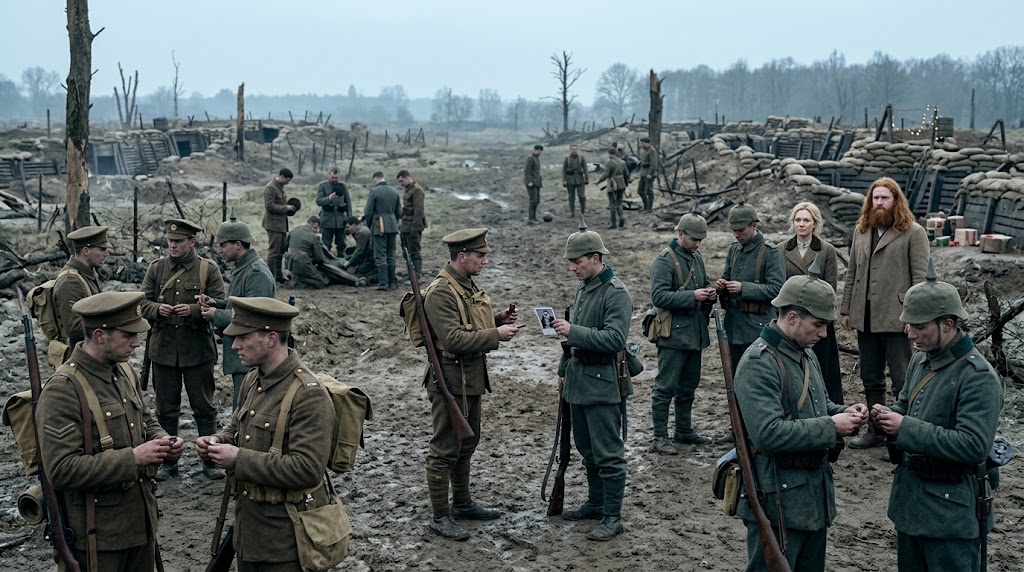
Christmas Eve, 1914.
Mud.
Wire.
Dead men between the trenches.
And Germans singing.
ARTHUR
We’d been shooting at one another all bloody week.
Then Christmas Eve comes along and somebody starts singing.
STACY
Your side?
ARTHUR
No.
Theirs.
British soldiers answer.
Different words.
Same melodies.
ARTHUR
Christ, we murdered their German.
They murdered our English.
Fair exchange.
CAELWYN
International cooperation.
STACY
In linguistic atrocities.
Then someone climbs out of the German trench.
No rifle.
Hands visible.
Nobody fires.
A British soldier follows.
Then another.
Soon men who had spent months trying to kill one another are standing together in no-man’s-land.
Cigarettes.
Tobacco.
Chocolate.
Cigars.
Buttons.
Photographs.
Names.
ARTHUR
That’s when I met Ernst.
STACY
Ernst?
ARTHUR
Ernst Keller.
He’d worked with horses before the war.
Somewhere in Bavaria.
STACY
How did you communicate?
ARTHUR
Bad German.
Bad English.
Pointing.
Pictures.
Beer helped.
CAELWYN
Human civilisation summarised.
Arthur shows Ernst a photograph of his family.
Ernst shows Arthur his.
STACY
You’d been shooting at him.
ARTHUR
Probably not him.
STACY
You know what I mean.
ARTHUR
Yes.
That’s the strange part.
The Germans were easy.
Ernst wasn’t.
Later, British and German soldiers bury their dead.
Together.
Arthur watches men from both armies remove their caps.
ARTHUR
You could tell which body was ours by the clothes.
Couldn’t tell which mother would cry harder.
Eventually someone finds a ball.
For a while, there is football in no-man’s-land.
ARTHUR
Ernst was terrible.
CAELWYN
At football?
ARTHUR
Hopeless.
STACY
Perhaps that’s why Germany invaded Belgium.
Silence.
STACY
Was that inappropriate?
Arthur bursts out laughing.
ARTHUR
Ernst would’ve laughed at that.
Not:
The German would’ve laughed.
Ernst.
Then Christmas ends.
The men return to their trenches.
The orders return.
So do the guns.
Ypres, 1938.
STACY
What happened to Ernst?
ARTHUR
Don’t know.
STACY
Could you have shot him?
Arthur thinks.
ARTHUR
If he was running at me with a rifle?
Probably.
If somebody had pointed across the field and said:
“That’s Ernst”?
I don’t know.
Later, Stacy and Caelwyn walk among the graves.
STACY
The truce didn’t stop the war.
CAELWYN
No.
STACY
It didn’t end nationalism.
CAELWYN
No.
STACY
Those men went back to fighting.
CAELWYN
Yes.
STACY
Then what changed?
Caelwyn looks across the cemetery.
CAELWYN
War needs categories.
German.
British.
French.
Enemy.
Ally.
Us.
Them.
They’re useful.
But they can hide things.
STACY
Like Ernst.
CAELWYN
Like Ernst.
Celebration did not create peace.
It did something smaller.
It interrupted the abstraction.
The enemy acquired a face.
A voice.
A mother.
A photograph.
A terrible football technique.
A name.
Arthur opens his hand.
An old German button lies in his palm.
ARTHUR
Christmas Eve, he was a German.
Christmas Day, he was Ernst.
Afterwards, they wanted him to be a German again.
CAELWYN
Did it work?
Arthur shakes his head.
ARTHUR
No.
I knew his name.
QUESTION FOR YOU
If someone you had been taught to call an enemy shared his food, showed you his family and told you his name — would you still see the same enemy the next morning?
PLAY EPIC. FEEL THE STORY.
Join Mythveil Chronicles:
https://startplaying.games/gm/dunchan
Explore the essays, research and narrative philosophy behind Mythveil Chronicles:
https://www.patreon.com/c/mythveilchronicles_bydunchanhuntergames