CAELWYN & STACY
DID ALL OF YOU COME HOME?
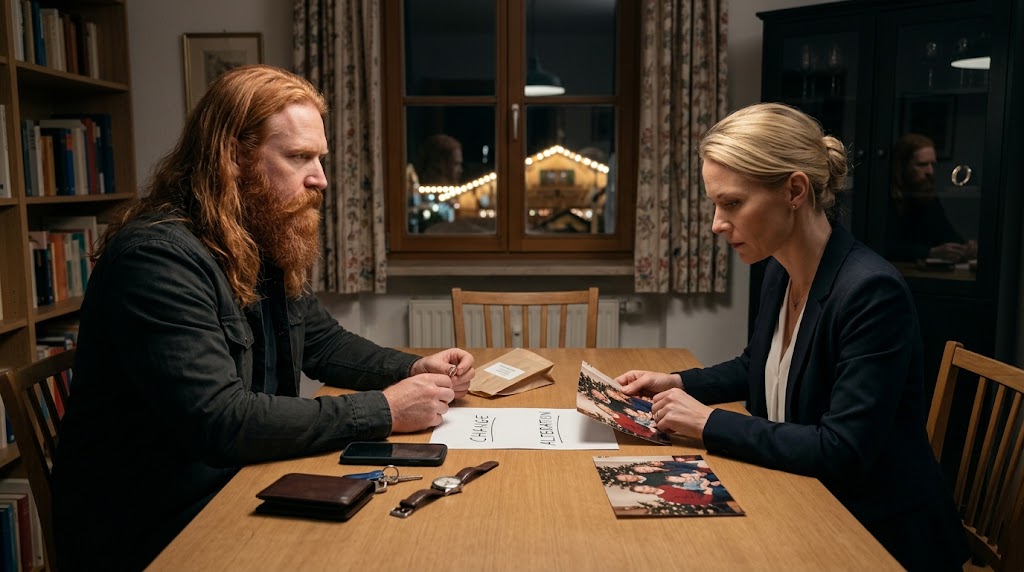
Caelwyn had put six things on the table.
A wallet.
A phone.
Keys.
A watch.
A wedding ring.
And a small evidence bag.
Stacy looked at them.
Then at him.
Then back at the evidence.
“No.”
“I haven’t said anything yet.”
“You’ve arranged personal possessions next to evidence.”
“Yes.”
“That is never a healthy beginning.”
Caelwyn picked up the keys.
“When someone comes back from an operation, what do we check?”
“Whether they’re alive.”
“Good start.”
“Whether they’re injured.”
“Yes.”
“Whether they’ve been exposed.”
“Yes.”
“Whether they brought anything dangerous back.”
“Yes.”
He put the keys down.
“And how do we check whether they brought themselves back?”
Stacy was silent.
There were perfectly human reasons to come back changed.
Trauma.
Grief.
Fear.
Exhaustion.
Illness.
Loss.
A favourite place can become unbearable.
A familiar sound can trigger alarm.
A person can remember loving something without being able to feel that love anymore.
None of that requires the Unnatural.
“So the man from the Wiesn could simply have changed,” Caelwyn said.
“Of course.”
“He remembers his wedding.”
“Yes.”
“The song.”
“Yes.”
“That he loved it.”
“Yes.”
“But he can’t feel why.”
“That can happen.”
Caelwyn nodded.
“And now the annoying part.”
“I wondered when we’d get there.”
“The room was still bigger on the inside.”
“Yes.”
“His watch still lost six hours.”
“Yes.”
“And the room played a song nobody had told it.”
Stacy sighed.
“Yes.”
“So?”
“So we do not get to use psychology as a bin marked ‘everything uncomfortable goes here’.”
Caelwyn smiled.
“There she is.”
Stacy drew a line down a sheet of paper.
On one side:
CHANGE
On the other:
ALTERATION
“Experience can change someone,” she said.
“And alteration?”
“Something objectively happened to them beyond ordinary psychological change.”
“Something taken?”
“Possibly.”
“Added?”
“Possibly.”
“Attached?”
“Possibly.”
“Replaced?”
Stacy hesitated.
“Possibly.”
“You hate saying that.”
“I hate saying it when you enjoy hearing it.”
Delta Green knew how to ask whether something had followed an agent home.
Contamination?
Possession?
Exposure?
Attachment?
Did something cross the perimeter?
Those were familiar questions.
But Caelwyn picked up the wedding ring.
“What if nothing came back with him?”
Stacy looked at him.
“What if something stayed behind?”
That was harder.
Because human stories have imagined that encounters with the Other can cost something for thousands of years.
Names.
Shadows.
Voices.
Memories.
Years.
Luck.
Souls.
Different traditions mean very different things by those ideas. Folklore is not clinical psychology, and religious traditions are not forensic evidence.
But they share an old human fear:
You can survive an encounter and still return diminished.
“That doesn’t prove anything was literally stolen,” Stacy said.
“No.”
“But in Delta Green…”
“We have to leave open the possibility that sometimes the metaphor becomes operationally literal.”
“Carefully.”
“Always.”
Caelwyn opened the evidence bag.
Inside was a family photograph.
Christmas.
Five people.
Bad jumpers.
A dog deeply offended by a paper hat.
“The father,” Caelwyn said.
Stacy found him.
“This was taken after the operation.”
He placed another photograph beside it.
Same family.
Same room.
Previous Christmas.
Stacy stared.
“That isn’t the same man.”
“Officially it is.”
“DNA?”
“Matches.”
“Fingerprints?”
“Match.”
“Dental records?”
“Match.”
“Manipulated photograph?”
“Original prints.”
The family recognised him.
He remembered where the spare key was hidden.
He remembered his first date with his wife.
He knew which child had broken the kitchen window.
Everything measurable said:
Same man.
But his family noticed things.
He ate food he had always hated.
He wrote certain letters differently.
He no longer dreamed.
He stopped whistling while making coffee.
His wife said he still told her he loved her.
But now he always said it half a second too late.
Caelwyn read that line again.
“That’s vicious.”
“Because it proves nothing.”
“Exactly.”
“So what test do you run?” Caelwyn asked.
Stacy said nothing.
“DNA says him.”
“Yes.”
“Memory says him.”
“Mostly.”
“Fingerprints say him.”
“Yes.”
“His family says not quite.”
“Yes.”
“Which one wins?”
“None automatically.”
Caelwyn nodded.
“And what did Delta Green decide?”
Stacy looked at him.
He slid the report across the table.
She read the final line.
Then read it again.
“They terminated him?”
“Yes.”
“That isn’t proof.”
“No.”
“They didn’t know he was contaminated.”
“No.”
“They didn’t know he wasn’t.”
“No.”
Stacy put the report down.
“So they removed the uncertainty.”
“Yes.”
“By killing the person.”
“Yes.”
Silence.
That was another possibility neither of them had written on the page.
Sometimes the Unnatural takes something.
Sometimes something follows you home.
Sometimes something remains behind.
Sometimes a terrible experience simply changes you.
And sometimes Delta Green itself takes what survived because it cannot risk discovering which explanation was correct.
Stacy wrote two sentences beneath her columns:
DO NOT PATHOLOGISE THE UNNATURAL.
Then:
DO NOT SUPERNATURALISE THE HUMAN.
Caelwyn read them.
“That’s annoyingly good.”
“I know.”
“You’ve ruined several essays.”
“Then they deserved it.”
He looked again at the wallet, phone, keys, watch, ring and evidence bag.
“People talk about coming home like it’s binary.”
“Home or not home.”
“Alive or dead.”
“Contained or contaminated.”
“Yes.”
“But maybe coming home isn’t a location.”
Stacy waited.
“Maybe it’s a question.”
“What question?”
Caelwyn looked at the wedding ring.
Then the evidence.
Then at her.
“How much of you made it back?”
AND WHAT DO YOU THINK?
After an encounter with the impossible, someone may return changed for entirely human reasons.
But in Delta Green, something might also have followed them, attached itself, been added, been taken — or remained behind.
And sometimes nobody can tell which happened.
If every measurable test said you were still you, but the people who loved you insisted something fundamental had changed, what evidence would you trust?
And when the Unnatural really exists, how certain should Delta Green have to be before it stops treating someone as a person and starts treating them as a threat?
Different views are welcome. Disagreement is welcome.
Spam, trolling and disrespect are not.