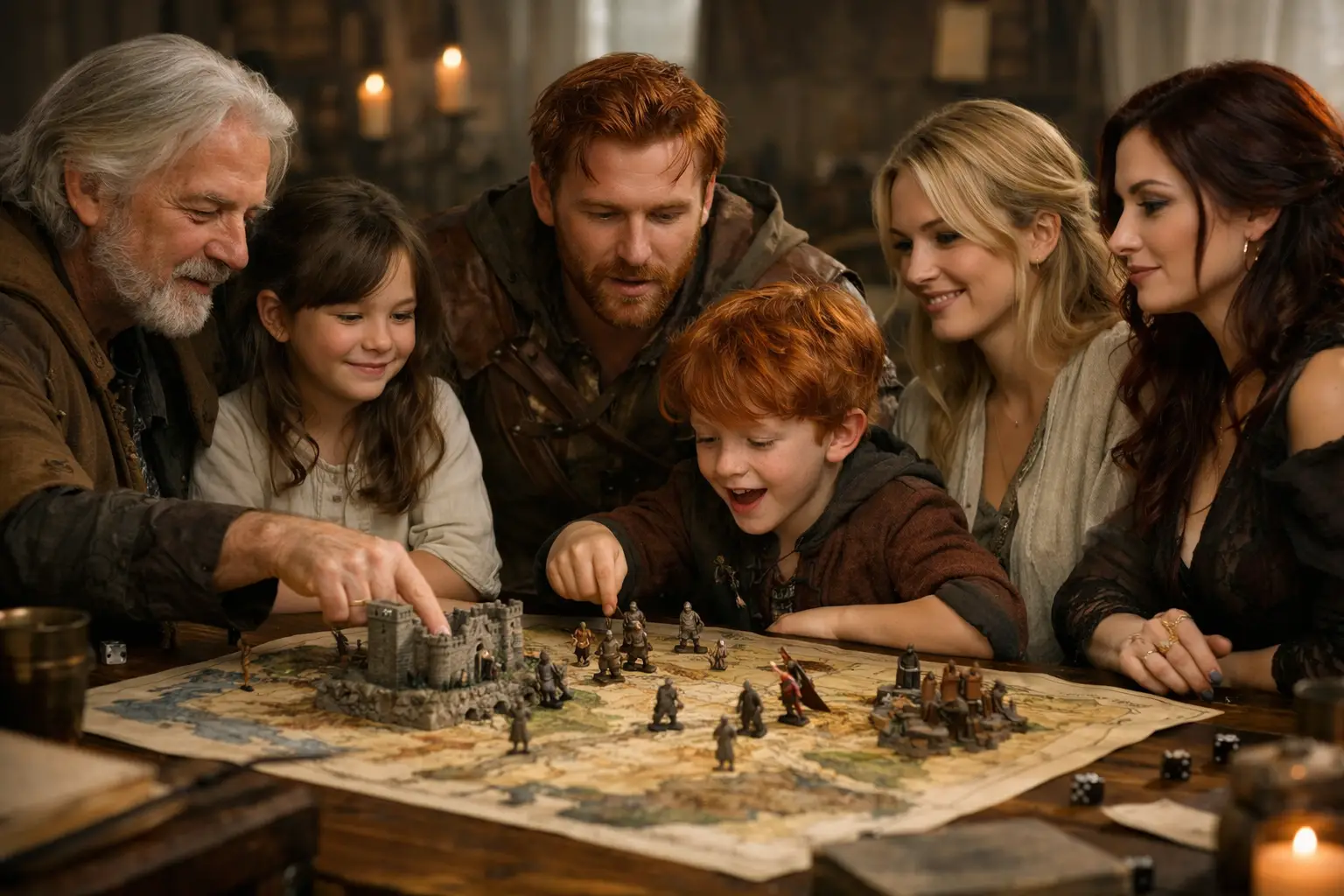
Can Players Shape Setting History at the Table? How research, canon, factions and consequence turn player action into history
A city bell rings at dawn.
Once, it marked the opening of the market.
Now it tolls for the dead.
Three winters earlier, the players exposed a magistrate who had been feeding names to a witch-hunter. The magistrate fell. His patrons fought to preserve their position. Families fled. Others moved into the empty houses. A workers’ association gained influence because somebody had to organise food while the old administration was collapsing.
The gallows eventually came down.
A memorial stands there now.
Nobody planned the bell.
Nobody wrote, before the campaign began, that this was what the city would become.
It happened because one player action became another person’s reaction, which created another opportunity, another conflict and eventually a new normal.
So: can players shape setting history?
Yes.
But that answer is too simple.
The more useful question is:
How much historical freedom can a world absorb without ceasing to be itself?
Not every setting offers the same amount of historical space.
Some worlds have dense canon and tightly connected metaphysics.
Some campaigns depend upon a particular causal sequence.
Some settings inherit a large body of real history and fictional canon while leaving the present comparatively open.
Others are intentionally sparse or wholly original, allowing the campaign itself to become one of the main sources of history.
These are not four rules for four games.
They are positions on a spectrum.
And even inside one campaign, different parts of the world may sit at different places on that spectrum.
A famous war may be fixed.
The village beside its battlefield may barely have been described.
A major faction may be tightly defined.
Its local branch may be almost entirely open.
Historical freedom is therefore not assigned once to an entire game.
It is assessed wherever the campaign touches the world.
Players do not need to rewrite the past to make history
Player agency is often measured too crudely.
Can the players kill the king?
Can they prevent the famous war?
Can they overthrow the empire?
Can they destroy the institution everyone knows from the sourcebook?
If not, some people assume the setting is too fixed.
That misunderstands both history and agency.
History is not made only by crowns and battles.
It is also made by institutions, roads, trade, migration, private loyalties, professional habits, religious practice, old grudges, surviving songs, abandoned buildings, altered borders and stories people keep telling after the witnesses are gone.
A player does not need to erase an established event to become historically important.
They can change who inherits its consequences.
Which faction survives.
Which family gains power.
Which institution loses legitimacy.
Which version becomes public memory.
Which forgotten figure becomes important.
Which old grievance returns.
Which part of the past suddenly matters again.
Players shape history not only by changing what happens, but by changing what the past is allowed to become in the present.
That becomes especially important when a campaign works inside an existing world.
Before allowing change, understand what is holding the world up
A consequence is only as good as our understanding of the world producing it.
Suppose the players destroy a bridge.
What happens next?
That depends entirely upon what the bridge actually is.
A military road?
A pilgrimage route?
A customs point?
The only winter crossing for several villages?
A sacred boundary?
A smuggling route?
The route by which grain reaches a city?
A bridge can be one object and ten systems at once.
Without research, the Game Master can still invent a consequence.
With research, the world can produce one.
That distinction matters.
The stronger the existing world, the more deeply we need to understand it before we can know what a player action is actually capable of changing.
That is why Mythveil research is transdisciplinary.
We may need history, archaeology, anthropology, ethnology, religious studies, philosophy, economics, law, geography, ecology, climate, architecture, medicine, military history, technology, folklore, mythology, oral tradition, literature, film, comics, games, roleplaying culture or popular memory.
Not because every campaign needs everything.
Because different questions require different tools.
A question about a port may begin with trade and geography and end in law, religion and folklore.
A question about a ruined shrine may require archaeology, local belief, political history and the stories later communities told about the site.
Research is not there to make the setting look clever.
It tells us what is connected to what.
And that tells us what a consequence can reasonably disturb.
Research the world to the depth the world requires — not to the depth the researcher can achieve.
Dense canon worlds: change requires precision
Some campaigns take place in worlds with extensive canon, strongly connected histories and carefully defined metaphysics.
Games set in universes such as the Cosmere are a useful example.
Here, large parts of the setting may already be carrying significant weight.
Major events connect to later events.
Cultures have established histories.
Political systems interact with theology, economics, environment and supernatural rules.
A small change may therefore touch more than it first appears to.
That does not turn the players into tourists.
It changes the shape of their freedom.
If the group wants the campaign to remain compatible with the established world, it makes little sense to casually remove one of the structural events upon which the rest of that world depends.
But there may be enormous space around those pillars.
A local house may rise.
A town may collapse.
An expedition may succeed.
An unrecorded relationship between communities may change.
A minor figure may become locally famous.
A previously undescribed settlement may accumulate decades of campaign history.
The players can become enormously important to the lives surrounding them without tearing out the foundations of the setting.
In a dense canon world, players write history in the spaces the canon leaves open.
This often requires more research, not less.
The more interconnected the world is, the more carefully we need to understand what one change may affect.
Agency is not reduced.
It becomes more precise.
Causally anchored campaigns: preserve what later events need
Other campaigns are constrained less by the total size of their canon than by causal structure.
Games such as Shadows of Atlantis can illustrate this kind of problem.
Certain events, discoveries or historical developments may need to exist because later elements depend upon them.
Remove the cause and the later structure ceases to make sense.
That does not mean every path between those causes must be fixed.
Quite the opposite.
Who survives?
Who knows?
Who lies?
Which organisation preserves a discovery?
Which faction reaches it first?
Who misunderstands what happened?
Which relationship forms because of it?
What disappears?
What returns thirty years later?
What gets remembered incorrectly?
Those spaces can remain highly dynamic.
The important thing is to recognise which elements form the load-bearing causal structure.
Preserve the causal spine. Let play rewrite what grows around it.
That is often more useful than saying, “Protect canon.”
Canon should not become museum glass.
It gives the world gravity.
It does not need to stop the world moving.
Historically anchored settings: the past can be firm while the present remains open
A third position appears in settings built upon substantial real history, often combined with fictional canon.
A World of Darkness campaign set in a real city such as New Orleans is a good example.
The city already possesses history.
That history has produced neighbourhoods, institutions, religious traditions, migration patterns, economic structures, racial and social tensions, architectural layers, disasters, cultural identities and collective memories.
Those are not things we casually rewrite because a twist would be convenient.
Then the fictional setting may add its own supernatural history, factions, characters and past conflicts.
Those too may become inherited structures.
The past can therefore be relatively firm.
The present does not have to be.
An old conflict remains part of history.
The players may not change why it began.
But they can decide whether it ends.
Who gains influence.
Who loses it.
Which faction fractures.
Which alliance becomes possible.
Which institution survives.
Which one becomes irrelevant.
Which historical grievance suddenly becomes politically useful.
Which old memory becomes dangerous again.
A setting can have a fixed past and a highly negotiable present.
Players do not need to erase history to become part of history.
They need to become one of the causes shaping what happens next.
Meaning can change even when the event cannot
This is where history becomes more interesting than a chronology.
Suppose a massacre happened a century ago.
That event is fixed.
It happened.
For a hundred years, one faction commemorated it as a victory.
Then the players uncover evidence showing that the official account concealed a betrayal.
The massacre remains.
But the present now contains a new struggle over what it means.
One faction suppresses the evidence.
Another publishes it.
A third believes the evidence is genuine but fears what public knowledge would do.
A fourth barely cares whether it is true and simply recognises an opportunity.
The past did not change.
Its force in the present did.
This is where Bardic Resonance begins to matter.
Canon may fix the event. Bardic Resonance can change what the event means now.
History is not only what happened.
It is also what later people believe happened, what they remember, what they distort, what they deny and what they decide to do because of it.
Open worlds: play can become one of the sources of canon
At the more open end of the spectrum are settings with broad gaps, deliberately undefined history or worlds developed primarily for the campaign itself.
Here the players can shape much more.
Sometimes even the past can continue growing during play.
Suppose the campaign begins with one sentence:
Two centuries ago, the kingdom survived a civil war.
That may be all we know.
Later, the players discover a ruined fortress.
Now the world asks questions.
Who fought there?
Why?
Who won locally?
Which family still holds land granted during the war?
Which religious rite changed because of the siege?
Which region remembers one commander as a liberator while another calls the same person a butcher?
The past develops because present play created a reason to understand it.
That does not mean arbitrary retroactive invention.
The new history must remain causally compatible with the world the players have already experienced.
Everything may be open to development, but not everything should be open to contradiction.
In a wholly original world, players can go even further.
They found an order.
Fifty campaign years later, that order is an old institution.
They save a village.
The village becomes a city.
They destroy a bridge.
Trade shifts.
Another town becomes rich.
They write a song.
Two generations later nobody remembers the original singer, but the song remains part of a political movement.
Now player action is not merely changing history.
It is becoming the event future history is built around.
Different worlds demand different kinds of historical care
This is why examples such as Cosmere, Shadows of Atlantis or World of Darkness are useful.
Not because each game receives one permanent rule.
Because they help us see different kinds of pressure.
A dense canon setting may demand more research before change.
A causally anchored campaign may require us to protect certain events while leaving everything around them highly flexible.
A historically grounded setting may preserve much of the past while allowing players enormous influence over the present and future.
An open or original world may allow play itself to become a major source of future canon.
Most campaigns contain several of these conditions at once.
The principle is therefore not:
“This game allows history to change.”
The principle is:
What is already fixed here? Why is it fixed? What depends upon it? What remains open? And how much change can this part of the world absorb without losing its identity or causality?
Once we know that, we can finally talk seriously about consequences.
Consequences should come from the world, not from the author’s mood
“Make player choices matter” is good advice.
It is also incomplete.
If consequences are simply invented by the Game Master after the session, then player agency is still depending upon authorial whim.
A living world needs more structure than that.
Player action should enter an existing network.
Factions.
NPCs.
Institutions.
Relationships.
Resources.
Beliefs.
Old debts.
Power.
Influence.
The players expose the magistrate.
Fine.
Who depended upon him?
Who hated him?
Who profited from him?
Who needed his office even if they despised the man?
Who inherits his records?
Who inherits his enemies?
Who wants the empty position?
Who suddenly becomes vulnerable?
Who suddenly becomes powerful?
Who even hears what happened?
Now we are no longer inventing a sequel.
We are following consequence.
Factions give consequence direction
A faction should never be reduced to a logo and an attitude towards the party.
It has wants.
Fears.
Resources.
Knowledge.
False beliefs.
Relationships.
Dependencies.
Internal fractures.
Influence.
And, crucially, people.
A merchant league may hate the magistrate and still oppose the players because instability threatens trade.
A religious institution may approve of exposing corruption but condemn the method used.
A revolutionary faction may consider the same event proof that the old order can be destroyed.
Another faction may see nothing ideological in it at all and simply recognise an opening.
You cannot simulate a faction you have not understood.
Research gives that faction identity.
Influence gives it reach.
Play gives it something to react to.
NPCs make faction response human
Factions still do not act by themselves.
People act.
The same office under two different people can produce very different consequences.
A cautious bishop contains a scandal.
An ambitious bishop uses it.
A frightened bishop suppresses it.
A fanatic turns it into doctrine.
The institution provides capacity.
The person decides what to attempt with it.
Profession changes attention. Biography changes interpretation. Position changes capacity.
That is why NPC history matters.
Their profession, culture, socialisation, scars, relationships, ambitions and obligations all change what they think a player action means.
The world is not reacting abstractly.
People are.
Bardic Resonance: the action happens once, meaning keeps moving
Now comes another layer.
Not everybody reacts to the same event.
They react to the version that reaches them.
The players expose the magistrate.
A worker says they liberated the district.
A noble says they destroyed lawful authority.
The magistrate’s family says they murdered an honourable man’s reputation.
A priest says corruption was real but judgement belonged to the court.
A rival politician knows the accusations were correct and still describes them as reckless because that version is useful.
The event happened once.
Meaning keeps happening.
That is Bardic Resonance.
What does this event become as its resonance moves through the world?
People simplify.
Exaggerate.
Misremember.
Fear.
Admire.
Weaponise.
Defend.
Sometimes deliberately.
Sometimes honestly.
A false interpretation can create true consequences.
Influence: who hears, who acts, who pushes back?
Then comes the Influence Game.
Influence is how the reach of a person, faction or institution enters the world and affects what can happen.
For the Game Master, the basic model can remain very simple.
If an actor does not have direct knowledge:
Do they hear about it?
Influence roll.
If they then decide to act:
Can they turn that intention into an effective change?
Influence roll.
If somebody actively opposes them:
Opposed Influence.
Hear it.
Act on it.
Done.
The dice do not decide what a faction wants.
The faction’s identity does that.
The dice determine whether it can actually move the world with what it wants.
Now consequence begins to produce more consequence.
The magistrate’s patrons close the river gates.
Merchants oppose them because trade is collapsing.
A church shelters displaced families.
A political rival uses the crisis to demand reform.
A criminal network offers new routes around the blockade.
The original player action is still present.
But the world has begun passing the ball to itself.
Guardian: what resists when one side becomes too powerful?
Living systems contain resistance.
When one side, one form of Influence or one interpretation becomes too dominant, something may begin to push back.
This is Guardian.
Guardian is not a compulsory balancing mechanic that erases success.
It is counter-resonance.
The question is:
What begins to resist when one side becomes too powerful?
Perhaps merchants fund political opposition because instability is destroying business.
Perhaps clergy turn against a movement once violence becomes too dominant.
Perhaps rival factions cooperate because none of them can tolerate one actor controlling the entire field.
Perhaps local communities begin resisting an institution that previously seemed untouchable.
Power changes the environment around it.
And sometimes that environment answers.
Nemesis: what fills the space when power disappears?
Nemesis asks a different question.
The magistrate falls.
Good.
Now what?
His office is empty.
His informants need new patrons.
People previously protected by him become vulnerable.
Records remain.
Debts remain.
Enemies remain.
Perhaps somebody much worse has been waiting for the space to open.
What happens when power disappears and leaves something behind?
That is Nemesis.
Nemesis is not punishment for player success.
It is the consequence of vacancy.
A cult is destroyed.
Its members scatter.
One joins another organisation.
One sells information.
One builds a new doctrine from the ruins.
The cult is gone.
Its absence has become historically active.
Bardic News: consequence has to return to the table
A simulation hidden in campaign notes is not enough.
The players need to experience what the world has made of their actions.
That is Bardic News.
Not:
“Faction Influence changed by two points.”
Instead:
A gate is closed.
A shopkeeper refuses service.
A church bell sounds at the wrong hour.
A pamphlet calls the characters traitors.
A song calls them heroes.
A new tax carries the name of the crisis they caused.
A child repeats a version of their story they barely recognise.
An old enemy’s portrait hangs beside theirs in a memorial.
Bardic News is how the world gives consequence back to the players.
The players know what they did.
Bardic News shows them what the world believes they did.
And then they respond.
That response becomes the next cause.
This is how consequence becomes history
The full movement looks like this:
Player Action → Bardic Resonance → Influence Reach → Faction and NPC Interpretation → Influence Action and Opposition → Guardian / Nemesis Pressure → Changed World State → Bardic News → New Player Action
Run that once and you have consequence.
Run it repeatedly and something else begins to happen.
A favour becomes an alliance.
An alliance becomes an institution.
An institution becomes tradition.
A temporary emergency measure becomes ordinary law.
A rumour becomes public memory.
A victory becomes a holiday.
A disaster becomes a taboo.
A lie becomes a political identity.
A rescued child becomes a faction leader.
A road closed during one crisis permanently redirects trade.
Now the campaign is not merely remembering events.
The past is becoming part of the machinery that produces the present.
Memory becomes history when yesterday’s consequences become part of today’s causes.
That is what Mythveil means by a world that remembers.
The amount of freedom changes. The method does not.
Different worlds demand different levels of caution.
Dense canon worlds may require extensive research before the campaign can safely disturb established structures.
Causally anchored campaigns may require certain events to remain while allowing the human history around them to change dramatically.
Historically grounded settings may inherit a firm past while leaving the present open to enormous player influence.
Open worlds may allow players to generate much of the history themselves.
The more fixed the world, the more carefully we research before allowing change. The more open the world, the more freely play can become history.
The method remains the same.
Understand the world.
Understand what is fixed.
Understand the people and institutions inside it.
Let players act.
Let that action travel.
Let factions respond.
Let influence collide.
Let resistance and vacancies create further consequences.
Then give the changed world back to the players.
And remember what happened.
The bell rings again
Years later, another group arrives in the city.
They never knew the magistrate.
They never met the original party.
To them, the memorial beside the market has always been there.
The workers’ association is now an ordinary part of city government.
A yearly procession crosses the square.
Nobody agrees on why the bell changed its purpose.
One guide says it honours the dead.
Another says it celebrates liberation.
An elderly woman still calls it the Traitors’ Bell.
The original players may be gone.
Their decision is not.
The past is still working.
That is what it means for players to shape setting history.
They do not need permission to rewrite everything.
They need a world capable of receiving what they do, understanding it according to its own structures, resisting where resistance makes sense, changing where change becomes possible, and carrying the result forward.
The question is not simply whether players are allowed to change history.
It is:
Which parts of history are inherited, which are contested, and which are still waiting to be written?
MYTHVEIL
We create worlds people want to live in.
Stories that remember. Worlds that change.
Read: https://mythveilchronicles.com/ Play: https://startplaying.games/gm/dunchan Watch: https://www.youtube.com/@MythveilChronicles Support: https://www.patreon.com/MythveilChronicles Collaborate: https://www.linkedin.com/in/francisco-jos%C3%A9-z-b05aab371/