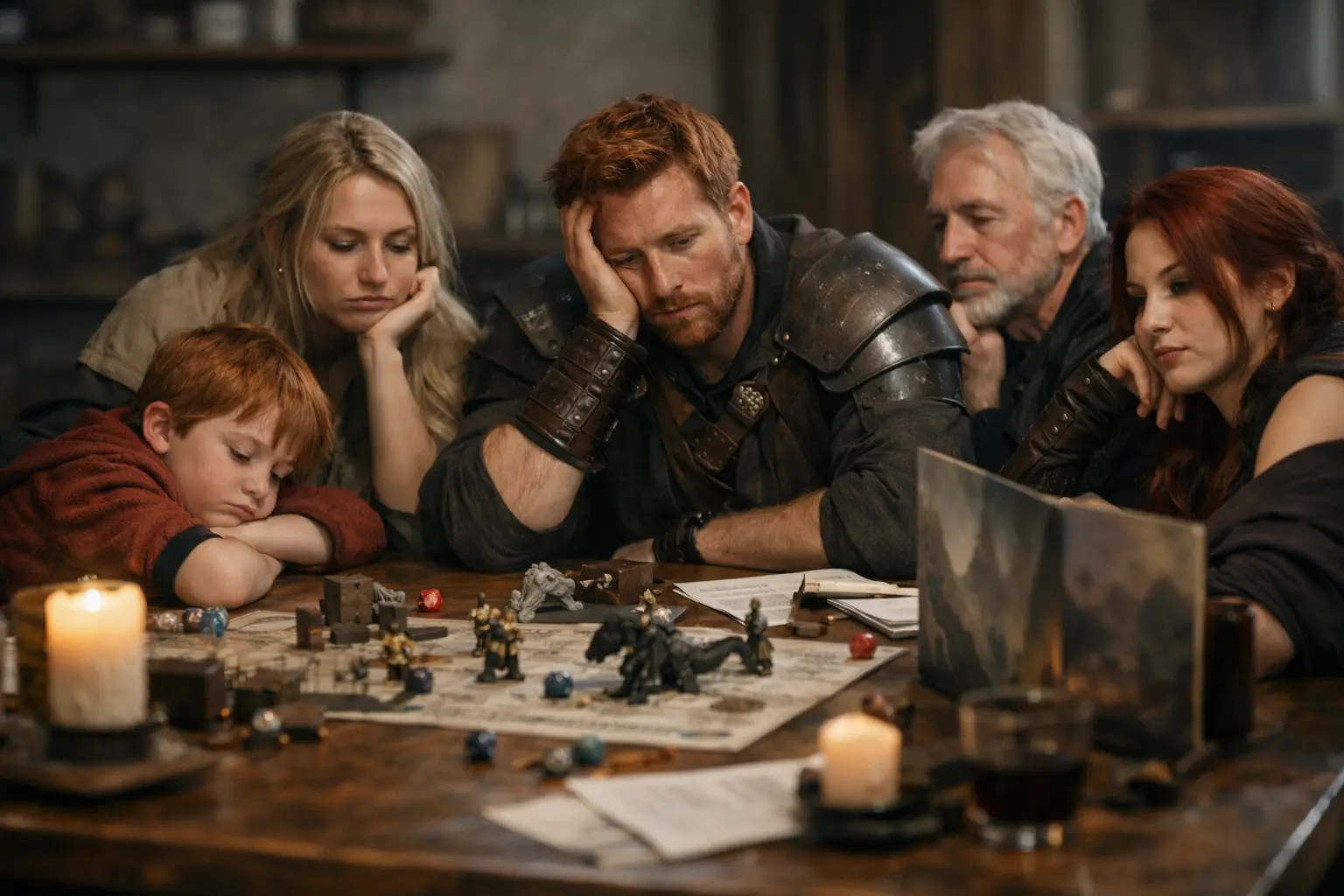
Why Do Tabletop Campaigns Lose Momentum?
How Living Worlds Keep Players—and Game Masters—Coming Back
◆
The party has reached the buried observatory. A traitor has been unmasked. Somewhere beneath the city, a door has begun to whisper a character’s true name.
Everyone talked about the campaign for weeks.
Then nobody mentioned the next session for a month.
If you have wondered why tabletop campaigns lose momentum, the answer is rarely that the players stopped caring about the story. More often, the story stopped behaving as though it needed them.
Momentum is not speed. A campaign can rush through battles, revelations, locations, and ancient evils while feeling strangely inert. Real momentum is the shared conviction that the world is changing, that choices are still travelling, and that something will be different when the group returns.
A static campaign requires the Game Master to invent every new movement.
A living world already has people, institutions, fears, rivalries, debts, and ambitions in motion. The players do not merely follow that movement. They interrupt it, accelerate it, redirect it, and occasionally set fire to the part everyone had agreed was probably load-bearing.
That difference matters for the players.
It also matters for the Game Master.
Momentum disappears when the world stops answering
Long-form roleplaying asks more of people than enthusiasm. It asks them to remember names, emotional wounds, promises, clues, rivalries, unfinished conversations, and consequences across busy adult lives.
That investment becomes difficult to sustain when sessions feel disconnected or when the next step exists only because the Game Master placed another quest marker on the road.
Campaigns usually lose momentum through small fractures rather than one dramatic failure:
A missed session is never rescheduled. A villain remains threatening only in exposition. A character’s personal history never enters the fiction. A difficult choice changes nothing visible. An abandoned lead waits patiently for six months, apparently supported by a generous preservation grant.
Each moment teaches the table the same lesson:
Attention is optional because the world will wait.
The answer is not constant spectacle. Quiet scenes, travel, grief, humour, uncertainty, and ordinary conversation all belong in lasting campaigns. But even quiet scenes should carry pressure, possibility, or aftermath.
A conversation in a rain-soaked inn can change an alliance.
A letter left unanswered can become evidence.
A kindness shown to the wrong person can become politically inconvenient years later.
Momentum survives when the world continues to interpret what happened.
A living world moves with or without the party
In a static campaign, nothing happens until the players choose the next adventure.
In a living world, the adventure may no longer exist when they return. Someone else accepted it, failed at it, profited from it, concealed it, or arrested the person who asked for help.
The players ignore the whispering door beneath the city.
The door does not remain a perfectly preserved plot hook.
Perhaps a religious order seals the district. Perhaps a criminal faction begins charging desperate families for safe passage. Perhaps an academic society opens the door in the name of responsible inquiry, a phrase that has preceded several regrettable historical events.
The situation changes because the forces around it possess their own motives.
That is where active momentum comes from.
Not from pushing the plot forward.
From knowing that the world is already moving.
This does not make the players irrelevant. It makes their agency more significant.
The world does not need the players in order to move. It needs them in order to become something it would never have become without them.
Their intervention changes which faction gains power, who survives, which story becomes public, what resource disappears, and what future suddenly becomes possible.
The world continues without them.
It becomes different because of them.
The Game Master should not know every outcome
A campaign is not truly emergent if the Game Master already knows where every road leads.
In a living world, the Game Master understands the forces at work:
who wants power, who controls food, who can command violence, who depends on an old alliance, who fears exposure, and who has waited years for someone else to make a mistake.
But those forces do not produce one predetermined ending.
The players kill a provincial governor. The Game Master knows which heirs have claims, which merchants control grain, which officers command the garrison, which priests can grant legitimacy, and which neighbouring power has been waiting for instability.
What happens next emerges from the collision.
Perhaps the merchants install a harmless heir and rule through debt.
Perhaps the army takes the city “temporarily,” as armies throughout history have often felt compelled to clarify.
Perhaps a minor civic institution becomes unexpectedly powerful because it controls the one service everyone suddenly needs.
The Game Master built the factions, ambitions, and fault lines.
Nobody planned for the undertakers’ guild to become the city’s most influential political force.
In retrospect, giving one organisation control over every funeral during a plague may have been a strategic oversight.
That surprise is not failed preparation.
It is evidence that the preparation has become generative.
The Game Master is no longer protecting a completed story. They are discovering the world alongside the players, from a different vantage point.
Active gravity is stronger than a louder threat
When momentum weakens, the instinct is often to escalate.
A larger monster appears. The conspiracy reaches the throne. The artefact can now destroy the continent rather than merely making one village deeply unpleasant.
But scale is not the same as gravity.
A campaign has active gravity when unfinished pressures pull the characters back into the world:
A rival is gaining influence.
An ally has become unreachable.
A rumour about the group is spreading faster than the truth.
A faction they weakened has found a new patron.
A person they protected now asks them to defend something they despise.
These developments matter because they are connected to previous choices.
A war threatening a kingdom is large.
A war exposing the debt that kept a character’s family alive is personal.
A plague threatening a city is large.
A plague placing the only honest physician under the control of a hated faction is playable.
Momentum grows when the next question is not merely “What happens now?” but:
What has our world become because of what we already did?
Player agency needs visible memory
Players can make decisions all evening and still feel powerless if the world quietly resets afterwards.
They side with a labour guild over a merchant house. Prices remain unchanged. The guards wear the same colours. Invitations continue arriving from everyone. No one appears to have noticed.
The decision existed at the table but not in the world.
Consequence is the memory of agency.
If the guild gains ground, show it in wages, patrols, street conversations, food prices, public symbols, and the confidence of people who were afraid to speak before.
If the merchant house loses influence, it may retreat, adapt, seek external allies, buy the local newspaper, or discover a passionate interest in public order.
A living world does not merely record that a choice occurred. It allows affected people to interpret it.
The player characters burn a smuggler’s warehouse.
They may believe they struck a criminal network.
The smugglers’ families may remember a winter without food.
A rival gang sees a recruitment opportunity.
The city government sees proof that adventurers require supervision.
One action creates several stories, and each story can move someone.
That is why visible memory creates momentum. The players begin carrying the campaign between sessions because they know their choices have not finished travelling.
The world should generate the next question
A campaign loses energy when the Game Master must repeatedly manufacture new reasons to care.
A living world produces new questions from existing conditions.
A trade strike raises food prices.
Rising prices create unrest.
Unrest strengthens a political movement.
That movement forces old rivals into an alliance.
The alliance threatens a religious institution.
The institution responds by declaring the economic crisis a moral failure, which is usually cheaper than importing grain.
No single step needs to be written as a plot.
Each follows from people protecting what they value.
This is where factions become more than organisations in a setting guide. They become sources of motion.
They act when the players intervene.
They also act when the players do nothing.
That gives the campaign a future tense.
The table no longer asks only what the Game Master has prepared. It begins asking what other people have done, what old enemies now want, and which opportunity will disappear if nobody acts.
Rhythm still matters
A living world cannot entirely defeat calendars.
Adult players have work, families, illness, travel, and obligations that do not become less real because an ancient god has finally learned someone’s middle name.
A regular slot still matters. It turns play into a shared ritual and makes anticipation possible. Fortnightly and monthly games can both maintain strong momentum when the group knows when it will return and receives enough support to re-enter the fiction.
What weakens campaigns most is uncertainty.
“Perhaps sometime next week” gradually becomes “We should really continue that campaign,” a sentence often spoken in the same tone used for clearing the attic.
Recaps therefore matter, but not as exhaustive records.
A strong recap restores significance:
What decision changed the situation?
What revelation remains dangerous?
Who is waiting for an answer?
What has happened since the last session?
Let players add what they remember. Their recollections reveal which parts of the world have acquired emotional weight—and which parts may have been much more fascinating in the Game Master’s notes than at the table.
Preparation should create motion, not protect scenes
Game Masters often answer lost momentum by preparing more.
More maps. More lore. More dialogue. More contingency plans. More beautiful scenes that must now occur because they took four hours to prepare.
Craft matters. Research matters. Atmosphere matters.
But preparation becomes a trap when the campaign starts protecting prepared material from player action.
If the players must attend the masquerade, trust the stranger, lose the relic, and flee the city, then their agency is decorative. They may choose different words, but the story has already submitted its paperwork.
Prepare pressures instead.
Know what the cult wants, what it fears, what resources it can use, and what it will attempt if ignored.
Know which factions are watching one another.
Know which relationship is close to breaking.
Know what changes if the players do nothing.
Then allow the players to destroy the planned evening in a way that creates a better campaign.
The reward is not chaos. It is discovery.
The World Tick carries momentum between sessions
The most important work often happens after play.
Not because the Game Master must write the next chapter, but because the world must process what just occurred.
At Mythveil Chronicles, this is where the logic of the World Tick becomes important. The exact method belongs to the deeper Rexborn architecture, but the principle is simple:
After the session, do not ask only what happened.
Ask what changes now.
Who gained influence?
Who lost protection?
Which relationship shifted?
Which position became vacant?
What counterforce begins to form?
What continues because the players never saw it?
Which consequence needs time before it becomes visible?
The World Tick allows older decisions, current faction pressure, and off-screen developments to meet.
That is often where the Game Master becomes surprised.
Two consequences that seemed unrelated suddenly reinforce one another. A minor NPC becomes strategically important. A neglected district turns into the centre of a conflict. A defeated faction survives by changing what it is.
Emergence happens at the table. Continuity is built between sessions.
The World Tick does not replace imagination. It gives imagination a world state to answer.
Bardic Resonance brings the world back to the players
Internal change is not enough.
A city can transform completely in the Game Master’s notes and still feel static if the players never encounter the transformation.
Bardic Resonance is the return of consequence in a form the table can experience.
A rumour.
A changed price.
A damaged statue.
A letter from someone presumed forgotten.
A public speech.
A new law.
A song that gets the heroes’ names wrong but their worst mistake distressingly right.
The world does not remember events neutrally.
People reshape them according to fear, loyalty, advantage, grief, and identity.
People rarely remember an event exactly as it happened. They remember the version that explains who they became afterwards.
That return creates momentum because it proves that the campaign continued to mean something while the group was away.
The players do not receive a new plot hook.
They receive an answer.
Momentum returns when everyone is curious again
The strongest sign of a healthy campaign is not perfect attendance or constant action.
It is curiosity.
The players want to know what happened beyond the scene they left.
The Game Master wants to know what the players will disrupt next.
Neither side fully owns the future.
That is why a living world can sustain momentum for years. The Game Master does not need to create every new story from nothing. Existing forces continue to move. Player actions change their conditions. Consequences travel. Memory returns in unexpected forms.
Even the Game Master can be surprised by what the world becomes.
The party eventually returns to the buried observatory.
The door beneath the city has stopped whispering.
Someone opened it.
The traitor they exposed is now a martyr to people who never met him. The faction they believed defeated controls the streets around the site. On the observatory steps waits a courier carrying a letter sealed with the crest of an old ally.
None of this is there because the campaign needed a louder threat.
It is there because the world kept moving.
That is why tabletop campaigns lose momentum when everything waits for the players—and why they regain it when choices continue to produce pressure, change, and memory.
The Game Master does not have to know the whole story.
They have to build a world capable of discovering it.
MYTHVEIL • Stories that remember. Worlds that change.
◆ ◆ ◆
MYTHVEIL
We create worlds you want to live in.
Stories that remember. Worlds that change.
Explore Mythveil’s living-world design, join one of our long-form campaigns, or talk with us about building a setting that continues moving beyond the current scene.
Read: https://mythveilchronicles.com/
Play: https://startplaying.games/gm/dunchan
Collaborate: https://www.linkedin.com/in/francisco-jos%C3%A9-z-b05aab371/
Read. Play. Watch. Support. Or collaborate.