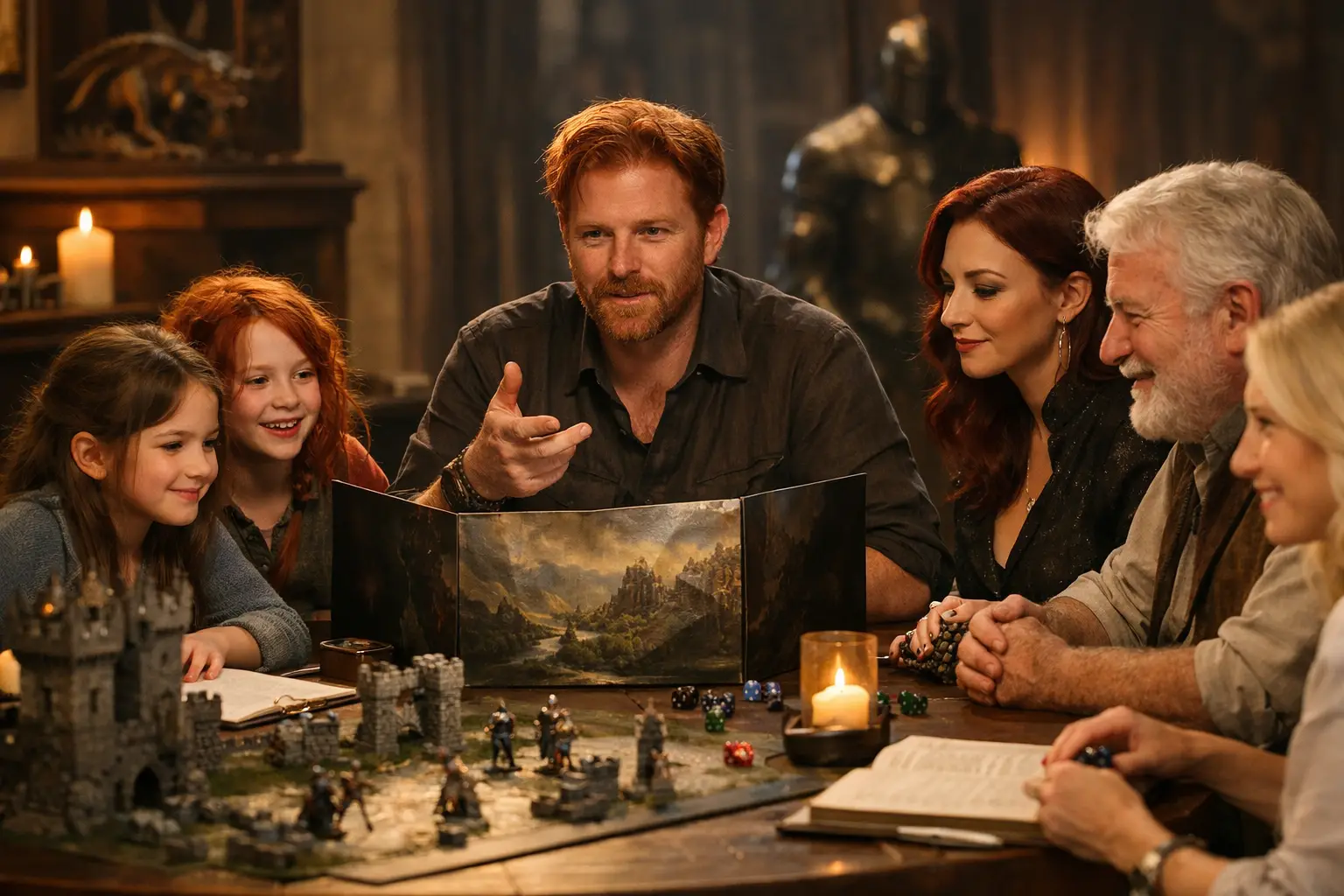
The difference often appears in the silence after a session ends.
Not the polite silence of people logging off and saying goodnight, but the charged quiet that follows consequence.
A character has made a choice that cannot be taken back. A faction has shifted. A city remembers.
If you are looking for a guide to professional game mastering, start there – not with voices, props, or encyclopaedic rules knowledge, but with the craft of creating sessions that leave a mark.
Professional Game Mastering is frequently misunderstood.
Some imagine it as a polished hobby with invoices attached. Others reduce it to performance, as though the work begins and ends with accents, maps, and punctuality.
Those things matter, but they are not the heart of the role.
A professional Game Master is not simply someone paid to run a game. They are a host, facilitator, narrative architect, atmosphere-builder, adjudicator, researcher, and steward of trust.
When the work is done well, players do not just enjoy an evening.
They enter a world that responds to them.
What this guide to professional game mastering actually means
A useful guide to professional game mastering has to address an uncomfortable truth.
Payment raises the standard.
The moment players invest money as well as time, expectation changes. They are not merely hoping for a decent session. They are placing trust in your preparation, your judgement, your emotional intelligence, and your consistency over weeks or months.
That changes the nature of the craft.
Home games can survive on improvisation, goodwill, and occasional chaos. Professional campaigns still need spontaneity, but they cannot rely on vagueness.
You need structure strong enough to hold player freedom without collapsing into confusion. You need tone that remains coherent. You need records, continuity, and an understanding of what each player came to feel, not just what they came to do.
This is why professional Game Mastering sits at the meeting point of artistry and service.
Too much focus on service alone, and the campaign becomes flat, transactional, forgettable.
Too much focus on artistry alone, and the table begins to feel trapped inside someone else’s novel.
The work lives in the tension between authorship and collaboration.
The foundation is trust, not spectacle
Many aspiring professional GMs begin with production value.
Better handouts. Better audio. Better terrain. Better overlays.
None of that is wasted effort, but spectacle cannot compensate for weak stewardship.
Players return because they feel safe enough to commit, seen enough to matter, and surprised enough to remain curious.
That means your first responsibility is social and emotional architecture.
Set expectations clearly. Explain tone, themes, absences, scheduling, cancellation policies, and table boundaries without evasiveness.
If your campaign promises horror, mystery, political intrigue, or tragic consequence, players should understand the shape of that promise before the first die is rolled.
Trust also depends on fairness.
Fairness does not always mean softness. Characters may fail. They may lose allies, status, and cherished ambitions. But when consequences arrive, players must feel they emerged from the logic of the world rather than the whims of the GM.
A living world can be cruel.
It cannot be arbitrary.
Professional standards behind the screen
There is romance in the image of the inspired storyteller scribbling notes by candlelight, but the day-to-day reality is more disciplined.
Reliable professional Game Mastering runs on invisible structure.
Preparation is part research, part curation. You are deciding what deserves focus, what can remain implied, and what must be tracked after play.
Session planning should not mean scripting outcomes. It should mean preparing pressures, motives, locations, and possible developments so that player choices matter.
The most memorable campaigns rarely come from perfect plotting.
They come from well-prepared worlds meeting unpredictable people.
Administration matters as much as atmosphere.
Can players easily understand your onboarding process?
Do they know when sessions run, how recaps work, what tools are used, and what level of commitment is expected?
Do you keep notes detailed enough to preserve continuity?
Professionalism is often judged in these supposedly minor moments.
Then there is pacing.
A professional GM learns to feel when a scene needs breath and when it needs a blade.
Too much indulgence and the story drifts.
Too much pressure and players lose room for agency or reflection.
Good pacing is not speed.
It is rhythm.
Living worlds versus disposable sessions
One of the clearest dividing lines in professional Game Mastering is whether the world changes in lasting ways.
Plenty of games deliver a fun night.
Fewer create the sensation that events continue echoing after the session closes.
A disposable campaign resets emotionally. Last week’s betrayal matters until the next encounter begins.
A living campaign accumulates memory.
Old choices return with altered meaning. Minor NPCs become central because players treated them seriously. Factions adapt. Rumours spread. History thickens.
This kind of depth requires systems of continuity, whether formal or intuitive.
You need to track relationships, consequences, unresolved threads, and shifts in power.
More importantly, you need to care about them.
Players can tell when continuity is ornamental.
They can also tell when the world truly remembers them.
For narrative-focused groups, this is often the difference between entertainment and belonging.
People do not just want to win scenes.
They want to inhabit stories that acknowledge their presence.
The business side of being a professional GM
Any honest guide to professional game mastering must admit that skill at the table and sustainability outside it are not the same thing.
Many gifted storytellers struggle because they avoid the business layer.
Others become efficient but lose the soul of the work.
You need pricing that reflects preparation time, not just session hours. You need boundaries that protect your energy. You need a clear understanding of what kind of experience you offer and for whom.
Not every table is your table.
Some players want light-hearted weekly escapism.
Others want slow-burn psychological horror, morally difficult decisions, political consequence, historical texture, and worlds dense with memory.
The clearer your identity, the easier it is for the right players to find you.
Consistency is part of the service.
Turning up prepared, communicating early, and following through on your campaign’s promise are not glamorous talents, but they are the bones of reputation.
Professional Game Mastering is a long game.
Trust accumulates gradually and can fracture quickly.
Why niche matters in professional game mastering
A broad offer may attract attention, but a specific creative identity builds loyalty.
This is especially true for story-rich campaigns.
If your strength lies in gothic horror, investigative dread, historical fantasy, factional drama, myth-soaked tragedy, or living-world consequence, say so with confidence.
Niche is not limitation.
It is signal.
It tells players what emotional weather they are stepping into.
It tells them whether your worlds are interested in consequence, absurdity, heroism, intimacy, or terror.
It also helps you prepare better, because your research, tone, and design philosophy become coherent rather than scattered.
Studios such as Mythveil Chronicles show how powerful this can be when campaigns are built not as isolated adventures but as persistent worlds shaped by memory, faction dynamics, and long-term consequence.
That kind of vision does not appeal to everyone.
That is precisely why it resonates so deeply with the right audience.
Crafting experiences people will pay to return to
The paid table asks a quiet question every session:
Was this worth returning for?
The answer rarely rests on a single dramatic twist.
It comes from cumulative care.
Players notice when their backstories are integrated without being exploited.
They notice when the atmosphere matches the premise.
They notice when a scene lands emotionally because you allowed it space instead of rushing towards the next combat.
They notice when mystery is structured rather than improvised into nonsense.
They notice when your NPCs have convictions rather than catchphrases.
And they notice restraint.
Not every moment needs flourish.
Not every revelation needs thunder.
Often the strongest scenes arrive when a GM trusts implication.
The empty chair at the council table.
The village shrine scrubbed clean after a name has been erased.
The ally who says, “I thought you would come sooner.”
Professional craft often looks like precision rather than excess.
Should you become a professional Game Master?
It depends on what you want from the role.
If you are seeking easy income from a pastime, the work may disappoint you.
It demands planning, administration, communication, emotional labour, and constant refinement.
If you love storytelling but dislike responsibility, it will test you.
If you want complete narrative control, it will frustrate you.
But if you are drawn to building worlds that breathe, to holding a table through tension and revelation, to shaping campaigns where choices linger like old songs and open wounds, then professional Game Mastering can become remarkable work.
Not because it makes games more official.
Because it asks more of the craft.
More clarity.
More care.
More memory.
More intention.
The best professional GMs do not sell access to rules.
They offer stewardship of experience.
They make room for stories that change people a little, and remain with them long after the session ends.
Play with a professional Game Master
At Mythveil Chronicles, professional Game Mastering means more than running weekly sessions.
It means living worlds, structured consequence, emotional continuity, deep preparation, and campaigns where players are not passengers inside someone else’s story.
They are agents inside a world that remembers them.
If you want a campaign built with care, pressure, atmosphere, and long-form consequence, join a Mythveil table.
Read more: https://mythveilchronicles.com
Play in a Mythveil campaign: https://startplaying.games/gm/dunchan
Support the worldbuilding: https://www.patreon.com/c/mythveilchronicles
Collaborate: [LinkedIn link]
Stories that remember. Worlds that change.