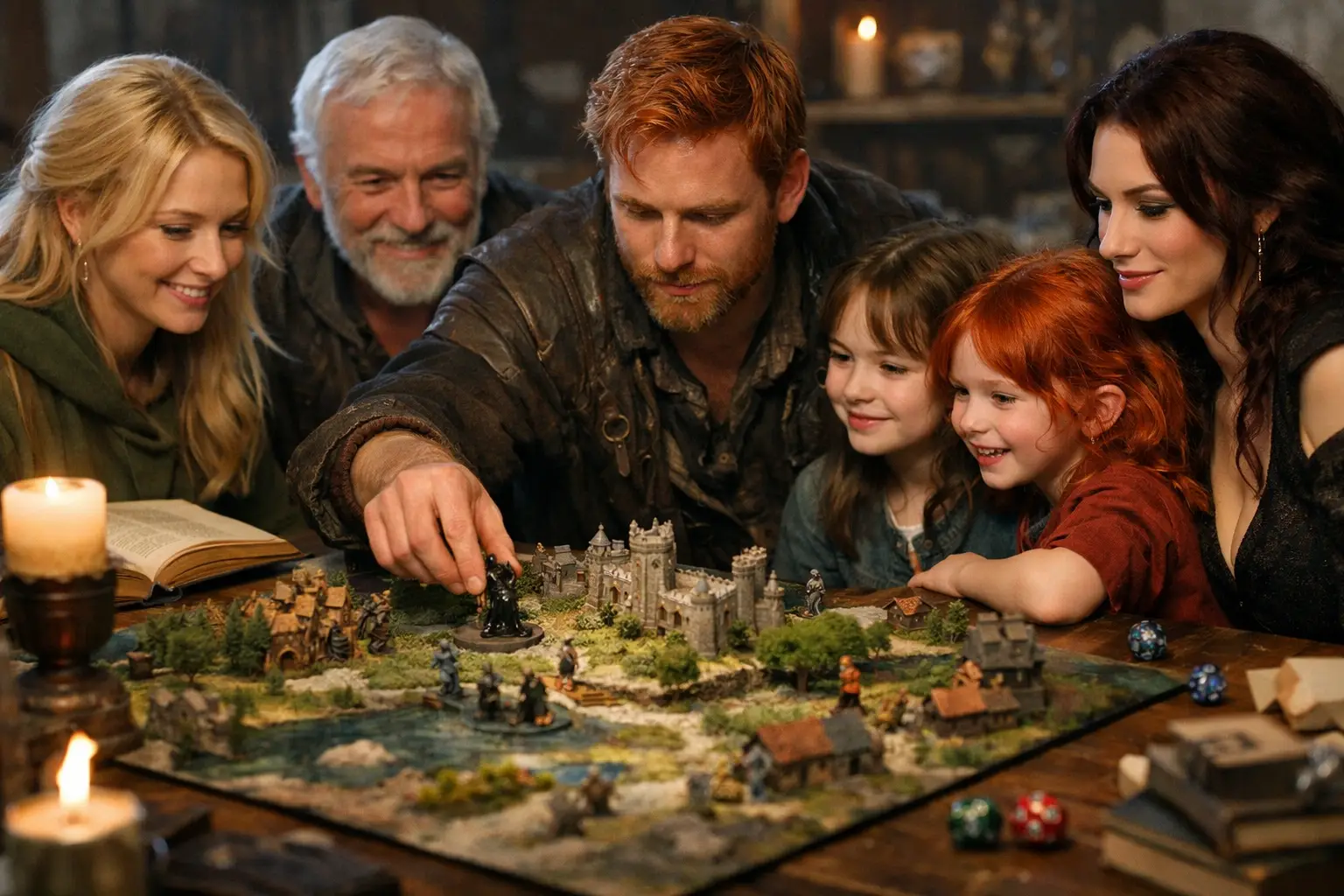
Living World Tabletop RPG: When the World Moves Without You
A city falls while your group is arguing over a locked door.
Not because the Game Master is cruel, but because the world was already moving. Armies march, cults recruit, merchants panic, and old promises come due whether the party is watching or not.
That is the essential difference in a living world tabletop RPG – the setting is not a painted backdrop waiting for heroes to arrive.
It breathes, remembers, and changes.
For players who have felt the thinness of campaigns where every road waits politely for the party, this difference is more than a design preference.
It is the line between a game you enjoyed for an evening and a story that lingers for years.
A living world does not merely offer events.
It offers consequence, continuity, and the unsettling thrill of real significance.
A living world tabletop RPG is more than open play
People often confuse a living world with a sandbox.
The overlap is real, but they are not identical. A sandbox usually means freedom of movement and choice. You can travel widely, pursue different goals, and ignore the obvious plot hook.
That freedom matters, but freedom alone does not make a world feel alive.
A living world tabletop RPG goes further. It assumes that people, factions, landscapes, beliefs, economies, and histories continue to evolve beyond the players’ immediate attention.
If the party leaves a border conflict unresolved, that conflict may deepen into civil war. If they save a magistrate, the law in that province may harden. If they empower a desperate cult in exchange for short-term aid, that bargain may stain the region for months.
The crucial element is not size.
It is continuity.
The world retains memory. Its people adapt. Its institutions react. Actions leave marks.
Why living worlds feel so different at the table
In a static campaign, choice can still exist, but it often leads back to prepared scenes.
The illusion holds for a while. Then players notice that every path bends towards the same encounter, the same revelation, the same convenient timing.
A world like that may still be entertaining, but it rarely feels independent.
A living world creates a different emotional texture.
Players become cautious in one moment and bold in the next because they understand that outcomes are not cosmetic. Victory changes the balance of power. Failure is not always a dead end, but it is rarely clean.
Time matters.
Reputation matters.
The people you spared in spring may return in winter wearing another lord’s colours.
This is where atmosphere deepens into meaning.
Horror becomes more frightening when institutions cannot protect you.
Political intrigue becomes richer when rival factions continue plotting between sessions.
Mystery becomes sharper when forgotten events remain embedded in the world’s memory rather than dissolving once the scene ends.
That persistence is what gives narrative weight to even small decisions.
A missed meeting, a broken oath, an act of mercy – these can echo far beyond the session in which they occurred.
The pillars of a living world tabletop RPG
A convincing living world usually rests on four foundations.
First, time must move.
Not every campaign needs a strict calendar worthy of an archivist, but the world needs a sense of temporal motion. Seasons change. News travels. Rivals prepare.
If nothing develops unless the party is looking directly at it, the setting still revolves around the table rather than existing alongside it.
Second, factions must possess motive and momentum.
Kingdoms, churches, guilds, insurgents, covens, families, and corporations should want things for reasons that make sense in the setting.
Better still, they should pursue those aims imperfectly.
A living world is not a machine.
It is a field of competing wills.
Third, consequences need to be trackable.
This does not mean punishing players for every improvised decision. It means treating actions as causes rather than decorations.
If the group burns a smuggler route, someone profits, someone starves, and someone seeks revenge.
Fourth, the setting needs memory.
Not only in the lore, but in play.
Non-player characters recall prior encounters. Settlements bear scars. Institutions change policy. History becomes part of the campaign’s present tense.
Without those four elements, many campaigns still tell excellent stories.
But they do not fully achieve the strange alchemy of a world that seems to continue breathing after the session ends.
The craft behind the illusion of life
Calling a world “living” can sound mystical, as if it appears through raw inspiration alone.
In practice, it is built through disciplined design.
The strongest living campaigns are usually supported by systems that track social pressure, faction movement, cause and effect, and the passage of time.
This does not require pages of unreadable notes or obsessive simulation for its own sake. In fact, excessive detail can suffocate play.
The aim is not to model every loaf of bread in the kingdom.
The aim is to know enough about the world’s structures that when players act, the consequences emerge naturally rather than arbitrarily.
That is where professional campaign architecture matters.
A living setting feels effortless at the table only when a great deal of thoughtful work has happened behind the curtain.
Faction clocks, influence maps, event chains, historical layers, relationship tracking, and thematic continuity all help transform improvisation into something coherent.
At Mythveil Chronicles, this philosophy sits at the heart of the work.
A persistent campaign should not feel like disconnected episodes held together by enthusiasm alone.
It should feel like entering a world with weather, memory, pressure, and consequence already in motion.
What players gain from living-world play
The obvious answer is immersion, but that word often gets flattened through overuse.
What players actually gain is a sense of authorship without control.
They matter deeply, yet the world does not surrender itself to them.
That tension is powerful.
It allows players to feel that their choices carry weight while preserving the dignity of the setting itself.
You are not pressing buttons in a narrative vending machine.
You are entering a place with its own wounds, ambitions, and histories.
For long-term groups, this creates rare emotional pay-off.
Characters do not simply level up. They accumulate debts, legends, enemies, and unintended consequences.
Their reputations become textured.
Their relationships with the world become specific.
A village they once saved may later despise them for reasons that are entirely understandable. A former antagonist may become a necessary ally. A half-forgotten decision may return with terrible clarity.
This is also why living worlds support a wider emotional range than many conventional campaigns.
They can sustain tragedy, wonder, dread, intimacy, political complexity, and moral ambiguity because they are not forced to resolve everything in neat arcs.
The trade-offs are real
Not every group wants this style, and that matters.
A living world tabletop RPG asks more from everyone involved.
Players need to care about context, remember prior events, and engage with uncertainty. Some groups prefer tighter adventures, cleaner goals, or a more relaxed drop-in rhythm.
There is nothing lesser about that.
Different structures serve different desires.
For Game Masters, living-world design demands consistency and restraint.
If every consequence is catastrophic, players become timid. If every thread becomes equally important, the campaign loses shape.
The art lies in choosing what the world remembers, what it forgives, and what it transforms.
There is also a pacing challenge.
Too much simulation and the campaign becomes administrative. Too little and the world starts to feel decorative again.
The best living campaigns do not show all their machinery.
They reveal just enough to let players sense the depth below the surface.
How to recognise whether a campaign world is truly alive
The simplest test is to ask a hard question:
If the player characters vanished for six months, what would happen?
If the honest answer is “not much until they return”, then the setting may be reactive but not alive.
If the answer includes wars escalating, alliances fracturing, faiths splintering, investigations going cold, markets collapsing, and private grief hardening into public action, then the world likely possesses genuine momentum.
Another useful sign is whether consequences create new stories instead of merely closing old ones.
In a living world, success rarely ends tension altogether.
It redistributes it.
Failure does the same.
The campaign keeps generating meaningful futures because the setting can metabolise action rather than simply rewarding or punishing it.
That is what makes these games so unforgettable.
They allow players to feel the pressure of history while still possessing agency within it.
They place individual choice inside larger systems of memory, power, fear, and hope.
And perhaps that is the quiet promise at the centre of the form.
In a world that truly lives, your actions do not disappear when the session ends.
They settle into the bones of the setting.
They alter what comes next.
They become part of the tale other people inherit.
That is why some campaigns are merely played, and others are remembered like places you once survived.
If this is the kind of tabletop experience you are looking for, Mythveil Chronicles was built for players and storytellers who want more than disposable adventures.
Explore our campaigns, workshops, and living-world design at Mythveil Chronicles – and step into a world that remembers you.