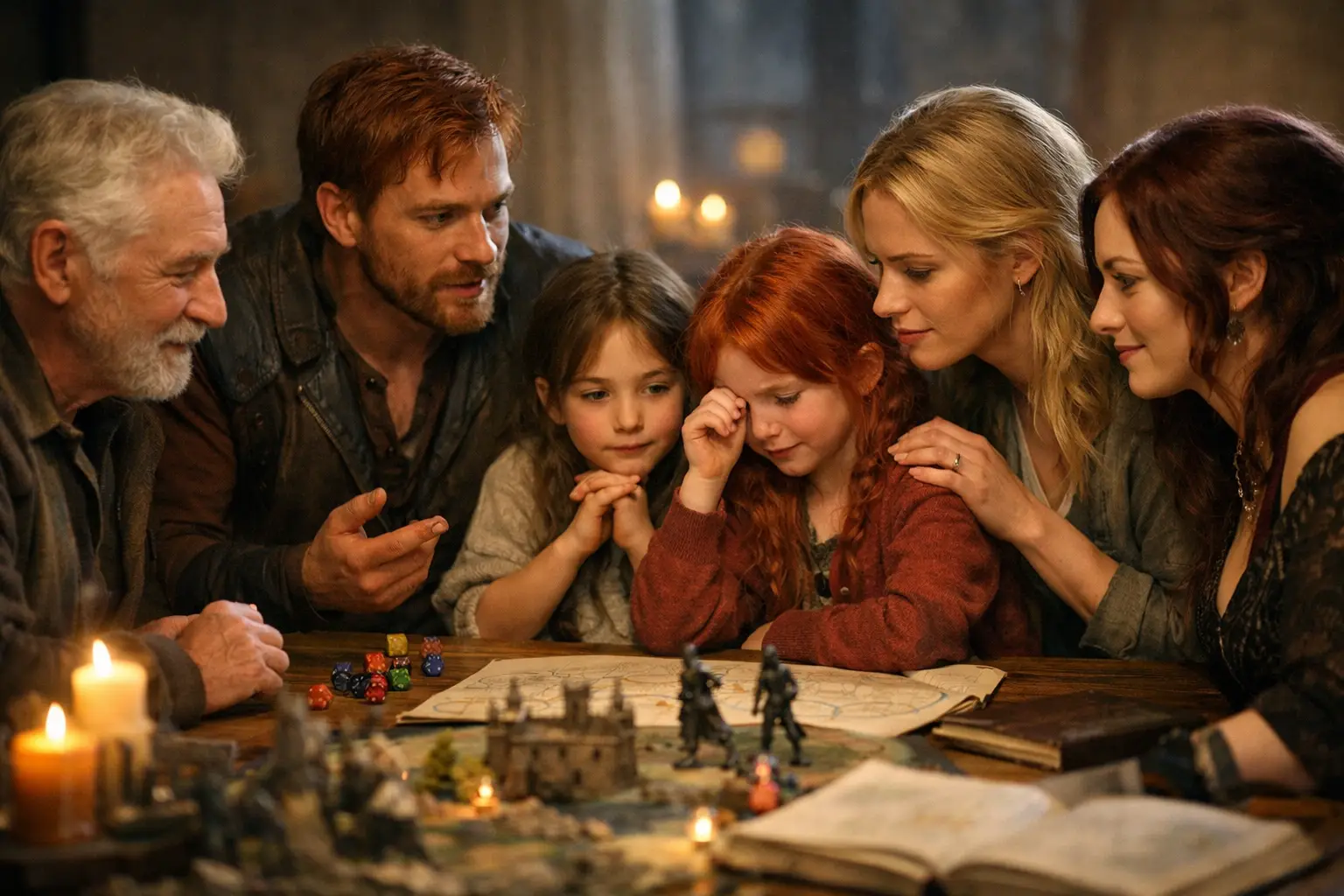
Emotionally Driven Tabletop Storytelling: When the World Keeps the Wound
A character kneels in the mud outside a chapel that no longer welcomes them.
The bell still rings. The villagers still whisper. Nothing on the character sheet has changed, yet everything has.
That is where emotionally driven tabletop storytelling begins – not with spectacle, not with a clever twist, but with the moment a player feels the weight of what their character has done, lost, hidden, or become.
Too many campaigns are remembered as sequences of events. A fight in a crypt. A chase through alleys. A deal with the wrong patron. Pleasant enough, perhaps, but quickly dissolved into anecdote.
Emotional memory works differently.
It anchors play in human stakes. It turns scenes into scars, promises, reckonings, and fragile moments of grace.
When people speak about the campaigns that stayed with them for years, they are rarely describing mechanics.
They are describing grief, loyalty, shame, wonder, dread, and hope.
What emotionally driven tabletop storytelling actually means
Emotionally driven tabletop storytelling is not the same thing as constant melodrama.
It does not mean every session must end in tears, confessions, or operatic tragedy. It means the emotional life of the characters is treated as part of the engine of play, rather than decorative flavour around the plot.
In practice, that changes the design of a campaign.
A war is not only about troop movements and victories. It is also about who is asked to betray their principles to survive it.
A mystery is not only about discovering the culprit. It is also about what the truth will cost once it is spoken aloud.
A horror campaign is not only about monsters in the dark. It is about what fear reveals, and what people become when they can no longer pretend to be untouched.
This approach asks a different question from the one many tables begin with.
Instead of asking, “What happens next?” it also asks, “Why does this matter to these people?”
That single shift deepens everything.
Why emotional stakes outlast plot twists
A plot twist can surprise a table for ten seconds.
Emotional consequence can shape an entire campaign.
Surprise has value, but it is often brief. If a noble patron is secretly the villain, the reveal may be satisfying, yet its real power depends on what it means to the characters.
Was one of them mentored by that patron? Did another sacrifice a friendship to defend them? Did the group build their sense of purpose around a lie?
Without that emotional groundwork, the twist is clever but thin.
This is why long-form campaigns become so powerful when they allow consequences to breathe.
A decision made in session three should not merely alter an encounter in session four. It should echo in relationships, reputation, self-image, and future choices.
People remember the night they spared the heretic and later found that mercy had set an entire district ablaze.
They remember the ally they failed, the child they could not save, the letter they never sent.
Emotional weight gives continuity its teeth.
For storytellers and Game Masters, this also means resisting the urge to smooth everything into neat resolution. Some of the strongest moments in play come from uncertainty.
Reconciliation may be partial. Victory may feel contaminated. Justice may arrive too late.
These are not failures of design.
Often, they are what make a world feel honest.
The foundations of emotionally driven tabletop storytelling
The heart of emotionally driven tabletop storytelling lies in three connected elements: character desire, meaningful consequence, and a world that remembers.
Character desire matters because emotion needs direction.
A player does not need a ten-page backstory, but they do need something that can be threatened, tested, or transformed.
Perhaps they crave absolution. Perhaps they want status. Perhaps they are protecting a sibling, chasing forbidden knowledge, or trying to prove that gentleness still has value in a cruel age.
Desire gives scenes tension before a single die is rolled.
Meaningful consequence matters because feelings without impact become performative very quickly.
If betrayal, sacrifice, confession, or restraint lead nowhere, players learn that emotion is cosmetic.
The campaign must respond.
Doors close. Trust weakens. Factions shift. Old friends return with altered loyalties. Even silence can become consequential when the world continues moving around the characters.
A world that remembers is what prevents emotional play from evaporating between sessions.
If a village is saved, people should speak differently. If a cult is exposed, someone will move to fill the vacuum. If a character lies to protect another, that lie should become part of the architecture of future scenes.
This is one reason persistent-world campaign design is so effective.
It allows memory to become structural rather than sentimental.
How to build emotional depth without forcing it
One of the common mistakes in emotionally driven tabletop storytelling is trying to demand intensity on command.
Players can feel when a scene is pushing for tears rather than earning them.
Emotional play works best when it is invited, not extracted.
The first step is simple: ask better questions.
Not only “What do you do?” but “What are you afraid this will cost you?”
Not only “Who do you trust?” but “Who would be devastated if they knew the truth?”
Questions like these create openings for players to define the emotional shape of their characters.
The second step is pacing.
If every session aims for devastating catharsis, the campaign becomes exhausting. Quiet scenes matter.
Shared meals, awkward reunions, a letter read alone by candlelight, the pause before entering a childhood home – these moments give players room to inhabit feeling rather than merely announce it.
Horror especially benefits from this rhythm.
Terror without tenderness becomes monotonous.
Tenderness is what makes terror hurt.
The third step is consent and table trust.
Emotional storytelling requires care. Not every player wants the same level of vulnerability, and not every theme is welcome at every table.
Clear communication creates freedom.
When people know their boundaries will be respected, they are far more willing to commit honestly to difficult scenes.
Atmosphere matters, but it cannot carry the whole weight
Many Game Masters are excellent at atmosphere.
They can conjure rain on slate roofs, incense in forgotten shrines, and the slow dread of footsteps in an empty corridor.
This is valuable.
Atmosphere prepares emotion. It creates the weather in which feeling can grow.
But atmosphere alone is not emotion.
A beautifully described ruin means little if no one at the table has a reason to care what was lost there.
Likewise, a haunting soundtrack or elegant setting detail cannot compensate for characters with no inner friction.
Style can sharpen a scene, yet substance must already be present.
This is where narrative craft becomes decisive.
The most affecting campaigns bind atmosphere to relationship and consequence.
The abandoned manor is not merely eerie. It is where two sisters last spoke before one vanished.
The battlefield is not merely grim. It is where a paladin broke their oath to save a single life.
Once place and feeling become inseparable, the world begins to breathe.
Why this style of play changes players as well as stories
The finest campaigns do more than entertain.
They alter the way participants think about character, choice, and narrative responsibility.
Emotionally driven tabletop storytelling asks players to become more attentive.
They listen more carefully. They notice what wounds another character is trying to disguise. They begin to understand that a decision is rarely only tactical.
It is ethical, relational, and symbolic all at once.
A choice to open the door, keep the secret, burn the evidence, or forgive the traitor becomes richer because it is no longer only efficient or inefficient.
It reveals identity.
For Game Masters and worldbuilders, this style of play also demands maturity.
It is harder than running a sequence of encounters. It requires patience, memory, and a willingness to let player decisions truly matter, even when they disturb prepared plans.
Yet the reward is profound.
You are no longer presenting a chain of events.
You are shaping a living record of who these people became under pressure.
That is why studios such as Mythveil Chronicles build for continuity and consequence rather than disposable adventure loops.
In a world that remembers, emotion is not an accessory.
It is evidence.
It proves that what happened here mattered.
The trade-off most tables must face
This approach is not ideal for every group, and pretending otherwise helps no one.
Emotionally rich campaigns usually ask for steadier attendance, stronger character investment, and more patience with slow-burning developments.
Some players want a lighter social evening with occasional heroics, and there is nothing wrong with that.
Others want deep immersion, painful decisions, and stories that linger after the session ends.
Problems arise when a table expects one and receives the other.
The answer is not to declare one style superior in every circumstance.
It is to be honest about intent.
If your group wants emotionally driven tabletop storytelling, build for memory, consequence, and vulnerability from the start.
Let mechanics support mood rather than replace it. Let the world react. Let people carry their choices forward.
A campaign becomes unforgettable when the players can feel, with unsettling clarity, that the world has kept a place for what they did there.
Not as a score, not as a trophy, but as an echo that continues sounding long after the dice have gone still.
If this is the kind of tabletop experience you are looking for, Mythveil Chronicles was built for players and storytellers who want more than disposable adventures.
Explore our campaigns, workshops, and living-world design at Mythveil Chronicles – and step into a world that remembers you.