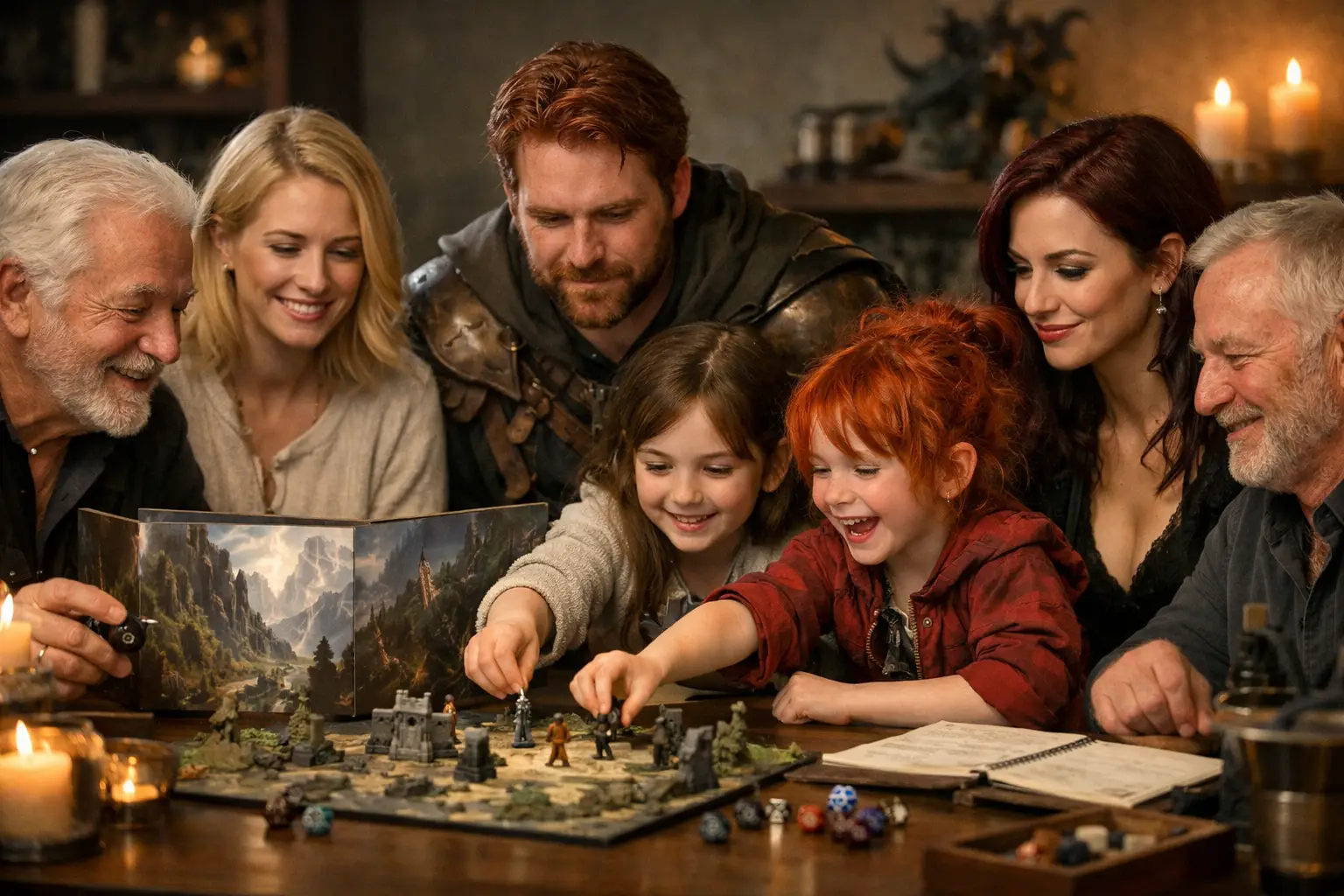
Best Long Term Online DnD Alternative
You can feel when a campaign has stopped remembering you.
The village you saved never changes. The rival you spared never returns. The lord you humiliated at court smiles the same polite smile three sessions later, as if nothing happened. Your choices vanish between sessions, and the world resets itself like stage scenery wheeled back into place after the audience has gone home.
That frustration is often what sends players searching for a long term online DnD alternative.
Not because fantasy adventure has lost its charm.
Not because Dungeons & Dragons suddenly stopped mattering.
For many players, D&D remains the gateway, the common language, the shared campfire around which modern tabletop roleplaying gathered. It is accessible, familiar, easy to recruit for, and capable of producing wonderful stories with the right table.
But long-form online play exposes a particular hunger.
After enough campaigns, some players no longer want only quests, levels, treasure, and monsters. They want consequence. They want atmosphere. They want political tension, moral pressure, horror, tragedy, mystery, intimacy, and deep character study. They want a world that remembers what they did and changes because of it.
The question is not simply what to play instead.
The better question is this:
What kind of story do you want your next two years to become?
What makes a long-term online D&D alternative worth choosing?
A true alternative is not just another ruleset with different dice probabilities. If you are planning to invest months or years in online play, the real measure is whether the game can support continuity of feeling as well as continuity of plot.
Does it hold tension over time?
Can it carry grief, paranoia, duty, obsession, faith, memory, social obligation, temptation, and change?
Can the setting respond when players alter its balance?
A long campaign lives or dies by those questions.
It is not enough for the party to visit new locations. The world must become different because they were there. The people they saved should remember. The people they failed should matter. The enemies they spared should make choices in their absence. The institutions they exposed should not simply vanish after the session ends.
That matters online even more than at a physical table.
Virtual campaigns live or die on momentum. If a game depends too heavily on tactical spectacle, it can begin to feel thin through a screen. Maps, tokens, and initiative trackers can be useful, but they are not enough to sustain emotional investment for a year or more.
If, however, the campaign is built around mystery, faction movement, moral pressure, evolving relationships, and a setting that changes between sessions, online play can become intensely immersive. Distance stops feeling like absence. It starts to feel like correspondence from another world.
A message arrives between sessions.
A faction changes its position.
A rumour spreads.
A newspaper misreports what the characters actually did.
A survivor tells the story wrong.
Suddenly the world has not paused. It has continued breathing.
The strongest long-term alternatives usually share three qualities. They create meaningful consequences beyond combat. They reward player decisions that reshape social, political, emotional, or supernatural landscapes. And they support a tone distinct enough to sustain emotional investment.
Without those elements, a campaign may still be enjoyable.
But it rarely becomes memorable.
The best long-term online D&D alternative may depend on tone
Players often ask for an alternative as though there must be one universal answer.
There is not.
What works for a gothic tragedy will not necessarily suit military horror, political intrigue, grim fantasy, cosmic investigation, or coming-of-age mystery. The right choice depends on what kind of pressure you want the story to place on the characters.
Call of Cthulhu is one of the clearest departures from D&D for groups who want fragility, uncertainty, investigation, and the slow erosion of certainty. It is especially powerful online because dread travels well through voice, text handouts, shared documents, recorded evidence, private messages, and controlled pacing. A long campaign in this mode can become a study in obsession. Every revelation costs something. Every answer makes the world less safe than it was before.
A Call of Cthulhu campaign does not ask, “How powerful can you become?”
It asks, “How much truth can you survive?”
That is a very different promise.
Warhammer Fantasy Roleplay offers another path. It is dirtier, stranger, and often more socially grounded than heroic fantasy. Careers, corruption, class, faith, disease, debt, superstition, and the sheer indignity of surviving in a hostile world give it enormous staying power. Long campaigns thrive when characters climb, fail, compromise, and leave scars on the setting rather than simply accumulating victories.
In Warhammer, saving the town does not mean the town becomes clean.
It means the town now has one more reason to fear you, resent you, praise you, exploit you, or drag you into the next disaster.
Delta Green suits players who want modern horror with institutional weight. It excels at the split between professional duty and private collapse. Online, this can be devastatingly effective. Briefings, redacted files, personal scenes, midnight messages, classified photographs, and the feeling that the conspiracy continues while you sleep all add to the pressure.
Delta Green is not only about monsters.
It is about what repeated exposure to the impossible does to a human life.
Your marriage suffers.
Your job performance collapses.
Your lies become habitual.
Your sense of reality corrodes.
And still the phone rings.
Vampire shifts the focus towards identity, desire, hierarchy, hunger, and political theatre. If your group wants personal horror and long-form intrigue, it can sustain years of play because the engine of the campaign is not a dungeon but a society. Your enemy today may be your patron next month. Every favour has a memory. Every insult ripens. Every alliance is also a future betrayal waiting for the right night.
In Vampire, power is never clean.
It comes with lineage, appetite, reputation, dependency, and debt.
Even quieter games such as Tales from the Loop can become profound over a long arc. Nostalgia, childhood wonder, loneliness, broken families, strange machines, and the gradual revelation of what a community hides can create campaigns that linger long after the sessions end.
The best long term online DnD alternative is therefore not automatically the darkest, strangest, or most complex game.
It is the one whose emotional promise matches the table.
Fear.
Belonging.
Decline.
Temptation.
Duty.
Wonder.
Corruption.
Grief.
Choose the pressure first.
Then choose the system.
Why living worlds matter more than system alone
A system can shape tone, but it does not guarantee longevity.
Plenty of campaigns fade not because the rules fail, but because the world never becomes larger than the immediate scene. If every problem exists only when the players are looking at it, the illusion eventually collapses.
The village is threatened only when the party arrives.
The villain acts only when the party enters the room.
The rebellion waits politely for the heroes to decide whether they care.
The haunted house remains haunted in exactly the same way until someone opens the next door.
After a while, the players notice.
This is where living-world design changes everything.
In a living campaign, factions pursue their own interests. Communities adapt. Rumours spread. Resources shift. Leaders panic. Institutions protect themselves. Survivors remember. Enemies learn. Consequences ripple outward whether or not the party is present to witness them.
The setting acquires memory.
It starts to feel less like a backdrop and more like a historical process.
That sense of ongoing life is often the true long term online DnD alternative players are seeking, even if they do not phrase it that way at first. They are not merely tired of one game line. They are tired of stories without residue.
They want choices that alter alliances.
They want old decisions to return months later in unexpected forms.
They want a city that remembers who saved it, who betrayed it, who lied to it, and who walked away when help was needed.
For online groups especially, this continuity creates anticipation between sessions. Players speculate. They write messages in character. They revisit clues. They argue over faction motives. They check old notes because old notes still matter. The campaign becomes part of their imaginative life rather than just another calendar appointment.
This is where studios such as Mythveil Chronicles build differently.
The goal is not only to run sessions.
The goal is to maintain a world with memory.
History, factions, relationships, rumours, wounds, debts, victories, failures, and player actions are tracked across time. That difference is not cosmetic. It changes how every session lands, because events are no longer isolated episodes. They become part of a longer memory.
A cult exposed too early may vanish underground.
A noble spared in one campaign arc may fund a rival faction in the next.
A town saved at terrible cost may honour the characters publicly while fearing them privately.
A newspaper may turn a heroic act into scandal because scandal sells better.
The world does not merely react.
It interprets.
And interpretation is where long-form play becomes dangerous.
Because once the world interprets your choices, you no longer control what they mean.
Trade-offs when leaving D&D behind
There is no honest way to discuss alternatives without admitting what D&D still does very well.
It is accessible.
It is widely understood.
It is relatively easy to recruit for.
Many players arrive with expectations already formed, and that shared literacy lowers the barrier to entry. Everyone broadly understands the rhythm: party, quest, danger, reward, growth. That common structure has value.
Leaving it behind requires a different kind of commitment.
Alternative systems ask more of the group. Sometimes they ask for patience with unfamiliar mechanics. Sometimes they ask players to embrace vulnerability over optimisation. Sometimes they require stronger trust at the table, because horror, tragedy, politics, and consequence-led play can reach deeper than monster-fighting ever will.
This is not a flaw.
It is a different artistic bargain.
If your group mainly wants light adventure, banter, tactical heroics, and reliable escapism, changing systems may solve nothing. There is no virtue in choosing a darker or more complex game if the table does not actually want that experience.
But if the real hunger is for pressure, atmosphere, emotional continuity, and a world that reacts like a living organism, then the extra effort is usually rewarded.
Another trade-off is pacing.
Some alternatives move more slowly on the surface because they care less about encounter volume and more about implication. A Delta Green session may spend an hour on a conversation with a witness because the real horror is not what the witness saw, but what they are refusing to admit. A Vampire session may revolve around one favour, one insult, one invitation to the wrong room at the wrong hour. A Warhammer session may turn a tax dispute, a plague cart, and a corrupt magistrate into the beginning of a political disaster.
That slower rhythm can be a gift in long-term online play.
Attention is not always sustained by more action.
Often it is sustained by tension.
By revelation.
By the sense that something is moving beneath the floorboards and the players are only beginning to hear it.
The trade-off is that everyone must agree to care.
Not only about winning.
About meaning.
How to choose your long-term online D&D alternative
Begin with the emotional promise, not the rules.
Ask what your players want to feel for six months.
Then ask what they want to feel for a year.
Then ask what they might still care about after two years.
Fear?
Belonging?
Decline?
Temptation?
Moral fatigue?
Wonder?
Political ambition?
Personal horror?
Once that answer is clear, system choice becomes easier.
If the table wants the slow collapse of certainty, Call of Cthulhu or Delta Green may be the right path.
If it wants dirt, class pressure, black humour, corruption, and survival inside a hostile society, Warhammer Fantasy Roleplay may be stronger.
If it wants hunger, status, intimacy, betrayal, and immortal politics, Vampire may carry the weight.
If it wants childhood mystery, nostalgia, wonder, and hidden sadness, Tales from the Loop may do more with silence than another game does with a battlefield.
Then look at campaign architecture.
Will the game support recurring factions, shifting loyalties, downtime development, personal consequences, and decisions that outlast a single session? Does the Game Master or studio running it have the structure to preserve continuity? Long-form play rarely fails for lack of lore. It fails because nobody is carrying memory forward.
It also helps to be realistic about group habits.
A brilliant political horror campaign will struggle if half the table wants beer-and-pretzels chaos. A melancholy mystery may sing for the right players and suffocate the wrong ones. A harsh survival campaign may thrill one group and exhaust another.
Longevity is not only about quality.
It is about fit.
Finally, pay attention to whether the campaign feels authored without feeling railroaded. The best online experiences have clear atmosphere, strong curation, and a deliberate sense of place, but they still leave room for player agency to change the world’s shape.
That balance is rare.
It is also worth seeking.
The best alternative to D&D is rarely the game with the loudest reputation. It is the one that gives your choices a future. When a world remembers what you did, remembers who you spared, betrayed, loved, or failed, play becomes more than pastime.
It becomes part of your own remembered life.
That is where long campaigns begin to matter.
Not because the rules are different.
Because the world finally remembers you.