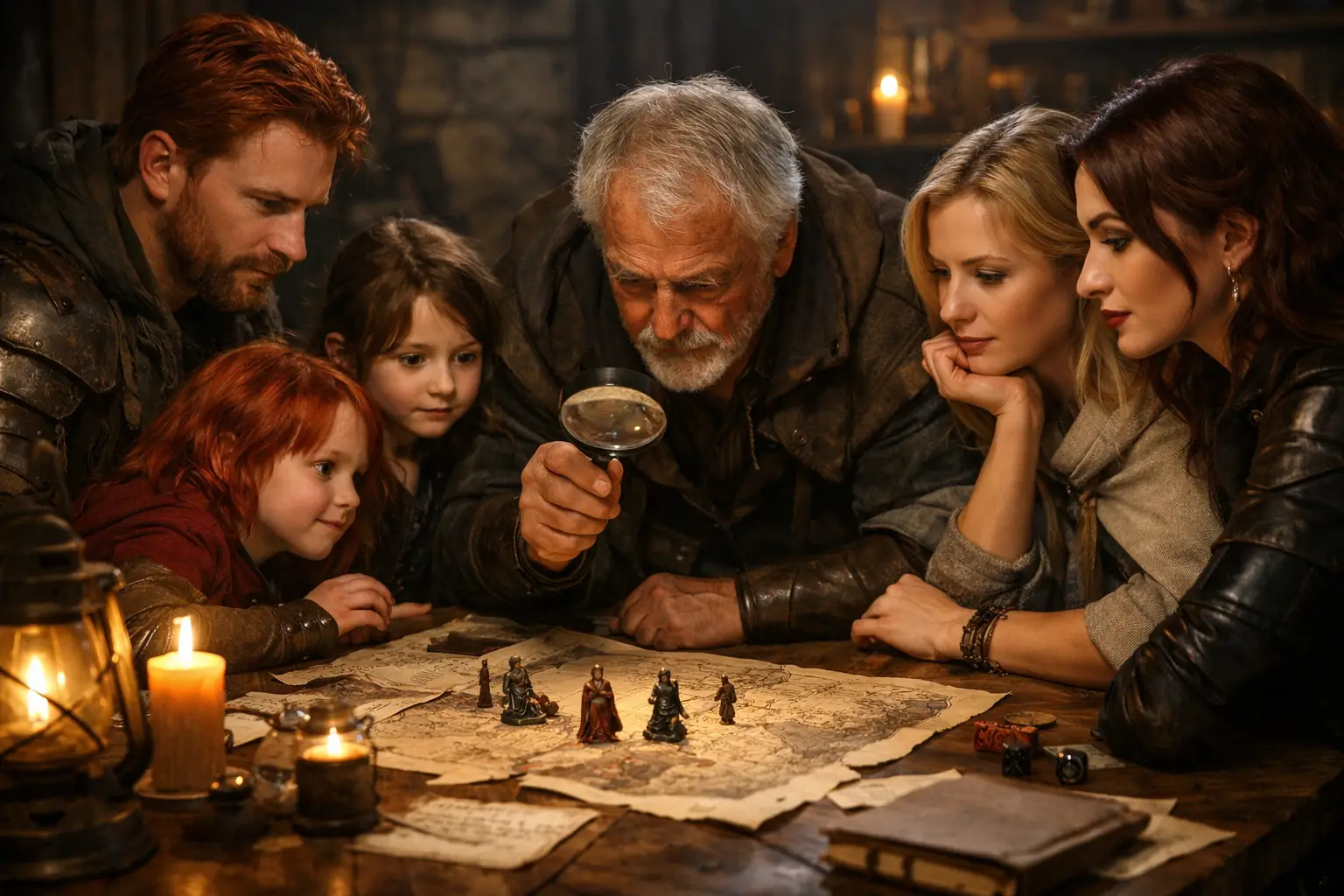
What Makes an Immersive Investigative RPG Campaign
A candle gutters in a safehouse kitchen.
The detective has finally found the ledger.
For three sessions, the group has followed rumours through police archives, dockside bars, parish records and the back rooms of men who smile too quickly. They expected names. Payments. Dates. Maybe a confession hidden in shorthand.
Then the detective turns the page.
The handwriting is familiar.
Not because they have seen it in the case file.
Because they grew up with it.
It is their sister’s hand.
Nobody speaks for a moment.
The ledger is no longer evidence.
It is an accusation.
That is the moment an immersive investigative RPG campaign stops being a puzzle delivery system and becomes something far more dangerous: a story with memory, consequence and emotional cost.
Too many mystery campaigns mistake obscurity for depth. They bury the truth beneath locked rolls, fragment clues until players feel stranded, or treat investigation as a mechanical corridor between action scenes. The result is not tension. It is fatigue. If a campaign is meant to feel alive, then the act of discovering its secrets must feel human: uncertain, layered, intimate and charged with the sense that every answer changes the world around it.
An immersive investigative RPG campaign is not about hiding the plot until the players guess correctly.
It is about building a world where secrets have roots.
The heart of an immersive investigative RPG campaign
At its best, an investigative campaign is not only about solving a case. It is about entering a living situation already in motion. People have motives before the players arrive. Institutions have histories. Rumours distort the truth. Factions conceal, reshape or weaponise information. The mystery matters because it emerges from a world that could plausibly continue without the investigators, and may continue differently because of them.
That distinction matters.
A thin mystery asks, “Can the group guess what the GM wrote?”
A richer one asks, “What kind of world produces this crime, disappearance, haunting or conspiracy, and what will it cost to pull on the thread?”
The latter creates immersion because players are not merely decoding clues. They are interpreting culture, memory, class, fear, faith, bureaucracy, family loyalty and self-deception.
The missing professor is not just missing. He owed money to the wrong patron, falsified field notes, offended the wrong local family and buried something in his last publication that three institutions would rather keep dead. The locked room is not just locked. It belongs to a house where nobody has used the east staircase since the winter of 1891. The cult is not just a cult. It is what remains when a town turns grief into doctrine and calls it tradition.
This is why the strongest investigative play so often flourishes in games such as Call of Cthulhu, Delta Green, Vampire, Tales from the Loop and the grimmer corners of Warhammer. These settings understand that evidence does not live in a vacuum. It sits in mouldering archives, half-burnt chapels, police reports altered by frightened officials and witness statements shaped by shame.
Setting is not backdrop.
It is part of the case file.
At a Mythveil table, this is where investigation begins to breathe. The question is not only where the clue is hidden. The question is why the clue was hidden, who benefited from its disappearance, who was hurt by its survival, and what will happen once the players drag it back into the light.
Because the moment truth becomes visible, the world must answer.
Atmosphere is not decoration
Many GMs speak of atmosphere as if it were an optional flourish added after the structure is done. In truth, atmosphere is one of the primary tools of investigation. It tells players what kind of questions to ask, what details feel charged, and where danger may be moral rather than physical.
A fluorescent office at 2am creates one investigative mood.
A fishing village where every portrait seems to watch the party creates another.
The first may suggest institutional rot, burnout and records hidden in plain sight. The second may suggest inherited silence, superstition and communal complicity. In both cases, atmosphere frames inquiry before anyone rolls a die.
An immersive investigative RPG campaign uses description with intent. Not pages of purple prose, but selected details that imply history.
Damp wallpaper.
The smell of old incense under bleach.
School trophies left in a flood-damaged hall.
A telephone ringing in a house that has been empty for six years.
These details do not simply paint a picture. They imply that lives were lived here, and that whatever happened has left residue.
Picture the players entering an abandoned municipal archive after midnight. The building should be empty, but one office light still burns behind frosted glass. On the wall outside hangs a framed photograph of the city council from 1978. Someone has turned every face toward the wall except one. Beneath the photograph sits a wastepaper basket filled with torn carbon copies of birth certificates.
No monster has appeared.
No clue has been explained.
But the players already know what kind of place this is.
They begin asking better questions.
Who turned the photograph around?
Why only that face?
Why birth certificates?
Why carbon copies and not originals?
Atmosphere has done its job because it has become investigative pressure.
When atmosphere works, players begin investigating beyond the obvious clue trail. They ask who cleaned the blood. Why the church bell rope is frayed. Why nobody in town uses a certain lane after dusk. Why the school trophy cabinet contains awards from every year except one.
Curiosity becomes instinctive because the world feels inhabited.
That is the point.
Atmosphere is not mood wallpaper.
It is the way the setting whispers where the bodies are buried.
Clues must move, not stall
The fastest way to kill an investigation is to make progress depend on a single die roll. If the story can collapse because one search test failed, the problem is not the players. It is the architecture.
A strong immersive investigative RPG campaign treats clues as vectors, not gates. Essential information should be discoverable through more than one approach: conversation, records, surveillance, personal history, environmental evidence, faction pressure or simple persistence. The uncertainty should lie in interpretation, timing and consequence, not in whether the campaign survives contact with bad luck.
This does not mean making mysteries easy.
It means making them resilient.
Players may find the letter in the desk, notice the unusual soot in the fireplace, or learn from a spooked witness that someone burned papers before dawn. Different routes, same forward motion. The tension comes from what the clue means and who notices the investigators circling closer.
A clue should feel like a door opening onto more danger, not like a keycard check at the entrance to the next scene.
Suppose the group is trying to discover who altered a police report. They might find the original carbon copy in a basement archive. They might pressure the night clerk who moved the file. They might compare the typed report with the officer’s older statements and notice the wording has changed. They might speak to the widow of the first investigator, who kept a private copy because she never trusted the department.
None of those routes should be “the correct one.”
They are different ways of entering the same wound.
There is also a deeper truth here. In memorable campaigns, information has a price. Perhaps obtaining the files means alerting Internal Affairs. Perhaps pressing the witness too hard drives them into the arms of a hostile faction. Perhaps reading the diary reveals not only the cult’s location, but the investigator’s own role in events they have forgotten.
Discovery should change the state of play.
A clue should not simply answer a question.
It should make the table ask whether they were ready to know.
That is where investigative play becomes immersive. The players no longer treat evidence as collectible objects. They begin treating information as volatile material. Something that can protect, expose, corrupt, condemn or destroy depending on who holds it and when.
The file is not safe because it is found.
Sometimes the danger begins when someone finally reads it.
The mystery must touch the characters
An investigation becomes immersive when it stops being abstract. The missing professor is interesting. The missing professor who mentored one of the characters, falsified archaeological records and may have concealed evidence of a massacre is unforgettable.
This is where many campaigns either soar or remain merely competent. If clues point only outward, the story risks feeling procedural. If clues also point inward, towards identity, guilt, belief, family, ideology or desire, then each revelation lands with greater force.
That does not require melodrama in every session. Sometimes the personal connection is subtle.
A player recognises the hymn sung by a suspect because their grandmother sang it.
A bureaucratic cover-up mirrors the institution that once discarded them.
A seemingly monstrous witness turns out to be protecting a child, forcing the group to question their assumptions.
These moments create emotional texture because they remind the players that investigation is not sterile. Truth enters through human lives. It stains families. It distorts memory. It makes people choose between honesty and survival.
That ledger in the safehouse kitchen matters because it does not only reveal a conspiracy. It reveals that someone the detective loves was close enough to touch it. Maybe she was guilty. Maybe she was threatened. Maybe she was trying to expose the same thing and failed. The answer matters, but the wound opens before the answer arrives.
That is powerful investigative design.
The clue does not merely advance the plot.
It changes the emotional weather at the table.
For long-form play, this approach is especially powerful because consequences can echo. One compromised choice in an early case may return months later through a promoted official, a bitter survivor, or a community that now fears the investigators more than the original threat. A lie told to protect a witness may become the reason a future jury acquits a monster. A favour accepted from a corrupt patron may become the thread by which that patron later pulls the party into something worse.
Worlds that remember are always more immersive than worlds that reset.
In a Rexborn-style living world, this memory is not decorative continuity. It is structure. Choices create pressure. Pressure changes relationships. Relationships reshape institutions. Institutions respond, conceal, retaliate or adapt. The investigation becomes part of the world’s history, not a temporary interruption of it.
That is when players start asking a different kind of question.
Not only, “What happened?”
But, “What did we just become part of?”
Pacing should breathe like a thriller, not a checklist
Investigation is often mishandled because it is paced as administration.
Interview.
Search.
Roll.
Clue.
Repeat.
That rhythm can work briefly, but over time it drains urgency from the table. Players may be moving from scene to scene, yet the story feels oddly static because nothing changes except the number of facts collected.
A better rhythm alternates pressure and reflection.
A quiet archive scene means more when followed by a knock at the door. A harrowing pursuit has greater impact when the next session allows the players to compare notes, notice contradictions and realise what they missed. Good investigative pacing understands that revelation needs space, but dread needs movement.
The best investigative campaigns often feel like breathing.
Inhale: the players gather evidence, speak to witnesses, sort through records, argue over theories.
Exhale: the world reacts.
A suspect vanishes.
A newspaper prints a false version of the case.
Someone follows them home.
A friendly contact stops answering the phone.
A body appears where there should not be one.
This does not mean every session needs a dramatic cliffhanger. Sometimes the most effective ending is quiet. A letter delivered too late. A photograph developed in the wrong colour. A witness using a phrase they could not possibly know. A church bell ringing from a tower that burned down before the characters were born.
The key is movement.
Something must shift.
This is also where restraint matters. Not every answer should arrive the moment a clue is found. Sometimes players need to sit with incomplete understanding. The notebook contains names, but not the pattern linking them. The corpse confirms ritual activity, but not motive. The recording proves a meeting took place, but not who else was in the room.
Ambiguity can be powerful if the campaign continues to provide meaningful traction.
What you must avoid is stagnation disguised as mystery. If the table spends an hour circling because there is no actionable lead, the atmosphere will not save you. Players need uncertainty, yes, but they also need momentum.
There is a difference between being lost inside a mystery and being locked outside the story.
The first creates immersion.
The second creates frustration.
A strong investigative RPG campaign keeps the door moving. It may open into danger, doubt or worse questions, but it opens.
Why living worlds make investigation stronger
The most compelling investigative campaigns feel as though the case exists within a larger ecology of power. The cult is not merely evil; it is tied to shipping interests, local politics, inherited wealth and a festival older than the church that tried to erase it. The missing person is not merely bait; they are a node in a web of debts, loyalties and institutional failures.
This is where living-world design changes everything.
When factions pursue their own aims between sessions, the investigation acquires consequence beyond the immediate scene. Suspects flee. Witnesses are silenced. Newspapers frame the story. Rivals exploit the chaos. False narratives harden into public truth. The players are no longer solving a static puzzle. They are intervening in an evolving reality.
Imagine the group uncovers evidence that a charitable foundation is funding disappearances. If they move slowly, the foundation relocates its records. If they accuse too early, it paints them as unstable conspiracy theorists. If they leak the documents, the press simplifies the story into scandal and misses the ritual pattern underneath. If they do nothing, the foundation gains another seat on the city council.
The mystery does not wait politely.
It adapts.
That dynamic is central to how Mythveil Chronicles approaches long-form storytelling. A campaign becomes more than a sequence of clues when the world responds, remembers and shifts under the weight of what the players choose to expose, protect or bury.
In this style of play, an investigation is not a line of breadcrumbs.
It is a disturbance.
The players enter a system of secrets, and the system reacts. Some people panic. Some lie. Some confess for the wrong reasons. Some try to profit. Some genuinely want the truth known but are terrified of what truth will do once released.
That is where the investigation gains moral force. Solving the case is not the same as healing the world. Sometimes solving the case breaks the world open. Sometimes silence would protect the innocent but empower the guilty. Sometimes the truth is necessary and still catastrophic.
Living worlds make investigation stronger because they refuse to keep truth harmless.
They let it move.
Trust at the table is part of the design
There is one final piece that often goes unspoken. Investigative roleplay only becomes truly immersive when players trust that confusion is purposeful, that attention will be rewarded, and that the GM is not hoarding meaning behind a screen for the sake of superiority.
Mystery requires opacity, but it also requires fairness. Players should feel that the truth can be reached through thought, observation, emotional engagement and courageous decisions. If every revelation feels arbitrary, immersion breaks. If every encounter could matter, players lean in.
That trust is built through consistency of tone, coherent causality and respect for player agency. It also depends on listening. Sometimes the most powerful turn in an investigation emerges from a player’s theory, fear or moral instinct. A living campaign can absorb that energy and answer it without becoming shapeless.
If players believe the world is coherent, they will investigate boldly.
They will remember names.
They will draw maps.
They will compare dates.
They will argue over motives while making coffee between sessions.
They will care enough to be wrong.
And that matters, because being wrong is part of investigation. A good mystery should allow mistaken theories without punishing curiosity. The players may misread the priest, trust the wrong witness, or assume the obvious suspect is innocent because the truth feels too neat. The campaign should answer those choices honestly, not mock them. Trust does not mean the world is safe. It means the world is legible.
Even horror needs fairness.
Especially horror.
Because when players trust the design, they can surrender to uncertainty. They can feel confused without feeling cheated. They can be frightened without feeling manipulated. They can discover that the ledger is written in the sister’s hand and know, instantly, that this is not a cheap twist.
It means something.
The best immersive investigative stories linger because they leave marks. Not just on the characters’ sanity, safety or relationships, but on the world itself. Doors stay broken. Names are remembered. Archives gain new files. Survivors tell altered versions of the truth. And somewhere, months later, a bell rings in a place the investigators thought they had already saved.
If you are building an investigative campaign, aim for more than a solvable riddle. Build a world that can keep secrets for reasons of its own, then let your players discover what those secrets cost.
The case begins with evidence.
The campaign begins when the evidence looks back.