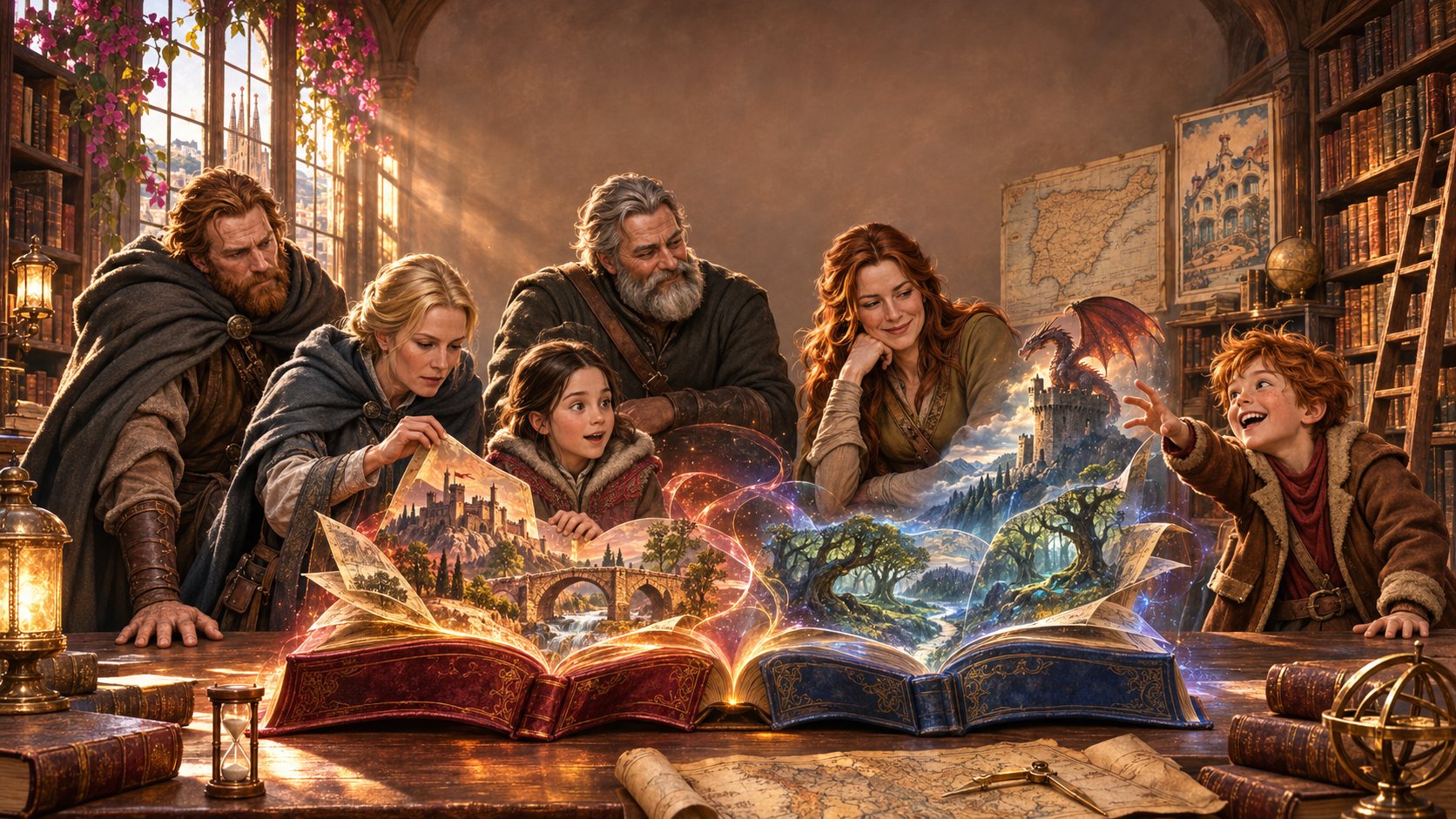
One Hobby, Many Beginnings — Chapter V
A Mythveil Chronicles Historical Essay | November 2026
Two books lie on the table.
One has a red cover. The other is blue. Both promise an adventure inside a mysterious cave, and both insist that the reader must make decisions rather than simply follow the story from beginning to end.
Mara picks up the red one.
Chibi takes the blue.
“Which one is the real adventure?” she asks.
“Both,” Caelwyn replies.
“But they’re different books.”
“Different languages,” Stacy explains. “The story can belong to more than one.”
Chibi studies his copy with considerable suspicion.
“Does my cave have a dragon?”
“Not every cave has a dragon,” Sean tells him.
“Then what’s the point?”
Eljara reaches across the table, opens the book and smiles.
“Perhaps you should go inside and find out.”
It is a simple exchange, but it brings us remarkably close to one of the defining characteristics of the history of gamebooks in Spain.
When commercial gamebooks arrived in the early 1980s, they entered a country with several literary languages, a vigorous publishing industry, a distinguished tradition of comics and illustration, and an emerging generation of readers fascinated by stories that allowed them to participate.
American and British imports certainly mattered. Without Edward Packard, R. A. Montgomery, Steve Jackson, Ian Livingstone and Joe Dever, the Spanish market would have developed very differently.
Yet imports explain only part of what happened.
Spanish publishers rapidly began producing their own interactive books. Local authors adapted the format to literary adventure, crime fiction and historical imagination. Illustrators brought the visual language of Spanish comics into branching narratives. Computer programmers explored related ideas through text adventures, while tabletop roleplaying developed a distinctive relationship with Spanish history, folklore and mythology.
The movement extended beyond Castilian Spanish. Catalan editions appeared at the beginning of the commercial boom; Basque and Galician publishing followed their own trajectories.
And when the mass market eventually contracted, collectors, independent publishers and enthusiasts preserved the medium until a new generation was ready to explore it.
This is the history of gamebooks in Spain: not the story of a country waiting for someone else to invent imagination, but of people discovering what they could do with a form that had suddenly become available to them.
Some of those people are famous.
Others are barely remembered.
A few remain hidden in the small print of books that have survived for forty years.
Their stories deserve to be told.
Before the Gamebook: A Novel You Could Shuffle
The history of Spanish interactive literature does not begin in 1983.
At least, not if we are willing to look beyond the commercial gamebook itself.
In 1964, the Spanish writer Max Aub published an extraordinary literary experiment called Juego de cartas — Card Game.
Aub was living in exile in Mexico. Having left Spain during the upheavals of the twentieth century, he had developed a literary imagination particularly interested in identity, memory, uncertainty and the difficulties of establishing a single, reliable account of events.
Juego de cartas did not take the form of a conventional novel.
Instead, it consisted of playing cards carrying written fragments. On one side were illustrations attributed within Aub’s fictional universe to Jusep Torres Campalans, a painter Aub himself had invented. On the other were letters concerning a man called Máximo Ballesteros.
Who was Ballesteros?
What had happened to him?
Could the conflicting accounts of those who knew him ever produce a complete picture?
The reader could rearrange the cards, encounter testimony in different orders and construct different understandings of the same absent figure.
Aub’s experiment was not a fantasy adventure and did not provide the numbered passages familiar from later gamebooks. It was a literary investigation into the relationship between narrative, physical form and interpretation.
Its historical significance lies partly in the way it challenged the assumption that a text must possess one fixed sequence.
The physical organisation of the work became part of its meaning.
There is an important geographical distinction here. Juego de cartas was first published in Mexico by Alejandro Finisterre, not in the Spanish commercial publishing market. It belongs to the cultural history of a Spanish writer in exile, which is not quite the same thing as the domestic history of Spanish gamebook publishing.
Nor is there evidence that the publishers of the 1980s consciously modelled their books on Aub’s experiment.
We should not turn resemblance into influence simply because the connection would make a satisfying historical narrative.
Nevertheless, Aub demonstrates that questions about movable narratives, reader participation and competing interpretations were being explored by Spanish-language writers well before the arrival of Choose Your Own Adventure.
The connection is intellectual rather than demonstrably genealogical.
That distinction matters.
The same caution applies to other experimental literary traditions. A novel that permits several interpretations is not necessarily an interactive gamebook. A work that rearranges its sequence does not automatically offer decisions capable of changing fictional events.
Open literature, nonlinear reading and rule-driven branching are related ideas, but they are not interchangeable.
For Mythveil Chronicles, that distinction is particularly interesting.
A story may allow several interpretations without giving its audience control over what happens. A game may allow many actions while offering very little meaningful change.
Participation alone does not guarantee agency.
Spain’s subsequent history would explore both possibilities.
1983: The Red Books Arrive in Barcelona
The decisive commercial moment came in 1983.
Editorial Timun Mas, based in Barcelona, introduced the American Choose Your Own Adventure format to Spanish readers under the title Elige tu propia aventura.
The opening volume was Edward Packard’s La cueva del tiempo — The Cave of Time.
Its appearance marked a significant change in the way many young readers encountered adventure fiction.
Instead of following a protagonist’s decisions, the reader made them.
An instruction might send them to a distant page. Another offered an alternative direction. A poor decision could terminate the adventure, while curiosity might reveal a path that had remained invisible during an earlier reading.
The familiar physical act of turning a page acquired a new purpose.
It became an action within the story.
A surviving edition of La cueva del tiempo provides unusually useful evidence. Its publication details identify a Spanish copyright in 1983, followed by further printings in June 1983, January 1984 and September 1984.
That sequence does not tell us exactly how many copies were sold.
It does, however, establish that the title continued to be printed during the first eighteen months of its Spanish existence.
It is a modest but solid piece of publishing history, precisely the sort of evidence that deserves more attention than unsupported claims about spectacular sales figures.
Timun Mas was not merely translating stories.
The publisher was introducing a different reading practice to a new audience.
The books explained how to use them. Readers were warned against moving through the pages in the conventional order. They were expected to understand that the sequence of the narrative depended upon their choices.
For an experienced roleplayer, such instructions might seem obvious.
For a child encountering their first branching story, they represented a remarkable invitation.
The author had written the possibilities.
The reader would decide which of them became the adventure.
Two Languages, One Beginning
There is another reason why 1983 is so important.
The arrival of commercial gamebooks in Spain was not exclusively a Castilian-language event.
Timun Mas also introduced Tria la teva aventura in Catalan, including La cova del temps and Les joies perdudes de Nabooti.
Historical accounts describe the Castilian volumes as having recognisable red covers, while Catalan copies were distinguished by blue.
The colour distinction is a small detail, but it illustrates something culturally significant.
Interactive adventure entered an already multilingual publishing environment.
The same basic invitation — choose what happens next — could be expressed in more than one of Spain’s languages.
The precise dates of some individual Catalan editions still require careful attention. Certain bibliographic records place La cova del temps in 1983, while a finding aid associated with translator Carme Tello points to 1984.
That discrepancy should not be disguised.
It may reflect different editions, printings or the way particular copies were catalogued. Until the original colophons have been compared directly, the safest conclusion is that the Catalan programme emerged at the beginning of the commercial boom, with specific publication details still requiring verification.
Carme Tello also illustrates a wider problem in the history of translated gamebooks.
Readers remember the authors whose names appeared prominently on the covers. They often remember the illustrators who gave the adventures their distinctive appearance.
Translators can disappear from the history, even when their work determined how an entire generation experienced the books.
A gamebook translation is not a purely mechanical operation.
Instructions must remain clear. References to numbered sections must be correct. Puzzles may depend upon language, cultural familiarity or carefully chosen terminology.
An error in an ordinary novel can change a sentence’s meaning.
An error in a gamebook can make a route impossible to follow.
Stacy studies the two books on the table.
“That’s quite a lot of responsibility for somebody whose name readers might never notice.”
“Publishing history has a habit of remembering the person on the front cover,” Sean replies.
“And forgetting half the people who made the book.”
He pauses.
“Rather like an adventuring party.”
Caelwyn gives him a tired look.
“Some of us remember the healer.”
“Only when you’re bleeding,” Stacy says.
For once, nobody argues.
The People Who Made Translation Work
Imported gamebooks provided Spanish readers with stories from abroad, but the books they held were the products of domestic editorial decisions.
Someone had to acquire the rights.
Someone selected the titles.
Translators converted the text into the appropriate language. Editors checked consistency and accessibility. Designers prepared the pages, and printers produced objects that had to withstand repeated use.
In a conventional novel, repeated reading usually means starting the book again.
A gamebook is handled differently.
Its pages are consulted non-sequentially. Readers turn backwards, revisit earlier decisions, record information and search for missed routes.
The physical object has to support that behaviour.
The Spanish success of Elige tu propia aventura therefore represents more than the popularity of an American idea. It also represents the work of the people who made that idea function in the Spanish publishing environment.
We still lack complete information about several early Castilian translators, original print runs, cover prices and distribution arrangements.
Rather than inventing those details, we should recognise them as questions worth asking.
Did bookshops and schools discover the format at the same time?
How did Timun Mas decide which American titles would work best in Spain?
Were particular adventures chosen for their themes, their mechanical simplicity or their commercial reputation?
How did the publishing team handle the considerable challenge of checking every branching reference?
Those questions cannot always be answered by looking at a cover.
They require surviving editorial records and the testimony of people who worked behind the scenes.
1985: When the Adventure Needed Dice
The next major phase began in the middle of the decade.
In 1985, Ediciones Altea, through its Altea Junior imprint, brought a different form of gamebook to Spain.
The British series Fighting Fantasy appeared as Lucha-Ficción, introducing readers to adventures such as El hechicero de la Montaña de Fuego, La ciudadela del caos and El bosque tenebroso.
Joe Dever’s Lone Wolf arrived as Lobo Solitario, with early Spanish titles including Huida de la oscuridad and Fuego sobre el agua.
Other collections followed, including Steve Jackson’s Sorcery! under the title Brujos y Guerreros, alongside La búsqueda del Grial and Crónicas Cretenses.
These books were related to the earlier branching adventures, but their demands were different.
A reader might now have to record equipment, manage resources, calculate statistics or resolve combat with dice.
The act of choosing a path remained important. Yet the outcome of a decision could also depend upon the state of the character.
A reader who had found a useful object earlier might survive an encounter that defeated another reader following a different route.
The book began to remember.
Not everything, of course. A printed adventure could only track the circumstances its author had anticipated.
But its rules introduced continuity between decisions.
Resources could be spent.
Injuries could accumulate.
Possessions could open or close possibilities.
That change brought the experience closer to tabletop roleplaying, even though a solo gamebook and a tabletop campaign remain fundamentally different forms.
A gamebook presents an authored network of possibilities.
A tabletop roleplaying group can attempt actions the author never specified, with a Game Master interpreting the consequences.
The overlap lies in the importance of choice, character state and the belief that actions should matter beyond the moment in which they occur.
For many Spanish readers, the arrival of Lucha-Ficción and Lobo Solitario was therefore an introduction not merely to fantasy adventures, but to a particular way of imagining themselves inside a system of rules.
A Note on Dates and Sales
The chronology matters here.
The original British publication dates of Sorcery! should not be confused with the dates of its Spanish editions. Some later online summaries reproduce dates associated with the British books as though they referred to their Spanish appearance.
Similarly, claims that Huida de la oscuridad sold extraordinary numbers of copies during its first month in Spain have circulated without sufficient supporting documentation.
A figure associated with international sales does not automatically describe the Spanish market.
The safer historical account is still an exciting one: by 1985, Spanish readers could encounter both the comparatively simple branching model associated with Choose Your Own Adventure and more complex adventures that incorporated recognisable roleplaying mechanics.
There is no need to exaggerate the numbers.
The cultural shift is significant enough on its own.
The Forgotten Question: When Did Spain Begin Writing Its Own Gamebooks?
It would be easy to describe the early Spanish market as a sequence of imports.
First came the American adventures.
Then the British fantasy books.
Spanish original works followed.
That sequence contains some truth, but it risks concealing how quickly domestic creators began experimenting with the format.
By 1985, Editorial Júcar had launched S.O.S. Tu libro juego de aventuras, a Spanish collection that deserves much greater attention in any serious history of the medium.
Its first volume, El mundo imaginado, is attributed in bibliographic records to Jesús Zatón, with Mercedes Villacampa also named in some listings.
The edition is dated 1985.
Another work by Zatón, La serpiente de fuego, appeared as the second volume of the collection. Several independent book records also date that title to 1985, although some collector lists give 1986.
This is not a trivial discrepancy if we want to reconstruct the development of original Spanish interactive writing.
But the more interesting problem concerns El mundo imaginado itself.
Jesús Zatón and the World Behind Júcar
Jesús Zatón was not simply an author who happened to contribute to a new literary format.
His career also included substantial editorial work with children’s and young people’s books, placing him within the professional environment in which a collection such as S.O.S. could be conceived and developed.
That makes him an especially important potential historical witness.
Who proposed the collection?
Was it designed in direct response to the popularity of Timun Mas?
Did Júcar intend to compete with imported fantasy adventures, or was the publisher interested in a broader combination of reading, puzzles and imaginative play?
What editorial principles united the books?
How much freedom did individual writers possess?
These questions matter because the collection was not a minor experiment consisting of one or two isolated titles.
Specialist bibliographies identify 28 volumes, published between 1985 and 1988.
The range included fantasy, detective fiction, science fiction, mystery and other forms of adventure.
Titles included El secreto del unicornio, La trama de Argel, Viejo amigo, Sherlock, Misión rescate oculto, La ciudad de los deseos, Viaje al futuro and Satélite maldito.
The contributing names extend well beyond Zatón.
They include figures such as Jesús R. Castellano, Ángel de la Calle, José Luis García Martín, Daniel Tubau, Begoña del Rosal and others whose contributions deserve closer examination.
Here is a genuinely important point.
Spain was not simply producing occasional home-grown imitations of imported gamebooks. It was developing an identifiable body of original interactive publishing through which multiple Spanish creators participated.
Unfortunately, not every volume of S.O.S. operated in precisely the same way.
Specialist bibliographic research indicates that at least one later title combines a largely linear story with puzzles rather than following the conventional branching-gamebook structure.
This complicates the apparently straightforward label librojuego.
Was Júcar publishing a coherent collection of branching adventures, a broader family of interactive children’s books, or a mixture of related formats?
Without examining the individual editions, it would be irresponsible to pretend that the answer is already settled.
Mercedes Villacampa and the Importance of Getting Credits Right
Mercedes Villacampa appears beside Jesús Zatón in specialist collector records for El mundo imaginado.
Some secondary sources describe both names as authors.
Other catalogue entries list only Zatón as the author and refer separately to interior illustrations.
At present, the surviving evidence available to this investigation does not conclusively establish whether Villacampa was a co-author, illustrator or another contributor.
Her name should not disappear simply because its exact function is uncertain.
But neither should we assign her a role without sufficient evidence.
This is a small example of a much larger difficulty.
The history of children’s publishing frequently remembers the most visible creator while losing the work of collaborators whose names appeared elsewhere in the book.
For a historian, a missing or ambiguous credit is not permission to improvise.
It is an invitation to investigate.
One surviving first edition, a clear scan of the title page and copyright page, or a written interview with Zatón could resolve the question.
Until then, Villacampa belongs in the record with her role carefully qualified.
Was El mundo imaginado the First Original Spanish Gamebook?
It is one of the earliest reliably dated Spanish original candidates in the sources examined for this article.
That is a meaningful finding.
It is not yet proof of an absolute national first.
The physical narrative structure of the 1985 edition remains to be inspected directly, and smaller contemporary publications may have escaped the surviving bibliographies.
We should resist the temptation to award a historical crown merely because one title is easier to find than its competitors.
Sometimes the most accurate sentence in historical writing is also the least spectacular:
This is the earliest example we have been able to document securely so far.
There is no shame in that.
It tells readers exactly where the evidence stands.
1986: Multiaventura and the Spanish Reinvention of Adventure
If Júcar represents an important early experimental programme, Ingelek demonstrates how ambitious original Spanish gamebook publishing could become.
In 1986, Ediciones Ingelek released Multiaventura, a collection of twenty illustrated volumes.
The programme was directed by Antonio Ferrer Abelló, with Vicente Robles responsible for production.
Rather than presenting itself as a sequence of imported fantasy quests, the collection drew extensively upon the international literary traditions familiar to Spanish readers.
Jules Verne, Arthur Conan Doyle, Daniel Defoe, Mark Twain, H. G. Wells and Bram Stoker supplied worlds, characters or literary inspirations.
The adventures did not simply reproduce the books from which they borrowed.
They invited readers to enter recognisable fictional environments and choose routes through new situations.
Titles included Nuevo viaje al centro de la tierra, Los caballeros de la galaxia, El caso Brackenstall, Tu nombre es Robinson, Aventuras en el Mississippi, El mundo perdido del profesor Challenger and El invitado de Drácula.
The collection’s opening instructions made its purpose explicit.
These books were not meant to be read straight through.
They offered multiple possible readings, and the reader’s decisions determined which of those paths would become the story.
That idea was not invented by Ingelek.
What made Multiaventura distinctive was the way Spanish writers and illustrators applied it to a broad literary imagination.
The resulting collection was neither a copy of Choose Your Own Adventure nor a conventional translation of the classics.
It occupied an intermediate space.
A reader could encounter something reminiscent of Verne while participating in a format that Verne himself had never used.
An old fictional world acquired new routes.
A Workshop of Spanish Writers
The collection brought together several writers and collaborators, including Pedro Montero, Carlos Sáiz Cidoncha, Pablo Barrena, Miguel González Casquel, José Ramón Azpiri, José María Méndez, José Antonio Azcano and Antonio Ferrer.
The precise attributions of individual volumes occasionally differ between secondary catalogues.
That is another reason to treat original copies as essential evidence.
Still, the breadth of the collaborative enterprise is clear.
Different authors were working within a recognisable editorial programme, producing adventures that could vary in setting and tone while remaining part of the same collection.
This was a significant piece of Spanish creative production.
Not every contribution to the history of gamebooks has to involve inventing an entirely new mechanism.
Sometimes the innovation lies in the cultural material a creator brings to the form.
In Multiaventura, Spanish writers used branching narratives to revisit international adventure literature from their own editorial and artistic perspective.
It was an act of adaptation, reinterpretation and play.
And for a reader who already loved those fictional worlds, it offered a compelling question:
What if the familiar story depended upon my choices?
Alfonso Azpiri and the Artists Who Made Choices Visible
A gamebook can be remembered for its rules, its plot or the decisions that killed a particularly unfortunate hero.
But the visual identity of the book often begins working before the first paragraph is read.
Spain’s strong comics and illustration traditions played a substantial role in its original interactive publications.
One of the most recognisable names was Alfonso Azpiri.
Azpiri illustrated seven volumes of Multiaventura, while other books featured work by Justo Jimeno Bazaga, Antonio Perera and Rodrigo Hernández.
These artists helped establish the collection as something visually distinct.
The reader did not encounter an abstract diagram of possibilities.
There were characters, landscapes, monsters, machinery and imagined environments.
A story’s world had a visual presence before the reader chose how to move through it.
That is particularly important when considering the relationship between gamebooks and comics.
Sequential art already depends upon movement across a page. Images are arranged to direct attention and establish the passage of time.
Interactive comics complicate that process by allowing the reader to choose between different visual or narrative sequences.
Illustrated gamebooks do something related but not identical.
The distinction is structural, not merely aesthetic.
A book containing prose choices and attractive pictures is not necessarily a branching comic.
If we want to understand how Spanish comics creators experimented with interactive storytelling, we need to inspect the actual design of their works.
Azpiri also connects this history to another developing medium.
He was active in the visual culture surrounding Spain’s home-computer games, including the celebrated artwork associated with the country’s 1980s software scene.
This gives us a concrete creative connection between printed gamebooks and computer entertainment.
The two markets did not simply share an audience.
At least some of the same artists helped define what adventure looked like in both.
At the Mythveil table, Sean pauses over an illustration.
“People remember the monster.”
“Of course,” Mara says. “It’s enormous.”
“They remember the sword, too.”
“And the treasure,” Chibi adds.
Sean nods.
“Then somebody should remember the artist.”
Stacy takes the book and turns it towards the light.
“Exactly.”
1987: The Reader Enters the Crime Novel
Fantasy was never the only possibility for interactive fiction.
In Spain, one of the most interesting original developments took the form of crime literature.
Timun Mas introduced Barcelona, máxima discreción, a series of interactive novels associated with established Spanish and Catalan writers of novela negra.
Its first volumes appeared in 1987, and the five-book sequence continued into 1988.
Among the contributors were Andreu Martín, Jaume Fuster, Emili Castellanos, Miquel Colomer, Jaume Ribera and Manuel Quinto.
The titles included Crímenes de aficionado, Cuando trasladéis mi féretro, La muerte arranca en primera, La sangre de mi hermano and Festival de terror.
The series deserves attention for several reasons.
First, it addressed an adult readership rather than concentrating exclusively on the children’s and adolescent market.
Second, it used a literary genre in which decisions, uncertainty and incomplete information are already essential.
A detective story is built around choices.
Whom should an investigator believe?
Which lead deserves attention?
When is it worth taking a risk?
What happens when the apparently innocent explanation proves misleading?
The branching structure offers a natural extension of those questions.
It also changes the reader’s responsibility.
In a conventional detective novel, we may suspect that the investigator is making a terrible mistake.
In an interactive crime story, that mistake may be ours.
The Detective Does Not Always Have to Be You
The Barcelona, máxima discreción books also demonstrate that interactive storytelling need not always place the reader in the fictional role of a heroic adventurer.
Some of the series’ stories employed a third-person perspective, allowing the reader to determine a character’s actions while remaining outside that character’s identity.
This is a useful distinction.
Reader agency can operate through direct identification, but it can also operate through narrative direction.
Choosing what a protagonist does is not quite the same thing as becoming that protagonist.
Both can be effective, and both create different kinds of distance between reader and story.
For literary crime fiction, that distance can be valuable.
A reader may guide the investigation while still judging the investigator.
The result is not simply a fantasy gamebook with the swords removed.
It is another experiment in the relationship between authorship and choice.
A Series in Two Literary Languages
The cultural background is equally significant.
Barcelona, máxima discreción appeared in Castilian and Catalan versions, with individual works originating in different languages.
Jaume Fuster’s Cuando trasladéis mi féretro, for example, was translated into Castilian by Guillermo Cárceles.
The series therefore belongs to the history of interactive publishing and to the wider history of Catalan and Castilian crime literature.
Translation was again part of the creative process, not an incidental commercial detail.
Nor should the entire five-book collection be assigned the date 1987.
The bibliographic record identifies the first two volumes with that year, while subsequent titles appeared in 1988.
Such corrections may seem small.
They prevent us from turning a real publishing programme into an inaccurate historical shorthand.
And they restore the individual works to the period in which readers actually encountered them.
1987: The Interactive Comic Enters the Conversation
Another Spanish development was attracting contemporary attention by the spring of 1987.
On 4 April, the newspaper El País published Agustí Fancelli’s report from the Bologna Children’s Book Fair under the title El libro-juego reafirma su expansión en la Feria del Libro de Bolonia.
This is one of the most valuable sources for the history of gamebooks in Spain because it records how the format was being discussed while the original commercial boom was still under way.
It is not a retrospective written decades later.
Fancelli described a market actively seeking new forms of participatory reading.
The article mentioned Timun Mas, Altea and other editorial initiatives, including Tú vives la aventura by Eugenio Sotillos and Josep Nabau.
The report identified the work as a cómic-juego available on the market.
That contemporary terminology matters.
It demonstrates that Spanish publishing and journalism were already discussing the relationship between comics and interactive books in 1987.
It does not, by itself, establish that the work was the world’s first interactive comic.
Nor does it settle the precise mechanics used within the surviving volumes.
Specialist bibliographies identify Tú vives la aventura as an Editorial Arín collection. The relationship between that imprint and other publishing divisions mentioned in contemporary reporting deserves clarification through original editions and company records.
Likewise, the distinction between visual branching and illustrated prose remains open until the books can be inspected directly.
Yet the historical importance of the project does not disappear because those details are unresolved.
Sotillos and Nabau were bringing experience from comics into a publishing movement that was already crossing the boundaries between reading and playing.
That crossover was occurring in Spain, with Spanish creators, during the original boom.
It belongs in the story.
What the Critics Thought at the Time
The same 1987 El País article contains another revealing detail.
It records the concerns of Italian writer Bianca Pitzorno, who regarded gamebooks as potentially valuable educational tools while questioning the simplicity of their characterisation.
Her criticism concerned the tendency for characters to be reduced to straightforward categories of good and evil.
That is an important contemporary challenge to the format.
It reminds us that the debate over whether gamebooks could produce meaningful literature is almost as old as the commercial phenomenon itself.
A branching story can contain dozens of endings without possessing a single complicated character.
Its decisions may be numerous but shallow.
Its fictional world may be extensive yet remain incapable of genuine surprise.
Those criticisms were not necessarily arguments against interactivity.
They were questions about what interactive storytelling should aspire to accomplish.
And they remain worth asking.
At Mythveil Chronicles, we encounter a related problem in tabletop roleplaying.
A campaign can offer impressive freedom of movement while ensuring that every important outcome remains predetermined.
Alternatively, it can offer a relatively small number of difficult decisions whose consequences reshape relationships, institutions or entire regions.
The quantity of available choices is not the same thing as their significance.
Pitzorno’s concern points towards a fundamental design question:
Can a work allow the reader to decide what happens without reducing its characters to simple instruments of those decisions?
The strongest interactive narratives attempt to answer yes.
Not because every possible ending is happy.
But because the characters remain recognisably human even when the story changes direction.
Reading, Learning and the Promise of Participation
Publishers recognised early that gamebooks could appeal to readers who did not enjoy conventional reading in the same way.
The books invited activity.
They offered suspense, immediate decisions, alternative endings and opportunities to begin again.
For teachers and librarians, the format raised an appealing possibility: perhaps a child might approach reading differently if the book required them to participate.
But there is a distinction between a plausible educational benefit and a proven one.
A gamebook may encourage engagement.
That does not mean every gamebook automatically improves literacy, critical thinking or learning outcomes.
Nor can we assume that all children respond to the format in the same way.
The Spanish record contains evidence of educational interest, discussions of participatory reading and later academic research into interactive literature.
It does not justify confident claims that the first commercial gamebooks produced measurable educational improvements across the country.
Such statements would require studies, methods and comparative evidence.
The more interesting historical question may be how the format changed readers’ relationships with books.
A child did not necessarily have to accept an adult narrator’s choice of direction.
The book asked for input.
A route could be abandoned.
An ending could be questioned.
Failure was not always final.
Mara considers this carefully.
“So you can lose, and the book still lets you try again?”
“Usually,” Stacy says.
“That seems fair.”
Chibi shakes his head.
“I don’t want to lose.”
“Then make better choices,” Sean suggests.
Chibi looks at him.
“I’ll make you go first.”
Sean considers the terms.
“That’s fair, too.”
The exchange is playful, but the underlying question is serious.
What does a reader learn when a story allows mistakes without permanently ending the experience?
The answer may depend less upon the number of available pages than upon the quality of the choices they contain.
One Country, Several Literary Histories
It would be misleading to describe Spanish gamebook publishing as though every region and language experienced the same development.
The history is more complicated.
Castilian and Catalan publishing shared the early commercial moment of Timun Mas, but they did not exhaust the country’s literary landscape.
Basque and Galician interactive works followed different paths, often with different publishers, audiences and institutional circumstances.
This is not a decorative footnote to Spanish history.
It is part of the history itself.
Catalan: Present at the Beginning
Catalan-language gamebooks were part of the early commercial phenomenon through Tria la teva aventura.
Their significance extends beyond the availability of translated adventure fiction.
Catalan also figured in the development of original adult interactive crime literature, notably through the works associated with Barcelona, máxima discreción.
Later publishers continued producing Catalan interactive books, including new editions and original educational or historical adventures.
The story is therefore one of both translation and creation.
The two should not be confused.
Basque: A Different Publishing Trajectory
Basque-language editions appeared under the title Aukeratu zeure abentura, associated with Elkar and Timun Mas.
The available institutional record includes a Basque volume dated 1991.
Later reissues demonstrate that the format remained present in the language beyond the original boom.
However, the precise date of the first Basque volume remains insufficiently documented in the sources examined here.
Nor do we yet have a reliable catalogue of early original Basque-language branching fiction.
The absence of such material from the present research is not proof that it did not exist.
It is a limitation of the available evidence.
A complete account would require additional work with Basque library catalogues, editorial archives and researchers familiar with the regional publishing history.
Galician: An Earlier Tradition and a Modern Renaissance
Galician publishing offers an especially instructive example of why definitions matter.
In 1993, Editorial Sálvora and associated Galician publishing initiatives produced books in the collection O meu Libro-xogo.
Surviving records include titles such as Os contrarios, Aprendendo as cores and Historias de nenos.
These were illustrated and sometimes spiral-bound interactive or activity-based books for young readers.
They document a history of participatory children’s publishing in Galician before the twenty-first-century revival.
But their existence does not automatically establish a tradition of elaborate branching fantasy narratives.
A book that encourages a child to manipulate images or engage in reading activities may be interactive without possessing the decision-tree structure of a gamebook adventure.
This distinction becomes important when considering more recent works.
In 2025, writer Ledicia Costas and screenwriter Luismi Pérez introduced Bruxas & Dragóns: Baba Iagá, illustrated by Bea Gregores and published by Triqueta.
The work offered 52 possible endings and incorporated mechanics inspired by earlier gamebooks and roleplaying traditions.
A second volume, A Bruxa Mala do Oeste, followed in 2026, expanding the available modes of play and continuing the series.
The authors’ work is an important contemporary contribution to original Galician fantasy gamebooks.
Its significance does not depend upon erasing everything published in the language before it.
Instead, the earlier activity books and the new branching adventures demonstrate that interactive reading can encompass different formats across different generations.
Both deserve accurate recognition.
From Gamebooks to Roleplaying: A Relationship, Not a Straight Line
The Spanish history of gamebooks inevitably intersects with the history of tabletop roleplaying.
But it is important not to confuse the two.
Commercial fantasy gamebooks were widely available during the 1980s, while original Spanish tabletop roleplaying design developed along its own trajectory.
One of the most important milestones was Ricard Ibáñez’s Aquelarre, published by Joc Internacional in 1990.
Aquelarre established a distinctive tradition of historical and folkloric roleplaying.
Its world drew upon medieval Iberia, religious culture, local legends, supernatural traditions and the tensions between historical reality and popular belief.
That combination matters.
Rather than simply recreating the dominant conventions of Anglophone heroic fantasy, Aquelarre approached fantasy through the history and cultural imagination of the Iberian Peninsula.
The supernatural did not require an entirely invented continent.
It could exist among familiar villages, monasteries, kingdoms and roads.
Historical identity became an important source of imaginative possibility.
This was a significant development in Spanish roleplaying culture.
Yet we should not claim that Aquelarre emerged directly from Spanish gamebooks without evidence.
The relationship is more complex.
There were shared readers. There were overlapping interests in fantasy, investigation, character choice and adventure.
Some participants who discovered gamebooks as children later became tabletop roleplayers.
But a shared generation is not the same thing as a direct creative lineage.
More specific connections emerged over time, including solo scenarios and independent interactive works inspired by Aquelarre.
In those cases, the direction of influence could run from tabletop roleplaying back towards gamebook design.
That reverses the convenient assumption that gamebooks always functioned as a preliminary stage before ‘real’ roleplaying.
The two forms have influenced each other in different ways.
And Spanish history illustrates that relationship particularly well.
Why Aquelarre Matters Beyond the Gamebook
For Mythveil Chronicles, Aquelarre is also relevant because it demonstrates how a country’s historical traditions can reshape fantasy.
Its underlying creative question is not simply what monsters might exist.
It is what happens when supernatural beliefs are taken seriously within a historically grounded society.
A demon is not merely an enemy with statistics.
It may also be part of a community’s religion, fears, laws, stories and understanding of moral responsibility.
A witchcraft accusation is not simply a plot device.
It exists within social relationships and institutions.
A supernatural event can have consequences that are political, spiritual and deeply personal.
That is a form of worldbuilding which approaches interactive storytelling as something larger than a sequence of encounters.
Spain’s tabletop roleplaying history deserves its own full investigation.
For the history of gamebooks, its importance lies in demonstrating how related forms of participatory storytelling could develop alongside one another without belonging to a single, simple family tree.
The Other Adventure: Spain’s Home Computers
While printed gamebooks invited readers to move between numbered passages, Spain’s home-computer scene was developing another kind of interactive storytelling.
During the late 1980s, aventuras conversacionales — text adventures — became an important part of Spanish computer culture.
One of the key figures was Andrés Samudio, associated with Aventuras AD and the development of the DAAD adventure system.
Titles such as La Aventura Original and La diosa de Cozumel emerged from this environment around the end of the decade.
At first glance, the relationship between a gamebook and a text adventure seems obvious.
Both depend upon an audience taking action within a fictional situation.
Both may require exploration, resource management and puzzle-solving.
But their mechanisms differ.
A printed gamebook generally reveals a limited collection of possible actions.
The reader chooses among the options prepared by the author.
A parser-based computer adventure might instead ask the player to type commands.
The game would interpret those commands according to its vocabulary, rules and internal state.
The result could create a different impression of freedom.
A reader sees two doors described on a page.
A computer player may attempt to examine the ceiling, open the wardrobe or ask a character an unexpected question.
Of course, the software can only understand what its designers have implemented.
The apparent freedom of a parser may still conceal a very narrow range of valid actions.
But the experience feels different.
The player explores the boundaries of an invisible system rather than following a visible network of numbered choices.
Shared Artists, Different Technologies
The Spanish computer-adventure scene also illustrates the importance of creative networks.
Alfonso Azpiri, whose illustrations helped define Multiaventura, was part of the wider visual culture of the Spanish software boom.
That gives us an identifiable link between interactive print and digital games.
The same artist could contribute to different media without those media necessarily sharing a direct technical lineage.
It is an important distinction.
A similarity in narrative structure does not establish influence.
A shared contributor, by contrast, is a documented connection worthy of further research.
The historical challenge is to understand precisely what travelled between the two forms.
Was it artistic style?
Audience expectation?
Publishing relationships?
Specific narrative techniques?
Or merely the wider enthusiasm for imaginative adventure that existed in both markets?
The surviving evidence supports the existence of overlapping creative communities.
It does not yet answer every question about how their practices influenced one another.
That is a promising subject for future original interviews.
The 1990s: When the Shelves Began to Change
By the 1990s, the commercial environment for gamebooks was changing.
The enormous visibility that branching adventures had enjoyed during the previous decade became harder to sustain.
Some collections ended.
Other titles survived through reissues, specialist circulation or second-hand markets.
Computer games offered different kinds of interactive experiences, while publishers reconsidered their programmes and audiences developed new interests.
The temptation is to describe this period as the death of the gamebook.
That would be misleading.
A commercial contraction is not the disappearance of a cultural practice.
Books remain in private collections.
Readers remember them.
Authors continue experimenting.
The format may lose its place in the most visible parts of the publishing market while surviving in less conspicuous communities.
We should also avoid reducing the contraction to a single explanation.
The success of computer games almost certainly formed part of the changing cultural environment, but a detailed economic history would need evidence from publishers, booksellers, distributors and contemporary sales figures.
Competition from other media is not automatically sufficient to explain why an individual collection ended.
Publishing is shaped by production costs, expectations, distribution, market saturation and editorial decisions.
The story of decline is therefore more complicated than the familiar claim that video games replaced gamebooks.
They did not erase the experience of choosing a story’s direction.
In many cases, they expanded the contexts in which people expected to do so.
The People Who Refused to Forget
One of the most important developments in the later history of Spanish gamebooks did not begin with a major publishing company.
It emerged from the work of readers.
Collectors preserved original editions, compared bibliographies and shared information about forgotten titles.
Online communities documented series that had disappeared from ordinary bookshop shelves.
Their work became indispensable for reconstructing the history of smaller publishers.
Projects associated with Spanish Lone Wolf enthusiasts, specialist databases and communities surrounding librojuegos helped preserve information that might otherwise have become exceedingly difficult to recover.
The catalogues compiled by enthusiasts such as those connected with Project Aon Spain and the work associated with Juan Pablo Fernández del Río’s La Fortaleza de Manpang offer extensive records of titles, collections and creators.
These archives do not replace original publishing documents.
Collector lists sometimes reproduce inaccurate dates, incomplete credits or assumptions about authorship.
But they can reveal where original material is likely to survive.
They can also draw attention to works ignored by mainstream literary histories.
A forgotten series may have no substantial academic bibliography.
Its original volumes may be out of print.
The publisher may no longer exist.
Yet a collector might still know the difference between a first edition and a later printing, recognise an overlooked illustrator or possess a copy containing crucial information.
This kind of cultural preservation rarely attracts the prestige associated with formal institutions.
It deserves recognition nonetheless.
Historical research depends upon what survives.
And survival often depends upon people who cared enough not to throw something away.
Eljara closes an old catalogue.
“So the people who kept these books became part of their history.”
“Quite often,” Caelwyn says.
“Even if they never wrote one?”
“Especially then.”
Chibi looks at the pile beside him.
“I kept my broken pencil.”
Mara considers the object.
“Why?”
“I might need it.”
Sean nods solemnly.
“A sound archival policy.”
The Spanish Gamebook Renaissance
The medium did not remain confined to collectors and historical enthusiasts.
From the 2010s onwards, Spanish gamebooks experienced renewed publishing activity.
This revival included new editions of familiar international works, but it also involved substantial original creation.
That distinction is essential.
A market sustained entirely by nostalgia is different from one in which contemporary writers and designers develop new stories, new audiences and new approaches.
Spain’s modern scene contains both.
Mainstream and specialist publishers have produced books for younger readers, while independent presses have explored increasingly diverse themes and mechanics.
Editorial Hidra’s Tú decides la aventura introduced original adventures by Spanish writers.
Other publishers, including Algar Editorial, developed interactive works connected with history, education and young readers.
The renewed availability of Elige tu propia aventura through Editorial Molino also helped bring familiar forms back into circulation.
Each part of this ecosystem contributes something different.
Reprints preserve access.
New children’s series introduce the format to readers without personal memories of the 1980s.
Independent publishers can explore subjects and mechanical complexities that may not fit the priorities of the largest commercial houses.
The revival is therefore not a single movement.
It is a collection of related publishing practices.
Suseya Ediciones and Interactive Fiction for Adults
Among the notable contributors to Spain’s modern original gamebook scene is Suseya Ediciones.
Its catalogue illustrates how far the format has moved beyond the assumption that gamebooks must be children’s fantasy adventures.
The publisher has developed works involving crime, horror, science fiction, steampunk, cyberpunk, westerns and other genres.
Titles appearing within its publishing history include Tiempo para la verdad, Una herencia disputada, Muerte entre las nubes, Cielo de cromo, Oro de sangre and the Expediente Z sequence.
The range is important.
It suggests a publishing culture in which interactive narrative is treated as a format capable of supporting different genres, rather than as a genre in itself.
A crime story does not become fantasy merely because readers make decisions.
A horror gamebook can use uncertainty and limited information differently from a heroic adventure.
Science-fiction settings can explore questions about technology, surveillance, identity or survival.
A western might emphasise negotiation, violence, loyalty and the consequences of personal reputation.
The format becomes a way of telling stories rather than a narrow set of expected settings.
Modern Spanish publishers have also experimented with different degrees of mechanical complexity.
Some books concentrate on choices within the narrative.
Others introduce character sheets, resources, combat systems and additional rules.
These approaches need not compete for the same audience.
They offer different forms of interaction.
The reader who enjoys exploring a branching story without dice is not experiencing an inferior version of a mechanically complex gamebook.
Nor is the reader who enjoys recording equipment and resolving challenges necessarily demanding a better story.
The question is what experience the design is trying to create.
Jacobo Feijóo, Research and the Craft of Branching Narratives
The revival has also generated renewed interest in the study and design of interactive literature.
Jacobo Feijóo has contributed to discussions about gamebook structure, narrative design and the relationship between reading and player choice.
His work includes Diseño narrativo de librojuegos and contributions to educational and historical interactive literature.
Projects such as Agencia Kronos, developed with Martín Rodríguez, demonstrate how branching adventures can be used to introduce younger readers to historical settings.
This is another reason why Spain’s contemporary scene deserves to be investigated on its own terms.
The history is not limited to the reappearance of old books.
There is a developing conversation about how interactive literature functions.
What makes a decision meaningful?
How does a writer prevent branching narratives from becoming unmanageable?
How can several paths produce satisfying stories without rendering their differences superficial?
What happens when readers are encouraged to explore a historical period rather than simply receive information about it?
Such questions connect practical gamebook design with narratology, educational research and tabletop roleplaying.
They also connect the present with debates already visible during the 1980s.
The questions have not disappeared.
Creators have acquired new tools and new experiences with which to answer them.
Sergio Colomino and the History of the Medium
Historical reconstruction has become part of the Spanish gamebook revival as well.
Sergio Colomino’s Tú eres el protagonista, published in 2023, contributes to the documentation of the medium and its popular history.
Such work matters because cultural memory can easily become selective.
Readers remember the books they loved most.
Publishers celebrate their commercially successful collections.
Collectors preserve what they can find.
But a genuinely historical account has to move beyond affection for individual titles.
It needs to identify publication sequences, distinguish original works from translations and recover the contributions of people whose names have been overlooked.
Colomino’s work belongs to this growing conversation between readership, preservation and research.
Alongside scholars, collectors and contemporary designers, historians of the medium can help explain not only what people remember, but how the surviving evidence supports or complicates those memories.
Spain’s interactive literature is no longer merely a childhood experience being recalled.
It is becoming an object of sustained historical investigation.
That development is itself part of the history.
Galicia in 2026: An Adventure with Fifty-Two Endings
The contemporary strength of the medium is particularly visible in Galicia.
Ledicia Costas and Luismi Pérez’s Bruxas & Dragóns combines original fantasy storytelling with the traditions of roleplaying and branching literature.
Illustrations by Bea Gregores give the books a distinctive visual presence, while the design invites readers to explore different paths and outcomes.
The first volume, Baba Iagá, offers 52 endings.
The creators have discussed the practical challenge of designing a complex decision tree and ensuring that different routes remain coherent.
The books also include mechanisms inspired by earlier printed adventures, such as ways to resolve uncertainty without requiring players to bring an elaborate collection of equipment.
A second volume, A Bruxa Mala do Oeste, expanded the project in 2026.
Its arrival illustrates how strongly the relationship between books, fantasy roleplaying and digital games continues to shape contemporary creative practice.
The authors belong to a generation that can draw upon all three.
But their work is not simply a recreation of the 1980s.
It combines those influences with contemporary approaches to children’s fantasy, illustration and narrative structure.
The result is a Galician-language contribution to interactive publishing that deserves to be understood both within Spain and within the wider international history of the medium.
And it demonstrates something encouraging.
A format that publishers introduced to Spanish readers more than forty years earlier can still inspire original stories.
It has not exhausted its possibilities.
Spain and Latin America: A Shared Language Is Not One Market
Another part of the history requires particular care.
Spanish-language gamebooks circulated beyond Spain.
Books published by Timun Mas and other Spanish companies reached readers in Latin America.
Meanwhile, publishers in countries such as Argentina produced their own editions of international interactive works.
Editorial Atlántida’s Argentine Elige tu propia aventura publications are an important example.
However, their chronology cannot simply be incorporated into a history of Spanish domestic publishing without qualification.
Different countries had different publishers, contracts, distribution arrangements and local audiences.
A Castilian-language edition produced in Barcelona is not the same object as an Argentine edition, even when both reproduce the same original American work.
The distinction also matters for sales and publication dates.
Some secondary sources contain conflicting information about the early Atlántida chronology, and further investigation of Argentine national bibliographic records would be required to resolve those discrepancies.
What we can say is that the Spanish-language gamebook world crossed national boundaries.
The full history would be much richer if it examined how these publishing networks interacted.
But it would also be misleading to treat Spain as the centre from which every Spanish-language interactive work spread.
Latin American interactive literature possesses its own history, authors, publishers and creative traditions.
Those deserve separate investigations.
For the present chapter, the important point is that language created opportunities for circulation without erasing differences between national publishing cultures.
The Historical Claims We Must Not Exaggerate
A responsible history of Spanish gamebooks should leave room for uncertainty.
Several questions remain unresolved.
Was El mundo imaginado the first original Spanish gamebook? It is an early, reliably dated candidate, but the available record does not establish an absolute first. The internal structure of the original edition and potential earlier publications still require investigation.
What was Mercedes Villacampa’s precise contribution? Her name appears in records associated with the 1985 book, but the attribution needs confirmation from an original copy or first-hand testimony.
Was Tú vives la aventura a fully branching comic? Contemporary reporting called it a cómic-juego, but detailed structural analysis of the original volumes is needed before making precise claims about its visual mechanics.
What were the commercial results of the early collections? Reprint records and surviving publication lists are useful, but they do not provide a complete picture of sales, distribution or profitability.
When did every regional-language collection begin? Some Catalan, Basque and Galician publication sequences still require verification through original editions and institutional catalogues.
Why did individual series end? Commercial contraction is documented, but the specific reasons for a publisher’s decisions cannot always be recovered from later memories.
These are not embarrassing gaps to conceal.
They identify the places where the history can still grow.
A surviving book may answer one question.
A publishing archive may answer another.
A translator, editor or author may remember details that never appeared in a catalogue.
And sometimes two witnesses will disagree.
That, too, is part of historical research.
The objective is not to produce the neatest possible timeline.
It is to develop the most accurate account the evidence permits.
The Original Voices We Still Need to Hear
For Mythveil Chronicles, the next stage of this investigation should involve original written interviews.
Jesús Zatón could help reconstruct the origins of Júcar’s S.O.S. collection, clarify the editorial programme and establish the contributions of its early collaborators.
Jacobo Feijóo could speak about the narrative structures of gamebooks, the Spanish research landscape and the relationship between historical education and interactive design.
Sergio Colomino could help identify surviving editorial records and explain the challenges of reconstructing the country’s early publishing history.
Ricard Ibáñez could offer valuable testimony about the development of Spanish tabletop roleplaying and the actual relationships between that movement and contemporary gamebook readers.
Juan Pablo Fernández del Río and other collectors or archivists could help identify forgotten titles, original editions and uncertain credits.
Contemporary publishers, including those responsible for original Spanish adult gamebooks, could explain what makes the modern market commercially and creatively different from the one that existed in the 1980s.
Ledicia Costas, Luismi Pérez and Bea Gregores could illuminate the collaborative process behind the current Galician revival.
These conversations would not merely repeat the article.
They could correct it.
They could complicate assumptions.
They might reveal creators or publications that have been overlooked.
That is why we consider written interviews a natural extension of historical research.
A substantial interview allows participants time to consult surviving material, reflect on their experiences and distinguish personal memory from documentary evidence.
We are interested in what the people who made this history can tell us — not simply in securing famous names for an editorial page.
The work remains open.
From Numbered Choices to Worlds That Remember
There is a final question worth asking.
What can the history of Spanish gamebooks teach us about interactive storytelling today?
One answer concerns the difference between offering choices and creating consequences.
A branching book can present many routes, but each must be planned in advance.
A roleplaying campaign can allow players to attempt unexpected actions, although its Game Master must still decide how the fictional world responds.
A computer adventure may hide its rules behind an interface, creating the impression of broader freedom than its underlying system actually permits.
These forms are different.
None possesses a monopoly on meaningful agency.
But they share a common problem.
What makes a choice matter?
The answer is not simply the number of available endings.
A decision matters when the experience recognises that it occurred.
It may change what a character knows.
It may alter a relationship.
It may affect which resources remain available.
It may open a possibility that did not exist before.
Or it may close a door permanently.
The histories of Lobo Solitario, Multiaventura, Barcelona, máxima discreción, Aquelarre and modern Spanish interactive works approach that problem in different ways.
One tracks a solitary hero’s resources.
Another reimagines the possibilities hidden within familiar adventure literature.
A crime story asks readers to take responsibility for an investigation.
A tabletop RPG allows an entire group to act within a historically grounded supernatural world.
A modern gamebook can combine branching fantasy with mechanics inherited from several generations of games.
What matters is not that every form produces the same kind of agency.
It is that each reveals different possibilities and limitations.
At Mythveil Chronicles, our own Rexborn approach to living-world campaigns begins with a related principle: the setting should respond to meaningful action, retain the consequences of earlier decisions and continue changing even when the players are looking elsewhere.
That is not something we should retroactively attribute to the pioneers of Spanish gamebooks.
Their goals, systems and historical circumstances were their own.
But the conversation between those earlier experiments and modern narrative design is valuable.
The past does not need to have anticipated our methods in order to teach us something.
The History of Gamebooks in Spain Is a History of People
It would be easy to end this journey with a row of familiar covers.
The red and blue books of Timun Mas.
The heroic fantasy adventures of Altea.
The imaginative experiments of Júcar.
The illustrated worlds of Multiaventura.
The detectives and uncertain loyalties of Barcelona, máxima discreción.
The early computer adventures.
The independent presses and contemporary Galician fantasy books.
They are all important.
But a publishing history is not complete when it has identified the objects.
Someone had to decide that those objects should exist.
Someone translated the words.
Someone drew the illustrations.
Someone checked the numbering and prepared the pages.
A publisher committed money to an unfamiliar format.
An author decided that a conventional story was not the only possible one.
A child opened a book and discovered that reading could involve making a decision.
Years later, a collector kept a damaged copy because it still mattered.
An archivist wrote down an overlooked credit.
A researcher asked whether the dates were correct.
Another writer began working on a new adventure.
That continuity is the real subject of this history.
Spain did not invent every form of interactive storytelling it encountered.
Nor did it merely imitate what arrived from abroad.
Its publishers and creators developed original collections, drew upon a rich literary and visual culture, experimented with adult genres, worked across languages and contributed to a tradition that continues to evolve.
The story includes important gaps.
It contains disputed dates, uncertain credits and books that still need to be opened and examined carefully.
But that uncertainty does not diminish the achievement.
It reminds us that cultural history is something people continue to discover.
The final chapter has not been written.
The Next Page
Back at the table, Mara has reached the end of her adventure.
Chibi is still reading.
“You’re taking ages,” she tells him.
“I’m looking.”
“For what?”
“Another way.”
Sean glances at the last page of the book.
“Sometimes there isn’t one.”
Chibi thinks about that.
Then he closes the book, places his finger between two earlier pages and opens it again.
“I found one.”
Mara leans over.
“That’s the way I went!”
“No. You turned left.”
“So?”
“I went right.”
The two children disappear into the book again.
Eljara watches them, amused.
“They’ll be occupied for hours.”
Stacy smiles.
“Provided Chibi doesn’t lose the page.”
Caelwyn looks at the books scattered across the table — old editions, new adventures, remembered stories and questions still waiting for answers.
“One story,” he says quietly.
“Not quite,” Sean replies.
He gestures towards the children.
“Not once somebody else gets to choose.”
And somewhere between the pages, another adventure begins.
About Mythveil Chronicles
Mythveil Chronicles is an independent tabletop roleplaying and creative studio combining professional game mastering, long-form campaigns, living-world design, GM mentoring and historical-cultural editorial work.
Our historical series One Hobby, Many Beginnings investigates the different national histories of gamebooks, interactive literature, tabletop roleplaying and related creative traditions.
We are particularly interested in the people behind those developments: authors, game designers, editors, translators, illustrators, researchers, publishers, collectors and communities.
Our approach combines documentary research with practical experience of interactive storytelling.
We welcome corrections supported by original editions, archival records, contemporary publications and first-hand testimony.
We also welcome contributions from the people who participated in this history.
Our aim is not to declare that every important idea originated in one particular country.
It is to understand how different creative communities shaped an international tradition.
And to make sure that the people who helped build it are not forgotten.
Sources and Further Reading
The following selection combines contemporary reporting, primary bibliographic evidence, institutional records and specialist historical resources. It does not constitute an exhaustive bibliography of Spanish interactive literature.
Literary Precursors
Fundación Max Aub — Bibliografía de Max Aub
Official bibliographic record for Juego de cartas, including its original Mexican publication and subsequent editions.
https://maxaub.org/bibliografia-max-aub/
Fundación Max Aub — Juego de cartas
Archive of visual material associated with Aub’s experimental card-based literary work.
https://maxaub.org/juego-de-cartas/
José R. Valles Calatrava — Los juegos narrativos de Max Aub en Juego de cartas
Academic study published in Revista de Literatura in 2007.
The Commercial Boom and Original Spanish Gamebooks
Editorial Timun Mas — La cueva del tiempo
Archival copy including original publication information and later printing details.
Project Aon Spain — Nuestras colecciones de librojuegos
Specialist collector bibliography documenting Spanish collections, including Júcar’s S.O.S. and other early publications. Individual dates and credits require comparison with original editions.
https://www.projectaon.org/es/foro3/viewtopic.php?start=120&t=915
Demian’s Gamebook Web Page — S.O.S., tu libro juego de aventuras
International specialist bibliography identifying the 28-volume Júcar collection and its creators.
https://gamebooks.org/Series/922/Show
Demian’s Gamebook Web Page — Barcelona máxima discreción
Bibliographic record for the five-volume interactive crime-fiction series published in 1987–1988.
https://www.gamebooks.org/Series/689/Show
Biblioteca Virtual del Ministerio de Defensa — La muerte arranca en primera
Institutional catalogue record documenting the 1988 edition, authorship and translation of the third Barcelona, máxima discreción volume.
Multiaventura — Collection Overview
Secondary reference outlining the original Spanish collection and its contributing artists.
https://es.wikipedia.org/wiki/Multiaventura
Contemporary Reporting
Agustí Fancelli — El libro-juego reafirma su expansión en la Feria del Libro de Bolonia
El País, 4 April 1987. Contemporary report on the growth of gamebooks, publishing initiatives and the debate surrounding interactive reading.
https://elpais.com/diario/1987/04/04/cultura/544485607_850215.html
Regional Languages and Contemporary Developments
Gallaecia Libros — Galician Book Records
Bibliographic descriptions of the 1993 O meu Libro-xogo collection, including original-language editions and contributors.
https://www.gallaecialibros.com/
Jacobo Feijóo — El lector-coautor: los librojuegos
Academic discussion of interactive literature, the reader’s role and the Spanish gamebook tradition.
https://fondodigital.uned.es/s/instruirdeleitando/page/lector-coautor-librojuegos
Ledicia Costas and Luismi Pérez — Bruxas e Dragóns
Contemporary reporting on the design and interactive structures of the Galician series.
Bruxas & Dragóns 2: A Bruxa Mala do Oeste
November 2026 reporting on the continuation of the Galician interactive-fantasy series.
Research and Preservation
Librojuegos.org
Spanish-language community and resources for interactive literature.
Suseya Ediciones
Contemporary Spanish independent publishing and original gamebook production.
Continue the Historical Journey
Chapter I — America
The History of Gamebooks in America — When the Reader Became the Hero
Chapter II — Britain
The History of Gamebooks in Britain — When the Book Became the Dungeon
Chapter IV — Italy
The History of Gamebooks in Italy — When Imagination Became a Game
Read. Play. Watch. Support. Or Collaborate.
Read Mythveil Chronicles · Play with Mythveil · Watch Mythveil · Support our work · Collaborate on LinkedIn
Real TTRPG. Real story. Real choices. Real consequences.
Discover your next adventure in the Mythveil Weekly Schedule.