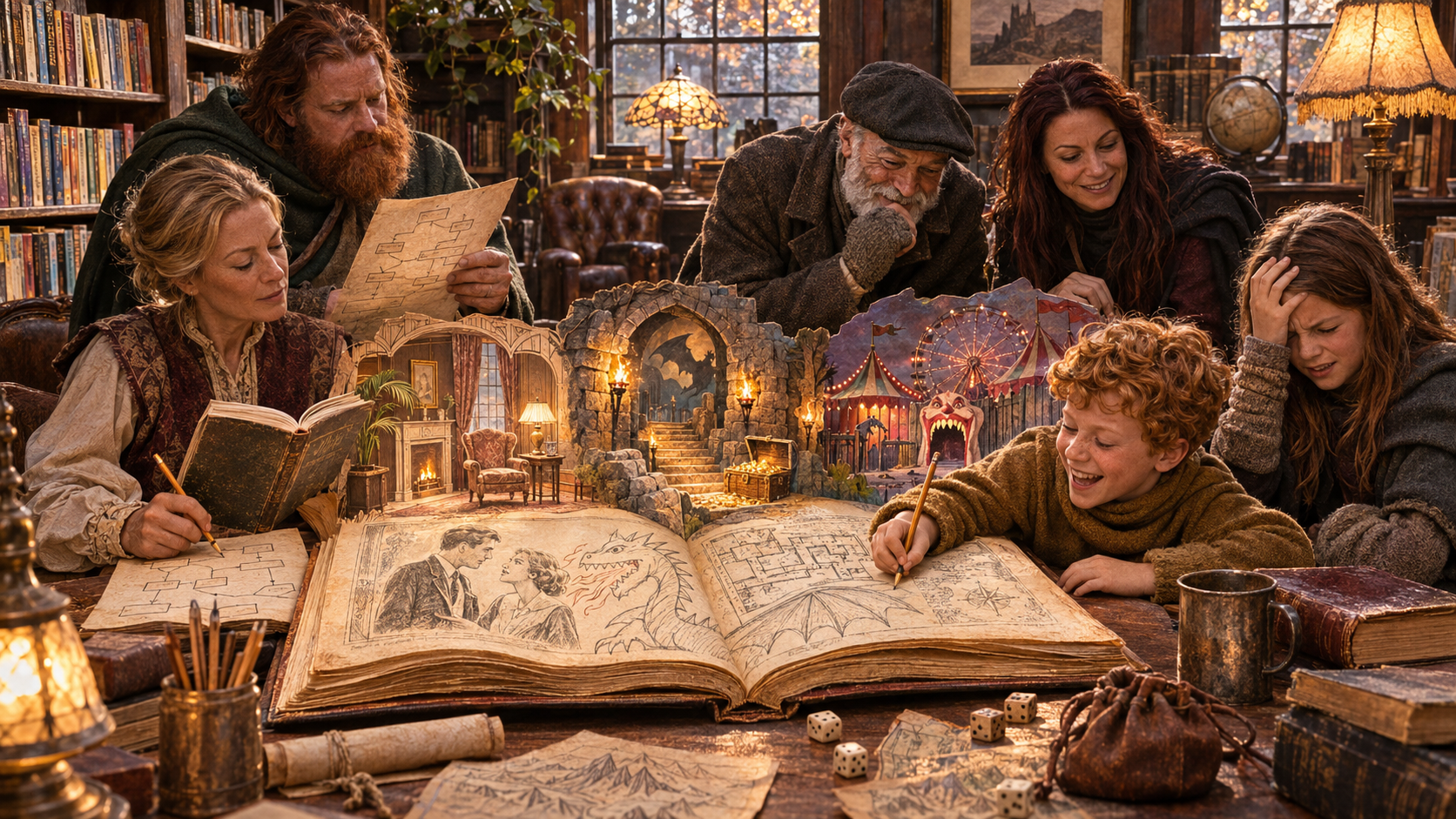
One Hobby, Many Beginnings — A History of Interactive Storytelling
Imagine opening a novel in 1930 and discovering that the author has refused to make the most important decision.
A young woman must choose what to do with her life. Marriage offers one future. Independence might offer another. The men around her have ambitions, weaknesses and decisions of their own.
Ordinarily, the novelist would decide what happens.
This time, the book asks you.
You make a choice, turn to another passage and discover what follows. Eventually, you arrive at an ending. There are forty-two others you might have reached instead.
No computer is involved. There is no fantasy dungeon, no dice and no character sheet.
It is an American romance novel.
And it appeared almost half a century before Choose Your Own Adventure became a publishing phenomenon.
Mara looks up from the book.
“Wait. The reader decides who gets married?”
“Among other things,” Stacy replies.
Chibi considers the possibilities.
“Can I choose a dragon?”
“Not in this one,” says Mara.
“Bad book.”
Sean looks at the title.
“Considering the consequences might actually be more dangerous than fighting a dragon.”
Caelwyn smiles.
“Now that is a promising beginning.”
My name is Eljara, and today the Mythveil Family is exploring the history of gamebooks in the United States.
Our journey begins with forgotten authors and experiments in interactive literature. It continues through schoolrooms, independent publishers, early roleplaying games, the great paperback boom, fantasy adventures, horror, computer games and modern interactive entertainment.
Along the way, we will meet famous writers and publishers. But we will also look for the illustrators, editors, teachers, librarians, collectors and readers who turned a peculiar literary experiment into a cultural movement.
Because the history of American gamebooks is not simply about books with multiple endings.
It is about the moment reading became a form of participation.
The American gamebook did not have a single inventor
Before we can reconstruct the history of gamebooks in America, we need to establish what we are actually studying.
A branching narrative allows the reader to choose between different passages. Those decisions may change the events, relationships or ending of the story.
A solo roleplaying adventure introduces additional mechanisms. The reader may create or develop a character, track equipment, roll dice, fight enemies or manage resources.
An educational branching text uses choices to guide learning. One answer may allow the reader to advance, while another sends them to an explanation or corrective exercise.
A computer text adventure can provide similar experiences through software rather than printed pages.
These forms share a structural principle: the reader or player does not simply proceed through a fixed sequence.
They must respond.
But similarity is not proof of common ancestry.
The American history of gamebooks contains several developments that emerged through different creative and institutional environments. Children’s literature, experimental fiction, educational technology, tabletop roleplaying and computer programming all contributed ideas about interaction.
Some of those ideas crossed boundaries directly.
Others developed in parallel.
A responsible history must distinguish the first documented example of a technique from the publication that made it commercially successful.
That distinction changes where our story begins.
Instead of opening with a bestseller from 1979, we begin in New York in 1930.
1930: Two women, forty-three endings and a forgotten literary experiment
Doris Webster and Mary Alden Hopkins published Consider the Consequences! through the Century Company in 1930.
The book followed three interconnected lives.
Helen Rogers faced decisions involving romance, marriage and independence. Jed Harringdale, one of her suitors, confronted his own choices. Saunders Mead, another, offered a different vision of security and responsibility.
The reader could follow decisions made by each of these characters.
Different choices produced different consequences, ultimately leading to forty-three possible endings.
The book’s surviving original text is especially revealing.
Webster and Hopkins did not simply present the work as an unusual novel. They explained that it could also be played individually, by courting couples or as a party activity.
Groups could vote on decisions. If participants disagreed, they could return later and explore another possibility.
In other words, the authors recognised that their work occupied a space between literature and social play.
The complete original text can now be examined through Wikisource.
This matters because Consider the Consequences! complicates several familiar assumptions.
Interactive fiction did not necessarily begin with fantasy.
It did not require a male adventurer.
Its first well-documented American examples were not exclusively written by men.
Nor did branching necessarily involve combat, treasure or monsters.
The fictional danger might be an unsuitable marriage, financial dependence, personal ambition or a decision that society would judge harshly.
And those subjects tell us something about the America in which the book appeared.
Marriage, employment and personal independence carried different consequences for women and men. An apparently private choice could be shaped by powerful social expectations.
Webster and Hopkins transformed those expectations into a structure of alternatives.
The modern reader may find some of those alternatives restrictive. Yet that restriction is itself historically meaningful.
A choice-based story can reveal the assumptions of its society through the possibilities it makes available — and through those it never offers.
The authors also deserve attention as people.
Webster worked in publishing, while Hopkins was a journalist and campaigner for women’s suffrage. Their backgrounds connect this early experiment to a wider history of women working in literature, journalism and public debate.
Their book was unusual, but it did not establish a continuous, clearly documented publishing movement leading directly to the 1970s gamebook boom.
That is an important limitation.
It would be misleading to claim that Edward Packard, Rick Loomis or R. A. Montgomery must have known their work simply because the structure was similar.
The evidence for such a direct connection has not been established.
What Consider the Consequences! demonstrates is something both simpler and more fascinating.
American writers were experimenting with meaningful reader choice decades before the gamebook became a recognised commercial genre.
The book was largely forgotten before researchers drew renewed attention to it. Its republication by Pushkin Press in 2025 gave modern readers another opportunity to explore that forgotten beginning.
Nearly a century after its original appearance, the story was still capable of asking a remarkably modern question.
What would you do differently?
The classroom discovered another kind of branching story
The next important development did not come from fantasy publishing.
It came from education.
During the middle decades of the twentieth century, American educators and psychologists experimented with methods of programmed instruction.
One influential figure was B. F. Skinner, whose work encouraged carefully structured learning sequences in which students received feedback as they progressed.
Another was Norman A. Crowder.
Crowder developed an approach commonly described as branching programmed instruction.
Rather than requiring every student to follow the same sequence, his method could direct learners to different material depending on their responses.
A correct answer might permit progress.
An incorrect answer could lead to an explanation before the student continued.
Some of these systems used teaching machines. Others appeared in printed instructional materials, including the TutorText series.
A historical account of programmed instruction documents the distinction between linear and branching approaches.
The resemblance to later gamebooks is clear.
A reader encounters a question.
They select an answer.
The book directs them elsewhere.
But the purpose was different.
An educational programme generally sought to guide learners towards defined knowledge or skills. A narrative gamebook could invite exploration, uncertainty or even disastrous decisions without treating every unsuccessful outcome as an error requiring correction.
The reader of a programmed textbook was primarily a learner.
The reader of an adventure gamebook became a participant in a fictional world.
Both systems made the physical act of turning pages part of an interactive process.
That resemblance deserves attention.
But we should not automatically claim that all later gamebook authors borrowed directly from educational technology.
Historical influence requires evidence, not merely a similar diagram.
This is one of the recurring challenges in reconstructing interactive storytelling.
Different people can discover related solutions to different problems.
And sometimes the problem is simply how to keep two children entertained before bedtime.
1969: Edward Packard and the bedtime story that would not stay on one path
Edward Packard was working as a lawyer when he developed an unusual method of telling stories to his children.
Instead of deciding every event himself, he began asking his daughters what the main character should do.
If they suggested different actions, he explored different possibilities.
The story could divide.
One adventure became several.
Packard later described the process in interviews, including a conversation with writer Grady Hendrix.
By 1969, Packard had developed the idea into a manuscript titled The Adventures of You on Sugarcane Island.
The reader occupied the central role in an adventure on an island.
Choices determined what happened next, including whether the protagonist survived.
The manuscript encountered resistance from major publishers.
Some editors apparently considered the structure too unusual or difficult for children. A book that demanded decisions could seem like an unnecessary complication in an industry accustomed to linear storytelling.
Packard continued trying to find a publisher.
His own historical account records submissions beginning in 1969 and 1970, followed by years without publication.
The delay is worth examining.
Innovative ideas do not become successful merely because someone has imagined them.
They must enter institutions capable of producing, distributing and explaining them.
A publisher needs to understand the product.
A bookseller needs to know where to place it.
A teacher or librarian may need to recognise its value.
And readers need to understand what they are being invited to do.
Packard had created a format whose commercial possibilities were not yet obvious.
His eventual breakthrough depended on another person recognising them.
1976: Sugarcane Island and the publisher who understood the game
In Vermont, R. A. Montgomery was involved with Vermont Crossroads Press, an independent publisher interested in innovative educational and children’s material.
Montgomery also had experience with simulations and roleplaying activities.
When Packard’s manuscript reached him, he recognised its potential.
Sugarcane Island appeared in July 1976 as the first book in a series called The Adventures of You.
The original edition was illustrated by Barbara Carter.
The bibliographic details survive in the gamebooks.org edition archive, while a national-library catalogue also preserves the book’s publication information.
The volume offered thirty-nine endings.
It was not yet the famous Bantam series.
It was a small-press experiment that had finally found a publisher willing to treat its unconventional structure as an advantage.
Montgomery was important for more than providing a printing contract.
His background in simulations helped him recognise a connection between the branching manuscript and experiences in which participants make decisions within constructed situations.
A reader could be treated as an active participant.
The book became a compact simulation of an adventure.
However, the creative and commercial relationship between Packard and Montgomery would later become a subject of differing historical accounts.
Packard’s personal history emphasises his original conception, the manuscript’s development and the history of the series title.
Chooseco’s official company history places greater emphasis on Montgomery’s publishing work, experience with simulations and development of the series as a business.
Those perspectives overlap in important ways.
They are not interchangeable.
An author may remember the difficult process of making an idea exist.
A publisher may remember the equally difficult process of making it commercially viable.
A complete history needs both, supported wherever possible by dated manuscripts, publishing records, contracts and contemporary correspondence.
The later success of Choose Your Own Adventure should not erase the earlier independent publisher.
Nor should commercial success automatically determine who receives historical credit.
Mara turns back to the first publication date.
“So the idea existed before the famous series?”
“Years before,” Stacy answers.
“And a publisher had to believe in it,” Caelwyn adds.
Sean considers this.
“An adventure about an island nearly disappeared into a desk drawer. That would have been a rather unfortunate ending.”
Chibi looks concerned.
“Was there treasure in the drawer?”
“Only rejected manuscripts,” says Mara.
“That’s worse.”
Another beginning in 1976: Buffalo Castle and the solo roleplaying revolution
The publication of Sugarcane Island was not the only significant American gamebook development in 1976.
That same year, Rick Loomis published Buffalo Castle through Flying Buffalo.
It was an adventure for Tunnels & Trolls, the tabletop roleplaying game created by Ken St. Andre in 1975.
Here the reader did more than choose between narrative alternatives.
The game used roleplaying mechanics.
Players could bring a character into the adventure, resolve events through rules, fight opponents and face consequences that depended on more than the selection of a printed passage.
The adventure provided a way to experience a roleplaying dungeon without another person acting as Game Master.
This was a different solution to a different problem.
Traditional tabletop roleplaying depended on a group, including someone responsible for describing situations, interpreting rules and responding to player decisions.
A solo adventure had to automate much of that work.
Numbered passages replaced some of the Game Master’s descriptions and decisions.
Dice and character statistics handled uncertainty.
The reader supplied the remaining imagination.
The original Buffalo Castle is documented by Demian Katz’s Gamebook Archive, which identifies Rick Loomis as its author and Elizabeth T. Danforth as its illustrator.
The date matters.
The publication preceded Britain’s Fighting Fantasy series by several years.
It also shows why the history of gamebooks should not begin and end with the commercial success of one children’s paperback series.
Sugarcane Island and Buffalo Castle represented distinct approaches to interactive reading.
One relied primarily on branching narrative choices.
The other incorporated the mechanisms of a roleplaying game.
Their publication in the same year is a remarkable historical convergence.
It does not automatically prove that one was derived from the other.
The important development was that a book could now carry some of the responsibilities traditionally assigned to a storyteller or referee.
A person could go exploring alone.
For tabletop roleplayers, that changed the relationship between time, companionship and adventure.
A group session might require several people to coordinate their schedules.
A solo adventure needed only a reader, the appropriate rules, a few dice and enough imagination to make the dungeon dangerous.
The book did not eliminate the Game Master from group roleplaying.
It demonstrated that some aspects of the Game Master’s work could be encoded in a printed structure.
That distinction would become important again in the history of computer roleplaying games.
1977–1979: From The Adventures of You to Choose Your Own Adventure
Montgomery continued developing the branching-book format.
When Packard pursued publication elsewhere, Montgomery wrote Journey Under the Sea, published in 1977 under the name Robert Mountain.
Packard’s next books appeared through J. B. Lippincott.
Meanwhile, the original concept continued to move through the publishing industry.
In 1978, Montgomery reached an agreement with Bantam Books, which was developing its children’s publishing operations.
The company adopted the name Choose Your Own Adventure.
In July 1979, Bantam released Edward Packard’s The Cave of Time as the first numbered volume in the series.
The original contained forty endings, according to surviving edition records.
Now the concept had a name, a recognisable format and a much larger distribution network.
That combination transformed its prospects.
A child did not need to know anything about experimental literature or roleplaying games.
The central instruction was almost immediately understandable.
The reader was the protagonist.
The reader made decisions.
Different decisions produced different outcomes.
It was a simple promise with considerable commercial power.
And because it was communicated through the title and presentation of the series, the concept could be understood before the book was opened.
The first edition’s illustrations were credited to Paul Granger, a name used by illustrator Don Hedin.
That detail reminds us how easily the history of a publishing phenomenon can conceal the people who shaped its visual identity.
A book is not only a manuscript.
It is a designed object.
Its cover must attract attention. Its pages must make navigation possible. Its illustrations must help readers imagine environments and dangers.
A successful format depends on more than the person whose name appears most prominently on the front.
The edition history of The Cave of Time preserves these details, including early printings, illustrations and subsequent reissues.
The extraordinary commercial power of YOU
The word you changed the relationship between a book and its audience.
Ordinary fiction may encourage readers to identify with a protagonist.
Branching fiction asks them to occupy the protagonist’s position directly.
The distinction is not absolute. Literature has always invited emotional participation.
But the gamebook makes participation part of its visible structure.
A passage places the reader in danger.
Two choices follow.
The next page is determined by the decision.
The story may reward courage, punish curiosity or produce an outcome that the reader never anticipated.
And unlike most ordinary novels, the same physical book can be read several times without following the same sequence.
The format encouraged rereading.
A finished story was not necessarily an exhausted book.
Another possibility remained.
This helped make the concept attractive to both publishers and readers.
According to Chooseco’s institutional history, Bantam published 184 original Choose Your Own Adventure titles, alongside numerous additional spin-offs, between 1979 and the end of the original publishing era.
The company reports more than 250 million copies printed across thirty-eight languages during that period.
Industry reporting in 2026 describes an even larger cumulative total for the wider history of the franchise.
Such figures reveal commercial scale, but historians should distinguish copies printed, copies distributed and copies sold.
They are not automatically the same measure.
We should also avoid allowing one bestselling brand to become the name of the entire literary form.
Choose Your Own Adventure is a specific publishing property and trademark.
Branching narratives and gamebooks existed beyond it.
Nevertheless, the cultural influence of the series was extraordinary.
For millions of American readers, it was their first recognisable encounter with a book that refused to proceed in a straight line.
The strange freedom of an adventure with forty endings
What did gamebooks actually give readers?
A common answer is freedom.
That answer needs qualification.
An author still writes the available passages.
The author determines which options appear.
The author decides what can happen after each selection.
A gamebook does not offer unlimited freedom.
It offers structured agency.
That structure is fascinating because it makes the boundaries of choice visible.
Some decisions appear momentous but lead to similar outcomes.
Others seem harmless and produce sudden disaster.
The reader learns that choices are meaningful, but not necessarily predictable.
This can be entertaining precisely because the consequences are fictional and reversible.
A wrong turn may end a story.
It does not permanently end the reader’s adventure.
The reader can return to the previous junction and try again.
Many readers discovered that the rules of engagement were delightfully negotiable.
They kept a finger between pages.
They explored endings before making a decision.
They memorised successful routes.
Some carefully followed the instructions, while others treated the physical book as a puzzle to be solved.
Was that cheating?
It depends on the purpose of the activity.
A competitive game might define a victory condition and rules against retracing steps.
A branching novel may offer no external opponent at all.
The reader can choose to value suspense, exploration, survival or the discovery of every possible ending.
The medium permits several ways to enjoy the same object.
And those possibilities reveal a deeper distinction.
A gamebook does not necessarily grant a reader control over the fictional world.
It grants the ability to explore a range of worlds chosen by the author.
That is a smaller promise than unlimited freedom.
It can still be an extraordinary experience.
The hidden architecture of a branching story
Behind the apparent simplicity of a gamebook lies a considerable design problem.
Every additional choice creates the possibility of further branches.
If each decision always produced two completely independent paths, the number of possible routes would grow rapidly.
A paperback cannot expand without limit.
Authors therefore needed to manage complexity.
Some passages reunited earlier branches.
Others ended an adventure quickly.
A few routes might lead to particularly desirable outcomes, while others explored failure, danger or unexpected discoveries.
This is why the map of a branching narrative can resemble a tree, a network or a maze.
It is also why authors needed more than conventional prose-writing skills.
They had to design information.
A player should usually know enough to make an interesting choice.
But not so much that every outcome becomes obvious.
A surprise ending must feel surprising.
A truly arbitrary ending can feel unfair.
A difficult decision works best when the reader understands the competing values without knowing exactly what the future holds.
These concerns resemble problems encountered by tabletop Game Masters.
How much information should players receive?
How do we make choices meaningful without making outcomes predictable?
What happens when the available options appear less interesting than the action a player actually wants to attempt?
The major difference is flexibility.
A human Game Master can improvise when a player proposes an unexpected solution.
A printed gamebook cannot respond to an action for which no passage has been written.
Its strength is not unrestricted improvisation.
Its strength is the carefully constructed exploration of alternatives.
The resulting form belongs as much to information design as to literature.
1982: Rose Estes brings Dungeons & Dragons to the gamebook shelf
As the success of Choose Your Own Adventure became impossible to ignore, other American publishers developed their own approaches.
Among the most important was TSR, the company behind Dungeons & Dragons.
In 1982, TSR launched the Endless Quest series.
Its first numbered volume, Dungeon of Dread, was written by Rose Estes.
The series introduced fantasy adventure to young readers through branching narrative.
It drew upon the imaginative world of tabletop roleplaying, including monsters, exploration, magic and dangerous locations.
Yet many early Endless Quest volumes did not require readers to understand the full rules of Dungeons & Dragons.
The barrier to entry was considerably lower.
A reader could encounter the fantasy world without preparing a character sheet or finding a gaming group.
That made the series a bridge between two audiences.
Tabletop gamers could recognise familiar creatures and settings.
Young readers unfamiliar with the hobby could simply begin an adventure.
The history of Endless Quest is especially interesting because its published numbering does not tell the complete story of its creation.
In a 2017 interview with Ultanya, Rose Estes recalled that Return to Brookmere was the first story she wrote for what became the series.
Dungeon of Dread was nevertheless published as volume one.
This distinction between the order of writing and the order of publication is precisely the kind of detail that disappears from simplified histories.
Estes also described her work within TSR and the circumstances in which the series developed.
Her testimony provides a valuable perspective on how an established roleplaying publisher approached a new literary audience.
The original Dungeon of Dread edition is documented by gamebooks.org.
It identifies Larry Elmore as the cover artist and Jim Holloway as the interior illustrator.
These artistic contributions mattered.
Fantasy illustration helped make imagined worlds tangible.
A cover could promise monsters, ruins or heroic adventure before the reader encountered the first paragraph.
The interior images could then provide visual continuity across a story that the reader might experience in several different orders.
Estes’s contribution also matters because women were not peripheral to the development of American gamebooks.
They were among the writers and creators who helped establish the form.
Their work deserves to be studied as part of the central history, not as a corrective footnote.
And the story continues.
In March 2026, Savage Realms announced Into Shadows Deep, a new interactive adventure by Estes.
More than four decades after Endless Quest began, one of its pioneering voices was again working within interactive fiction.
That offers a particularly valuable historical perspective.
A form often described as a nostalgic artefact of the 1980s remains a living creative practice.
Not every American gamebook belonged to Choose Your Own Adventure
The commercial prominence of one series can obscure the diversity of an industry.
The early 1980s produced many American branching-book experiments.
The Which Way Books series, published in the United States by Simon & Schuster’s Archway imprint, began in 1982.
It encompassed fantasy, science fiction, adventure, horror and licensed properties.
Its later titles included stories connected with Star Trek.
The series also inspired related lines involving romance, sport and superheroes.
The historical catalogue at gamebooks.org identifies Nancy Lamb and Rita Golden Gelman as associated with the series’ creation.
Their involvement deserves attention as part of the broader history of women working in interactive publishing.
The variety of Which Way Books also reveals how rapidly the format could move beyond one publisher’s original identity.
Branching fiction was not inherently restricted to fantasy adventure.
Readers could explore science fiction, celebrity, sport, romance and supernatural mysteries.
A similar expansion occurred within Choose Your Own Adventure itself.
Authors included Edward Packard, R. A. Montgomery, Shannon Gilligan and Deborah Lerme Goodman.
Goodman’s The Magic of the Unicorn illustrates the importance of fantasy and mythology within the wider catalogue.
Studying these writers means paying attention to differences in tone, audience, subject matter and narrative design.
Not every author approached choice in the same way.
Some valued surprise.
Others developed elaborate mysteries.
Still others used fantastic journeys to explore morality, knowledge or personal responsibility.
The history of American gamebooks becomes richer when individual works are allowed to differ, rather than being treated as interchangeable products of a publishing formula.
1984: Time Machine and the promise of learning history through adventure
In 1984, another American gamebook series developed a particularly interesting relationship between interactive storytelling and historical imagination.
The Time Machine books, associated with Byron Preiss Visual Publications and published by Bantam, sent readers into different historical periods.
Early titles included Secret of the Knights, Search for Dinosaurs, Sword of the Samurai and Sail with Pirates.
The series later explored the American Civil War, the American Revolution, ancient cultures and major historical events.
The surviving bibliography documents twenty-five principal volumes published between 1984 and 1989.
These books invite an important question.
Can choosing a course of action inside a fictional historical setting help a reader understand history?
Potentially, yes.
The method can make historical circumstances feel immediate.
Instead of memorising that someone faced danger during a voyage, the reader encounters a constructed version of those dangers and must decide how to respond.
But there are limitations.
Historical events are not infinitely flexible.
The past happened in particular ways, whether or not a modern reader prefers another outcome.
A historical gamebook must balance factual explanation with fictional freedom.
It also brings the author’s assumptions into the experience.
Which cultures are presented as dangerous?
Whose perspective becomes central?
Who appears as a hero, an enemy or a passive observer?
Which historical problems are reduced to a simple decision between two options?
These are not reasons to dismiss the format.
They are reasons to examine its educational and cultural choices critically.
A well-designed historical gamebook can awaken curiosity.
It should not be mistaken for a complete reconstruction of the past.
The distinction is especially relevant to Mythveil Chronicles, where historical research and player agency often meet.
A historical setting becomes more convincing when players understand the actual constraints of the society they inhabit.
Freedom becomes meaningful when it operates within a world that has substance.
Pulp fiction, superheroes and the adventure imagination
American gamebooks did not develop in a cultural vacuum.
They emerged within an environment already shaped by adventure stories, science fiction, fantasy, comic books, television and tabletop games.
The heroes of pulp magazines often faced extraordinary dangers through courage, ingenuity or a willingness to take risks.
The traditions associated with Robert E. Howard, Edgar Rice Burroughs and other adventure writers offered imagery familiar to generations of American readers.
Science fiction supplied distant planets, strange technologies and the possibility of exploring unknown worlds.
Detective fiction contributed mysteries and the appeal of uncovering hidden information.
Superhero comics provided recognisable conflicts involving danger, responsibility and identity.
Gamebooks could draw upon this wider repertoire.
But the historical relationship requires care.
The presence of a barbarian, alien or haunted mansion in an interactive book does not automatically establish direct influence from a particular author, comic or film.
Images and ideas often travel through several media before appearing in another form.
A fantasy gamebook might be influenced by tabletop roleplaying, which was itself shaped by literature, wargaming and popular fantasy.
A science-fiction gamebook might reflect both older magazine fiction and contemporary film culture.
An interactive superhero adventure might connect licensed intellectual property with the mechanics of branching fiction.
What made gamebooks distinctive was not that they invented these genres.
It was that they changed the reader’s position within them.
The reader was no longer simply watching the astronaut explore the planet.
They had to decide which tunnel the astronaut entered.
They were not merely following a mystery.
They were responsible for choosing where to investigate.
That shift turned familiar genre conventions into a new kind of experience.
1995: Give Yourself Goosebumps and the delicious pleasure of choosing the wrong door
The connection between branching fiction and horror became especially visible in the 1990s.
R. L. Stine’s Goosebumps books had already established a major place in American children’s horror publishing.
In 1995, Scholastic launched the interactive spin-off Give Yourself Goosebumps.
Its first title was Escape from the Carnival of Horrors.
Published in July 1995, the book invited readers into a sinister amusement park where their choices could lead to escape, disaster or increasingly bizarre outcomes.
Its original edition contained twenty-five endings.
These details are recorded in the gamebooks.org edition catalogue.
The series continued through the end of the decade, eventually including dozens of titles and special editions.
The connection between gamebooks and horror is particularly revealing.
Horror has always depended on uncertainty.
A character hears a noise from the cellar.
The reader suspects that opening the door may be unwise.
In a conventional horror story, the character makes the decision.
In a branching horror story, the reader may be asked to choose.
That makes an old narrative pleasure more immediate.
You may know that the obvious course is dangerous.
You may choose it anyway.
Curiosity becomes a mechanic.
So does temptation.
The genre can also turn failure into entertainment.
A terrible ending may be frightening, absurd or unexpectedly funny.
Readers can return to the decision and discover an alternative.
This creates a peculiar relationship with danger.
The experience may feel personal, but its consequences remain contained within the book.
For younger readers, that mixture of control and uncertainty can be especially compelling.
The stories also drew upon a wider American culture of horror entertainment: haunted attractions, monsters, urban legends, strange experiments, evil toys and unsettling everyday places.
The connection does not mean that every book was inspired by a specific haunted attraction or local legend.
It means that gamebooks participated in a recognisable cultural language.
The amusement park, the laboratory, the old house and the dark corridor were already familiar sites of fictional danger.
Branching fiction gave readers permission to make the decisions that horror audiences usually shout at the characters on screen.
Mara closes the book.
“I would not enter that carnival.”
Sean raises an eyebrow.
“Then you might miss the adventure.”
“I might also survive it.”
Chibi has already opened the book again.
“I want the scary ending.”
Stacy sighs.
“Of course you do.”
Eljara watches him turn the page.
The interesting thing is that he already knows it is dangerous.
And the book has made that knowledge part of the pleasure.
The reader, the monster and the beginnings of digital folklore
It is tempting to draw a straight line from interactive horror books to modern creepypasta, online urban legends and digital horror games.
There are meaningful similarities.
A fictional document can invite readers to imagine themselves involved in an unfolding mystery.
An interactive game can distribute information gradually and make the audience feel responsible for investigating it.
Internet horror can blur the boundary between a fictional account and the apparent testimony of someone who experienced it.
But resemblance is not proof of descent.
Modern creepypasta culture developed through internet communities, copying, adaptation and shared storytelling conventions.
Its history is not reducible to children’s gamebooks.
Nevertheless, both forms raise related questions.
What happens when the audience becomes an active participant in the experience of fear?
How does uncertainty change when the reader can make decisions?
Why do people return to stories whose endings they already know?
And how does a fictional experience become part of personal memory?
The gamebook offers one early, widely distributed printed answer.
The reader can make the wrong decision, experience the consequences and then return to the moment before disaster.
In a sense, the book allows an experiment with fate.
The monster may win.
But the reader can turn back.
Computers were exploring choice as well
During the same decades that gamebooks grew in popularity, American computer enthusiasts were developing new forms of interactive storytelling.
Early computer adventure games allowed players to explore environments, enter commands, solve puzzles and influence the progress of a fictional situation.
Colossal Cave Adventure, developed in the 1970s by Will Crowther and expanded by Don Woods, became a foundational example.
The Zork games developed through the work of programmers associated with MIT and later Infocom.
These works shared several concerns with printed gamebooks.
How does a player understand the environment?
What information should be provided?
How can an imagined world respond to decisions?
What happens when a player attempts something unexpected?
But there were significant differences.
A printed gamebook generally presents a limited menu of choices.
A text adventure can accept written commands and interpret them through a parser.
The player may attempt actions that the game cannot understand.
The result is another form of structured agency, but one organised through software rather than page numbers.
It would be historically inaccurate to claim that American computer adventures were simply digital versions of Choose Your Own Adventure.
The two traditions developed through overlapping but distinct environments.
Computer programming, university culture, puzzle design, tabletop roleplaying and literary experimentation all contributed to interactive fiction.
Yet the comparison reveals a shared historical transformation.
The audience was becoming accustomed to stories that required input.
A reader could choose between pages.
A computer player could type an instruction.
A tabletop player could describe an action to a Game Master.
These were different technologies for negotiating the relationship between imagination and response.
Their convergence would become increasingly important as digital entertainment developed.
And it explains why the history of gamebooks provides such a useful foundation for a future history of computer roleplaying games.
Was a gamebook really a game?
The word gamebook conceals a difficult question.
How much game must a book contain before it becomes a game?
A branching novel with no dice or scoring system may offer many endings but few formal mechanics.
A solo roleplaying adventure may contain character statistics, equipment, combat rules and success conditions.
An educational branching text may treat correct answers as progress towards a defined learning objective.
A puzzle book may use navigation and observation rather than explicit character decisions.
These are related forms, but they produce different experiences.
Game studies offers several ways to examine the distinction.
Some definitions emphasise rules, goals and measurable outcomes.
Others consider participation, interpretation and the social meanings people construct through play.
A gamebook complicates the boundary because it can be read as literature and played as a game.
The same person may alternate between those approaches.
A reader might become immersed in a story.
Then they might study its structure.
Then they might attempt to discover every ending.
The activity changes without the book changing.
That flexibility is part of the form’s appeal.
And it makes gamebooks especially interesting for interdisciplinary research.
They belong to literary history, publishing history, game design and the history of reading practices simultaneously.
Trying to assign them to only one of these disciplines would diminish the subject.
What gamebooks taught readers — and what we cannot prove
Publishers and enthusiasts have often argued that gamebooks encourage children to read.
There are understandable reasons for that claim.
The reader receives frequent invitations to act.
The story can be explored repeatedly.
Short passages and immediate decisions may provide a different rhythm from conventional chapter books.
The promise of multiple endings can encourage curiosity.
Educators have also used interactive texts to support decision-making, reading comprehension and discussion.
The history preserved by the Strong National Museum of Play includes an account of Montgomery showing Packard’s early manuscript to a teacher and receiving an enthusiastic response from students.
That is an interesting historical recollection.
It should not be confused with controlled evidence that gamebooks improve literacy for every child.
Enjoyment and educational effectiveness are related questions, not identical ones.
A child may eagerly reread an interactive adventure without improving every measured aspect of reading comprehension.
A different child may find the branching structure confusing.
Some readers may focus on discovering endings rather than understanding the intervening text.
Others may be motivated precisely by the opportunity to make decisions.
The educational value of a gamebook depends on its design, the reader, the setting and what the experience is supposed to achieve.
It is therefore more useful to ask specific questions.
Can branching fiction encourage voluntary reading?
Can it support discussion about consequences?
Can it help readers recognise alternative perspectives?
Can it make historical or ethical problems more engaging?
And under what conditions does it do those things successfully?
The answers require research rather than promotional certainty.
Nevertheless, one cultural achievement is unmistakable.
Gamebooks offered readers a widely accessible way to engage actively with printed narrative.
For many, reading became something they could explore rather than merely finish.
Who gets to be the hero when the book says YOU?
Second-person narration has a powerful advantage.
A book can address its reader without specifying every aspect of the protagonist’s identity.
The word you appears open.
It does not necessarily assign a gender, appearance, background or social position.
That flexibility may help different readers imagine themselves inside the adventure.
But the openness is not unlimited.
A story still makes assumptions.
Its illustrations may depict a particular kind of hero.
Its setting may assume certain cultural knowledge.
Its available choices may reflect the author’s expectations about courage, morality, family or social status.
Some readers may find themselves easily represented.
Others may have to imagine past the limitations of the text.
The historical study of gamebooks should therefore include questions of gender, class, race and accessibility.
It should also consider the authors and workers who shaped the industry.
Doris Webster and Mary Alden Hopkins contributed to the form long before its commercial boom.
Rose Estes helped establish the relationship between fantasy roleplaying and branching children’s literature.
Shannon Gilligan, Deborah Lerme Goodman, Nancy Lamb and Rita Golden Gelman belong to the broader history of American interactive publishing.
Elizabeth Danforth, Barbara Carter, Larry Elmore, Jim Holloway, Don Hedin and other illustrators helped determine what those books looked like and how their worlds were understood.
Writers were not the only creators.
Editors structured manuscripts.
Designers organised passages.
Illustrators provided visual identities.
Printers and production teams transformed complicated branching structures into usable books.
Librarians, teachers and booksellers helped introduce them to readers.
A history that remembers only the most famous male founders would miss much of the labour that made the medium possible.
The paperback as a physical machine for imagination
There is something wonderfully distinctive about the material form of a gamebook.
It does not need electricity.
It does not require a screen.
Its interactive system is embedded in numbered passages, printed instructions and the reader’s own actions.
The reader moves through the story by manipulating a physical object.
Turning pages becomes a kind of interface.
A finger between pages can serve as a primitive save system.
A handwritten map can become a record of explored possibilities.
A character sheet can store information that the book itself does not remember.
Dice can introduce uncertainty.
In a more elaborate solo adventure, the player may need to maintain several forms of state simultaneously: current health, equipment, resources and location.
These are information systems built from paper.
The same physical simplicity made the format portable.
A gamebook could travel in a schoolbag, accompany a family holiday or sit beside a bed.
A reader did not have to schedule a gaming session with friends.
The adventure was available whenever the book was opened.
That mattered historically.
Personal computers and game consoles were not equally available to every household during the early years of the gamebook boom.
Printed books had their own costs and access barriers, but they could circulate through libraries, schools, bookshops and second-hand collections.
They could also survive long after the original publication programme ended.
A damaged paperback might continue to be read for decades.
And the fingerprints, creases and pencilled notes left by readers can become evidence of how the book was actually used.
The forgotten archivists of interactive fiction
One of the difficulties in studying American gamebooks is the uneven survival of evidence.
The major publishers left catalogues and publicity material.
Popular authors gave interviews.
Bestselling series appeared in newspapers and trade magazines.
But smaller publications could disappear with little documentation.
A local printing might survive only in a collector’s cupboard.
An illustrator’s contribution might be recorded under a pseudonym.
A revised edition might contain different artwork, page numbers or endings.
Some publications were sold internationally under different titles.
Without careful bibliographic work, it becomes easy to confuse a later reprint with an original publication.
This is where fan historians and collectors become indispensable.
Demian Katz’s Gamebooks.org is a particularly important resource.
Its catalogue preserves information about series, individual titles, editions, authors, illustrators, translations and related materials.
The archive also illustrates the value of collaborative documentation.
Collectors contribute details that may be difficult to find in conventional institutional sources.
A printing date observed inside an original book can clarify a disputed chronology.
An illustration credit may restore recognition to a forgotten artist.
A comparison between editions can reveal how publishers altered a text.
Such work deserves to be recognised as historical preservation.
Academic research has an important role, but so do the communities that have kept these books alive.
A university library may preserve an original edition.
A collector may know that another edition contains different endings.
An author may recall why the change was made.
The strongest history brings these forms of evidence together.
From commercial triumph to a changing market
By the 1990s, the American gamebook industry had changed.
The original Choose Your Own Adventure series eventually ended its Bantam publishing run.
Changing reading habits, new entertainment formats, publishing decisions and the challenges of sustaining a long-running series all belong to the wider story.
Digital entertainment was developing rapidly.
Computer and console games offered interactive environments with sound, animation and increasingly complex systems.
But it would be simplistic to claim that video games merely killed gamebooks.
The relationship between print and digital entertainment was more complicated.
Interactive books continued to exist.
Older series circulated through second-hand markets and libraries.
New formats appeared.
Some publishers experimented with digital adaptations.
Readers who had grown up with the original books later introduced them to their children.
The industry also faced questions of intellectual property.
The history of the Choose Your Own Adventure trademark, the conclusion of the Bantam era and the later development of Chooseco deserve particularly careful treatment.
Packard’s personal recollections and the official history of Chooseco emphasise different aspects of this transition.
Those differences are useful evidence of the perspectives involved.
They should not be resolved by assuming that either account automatically contains the complete institutional history.
The distinction between an author’s original concept, a publisher’s commercial organisation and the legal ownership of a brand is essential.
A literary form can belong to a broad culture.
A particular title or trademark may belong to a specific company.
Confusing the two can distort historical discussions.
When Black Mirror encountered Choose Your Own Adventure
In 2018, Netflix released Black Mirror: Bandersnatch, an interactive film in which viewers could make decisions affecting the unfolding story.
The format invited obvious comparisons with gamebooks.
But it also became the centre of a legal dispute.
Chooseco brought a trademark claim involving the use of the Choose Your Own Adventure name.
The case was settled in 2020, as reported by Bloomberg Law.
The dispute is historically revealing.
By this point, a phrase that had become widely associated with interactive storytelling also represented a specific commercial property.
The underlying concept of branching narrative was far older than either company.
Yet the commercial identity attached to that concept still had legal significance.
This illustrates an important distinction between cultural influence and intellectual property.
A storytelling technique can spread across literature, film and games.
A protected brand is a different matter.
The case also demonstrates that gamebooks were not simply a forgotten publishing curiosity.
Their language and legacy remained relevant to contemporary entertainment.
The screen had changed.
The fundamental invitation was familiar.
Make a choice.
See what happens.
2025–2026: The past returns to the bookshelf
The contemporary revival of gamebooks is not confined to nostalgia.
Several developments in 2025 and 2026 reveal how publishers and readers continue to reconsider the form.
In 2025, Pushkin Press republished Consider the Consequences!, bringing the 1930 work by Webster and Hopkins to an audience that may never have encountered it.
The republication also encourages a broader understanding of interactive literature, reminding readers that branching narrative had a life before the most famous commercial franchises.
Edward Packard’s original books have also returned to print through new agreements with Chooseco.
His published chronology records a 2024 agreement covering several original titles, with reissues appearing in 2025 and 2026.
Rose Estes returned to interactive fantasy with Into Shadows Deep in 2026.
And Chooseco announced a further development in September 2026.
The company plans to introduce CYOA Unbound, an imprint for adult readers, with its first releases scheduled for 2027.
The announced programme includes an interactive retelling of Jane Austen’s Pride and Prejudice by C. Davitt Bell and Culty by Fancy Feast.
The company has also described ambitions involving horror, mystery, thrillers, romance and other genres.
These are announced future publications, not books already released as of November 2026.
The plans are documented in Publishers Weekly and on the official CYOA Unbound page.
The significance lies partly in the intended audience.
For decades, the most familiar image of the American gamebook was a children’s paperback.
The new imprint suggests that publishers see opportunities to develop branching literature for adults as well.
That does not mean adult interactive literature is an entirely new invention.
The 1930 beginning of our story should already have cured us of that assumption.
Instead, it shows how a form can be rediscovered and repositioned for different generations.
The history has not ended.
It is being edited, republished and extended.
What we still do not know about the history of American gamebooks
The surviving evidence provides a substantial outline of the American gamebook movement.
But important questions remain.
How did the earliest readers describe their experiences?
Which independent publishers experimented with branching stories before they became commercially familiar?
How many educational publications used related techniques without being described as gamebooks?
What happened inside editorial meetings where unconventional manuscripts were accepted or rejected?
Which illustrators, editors and production workers developed practical solutions to the problems of publishing branching narratives?
How did different readers respond to the apparent freedom offered by the second person?
What evidence exists for the claim that gamebooks improved reading habits or literacy?
And how should we reconstruct commercial disputes when participants preserve different memories of the same events?
These questions cannot all be answered through a single publishing company’s anniversary history.
They require original editions, correspondence, interviews, trade publications, scholarly research and the work of collectors.
Mythveil Chronicles has extended invitations for written historical interviews to several people whose perspectives may help address these gaps: Edward Packard, Rose Estes, Shannon Gilligan, Ken St. Andre, Deborah Lerme Goodman, R. L. Stine and Demian Katz.
Those invitations are not completed interviews, and no historical claim in this article should be presented as endorsed by an invited participant.
Our purpose is to recover direct testimony while the opportunity remains.
We also welcome corrections and contributions from other writers, publishers, illustrators, researchers, collectors and readers.
A surviving letter, catalogue or early printing may contain information absent from the established histories.
Sometimes a forgotten detail changes the chronology.
Sometimes it restores credit to a person who was there.
And sometimes it reminds us that the history of a medium is larger than the stories its most successful companies tell about themselves.
The reader became the hero — but the book still remembered the author
There is an appealing contradiction at the heart of the gamebook.
It promises the reader the power to choose.
Yet every choice exists because someone wrote it.
The reader may decide which door to open.
The author created the doors.
The reader may face terrible consequences.
The author determined what those consequences could be.
The reader may return to an earlier page and attempt a different route.
The book remembers all the routes, even those the reader has not yet discovered.
This relationship between authorial structure and reader agency is not a defect.
It is the defining creative tension of interactive storytelling.
A book that offered no choices would return us to conventional narrative.
A book that offered unlimited possibilities would no longer be the same kind of printed object.
The gamebook exists between those extremes.
It creates a designed world and allows the reader to explore within it.
And that principle connects American gamebook history to much larger developments in games and storytelling.
Tabletop roleplaying introduced the possibility of responding to an imaginative world through dialogue with a human Game Master.
Solo adventures demonstrated how some of that interaction could be represented by rules and passages.
Computer games translated related problems into software.
Interactive films brought branching choices onto screens.
Yet the small paperback remains distinctive.
A person can hold the entire system in their hands.
They can return to a previous decision.
They can explore an ending that another reader may never find.
They can discover that choosing differently changes the story.
Not necessarily the whole world.
But enough of it to matter.
Mara closes the last book on our table.
“So the reader is the hero?”
“Sometimes,” Stacy says. “Sometimes the reader makes a terrible decision.”
Sean smiles.
“The two are hardly mutually exclusive.”
Caelwyn looks over the documents.
“The interesting question is not merely whether a decision is offered. It is whether the world has been designed to make that decision meaningful.”
Eljara nods.
“And whether the people who built that world receive the recognition they deserve.”
Chibi has been unusually quiet.
He holds up the book.
“I found the dragon.”
Mara stares at him.
“There isn’t a dragon in that book.”
He points to a page.
“I drew one.”
Sean looks at the drawing.
“An unexpected branch of the narrative.”
Stacy takes a long breath.
Caelwyn looks rather pleased.
And somewhere between the printed story and a child’s imagination, the adventure has acquired an ending its authors never wrote.
That may be the most enduring lesson of the American gamebook.
Its history did not begin with one famous bestseller, one company or one heroic inventor.
It began through different experiments in literature, learning, gaming and publishing.
Some became extraordinary commercial successes.
Others disappeared into archives, private collections or forgotten bookshelves.
All contributed to a much larger question.
What happens when a story stops asking us only to listen and begins asking us to decide?
The answer changed reading.
It helped shape gaming.
And it continues to influence the stories we tell, play and remember.
The book may have a final page.
The possibilities do not necessarily end there.
Historical sources and further reading
This article draws upon original publications, author testimony, institutional histories, historical bibliographies, publishing journalism, game studies and surviving fan research.
Institutional histories and first-person recollections are treated as evidence of the perspectives they represent, not as independent proof of every claim. Where direct influence or an exact chronology cannot be established, the distinction remains visible.
Early interactive literature and education
- Doris Webster and Mary Alden Hopkins — Consider the Consequences! (1930). Transcription of the original work and its interactive instructions.
- Pushkin Press — Consider the Consequences!. Modern republication and information about the authors.
- Smithsonian Magazine — The Surprisingly Long History of Choose-Your-Own-Adventure Stories. Broader historical context.
- Programmed Instruction — historical overview. Discussion of linear and branching instructional methods.
The American publishing pioneers
- Edward Packard — A Brief History of Choose Your Own Adventure. Author’s own chronology and perspective.
- Grady Hendrix — Edward Packard Interview. First-person recollections of the early concept and writing process.
- Choose Your Own Adventure — Our History. Publisher’s account of Montgomery, Packard, Vermont Crossroads Press and Bantam.
- The Strong National Museum of Play — You and You Alone. Institutional perspective on the series and its readership.
- Gamebooks.org — Sugarcane Island edition history. Bibliographic evidence from original and later editions.
- Gamebooks.org — The Cave of Time edition history. Publication dates, illustrations, endings and reissues.
Solo roleplaying and the fantasy gamebook
- Gamebooks.org — Buffalo Castle. Original publication, authorship and illustrations.
- Rose Estes — Twenty Questions Interview. First-person recollections of Endless Quest.
- Gamebooks.org — Dungeon of Dread. Original 1982 edition details.
- Gamebooks.org — Endless Quest bibliography. Historical series documentation.
- Savage Realms — Rose Estes and Into Shadows Deep (2026). Contemporary publication announcement.
Alternative series, horror and media
- Gamebooks.org — Which Way Books. Series history, authors and publishers.
- Gamebooks.org — Time Machine. Historical-adventure series and bibliography.
- Gamebooks.org — Give Yourself Goosebumps. Series history and individual titles.
- Gamebooks.org — Escape from the Carnival of Horrors. Original publication details.
- Bloomberg Law — Netflix Settles Choose Your Own Adventure Trademark Dispute. Contemporary legal reporting.
Archives, revival and continuing development
- Demian’s Gamebook Web Page. Extensive bibliographic and community-maintained archive.
- Publishers Weekly — Choose Your Own Adventure Publisher Launches Adult Imprint (2026). Current publishing-industry reporting.
- Chooseco — CYOA Unbound. Official announcement of the planned adult imprint.
The documentary record remains incomplete. The relationship between early branching literature, programmed learning, solo roleplaying and computer adventures should not be represented as one established line of direct influence where the evidence does not support that conclusion.
Continue One Hobby, Many Beginnings
The history of gamebooks belongs to a wider story about the evolution of participation in imaginary worlds.
Explore how tabletop roleplaying developed in the United States, and how American live-action gaming created another path from imagining an adventure to experiencing it.
The History of Tabletop RPGs in the USA — From the First Tables to Many Voices
The History of LARP in the United States — From Backyard Battles to Worlds That Remember
Mythveil Chronicles welcomes historical corrections, original documents, early editions, unpublished memories, author testimony and written editorial collaborations.
Our work investigates the history of storytelling across literature, games, culture and the communities that keep these traditions alive.
Read. Play. Watch. Support. Or Collaborate.
Read Mythveil Chronicles · Play with Mythveil · Watch Mythveil · Support the Work · Collaborate on LinkedIn
Worlds That Remember. Stories That Matter.
Discover your next adventure through the Mythveil Weekly Schedule.