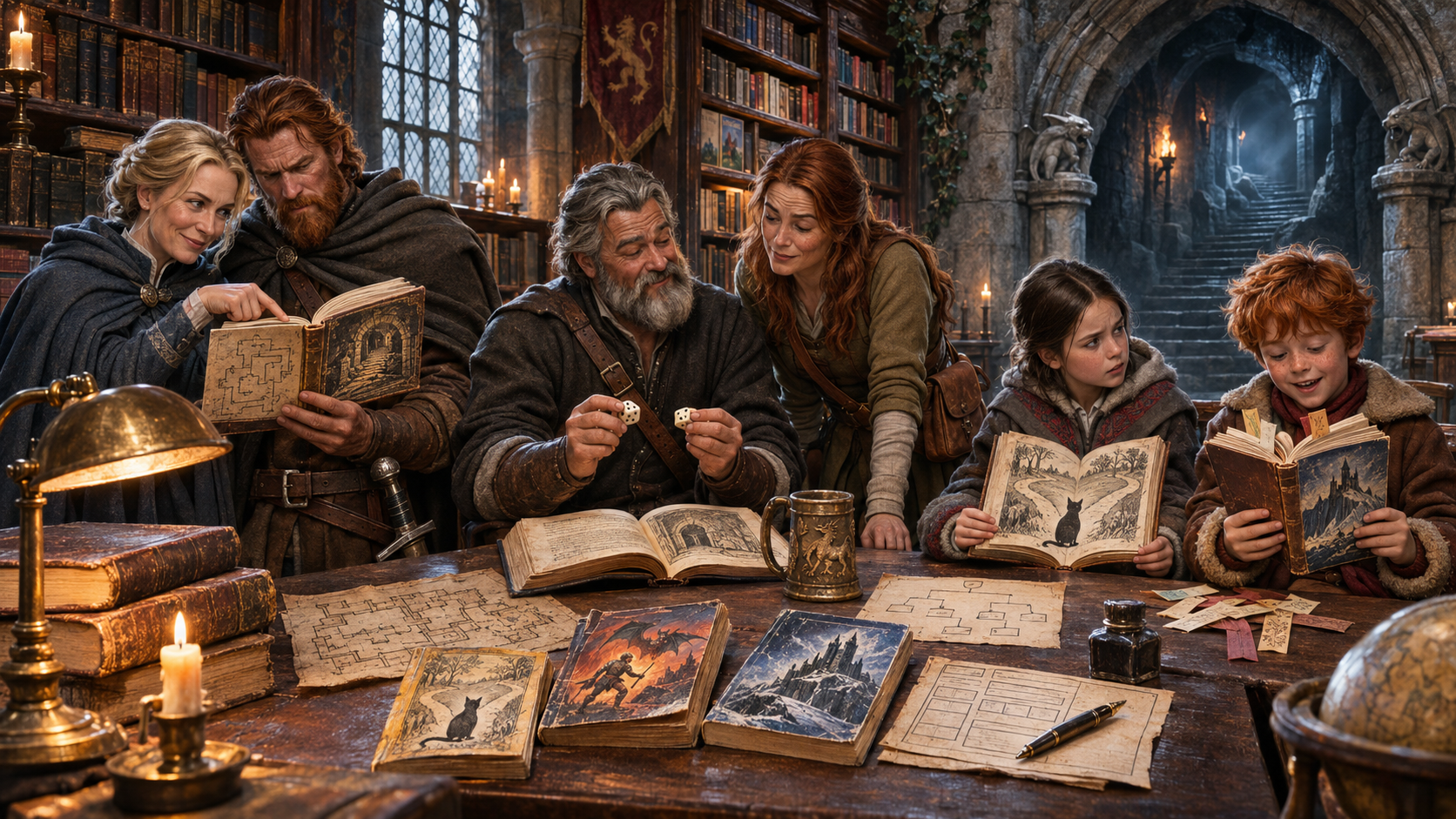
One Hobby, Many Beginnings — A History of Interactive Storytelling
A black cat has just left boarding school.
He has a name, Les, and a future that has not yet been decided. Perhaps he will find safety. Perhaps he will encounter trouble. Much depends on what happens next.
For once, however, the author is not entirely responsible.
You are.
This is Britain in 1967, and E. W. Hildick has published Lucky Les: The Adventures of a Cat of Five Tales. Its readers can influence the cat’s adventures and reach five different endings.
There are no elaborate combat rules, fantasy character classes or twenty-sided dice. The book predates the famous Fighting Fantasy series by fifteen years.
And it is not alone.
Within a few years, British readers will encounter political decision-making fiction, strange literary experiments and illustrated adventure books that send them from one numbered passage to another.
By 1977, they can explore fantasy dungeons alone, using adapted versions of an American roleplaying game.
Then, in August 1982, a paperback appears with an unforgettable invitation.
You are the hero.
Its title is The Warlock of Firetop Mountain.
And British publishing will never look quite the same again.
Mara examines the old cat story.
“So you choose what happens to him?”
“Within the choices the author provides,” Stacy replies.
Chibi frowns.
“Can I help the cat?”
“Sometimes,” says Eljara.
“Good.”
Sean turns to a later book. Its cover shows a distinctly less friendly creature.
“And sometimes the book is trying rather hard to kill you.”
Chibi looks at him.
“Why?”
“An excellent question,” Caelwyn says.
It is also an excellent place to begin.
The history of gamebooks in Britain is about much more than two famous authors or a successful series of fantasy paperbacks. It is a story of experimentation, education, publishing, illustration, childhood, cultural anxieties, technological change and the persistent human desire to enter a fictional world rather than merely observe it.
Above all, it is the history of people who imagined different answers to the same question.
What if the reader could decide what happened next?
The history of British gamebooks has more than one beginning
Before looking for the first British gamebook, we need to establish what the term means.
A branching story allows readers to choose between different passages, potentially changing the course or ending of a narrative.
A solo roleplaying adventure goes further. It may use dice, character attributes, combat rules, inventories and persistent information to simulate parts of a tabletop roleplaying experience without a human Game Master.
Experimental literature can disrupt conventional reading order without turning the reader into a character making decisions within the story.
Educational programmed instruction directs learners through different material according to their responses. Its primary purpose is teaching, even when its structure resembles interactive fiction.
These distinctions matter because Britain developed or adopted examples of all four.
Their histories overlap, but they are not interchangeable.
An experimental novel is not necessarily a game. A children’s adventure with several endings is not necessarily a roleplaying game. An educational text that changes its sequence according to a student’s answers does not automatically share a direct ancestry with a fantasy dungeon.
Nor does finding an earlier publication diminish the achievements of later creators.
Historical significance is not a competition to find the oldest possible date.
Sometimes the important achievement is invention.
Sometimes it is adaptation.
Sometimes the real breakthrough comes when an idea moves from a specialist audience into ordinary homes, schools and bookshops.
British gamebook history contains all three.
The 1960s: When books began answering their readers
Before gamebooks became recognisable as entertainment, British educators were exploring ways to make printed material responsive.
Programmed instruction attracted considerable interest during the middle decades of the twentieth century. Students could proceed through carefully arranged sections, receiving explanations or further questions depending on their answers.
Publishers such as English Universities Press participated in this educational environment, producing material associated with programmed learning and teaching machines.
The underlying idea was straightforward.
A conventional textbook usually expects readers to follow its prescribed order. A programmed text can redirect them according to what they already understand.
Someone who answers correctly moves ahead.
Someone who struggles may encounter another explanation.
This is not yet a fantasy adventure. The student is not choosing whether to enter a haunted tower or negotiate with a dragon.
Nevertheless, the book is no longer entirely passive.
Its physical arrangement becomes part of a procedure.
The distinction is important. Later gamebooks would use similar structural techniques to generate uncertainty, danger and imaginative freedom rather than progress towards a predetermined educational objective.
There is no reason to assume that every subsequent gamebook author studied programmed-learning theory.
But the educational experiments show that British writers, publishers and teachers were already thinking seriously about how printed pages could respond to readers.
The book was becoming something more than a fixed sequence of text.
1967: Lucky Les and the forgotten cat with five futures
E. W. Hildick’s Lucky Les: The Adventures of a Cat of Five Tales appeared in London in 1967, published by Anthony Blond.
Its illustrations were created by Peter Barrett.
The surviving bibliographic record describes a volume of approximately 120 pages, arranged into fifteen chapters and five different endings.
The reader helps determine the adventures of Les, a fortunate cat who has recently left boarding school.
This is an unusually charming point of departure for a medium later associated so strongly with swords, monsters and fatal mistakes.
A child did not need to understand roleplaying conventions to participate.
The invitation was already part of the story.
Something happens to the cat.
The reader makes a choice.
The book offers a consequence.
Modern descriptions sometimes call Lucky Les the first British gamebook.
That is a retrospective classification, not a universally settled historical verdict.
It depends on whether we define a gamebook primarily through branching choices, explicit game rules or some combination of both.
What we can establish is that a British children’s book with multiple reader-directed outcomes existed in 1967, long before the commercial success of Fighting Fantasy.
It is equally important to resist inventing an influence that has not been demonstrated.
We cannot conclude that Steve Jackson or Ian Livingstone read Lucky Les merely because they later developed an interactive book.
The work deserves historical recognition without needing to become the secret ancestor of everything that followed.
Its existence reminds us that the history of interactive reading is broader than the history of fantasy gaming.
And that sometimes a cat reaches the crossroads before the adventurers arrive.
1969: State of Emergency gives the reader a political crisis
Two years later, Dennis Guerrier and Joan Richards published State of Emergency: A Programmed Entertainment.
The work appeared in Britain through William Heinemann and Penguin.
Instead of controlling a child, animal or fantasy hero, the reader confronts the decisions of a political leader in a newly independent fictional African state.
Questions concern government, national development, security, diplomacy and personal responsibility.
The book explicitly connected its approach to the techniques of programmed learning.
That connection is historically significant.
It shows that writers could take a structure associated with education and use it to explore political choices through fiction.
Unlike a conventional novel, State of Emergency asks the reader to consider alternatives and encounter different consequences.
But it also demonstrates the limitations of structured choice.
The available political options have already been selected by the authors.
Their assumptions about government, foreign relations and development shape the experience.
A modern reader may therefore find the work interesting for two reasons.
It is an early example of interactive political storytelling.
It is also a document of the cultural expectations and political assumptions of the period in which it was written.
The setting of a newly independent African nation is especially important.
The late 1960s were shaped by the consequences of decolonisation, international political competition and debates over the economic future of newly independent states.
An interactive novel dealing with these issues can reveal how British writers imagined those circumstances.
It cannot be treated as a neutral simulation of African political life.
That distinction matters whenever historical fiction offers readers choices within cultures or societies that are not their own.
There is also a lesson in the attribution of the work.
Joan Richards was a co-author, yet later bibliographic descriptions have not always represented her contribution consistently.
This should encourage careful comparison of original title pages and later catalogue records.
It does not by itself establish deliberate exclusion.
Historical recognition requires precision, not speculation.
Another experiment in 1969: The Unfortunates
That same year, B. S. Johnson published The Unfortunates.
It is one of the most striking examples of British experimentation with the physical form of the book.
Rather than being conventionally bound, the novel was issued as twenty-seven separate sections inside a box.
The opening and closing sections were identified.
The twenty-five pieces between them could be read in varying orders.
Johnson used this unusual structure to explore memory, grief and the experience of returning to a place associated with someone who had died.
The apparent disorder of the reading experience reflected the unpredictable ways in which memory can interrupt the present.
The reader participates by determining the sequence of the material.
But the work is not a conventional gamebook.
There is no adventurer whose decisions alter the fictional world, no character sheet and no system of victory or defeat.
Its importance belongs primarily to experimental literature.
Why include it in a history of British gamebooks?
Because it demonstrates that the relationship between reader and printed text was being challenged from different directions.
A writer interested in memory might dismantle the ordinary order of a novel.
A teacher might build a system that sends a student to an appropriate explanation.
An adventure writer might let a child choose the next event.
Each experiment asks how much control a book should retain and how much it can surrender.
The answers were not identical.
Nor did they need to be.
1972: Tracker Books bring interactive adventure to the paperback shelf
In 1972, Transworld’s Tracker Books introduced another important British development.
Early volumes included Mission to Planet L, Secret of the Seventh Star, Treasure of Shark Island and The Black Dragon.
John Allen and Kenneth James wrote these early adventures, with illustrations by Roger Knights.
The books used an unusual landscape format and relied heavily on visual material.
Readers might follow numbered references printed in the text or in illustrations. Some titles incorporated visual puzzles as well as narrative decisions.
The format was not identical to the later fantasy roleplaying gamebook.
There was no universal system of character attributes or combat rules shared across the series.
Its emphasis lay on interactive adventure, observation and discovery.
Nevertheless, the books gave readers a place inside the action.
A science-fiction rescue mission could become something they navigated rather than merely read.
A mystery could ask them to inspect evidence.
A journey could change direction according to a decision.
The surviving catalogue documents twelve Tracker Books published between 1972 and 1980.
That makes the series especially important.
It was not simply one experimental volume appearing in isolation.
It represented a sustained British attempt to develop interactive adventure publishing before Fighting Fantasy.
The series also broadened its subject matter, moving beyond its early combination of science fiction, adventure and mystery into sport and other contemporary settings.
This reminds us that interactivity was not originally confined to fantasy.
A football match, a puzzle or a science-fiction problem could offer a reader just as much opportunity to make decisions as a dungeon.
The later dominance of fantasy was a major commercial development.
It was not an inherent requirement of the form.
1977: Britain already had solo roleplaying adventures
The next turning point brings us directly into the history of tabletop roleplaying.
In the United States, Ken St. Andre had created Tunnels & Trolls in 1975. Rick Loomis published its solo adventure Buffalo Castle in 1976 through Flying Buffalo.
These developments matter to our American history, but their arrival in Britain belongs to a different story.
By 1977, a British edition of Tunnels & Trolls was being produced through the publishing environment associated with Games & Puzzles magazine.
One of the people involved was Selwyn Ward.
Ward later wrote about the period in a historical recollection published through Board’s Eye View. He explained that he edited the British edition of Buffalo Castle in 1977, along with British editions of Deathtrap Equaliser and Labyrinth.
His recollection is particularly important because it describes a direct British publishing connection with solo roleplaying adventures several years before The Warlock of Firetop Mountain.
Here the player was doing something recognisably different from choosing an ending in a simple branching story.
A roleplaying character could enter an adventure.
Rules governed certain outcomes.
Combat and uncertainty could be resolved through dice.
The book provided descriptions and instructions that substituted for some functions normally performed by a Game Master.
The result was a solo tabletop roleplaying experience carried by printed pages.
Ward also remembered something else.
The illustrations.
He singled out Polly Wilson’s work as one of the memorable achievements of those early British editions.
That observation opens a neglected chapter of gamebook history.
Wilson’s artistic contributions connected British roleplaying publications with the developing visual culture of fantasy games.
Her drawings appeared in the wider White Dwarf environment, and she later contributed artwork to the Advanced Dungeons & Dragons Fiend Folio.
She belonged to a creative network that helped British fantasy gaming develop its own identity.
It would be misleading to describe Buffalo Castle as an originally British invention. The underlying adventure came from America.
Equally misleading, however, would be a history in which the British editorial and artistic contributions simply disappear.
Importing a work is not the same activity as creating it.
Editing, illustrating, localising and distributing it are still historically meaningful forms of creative labour.
And by 1977, British readers could already encounter the central idea that a book might guide them through a fantasy dungeon without a human Game Master.
That changes how we understand 1982.
The British roleplaying scene that made Fighting Fantasy possible
To understand the commercial breakthrough, we must look beyond books and consider the communities surrounding them.
During the 1970s, tabletop roleplaying was developing a recognisable British identity.
Dungeons & Dragons had arrived from the United States, attracting enthusiasts interested in fantasy, wargaming, simulation and imaginative adventure.
Games Workshop emerged as an important part of that culture.
Ian Livingstone, Steve Jackson and John Peake founded the business in 1975, initially pursuing a broader range of games before concentrating increasingly on hobby gaming.
Jackson and Livingstone became closely involved in introducing and distributing American roleplaying games in Britain.
Their early publication Owl and Weasel eventually gave way to White Dwarf in 1977.
The new magazine provided a regular venue for articles, reviews, adventures, correspondence and discussions about the rapidly developing hobby.
Events such as Games Day brought enthusiasts, publishers and retailers into direct contact.
This environment matters more than any isolated anecdote about two men sitting down to invent an adventure.
The creators already knew how tabletop roleplaying worked.
They had experience selling games and explaining unfamiliar systems.
They understood that players enjoyed taking meaningful actions in imaginary worlds.
They also understood the obstacle.
A conventional tabletop roleplaying session required a group, rules and somebody capable of running the game.
Finding all three was not always easy.
A book that could provide its own adventure and adjudicate basic rules promised a different kind of accessibility.
Yet Britain already had Tunnels & Trolls solo adventures.
The historical question is therefore not whether Jackson and Livingstone were the first people in Britain to imagine solitary roleplaying.
They were not.
The more interesting question is how their particular design, publishing partnership and timing transformed that possibility into an extraordinary commercial success.
1980: The convention, the editors and the manuscript called The Magic Quest
The familiar story begins at Games Day in 1980.
Jackson and Livingstone met representatives from Penguin Books. A discussion developed around creating a book that could introduce a broader audience to roleplaying.
Rather than producing a conventional explanatory guide, the two proposed an adventure readers could actually play.
The project developed under the working title The Magic Quest.
But there is a historical problem with many retellings of this encounter.
They do not always credit the same editor.
Some accounts identify Philippa Dickinson as the person who first encountered the proposal.
Others identify Geraldine Cooke, connecting her to the original commissioning discussion and Dickinson to the subsequent editing of the book at Puffin.
This is not merely an argument over an incidental name.
Publishing decisions are made by people.
An editor can recognise an opportunity that a commercial department has not yet understood.
Another editor may then spend months making the manuscript work.
Their responsibilities may overlap, but they are not necessarily identical.
The surviving accounts require careful comparison with contemporary publishing records.
What is clear is that both Geraldine Cooke and Philippa Dickinson belong to the history of Fighting Fantasy.
Their participation in the Guardians of the Golden Skull discussion at Fighting Fantasy Fest 6 in September 2026 is a valuable reminder that the editorial history remains recoverable through surviving witnesses.
The early project also involved substantial development.
Jackson and Livingstone had to reconcile the different approaches they brought to the adventure.
A branching manuscript needed to function as a navigable network.
Combat rules had to be comprehensible.
Descriptions had to carry enough information for decisions to feel meaningful.
A reader encountering the book for the first time could not be expected to understand the entire culture of tabletop roleplaying.
The authors needed to make the experience approachable without removing the danger or excitement that made it worthwhile.
The development has produced a number of memorable anecdotes, including recollections about differing rule systems and the challenge of arranging hundreds of numbered sections.
Those anecdotes are useful evidence of how the creators remembered the process.
But memories recorded decades later should not be mistaken for a complete set of contemporary production documents.
Even apparently simple questions — such as the precise original print run — deserve caution.
The surviving research does not conclusively establish every number repeated in later accounts.
We can describe the breakthrough without turning uncertainty into fact.
27 August 1982: The Warlock of Firetop Mountain
On 27 August 1982, Puffin published The Warlock of Firetop Mountain.
Its authors were Steve Jackson and Ian Livingstone.
The original cover was painted by Peter Andrew Jones.
The interior illustrations were created by Russ Nicholson.
The book contained four hundred numbered sections.
The adventure invited readers into the dangerous mountain stronghold of the sorcerer Zagor.
For many young readers, the experience was unlike anything else on the ordinary paperback shelf.
They could create a character using a small number of statistics.
They could roll dice to resolve combat.
They could explore tunnels, discover objects, encounter creatures and make decisions with lasting consequences.
The rules centred on three familiar characteristics:
Skill, Stamina and Luck.
That was a far smaller system than the rulebooks and character options associated with a complete tabletop roleplaying game.
The simplification was central to the format.
The reader did not need an experienced Game Master.
There was no need to convince several friends to attend a weekly session.
A pencil, paper, dice and the book were enough.
Even the requirement for actual dice could be worked around through a random-number method printed within the book.
This was a remarkable achievement of design and publishing.
The adventure felt like a game.
It looked like a book.
It could be sold through the children’s paperback market.
And it was understandable to readers who had never heard of tabletop roleplaying.
That is the historical achievement of The Warlock of Firetop Mountain.
It did not create every component of interactive literature or solo roleplaying from nothing.
It brought them together in a commercially effective form that reached a much wider audience.
Why a four-hundred-section book felt like a world
The familiar promise of Fighting Fantasy was direct.
The reader was the hero.
But this promise deserves scrutiny.
The book did not allow unlimited freedom.
Every available action had been written in advance.
The author determined what rooms existed, which dangers could appear and what consequences followed particular decisions.
If a reader wanted to negotiate with a monster and the text provided no such option, the book could not invent a new response.
It was not a human Game Master.
Nevertheless, the experience could feel remarkably personal.
A reader chose the corridor.
They decided whether to investigate a suspicious object.
They managed their character’s survival.
They discovered that an apparently minor action might influence events much later.
The structure encouraged curiosity, caution and experimentation.
It also made failure part of the experience.
The wrong choice might be fatal.
An unfortunate dice roll could end the adventure.
Missing an important item might make the final confrontation impossible to survive successfully.
Readers frequently returned to earlier decisions, kept fingers between pages or replayed the book after reaching an unsatisfactory conclusion.
Some treated the adventure as a challenge to overcome honestly.
Others wanted to explore every possible route.
The format allowed both approaches, even when the printed rules encouraged one style of play over another.
This is one reason gamebooks occupied such an interesting space between literature and gaming.
The story was authored.
The route through it belonged, to a limited but meaningful extent, to the reader.
Puffin, the bookshop and the schoolbag
A good invention does not automatically produce a cultural phenomenon.
It needs production, distribution and readers.
Puffin’s role in the success of Fighting Fantasy was therefore essential.
The publishing house already possessed experience reaching children through ordinary retail channels, school-related publishing and the wider Penguin organisation.
A specialist hobby product could now be presented as a paperback.
That changed the audience.
Readers who would never visit a gaming shop might discover The Warlock of Firetop Mountain in a familiar bookstore.
Someone whose friends did not play Dungeons & Dragons could still enter a dungeon.
A child could take an adventure home without persuading their parents to buy a complete roleplaying system.
The books were portable and comparatively accessible.
They were also designed to be read more than once.
The same volume might occupy its owner for many attempts.
In later accounts, Livingstone remembered the importance of word-of-mouth recommendations among schoolchildren.
Those memories are valuable, although they should not replace independent evidence about sales and reading habits.
The surviving Puffin archives show that the publisher soon supported the expanding format through organised publicity and direct-sales material.
The University of Bristol’s Penguin Archive preserves catalogues, order forms, promotional material and information packs from the period.
A 1985 Puffin Adventure Gamebooks information pack is particularly interesting because it demonstrates that the publisher was presenting the format systematically, not merely allowing a surprise bestseller to circulate without further attention.
Publisher accounts commonly describe Fighting Fantasy as having sold around twenty million copies worldwide across its wider publishing history.
Such figures indicate the extraordinary reach of the brand, but they should be identified as publishing-industry claims, with attention paid to whether a particular source describes copies printed, shipped or sold.
More precise figures for individual early printings require their own evidence.
The economic achievement remains substantial without inventing exact numbers.
The artists who made the darkness visible
Gamebook history is often written as though the author alone built the world.
The surviving books tell a different story.
Peter Andrew Jones’s original cover for The Warlock of Firetop Mountain helped make the first book immediately recognisable.
Russ Nicholson’s interior illustrations gave the adventure a distinctive identity.
Their importance was not purely decorative.
A drawing could make a creature seem dangerous before the reader faced a choice.
A sketch of a doorway, corridor or monstrous figure could establish a mood that the prose did not need to explain in full.
In an interactive book, the reader might encounter those illustrations in different sequences.
The visual world had to remain coherent even when the order of the experience changed.
As the series expanded, artists including Iain McCaig, Les Edwards, Ian Miller, John Blanche, Malcolm Barter, Martin McKenna, Alan Langford and Tony Hough contributed to its evolving identity.
These were different artistic voices.
Their work should not be flattened into one generic fantasy style.
Some created strange, unsettling monsters.
Others gave imaginary landscapes a feeling of physical space.
Certain covers emphasised threat and mystery.
Others promised heroic adventure, spectacle or something almost dreamlike.
For many readers, a single illustration remains more memorable than a particular paragraph.
The medium relied upon that relationship between image and imagination.
And the people who supplied the images deserve to remain visible in its history.
Polly Wilson’s earlier work in the British Tunnels & Trolls environment makes this especially clear.
The visual history began before the best-selling series appeared.
It continued through publishers, styles and generations of artists.
Fighting Fantasy becomes more than one dungeon
Following the success of The Warlock of Firetop Mountain, the range expanded rapidly.
Steve Jackson’s The Citadel of Chaos and Ian Livingstone’s The Forest of Doom followed in 1983.
The subsequent books explored increasingly varied settings.
Starship Traveller brought science-fiction adventure into the format.
City of Thieves offered a dangerous urban environment.
Deathtrap Dungeon turned the dungeon itself into a deliberately constructed challenge.
Later titles explored horror, mystery, science fiction, superheroes and other approaches to interactive play.
This breadth matters.
The original success had demonstrated the appeal of a fantasy dungeon.
It had not established that every future gamebook needed to be one.
The same underlying mechanics could support different genres.
Some stories relied heavily on combat and survival.
Others placed greater emphasis on investigation, atmosphere or unusual decisions.
Writers beyond Jackson and Livingstone contributed new voices.
The wider series gradually developed recurring places and shared fictional geography, most prominently the world of Titan.
The Warlock magazine, published between 1984 and 1986, extended the experience beyond individual books.
Its thirteen issues included adventures, articles, artwork and gaming material.
The magazine also provided a route for further writers and artists to contribute.
This was becoming an ecosystem.
Books generated a readership.
A readership supported magazines, supplements and additional creative work.
The worlds expanded beyond any single volume.
Sorcery!: Four books, one great journey
Between 1983 and 1985, Steve Jackson developed Sorcery!, a four-part interactive fantasy campaign.
Its volumes were The Shamutanti Hills, Kharé: Cityport of Traps, The Seven Serpents and The Crown of Kings.
The adventure followed a quest across dangerous territory to recover the Crown of Kings.
The structure offered a different relationship between character and story from many stand-alone Fighting Fantasy volumes.
A reader could carry their progress from one book into the next.
Actions and decisions had consequences beyond the immediate volume.
The player could also choose between different approaches to the challenge, including a warrior or a spellcasting adventurer.
The magic system required attention to a separate repertoire of spells, each represented through short letter codes.
This added another layer to decision-making.
A spell was not simply a solution presented at the moment of danger.
The reader had to recognise possibilities, remember information and judge whether magic was appropriate.
The books also grew beyond the familiar four-hundred-section structure.
The fourth volume, The Crown of Kings, contained eight hundred sections.
That expansion allowed a more substantial final adventure.
Visually, the series is inseparable from John Blanche.
His artwork gave Sorcery! a strange, unsettling personality unlike the appearance of many other gamebooks.
The landscapes, characters and creatures felt as though they belonged to a world governed by unfamiliar rules.
Blanche’s contribution extended into Warlock magazine and other related publications.
His death in June 2026 was therefore a significant loss not only to the visual history of Warhammer, with which his name is so strongly associated, but also to the history of British interactive fantasy.
To understand Sorcery! properly, we must recognise both Jackson’s narrative design and Blanche’s artistic imagination.
The adventure was constructed in words and numbers.
Its atmosphere was also built in lines, shadows and colour.
1984: Lone Wolf and the idea of a hero who remembers
In June 1984, Joe Dever published Flight from the Dark, the first book of the Lone Wolf series.
The original British edition was issued through Sparrow, with artwork by Gary Chalk.
The reader assumed the role of Lone Wolf, a young Kai warrior who survives the destruction of his order and must carry warning of an approaching danger.
The premise created a powerful sense of personal purpose.
Instead of being merely an unidentified adventurer exploring a succession of unrelated places, the player occupied a defined position within an unfolding epic.
Lone Wolf had a world, an identity and a history.
The reader could develop abilities, acquire equipment and carry progress between volumes.
Different books formed part of an increasingly large campaign.
The choice of Kai disciplines gave the player a particular relationship with the character.
Abilities mattered across changing situations.
The adventure was not necessarily confined to a single successful journey through one book.
A continuing character could acquire experiences and survive into later chapters of a much larger story.
This helped distinguish Lone Wolf from many competing gamebooks.
The books offered both accessible solo play and the continuity associated with a long-running roleplaying campaign.
The world of Magnamund provided the larger framework.
Its nations, conflicts, cultures and dangers gave the player’s experiences a sense of belonging to something that extended far beyond a single decision tree.
Gary Chalk’s illustrations were fundamental to this achievement.
His maps and images made Magnamund feel like a place with history and geography.
Players were not simply moving from paragraph to paragraph.
They were travelling through an imagined world.
Dever’s work subsequently developed across several cycles and many volumes.
Its survival would become one of the most remarkable stories in the later history of gamebooks.
But in 1984 the essential achievement was already visible.
The book could remember who its hero had become.
GrailQuest: A wizard, a sword and a very British sense of humour
Not every British-market gamebook wanted to be solemn.
In 1984, J. H. Brennan introduced GrailQuest with The Castle of Darkness.
The series ran to eight volumes between 1984 and 1987, published in Britain through Armada.
Brennan, an Irish writer from Northern Ireland, complicates any overly neat attempt to assign all British-market publishing to a single national literary identity.
His work belongs to this publishing history, while his personal and cultural background deserves accurate recognition.
GrailQuest drew upon Arthurian legend, fantasy adventure and comedy.
The player became Pip, a hero whose experiences were often interrupted by the highly questionable decisions and behaviour of the surrounding characters.
Merlin was hardly an infallible figure of wisdom.
The talking sword E.J. possessed a personality of its own.
Danger and absurdity existed side by side.
The books also developed memorable devices involving dreams, death and unusual narrative detours.
The series repeatedly reminded readers that they were inside a story.
But rather than destroying the adventure, this self-awareness became part of its charm.
The humour could be absurd, self-referential or openly affectionate towards the conventions it was parodying.
John Higgins’s interior illustrations contributed to the personality of the series, while Les Edwards provided striking cover artwork.
GrailQuest matters because it demonstrates that a gamebook does not have to treat its own rules or fantasy world with solemn reverence.
The player can be in genuine danger while the author laughs at the situation.
Indeed, sometimes the laughter makes the danger more memorable.
Sean considers the description of Pip’s predicament.
“So the wizard is unreliable, the sword has opinions, and death may not be the end of the joke?”
“That is one way of describing it,” Eljara replies.
“Sounds familiar.”
Mara looks suspiciously at Caelwyn.
“Are all wizards like that?”
“Absolutely not,” he says.
Stacy says nothing.
Which is perhaps the wisest contribution to the conversation.
Starlight Adventures: The forgotten girls’ gamebook series
One of the most interesting discoveries in the British publishing record concerns a series that receives far less attention than Fighting Fantasy.
The University of Bristol’s Penguin Archive contains a promotional brochure from 1984 announcing Starlight Adventures as a new series of adventure gamebooks intended for girls.
The six books appeared in 1985.
Their titles were Star Rider, Riddle of the Runaway, Island of Secrets, Danger on the Air, Ice Dancer and Trance.
Writers included Carole Carreck and Heather Fisher.
The series explored subjects such as horse riding, investigation, sport, personal ambition and mystery.
Its protagonists were female.
There were sometimes romantic elements, but the books cannot be reduced to romance alone.
Perhaps most interestingly, the volumes did not all use the same game system.
Some relied primarily on narrative decisions.
Others incorporated chance, scores or different forms of character information.
Ice Dancer, for example, used Luck, Energy and Confidence as attributes.
That variety makes the series worth studying as a set of individual works rather than dismissing it as a simple imitation.
The marketing language of the period is also revealing.
The publisher presented the books specifically as adventures for girls.
That tells us something about how the children’s book market was segmented in the 1980s.
It does not mean that girls were absent from the readership of Fighting Fantasy, or that boys could not enjoy Starlight Adventures.
Actual reading habits rarely obey marketing categories perfectly.
What the surviving material demonstrates is that Puffin recognised different potential audiences for interactive literature and experimented with products intended to reach them.
The existence of the series also changes the familiar image of the British gamebook boom.
Its history was not confined to male adventurers, male writers or one type of fantasy.
There were female protagonists.
There were women writing interactive adventures.
There were different approaches to danger, success and character development.
Some have survived more visibly than others.
The fact that Starlight Adventures is now comparatively obscure is not evidence that it was historically insignificant.
It is a reason to investigate how publishers promoted it, how readers responded and why it did not achieve the enduring prominence of its better-known competitors.
Mara examines the list of titles.
“So girls had their own adventure books?”
“Some publishers marketed them that way,” Stacy explains.
“Did they have to?”
“No,” Stacy says. “A good adventure doesn’t belong to one kind of reader.”
Chibi points to Star Rider.
“Can I ride the horse?”
“Of course,” says Mara.
“Then I like this one.”
The Way of the Tiger: Martial arts and the continuing hero
In 1985, Mark Smith and Jamie Thomson introduced The Way of the Tiger.
The series combined fantasy adventure with martial arts, presenting the reader as a trained ninja moving through the world of Orb.
Its original six books appeared between 1985 and 1987.
The adventure involved more than simply choosing which opponent to fight.
The player’s identity, training and continuing mission formed an important part of the experience.
Combat was shaped by martial arts techniques rather than the generic fantasy fighting of many earlier gamebooks.
As the story progressed, its scope expanded beyond individual encounters.
The reader’s decisions could involve political conflict and responsibility for the fate of larger communities.
The books became a continuing narrative rather than a series of unrelated assignments.
The series also demonstrates why historical bibliographies need precise dates.
Modern catalogues frequently list eight books.
That reflects later expansion.
The original run consisted of six volumes.
A new prequel, Ninja!, and a concluding volume, Redeemer!, were added in the 2010s, completing and extending the earlier cycle.
It would be inaccurate to treat those later additions as though they had been part of the original 1980s publishing programme.
The distinction matters because the original series’ unresolved ending became part of how readers remembered it.
The later continuation belongs to a different historical moment, one shaped by collectors, nostalgia and renewed publishing opportunities.
Both moments deserve recognition.
They should not be collapsed into one.
Golden Dragon and the pressure to create something different
In the middle of the 1980s, Dave Morris and Oliver Johnson developed the Golden Dragon fantasy gamebooks.
Published through Grafton’s Dragon imprint, the series offered another approach to solo fantasy adventure.
The books used a relatively compact combat procedure and often made survival a demanding proposition.
Their design could be unforgiving.
Exploration, careful attention and sometimes extensive mapping mattered greatly.
The adventures demonstrated that the same market could support different interpretations of difficulty and player agency.
But the history of Morris and Johnson becomes especially interesting when we look at what followed.
The creative challenge was no longer merely to produce another book that resembled the existing successful series.
New projects needed distinctive identities.
Writers and editors were experimenting with increasingly ambitious answers.
One of those answers was Blood Sword.
Blood Sword: When the book became a party of adventurers
The first Blood Sword volume, The Battlepits of Krarth, appeared in 1987.
The series continued through five volumes, concluding with The Walls of Spyte in 1988.
Dave Morris and Oliver Johnson were central to its creation, with Jamie Thomson also contributing to the final volume.
Blood Sword introduced an especially ambitious idea.
The same adventure could be played by one person or by a small group.
The books supported as many as four players.
The characters possessed different capabilities.
Combat could involve tactical positions represented on printed maps.
The players had to consider cooperation, movement, abilities and the consequences of their actions.
This altered the relationship between reader and book.
A conventional solo gamebook generally assumes that one person controls the central protagonist.
Blood Sword could support discussion and collective decisions.
The social dimension of tabletop roleplaying re-entered the experience.
The printed text still handled much of the narrative structure, but the players could now collaborate.
The setting was also substantial.
The adventures took place in a richly developed fantasy world connected with the wider Dragon Warriors roleplaying tradition.
Their fictional environment contained religion, politics, history and conflicts that extended beyond isolated encounters.
The system was more demanding than the simplest adventure gamebooks.
But that complexity served a different creative goal.
The ambition was not only to make a book feel like a dungeon.
It was to make a sequence of books function like an extensive roleplaying campaign.
A particularly intriguing detail survives in Dave Morris’s recollections of editorial discussions.
He describes an editor named Liz encouraging a clearer point of difference for the project.
The full identity and role of this editor remain insufficiently established in the research currently available.
Rather than inventing a surname, a responsible history should leave the question open.
It is precisely the sort of detail that deserves investigation while the people involved can still remember it.
Because sometimes a major creative innovation begins with an editor asking a deceptively simple question.
What makes this one different?
Other experiments: Interactive comics and two-player adventures
The British gamebook boom did not remain entirely inside ordinary paperback fiction.
In 1986, 2000 AD developed Diceman, a short-lived interactive comic publication associated especially with writer Pat Mills.
The idea was to bring gamebook-style decisions into the visual language of British comics.
The project produced five issues.
It demonstrated how the format might move from printed prose into comic strips, where images and page layouts became central parts of the decision-making experience.
Mills later recalled that he had been aware of the gamebook craze and saw interactive comics as an obvious experiment worth attempting.
The result brought together the traditions of British comics and game design.
Elsewhere, publishers explored two-player gamebooks and related variations.
Clash of the Princes, for example, offered a different structure through which two readers could participate in a connected adventure.
These experiments did not all develop into enduring commercial lines.
But they demonstrate that the industry was not simply repeating an established formula.
Writers, artists and publishers were continually testing what an interactive printed work might be.
Some experiments emphasised competition.
Others emphasised cooperation.
Some expanded narrative continuity.
Others changed the visual presentation.
The gamebook was becoming a flexible design language.
Heart of Ice: What happens when we remove the dice?
By the early 1990s, gamebook creators were still developing new approaches.
Dave Morris’s Heart of Ice appeared in 1994 as part of the Virtual Reality gamebook series.
It offered a striking alternative to traditional dice-based adventure.
The design relied on character abilities, choices and information tracked through the text rather than conventional random combat resolution.
This allowed a different relationship between decisions and outcomes.
In a dice-driven adventure, a sound decision can still end in failure because of chance.
A more deterministic system can place greater emphasis on what the reader knows, what they have acquired and which course of action they choose.
This does not automatically make the experience easier.
Uncertainty can arise from incomplete information, competing objectives and the consequences of earlier decisions.
Heart of Ice is important because it challenges the assumption that a gamebook requires random combat to function as a game.
It shows how the sense of participation can come from planning, interpretation and the accumulation of knowledge.
The book also belongs to a wider moment when interactive fiction was experimenting with systems that asked readers to think about agency differently.
The reader was not simply surviving a sequence of fights.
They were navigating a carefully constructed network of possible actions.
Fabled Lands: When the book became an entire world
In 1995, Dave Morris and Jamie Thomson introduced Fabled Lands through Pan Books.
The concept represented one of the most ambitious developments in printed gamebook design.
Instead of following a single predetermined quest, the reader entered an open fantasy world.
Different books represented different regions.
The player could travel between them.
Equipment, abilities, possessions, discoveries and other information could persist across adventures.
There was no requirement that every reader follow the same narrative path.
Some might pursue a particular mission.
Others might travel, explore or build their character’s fortunes.
The world offered numerous possibilities without demanding that all roads lead to one final confrontation.
In its own medium, Fabled Lands approached the structure of an open-world roleplaying game.
It did not possess the unlimited responsiveness of a human Game Master.
Every encounter was still written.
Every available location and choice had to be designed.
Yet its larger architecture allowed readers a remarkable degree of control over the order and direction of their experiences.
Six original books appeared in 1995 and 1996.
The planned series was larger, but the original publication programme ended before its completion.
For its readers, that created an unusual problem.
The fictional world remained open.
The publishing world had closed.
Years later, crowdfunding helped make another volume possible.
The seventh book, The Serpent King’s Domain, appeared in 2018, with Paul Gresty providing the text for the continuation.
This is a useful reminder that modern expansions should be credited to the people who actually created them, rather than automatically attributing every later volume to the original founders.
The survival of Fabled Lands also demonstrates something important about its audience.
The community continued to care about a world whose original commercial life had ended decades earlier.
Readers had not merely consumed a series.
They had developed an attachment to a place.
And they wanted the opportunity to return.
Horror, controversy and the British imagination
The success of gamebooks did not pass without criticism.
During the 1980s, British debates about fantasy roleplaying, occult imagery and the influence of popular entertainment on children sometimes developed into moral controversy.
These discussions formed part of a wider international anxiety about games and their supposed effects on young people.
Steve Jackson’s House of Hell, published in 1984, brought the atmosphere of supernatural horror into the Fighting Fantasy line.
Its imagery and subject matter offered an obvious focus for critics already suspicious of fantasy gaming.
Ian Livingstone has recalled encountering accusations that the books encouraged dangerous behaviour or exposed children to disturbing influences.
One frequently repeated anecdote concerns a claim that a child had levitated after reading an adventure.
It is a memorable story.
It should nevertheless be treated as a retrospective anecdote unless a contemporary recording or comparable independent evidence can be established.
The documented existence of moral criticism does not prove every colourful example later associated with it.
Nor should we assume that all parents, teachers or religious communities shared the same fears.
Reactions were varied.
Some adults were suspicious of fantasy gaming.
Others recognised the pleasure their children took in reading.
Some teachers and librarians welcomed the books as a way to engage readers who might not be attracted to conventional fiction.
The historical question is not whether gamebooks were uniformly praised or condemned.
It is how a new form of entertainment became a subject of wider cultural discussion.
Books that gave children control over imaginary dangers could seem exciting to readers and unsettling to observers.
That tension is not unique to gamebooks.
It has accompanied many forms of imaginative play.
Did gamebooks teach a generation to read?
The claim that gamebooks encouraged reading appears frequently in interviews, publisher material and personal recollections.
There are understandable reasons for its persistence.
A gamebook offers frequent moments of decision.
It rewards attention to instructions.
It encourages readers to return to the same text.
It can provide an immediate sense of participation.
Someone who finds a conventional novel intimidating may be intrigued by a book that promises an adventure in which they are the protagonist.
The format also requires particular reading skills.
A reader must recognise instructions, remember relevant information and follow references accurately.
They may need to distinguish between what a character knows and what the player has discovered on a previous attempt.
Some adventures encourage mapping, note-taking and numerical reasoning.
These activities can make reading feel purposeful.
But educational enthusiasm should not be confused with independent proof.
The surviving research does not provide a comprehensive set of British school studies or official library statistics demonstrating a measurable improvement in literacy caused specifically by gamebooks.
Publisher claims and memories of enthusiastic children are valuable evidence of cultural experience.
They are not equivalent to a controlled educational study.
The more useful conclusion is that gamebooks offered a distinctive form of reading participation that many readers found compelling.
For some, that experience may have encouraged wider interest in books, fantasy or roleplaying.
For others, it may simply have been enjoyable in its own right.
Both outcomes are worthy of historical attention.
A form of entertainment does not need to prove that it improved school performance to possess cultural value.
The difficult economics of a branching world
By the 1990s, the conditions surrounding gamebook publishing were changing.
The original Fighting Fantasy line at Puffin continued until 1995.
Its final numbered volume was Jonathan Green’s Curse of the Mummy, book fifty-nine.
This is an important bibliographic correction.
Some later recollections describe the original line as ending earlier, around the fiftieth volume.
The surviving publishing record demonstrates that the Puffin sequence continued beyond that point.
The broader gamebook market was also experiencing pressure.
Computer and console games increasingly offered elaborate interactive experiences.
Publishers faced decisions about changing readerships, shelf space, production costs and the commercial prospects of long-running series.
Complex books could be demanding to develop.
A branching adventure required careful planning, testing and correction.
A mistake in a numbered reference could send a reader to the wrong passage.
An overlooked design problem could make an adventure impossible to complete.
A highly ambitious interconnected series could also create obligations to readers that were expensive to fulfil.
But it would be misleading to claim that videogames simply killed the printed gamebook.
The development of the two forms was more complicated.
Digital entertainment created competition.
It also expanded the audience’s familiarity with interactive storytelling.
Some former gamebook readers became computer-game players.
Some writers and designers moved between media.
And the printed books retained qualities that digital products did not automatically replace.
They could be owned, collected and reread without depending on a particular electronic platform.
The disappearance of a publishing programme did not necessarily mean the disappearance of its audience.
The people who kept the books alive
When publishers withdrew from some gamebook lines, collectors and fans became increasingly important.
They preserved books, documented editions, compared illustrations and remembered obscure titles.
Some developed extensive catalogues.
Others collected contemporary advertisements, magazine material, original artwork and publishing information.
Demian Katz’s Gamebooks.org became an especially valuable international bibliographic resource.
It documents titles, editions, creators, translations and related material across multiple gamebook traditions.
Its importance to British gamebook history is substantial because it helps separate an original publication from a later reissue.
That may sound like a small distinction.
It is not.
A revised edition can have different illustrations.
A new printing may alter the text.
An international translation may introduce a title that resembles no earlier English name.
A series may eventually gain additional books that did not exist during its original publication period.
Without careful documentation, these details become confused.
Independent collectors such as Jamie Fry have also contributed to preserving the history of Fighting Fantasy editions, variations and associated publications.
This work deserves recognition.
It is historical preservation performed by people who care about the material evidence.
Their archives can sometimes answer questions that broad histories overlook.
What did the original cover look like?
Which artist created a particular image?
What was actually printed in 1983?
Did a publisher revise the rules?
What did a contemporary reader see when opening the first edition?
The answers matter because history is built from surviving evidence.
A remembered story is valuable.
An original publication can sometimes confirm, correct or complicate that memory.
Project Aon and the unusual survival of Lone Wolf
Few fan preservation projects illustrate the possibilities of this work better than Project Aon.
Joe Dever allowed a selection of his books to be distributed online through the project, subject to specific permissions and conditions.
Other creators also permitted their contributions to appear.
The result provided readers with an authorised way to access material that had become difficult to obtain through ordinary publishing channels.
It was not simply an act of nostalgia.
It helped sustain a community around Magnamund.
Readers could return to familiar adventures.
New readers could discover them.
Volunteers contributed technical, editorial and preservation work.
The project’s existence also illustrates the importance of distinguishing between legal access and unrestricted public-domain status.
The books did not become free of copyright simply because they were made available online.
Their distribution was governed by permissions.
That distinction matters to anyone preserving creative work.
The survival of Lone Wolf subsequently involved new editions, additional publishing activity and the continuation of Joe Dever’s unfinished plans.
Dever died in November 2016.
His son Ben Dever, working with collaborators including Vincent Lazzari, helped carry forward the work left behind.
This continued development creates a remarkable relationship between generations.
The original creator’s world survives through inherited notes, editorial decisions, new writing, illustrations and an audience that has remained attached to the story.
The history of a gamebook can outlive the original act of authorship.
But that continuity does not remove the need to credit the people responsible for each new stage.
Digital adventures and the return of Sorcery!
The digital adaptation of gamebooks is often described as a natural progression.
In some respects, it is.
A computer can remember character information.
It can resolve dice rolls automatically.
It can manage maps and inventories.
It can prevent readers from following an invalid reference.
Yet converting a printed adventure into software also changes the experience.
A human reader may enjoy managing paper, pencil and dice.
The computer can replace those actions with a more integrated interface.
It may add animations, sound or dynamic presentation.
It can also introduce new constraints.
A digital adaptation is dependent on software, hardware and long-term compatibility.
The printed book and its digital counterpart therefore offer related but different forms of participation.
One significant British example is inkle’s adaptation of Steve Jackson’s Sorcery!.
Released across several instalments beginning in 2013, the digital version transformed the original book series into an interactive software experience.
It retained the spirit of branching adventure while exploring possibilities available through computation.
The adaptation demonstrates how a familiar narrative structure can be reinterpreted rather than merely reproduced.
Another important development is the return of older gamebooks to the technology of their original period.
In July 2026, Project Aon reported the release of a new ZX Spectrum adaptation of Joe Dever’s Flight from the Dark.
The project included the book’s full original set of 350 sections and Gary Chalk’s illustrations, with the computer managing the game rules.
This offers an interesting historical inversion.
A paper adventure from 1984 returns as a program for a computer associated with that same era.
The medium changes.
The imaginative world remains recognisable.
And the community once again becomes part of the creative process.
2026: The British gamebook is still alive
As of November 2026, British gamebooks remain an active field of publishing, collecting, adaptation and historical discussion.
Ian Livingstone’s Tomb of the Golden Skull appeared through Scholastic in August 2026, with a collector’s edition following in September.
Karl Kopinski and Leo Hartas contributed artwork to the publication.
The book continues the Fighting Fantasy tradition more than four decades after The Warlock of Firetop Mountain appeared.
In the Lone Wolf world, Light of the Kai: Volume One appeared in 2026.
It was developed from Joe Dever’s legacy by Ben Dever and Vincent Lazzari, with visual contributions including the return of Gary Chalk.
These publications are significant because they demonstrate different forms of continuity.
One involves an original creator writing a new adventure.
The other involves collaborators and family continuing work from a creator’s surviving plans.
Both depend on a community of readers that still values the worlds established decades earlier.
The wider culture is active too.
Fighting Fantasy Fest 6 took place at the University of West London on 5 September 2026.
Its programme included discussions about publishing history, visual collaboration, the evolution of Titan and modern adaptations.
Among the participants were Ian Livingstone, Geraldine Cooke, Philippa Dickinson, Jamie Thomson, Marc Gascoigne, Jonathan Green and numerous artists.
The gathering was not simply a celebration of famous books.
It brought together people who had performed different kinds of work across the medium’s history.
That is an opportunity for historians.
Editors can remember decisions that authors did not witness.
Artists can explain how manuscripts became images.
Publishers can describe the difficulties of selling an unfamiliar format.
Collectors may possess original editions or documents that resolve uncertain dates.
And readers can describe what the books actually meant in everyday life.
The history is still being recovered.
Not every announced gamebook project should be treated as a completed publication.
Digital adaptations, forthcoming continuations and crowdfunding campaigns need to be distinguished from products that have actually been released.
A living history changes.
It also requires continuing verification.
Why the British gamebook mattered beyond Britain
The British gamebook boom became an international phenomenon.
Fighting Fantasy, Lone Wolf and other series travelled through translations, adaptations and international publishing arrangements.
Their readers encountered the books in different languages and cultural settings.
Sometimes the original illustrations were retained.
Sometimes publishers introduced new covers.
Titles could be changed.
Rules and presentation could be adapted for local markets.
These differences helped produce distinctive national traditions of gamebook reading.
It would therefore be too simple to treat Britain as the single source of all subsequent international interactive literature.
As our American history demonstrates, branching fiction and solo roleplaying already had important precedents elsewhere.
British publishers drew upon an existing international environment.
They also created works that profoundly influenced readers and creators beyond the United Kingdom.
That exchange is central to the history.
Ideas moved across borders.
Publishers interpreted them.
Local writers developed new forms.
Readers encountered different versions of seemingly similar adventures.
Some international markets subsequently produced their own innovative series rather than remaining dependent on British imports.
This is why Mythveil Chronicles approaches the history of gamebooks country by country.
A translation is not automatically a local invention.
A commercial success is not necessarily the first example of a form.
And a creative tradition becomes more interesting when its cultural exchanges are recognised rather than simplified.
The British story matters enormously.
But it is one chapter in a larger international history.
What the surviving evidence still cannot tell us
The history of British gamebooks is unusually rich in personal recollections, surviving books and enthusiast documentation.
Even so, substantial gaps remain.
We do not possess a complete account of every editorial conversation that led from The Magic Quest to The Warlock of Firetop Mountain.
The precise roles of some early publishing contacts require further documentary investigation.
Claims about initial print runs and the speed of early reprinting should be checked against original publishing records.
The relationship between British editions of Tunnels & Trolls and the subsequent design of Fighting Fantasy deserves careful investigation rather than assumptions based on structural similarity.
The readership of early British interactive literature remains difficult to reconstruct comprehensively.
Who bought Lucky Les?
How were the Tracker Books received by children?
What did teachers and librarians think of these formats before the major fantasy boom?
How did readers of Starlight Adventures compare their experiences with other contemporary gamebooks?
Which authors and editors have disappeared from conventional histories because their work was credited inconsistently?
How much did original illustrators influence the creative direction of the books they helped produce?
These questions cannot all be answered through modern publisher anniversaries or nostalgic interviews.
They require original editions, archival correspondence, contemporary journalism, sales records and testimony from people who participated.
The University of Bristol’s Penguin Archive is particularly valuable for understanding Puffin’s publishing activity.
Its surviving promotional material documents the changing presentation of interactive adventure books during the 1980s.
Other evidence remains in private collections, personal papers and the memories of people who worked in the industry.
Recovering this history means listening carefully.
It also means knowing when an attractive story has not yet been proved.
Mythveil Chronicles continues to seek written historical testimony, archival guidance and corrections from creators, editors, artists, researchers and collectors.
Such contributions can deepen future editions of the research.
They should never be represented as completed interviews or endorsements before they exist.
A historical record becomes stronger when it is willing to remain open to correction.
When a book became a world
The history of British gamebooks does not lead to one perfect form.
Some books offer a handful of decisions.
Others contain elaborate combat systems.
A series can follow a hero across decades of imaginary history.
A different series can invite the reader to wander through a world without a single prescribed destination.
Some adventures are frightening.
Others are funny.
Some demand dice, paper and careful accounting.
Others remove chance almost entirely.
All ask the reader to participate.
But participation is not the same as unlimited freedom.
The author still creates the possibilities.
The publisher shapes the finished object.
The illustrator makes its world visible.
An editor helps determine whether the structure functions.
And readers transform those possibilities into experiences.
That last contribution is difficult to measure.
A child reading Lucky Les in 1967 could not know that the history of interactive books would eventually include fantasy dungeons, martial arts campaigns, open worlds and computer adaptations.
A reader discovering The Warlock of Firetop Mountain in 1982 might not have known anything about the earlier British experiments.
Someone following Lone Wolf through Magnamund could become attached to an imaginary world whose story would remain unfinished for years.
The books were different.
The invitation was familiar.
You may enter.
Your decisions matter.
And the world will respond in the ways its creators have imagined.
Mara closes the last volume.
“So who actually invented gamebooks in Britain?”
Caelwyn looks across the table at the growing collection of books, publishing records and illustrations.
“That depends on which kind of gamebook you mean.”
Stacy nods.
“And on whether we’re asking who tried an idea first, who developed it or who brought it to a wider audience.”
“That’s more than one answer,” Mara says.
“History often is,” replies Eljara.
Sean picks up an old fantasy paperback.
“All I know is that someone eventually made books dangerous enough to require dice.”
Chibi has returned to Lucky Les.
He studies the cat’s five possible endings.
“Can the cat choose?”
Mara smiles.
“No. You choose for him.”
Chibi looks at the page for a moment.
“Then I’ll pick a good one.”
And perhaps that is where our history finally comes together.
Not in one inventor’s study, a single publisher’s office or the first successful fantasy paperback.
But in the moment when a reader encounters a possibility and decides what to do with it.
Britain did not invent every form of interactive storytelling.
It helped transform several traditions into something that millions of people could hold in their hands.
Writers constructed the paths.
Editors and publishers made them accessible.
Artists filled them with wonder and danger.
Readers gave them life.
And more than forty years after the first Fighting Fantasy book entered the shops, those worlds are still being explored.
The final page was never quite the end.
Historical sources and further reading
This article draws on surviving editions, bibliographic records, contemporary accounts, institutional archives, retrospective interviews and official publisher material. These sources do not always agree. Later memories are therefore distinguished from publication records, and marketing claims are not treated as independent evidence of educational effectiveness or sales.
Early British interactive literature
- Gamebooks.org — Lucky Les. Bibliographic record of the 1967 title, illustrator, chapter structure and endings.
- University of Southampton — State of Emergency in the history of hypertext. Historical academic discussion identifying the work as a combination of branching fiction and programmed instruction.
- Kirkus Reviews — State of Emergency (1969). Contemporary account of the work and its political decision-making structure.
- Gamebooks.org — Tracker Books. Series bibliography and description of its unusual visual and interactive format.
Early British roleplaying and Fighting Fantasy
- Selwyn Ward — Tunnels & Trolls Solo Adventure Books. Firsthand recollection of British editions from 1977 and Polly Wilson’s artwork.
- Ian Livingstone — Interview with Starburst Magazine. The author’s recollections of Games Workshop, Games Day and the development of Fighting Fantasy.
- Gamebooks.org — Original editions of The Warlock of Firetop Mountain. Original publication date, illustrations, printing history and structure.
- University of Bristol — Penguin and related archives. Institutional description of the surviving Penguin publishing records.
- University of Bristol — Puffin series archive, DM1294/10/5/39. Original catalogue descriptions of promotional material, Starlight Adventures and Fighting Fantasy.
- Fighting Fantasy Collector — Original Puffin Series. Reference to the original fifty-nine volumes.
- Gamebooks.org — Warlock magazine. Bibliographic record of the thirteen issues.
The major British series and their innovations
- Gamebooks.org — Sorcery!. Four-volume publication history.
- Gamebooks.org — Flight from the Dark. Original British edition of Joe Dever’s first Lone Wolf book.
- Gamebooks.org — GrailQuest. Eight-volume bibliography.
- Gamebooks.org — Starlight Adventures. Six-volume series, publication dates and differing approaches to game mechanics.
- Gamebooks.org — The Way of the Tiger. Original six-volume publication sequence and later additions.
- Gamebooks.org — Heart of Ice. Original 1994 publication and later editions.
- Gamebooks.org — Fabled Lands. Original books, later seventh volume and overall series history.
- Dave Morris — For Art’s Sake. Firsthand account of the return of Fabled Lands through crowdfunding.
- Pat Mills — Discussion of 2000 AD’s Diceman. Retrospective discussion of the interactive comic experiment.
Survival, legacy and the present
- Project Aon — Home. Official account of the authorised preservation of Joe Dever’s books.
- Project Aon — Frequently Asked Questions. Permissions, licensing and preservation context.
- Project Aon — News and developments. Including the July 2026 ZX Spectrum adaptation of Flight from the Dark.
- Fighting Fantasy — John Blanche (1948–2026). Official tribute and discussion of his contribution to Sorcery!.
- Fighting Fantasy Fest 6 — Programme and talks, September 2026. Official programme documenting editors, creators and artists.
- Scholastic — Tomb of the Golden Skull (2026), bibliographic listing. Publication and contributor details.
- Gamebooks.org — Light of the Kai: Volume One (2026). Edition and creator information.
- Demian’s Gamebook Web Page. Extensive bibliography maintained by a longstanding specialist community.
Research limitations
The historical record remains incomplete. Exact initial print-run figures, certain editorial responsibilities, school and library usage, disputed dates and some personal contributions require further primary-source investigation.
This article does not claim that the early British works formed one proven line of influence leading directly to Fighting Fantasy. Nor does it treat recollections of childhood reading as controlled evidence of educational outcomes.
We welcome documentary corrections and original testimony that can improve the record.
Continue One Hobby, Many Beginnings
The British gamebook was part of an international transformation in the relationship between stories and their audiences.
Explore the parallel American history, from early branching literature and solo roleplaying to the mass-market success of Choose Your Own Adventure:
The History of Gamebooks in America — When the Reader Became the Hero
Discover how the wider history of tabletop roleplaying developed through overlapping national traditions, creative experiments and communities that gave those experiments life.
Mythveil Chronicles welcomes historical corrections, surviving publishing records, original editions, author and artist testimony, and written editorial collaboration.
We research not only celebrated creators, but also the people whose work made their worlds possible.
Read. Play. Watch. Support. Or Collaborate.
Read Mythveil Chronicles · Play with Mythveil · Watch Mythveil · Support the Work · Collaborate on LinkedIn
Worlds That Remember. Stories That Matter.
Discover your next adventure through the Mythveil Weekly Schedule.