
Languages: English · Deutsch · Italiano · Español
Pulp Cthulhu · The Long Winter · November 2026 · Week 4 · Mara & Chibi
A Life in the Ice
February 1936. Miskatonic University, Arkham.
Chibi had decided that museums were fundamentally unreasonable places.
They collected the most extraordinary things in the world and then became upset when anyone tried to touch them.
CHIBI: “If a dinosaur has been dead for millions of years, I doubt it will complain.”
MARA: “That’s not the point.”
CHIBI: “Then what is the point?”
Before she could answer, Professor Arthur Merrick appeared.
MERRICK: “Perhaps I can show you.”
He led them downstairs into the refrigerated collections.
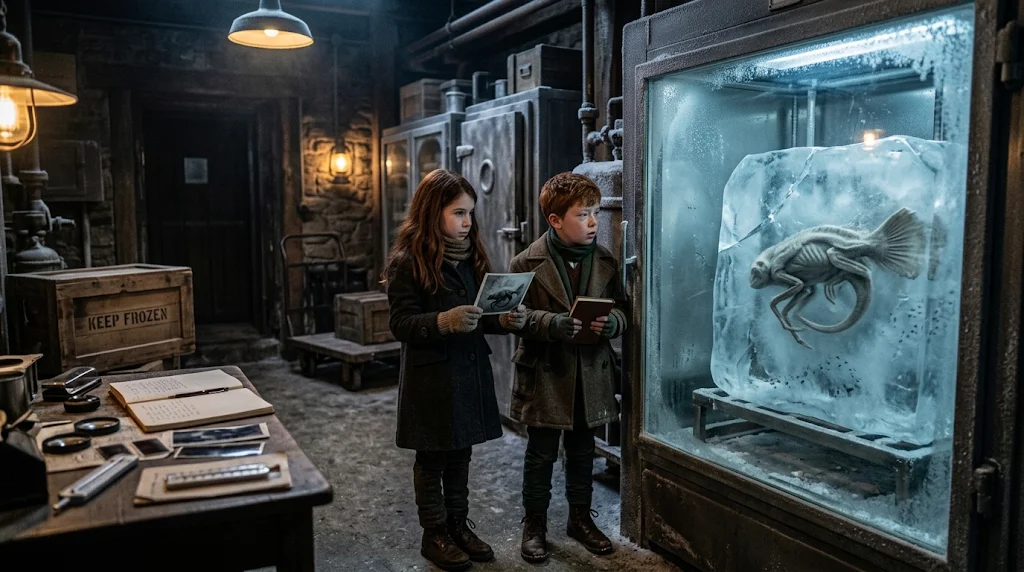
The children recognised the wooden crate immediately.
It belonged to the Miskatonic Polar Survey of 1931.
They had encountered it the previous winter, during the strange events surrounding the university icehouse.
The warning on its side had not changed.
KEEP FROZEN.
But the crate had finally been opened.
Inside a glass-fronted refrigerated cabinet lay a block of cloudy ice.
Something dark was embedded within it.
The creature was approximately the length of a large cat, but its shape was entirely unfamiliar.
Several narrow limbs folded against a ridged body. A curved appendage lay beneath it. At one end, something resembling a fan spread through the frozen material.
CHIBI: “That’s a very ugly lobster.”
DR WARD: “It isn’t a lobster.”
CHIBI: “A crab?”
DR WARD: “No.”
CHIBI: “Are you sure?”
Dr Evelyn Ward, the university’s comparative zoologist, looked at him.
WARD: “Fairly.”
Mara leaned towards the glass.
MARA: “Where’s its head?”
Ward smiled.
WARD: “That’s one of the questions we’re trying to answer.”
The specimen had been discovered in a frozen deposit on the Greenland coast during the 1931 expedition.
Its age was uncertain.
So was its anatomy.
And the dark markings preserved in the ice beside it resembled footprints that did not correspond to its visible limbs.
CHIBI: “Maybe it has more legs.”
Ward considered that.
WARD: “Possibly.”
Chibi looked astonished.
CHIBI: “Was that a scientific contribution?”
MERRICK: “Don’t let it go to your head.”
Then Mara noticed something in an old expedition photograph.
A hooked appendage appeared to be pointing in a different direction.
MARA: “It’s moved.”
Ward examined the picture.
WARD: “Not necessarily. The photograph may be reversed. The angle could be misleading.”
MARA: “But those bubbles are in the same place.”
Ward compared the details carefully.
WARD: “Then we’ll examine the original negative.”
Chibi stared at the frozen creature.
CHIBI: “What if it’s still alive?”
Nobody laughed.
Ward took the children into an adjoining office.
WARD: “Something can be preserved without being alive. Cold can slow decay, and some organisms tolerate remarkable conditions. But we cannot assume this one survives freezing.”
MARA: “Would thawing it tell you?”
WARD: “Perhaps. But thawing could also destroy evidence we cannot recover.”
Mara thought about that.
MARA: “Or kill it, if it really is alive.”
Ward looked at her.
WARD: “Exactly.”
The children had barely returned to the collection room when Mr Leonard Harrow arrived.
He was an administrator who regarded scientific discoveries chiefly as opportunities to attract wealthy benefactors.
HARROW: “When can we announce what it is?”
WARD: “When we know.”
HARROW: “Surely you have a theory.”
WARD: “Several.”
HARROW: “Then choose the most promising.”
CHIBI: “That’s not how guessing works.”
Mara elbowed him.
But Ward smiled.
Harrow was still asking when the specimen could be displayed when the lights went out.
A winter squall had damaged a power line.
The refrigeration machinery fell silent.
The specimen would remain frozen for some time inside its insulated enclosure, but Ward arranged to transfer it to a reserve cold room.
Mr Reed, the university icehouse keeper, arrived with two maintenance men.
REED: “You two again?”
CHIBI: “Hello!”
REED: “I should have retired.”
The heavy insulated case was loaded onto a trolley.
Mara and Chibi were instructed to remain behind a safety line.
They obeyed.
Then the trolley reached the old freight lift.
A wheel struck the raised edge.
The platform tilted.
Wood splintered.
The case slid sideways.
Reed’s coat became trapped against the railing.
WARD: “Stop! Nobody move the platform!”
One of the maintenance men struggled to hold the trolley.
The other reached for a rope.
Chibi noticed a wooden wheel chock lying against the wall.
CHIBI: “Mara! The block!”
Mara immediately called to Ward.
MARA: “The wheel chock! Stop the wheel!”
A maintenance man retrieved it from the safe side of the lift.
The wheels were secured.
The case stopped sliding.
Reed was freed.
Nobody had been seriously injured.
But a new fracture ran through the ice inside the case.
As the researchers carefully moved it along a safer route, Mara heard something.
Tick.
Then again.
Tick.
MARA: “Did you hear that?”
CHIBI: “It came from inside.”
Ward listened.
WARD: “Could be stressed ice cracking after the impact.”
CHIBI: “Could it be the creature?”
WARD: “We have no evidence of that.”
Chibi looked at the block.
CHIBI: “That’s becoming a familiar answer.”
By evening, power had returned and the specimen was safely refrigerated again.
Ward spread the expedition photographs across her desk.
The new fracture had exposed details previously hidden by cloudy ice.
The creature’s broad appendage appeared to occupy a different position.
And beneath its body, the small impressions formed a pattern that did not match its visible limbs.
MARA: “Perhaps another animal made those tracks.”
WARD: “Perhaps. If they’re tracks at all.”
CHIBI: “Maybe something was following it.”
Mara examined the photograph.
MARA: “Or maybe it was following something.”
Ward opened the 1931 field records.
The expedition had recovered the frozen specimen but left much of the surrounding deposit in Greenland.
They had not documented all the markings.
WARD: “We may be missing the most important part of the evidence.”
CHIBI: “Then you’ll have to go back.”
MERRICK: “An Arctic expedition is not quite like returning to a shop because you forgot your hat.”
CHIBI: “I wouldn’t forget my hat in the Arctic.”
Later, the children walked home through snowy Arkham.
CHIBI: “Everyone keeps calling it a specimen.”
MARA: “That’s what scientists call things they study.”
CHIBI: “But what if it’s somebody?”
Mara stopped.
MARA: “What do you mean?”
CHIBI: “What if it knows things? What if it doesn’t want to be cut open?”
They stood beside the frozen river.
MARA: “We don’t know whether it’s alive.”
CHIBI: “I know.”
He watched the dark water moving between the ice.
CHIBI: “But when you find something frozen, how do you know whether you’re rescuing it or letting it loose?”
Mara couldn’t answer.
Back at the museum, Dr Ward continued examining the original photographs.
The dark impressions appeared to extend beyond the frozen block recovered in 1931.
Whatever had made them might never have been inside the ice at all.
She wrote a note:
The specimen must not be interpreted in isolation from its original deposit.
Then she turned out the light.
Beyond the office wall, the refrigeration machinery hummed steadily.
Nothing moved.
Nothing emerged.
Nothing proved that the strange creature was alive.
The ice held.
For now.
THE MYTHVEIL QUESTION
CHIBI: “If something has been frozen for thousands of years, should we wake it?”
MARA: “First we’d have to know whether it’s alive.”
CHIBI: “And if it is?”
MARA: “We’d have to understand what waking it might do.”
CHIBI: “To us?”
MARA: “To it as well.”
Chibi thought for a moment.
CHIBI: “And if the ice is the only thing keeping everyone safe?”
Mara looked towards the university buildings.
MARA: “Then perhaps the most important discovery is knowing when not to break it.”
ENTER THE LONG WINTER
Ancient ice preserves evidence of worlds humanity never knew. But in Pulp Cthulhu, discovering an unknown life-form is only the beginning. The real question is whether we have the right to change what we do not yet understand.
The Miskatonic Files · StartPlaying
Shadows of Atlantis · StartPlaying
Mythveil Chronicles — Real TTRPG. Real story. Real choices. Real consequences.