
Languages: English · Deutsch · Italiano · Español
Pulp Cthulhu · The Long Winter · November 2026 · Week 4 · Stacy & Caelwyn
The City That Outlived Its Makers
December 1936. Antarctica.
CAELWYN: “I have a complaint.”
Stacy looked up from the expedition aircraft.
STACY: “Only one?”
CAELWYN: “It’s summer.”
STACY: “Yes.”
CAELWYN: “Then why am I freezing?”
STACY: “Because we’re in Antarctica.”
He considered that.
CAELWYN: “A thoroughly unreasonable continent.”
Beyond the aircraft, mountains of black rock rose from an almost endless expanse of ice.
They were looking for a smaller ruin associated with the extraordinary discoveries of Miskatonic University’s Antarctic expedition of 1930–31.
Professor William Dyer had described impossible fossils, ancient structures and a civilisation older than humanity.
He had also warned against returning.
Naturally, certain people had interpreted that warning as an invitation.
Stacy had joined as a mechanical specialist. Caelwyn had come to investigate the historical implications of the reports. Dr Miriam Voss, a geologist, accompanied them.
Their pilot, Rose Mercer, remained with the aircraft.
MERCER: “Six hours. If the wind strengthens, you come back.”
STACY: “Understood.”
CAELWYN: “Even if we discover something extraordinary?”
Mercer looked at him.
MERCER: “Especially then.”
The ruin stood on a wind-scoured mountain spur.
Its first wall appeared almost natural.
Dark stone. Angular fractures. Ice packed into every opening.
Then Stacy found a narrow joint that turned around a corner without changing width.
STACY: “That isn’t easily explained by a natural crack.”
Voss cleared away a little snow.
Beneath it lay a carved pattern.
Five radiating shapes surrounded a central form.
VOSS: “Someone made this.”
Caelwyn knelt beside her.
CAELWYN: “Someone.”
He looked towards the mountains.
CAELWYN: “Though perhaps not anyone we would recognise.”
They climbed onto a nearby ridge.
And stopped.
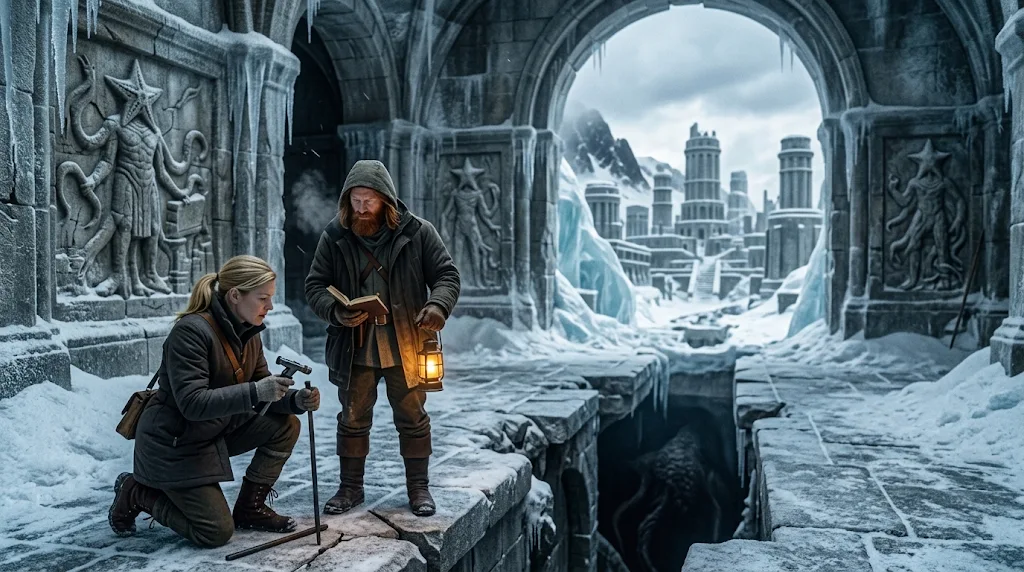
Beyond them, a vast city lay partly buried beneath Antarctic ice.
Enormous terraces stretched across the plateau.
Dark towers rose beside collapsed avenues.
Cylindrical buildings surrounded five-sided courtyards.
Some structures had entrances that no human body could comfortably use.
VOSS: “This is impossible.”
STACY: “No. It’s there.”
She handed Voss the binoculars.
STACY: “The question is who built it.”
Caelwyn stared at the city.
CAELWYN: “We’ve always imagined ourselves as the builders of the world’s first great civilisations.”
STACY: “Perhaps we were simply the first humans to do it.”
Inside the ruined outpost, the walls were covered with extraordinary carvings.
The figures had cylindrical bodies, fivefold arrangements of appendages, wing-like structures and star-shaped heads.
They resembled no human beings.
And yet they were shown building.
Examining instruments.
Gathering in groups.
Recording events.
Some appeared around smaller figures in scenes that might have been ceremonies or burials.
CAELWYN: “The Elder Things.”
STACY: “Or images of them.”
She studied a relief.
STACY: “We should be careful. Pictures aren’t the same as an explanation.”
CAELWYN: “Quite right.”
He examined a panel crowded with elaborate machinery.
CAELWYN: “Still, they appear to have possessed remarkable engineering skills.”
STACY: “Someone had to keep those machines working.”
CAELWYN: “And I imagine their scholars complained about the maintenance budget.”
She laughed.
But in the next chamber, the carvings became darker.
The Elder Things appeared beside immense, shapeless creatures.
Some of those creatures supported enormous stones.
Others extended temporary limbs to handle unfamiliar tools.
Their bodies changed from one panel to another.
VOSS: “What are they?”
Caelwyn opened his notes.
CAELWYN: “Shoggoths.”
According to the history suggested by the carvings and Dyer’s earlier reports, the Elder Things had engineered these extraordinarily adaptable beings for labour.
But the images did not end with obedient workers.
Later panels showed conflict.
Buildings collapsed.
The shapeless creatures confronted their makers.
VOSS: “They rebelled?”
STACY: “That may be how the Elder Things recorded it.”
CAELWYN: “And perhaps how they wished it remembered.”
He looked at the creatures carved into the wall.
CAELWYN: “If you create a being capable of learning, does that give you the right to command it forever?”
Stacy shook her head.
STACY: “Creation doesn’t automatically establish ownership.”
VOSS: “But those creatures may have killed their creators.”
STACY: “That doesn’t make them harmless.”
She pointed towards the Elder Things.
STACY: “And it doesn’t automatically make their creators right.”
They moved into the final gallery.
Here, the images changed again.
The ancient cities grew quieter.
Ice appeared around buildings.
The surface settlements emptied.
Figures retreated into mountains and subterranean passages.
VOSS: “The climate changed.”
Stacy nodded.
STACY: “That may be what this sequence depicts.”
CAELWYN: “They built an empire that lasted beyond anything we can imagine.”
STACY: “And even that couldn’t guarantee their survival.”
He studied a carved avenue disappearing beneath stylised ice.
CAELWYN: “The winter didn’t have to hate them.”
STACY: “No.”
CAELWYN: “It only had to make their home uninhabitable.”
For a moment, the enormous city beyond the walls seemed less like an alien nightmare.
And more like a place people had once loved.
Then something moved beneath the floor.
A deep, wet sound travelled through the stone.
Stacy stopped.
STACY: “Did you hear that?”
Voss examined the passage beyond the gallery.
Dark moisture glistened between the stones.
The floor was warmer than the surrounding ice.
VOSS: “Geothermal water?”
STACY: “Possibly.”
The sound came again.
This time, it resembled someone attempting to imitate a human voice.
Badly.
Caelwyn lowered his lamp.
CAELWYN: “I believe we’ve studied enough for today.”
They turned towards the exit.
And found the fissure in the floor filling with something black.
At first it resembled water.
Then a rounded shape rose from the surface.
Something resembling an eye appeared.
Then another.
They dissolved as quickly as they had formed.
Temporary limbs pushed against the ancient masonry.
The mass flowed forward.
VOSS: “What is that?”
Caelwyn stared.
CAELWYN: “Something the builders may have left behind.”
STACY: “Move. Now.”
The thing rose towards the stone crossing.
Its enormous body possessed no permanent shape.
It spread along the walls, forming structures that appeared and vanished as it moved.
A Shoggoth.
Whether it was following them or simply trying to pass through the chamber, Stacy could not tell.
Then a stone support shifted.
The crossing lurched.
Voss fell.
Her boot became wedged beneath a heavy slab.
VOSS: “I’m trapped!”
Stacy dropped beside her.
STACY: “Don’t pull. You’ll make it worse.”
Caelwyn raised his lamp towards the approaching mass.
CAELWYN: “How long?”
STACY: “Longer if you keep asking.”
She took a short iron surveying bar and a folding jack from her equipment.
Working quickly, she positioned the tools beneath the slab.
The stone moved.
Only slightly.
But enough.
STACY: “Miriam, pull your foot back. Now!”
Voss cried out.
Her boot came free.
Caelwyn caught her and helped her stand.
Behind them, the Shoggoth pressed against the masonry.
Stone cracked.
VOSS: “The photographs!”
Several camera plates lay scattered beside the fissure.
Stacy looked at them.
Then at the approaching mass.
STACY: “Leave them.”
VOSS: “But they’re proof!”
Stacy met her eyes.
STACY: “And you’re alive.”
They hurried towards the entrance.
Voss could barely walk.
Caelwyn supported her while Stacy guided them through the ruins.
At the final archway, an enormous stone slab rested against a broken support.
Stacy stopped.
CAELWYN: “What are you doing?”
STACY: “Giving us time.”
She positioned her iron bar beneath the damaged stone.
STACY: “Get Miriam outside.”
He hesitated.
STACY: “Go!”
Caelwyn obeyed.
Stacy pushed.
The support gave way.
The slab dropped across the passage with a thunderous crash.
Behind it, something immense struck the stone.
The barrier shuddered.
Stacy ran.
They emerged into the Antarctic sunlight.
Mercer was waiting beside the aircraft.
MERCER: “What happened?”
STACY: “Miriam’s injured. We need to leave.”
A distant crash sounded from inside the ruin.
Mercer glanced towards the dark entrance.
MERCER: “Earthquake?”
Caelwyn looked back.
CAELWYN: “I wish.”
Mercer asked no further questions.
Minutes later, the aircraft lifted from the snow.
Below them stretched the city of the Elder Things.
Its towers were broken.
Its avenues were empty.
Its makers had vanished.
And something they had created might still be moving beneath the ice.
On the return flight, Stacy examined the surviving photographs.
STACY: “We were inside a city.”
CAELWYN: “Yes.”
STACY: “An entire civilisation.”
CAELWYN: “Older than humanity.”
She looked towards the distant mountains.
STACY: “And we barely understood a single room.”
They preserved their records but withheld the precise route until another expedition could be planned with appropriate safeguards.
Some people would accuse them of secrecy.
Others would demand immediate access.
And somebody, inevitably, would insist that whatever technology the Elder Things had possessed ought to belong to humanity.
That worried Stacy more than she cared to admit.
Days later, as the expedition prepared to leave Antarctica, Caelwyn joined her outside the coastal base.
The polar sunlight shone across the frozen landscape.
CAELWYN: “Does it trouble you?”
STACY: “What?”
CAELWYN: “That humanity wasn’t first.”
She smiled.
STACY: “The Earth was old before we existed. We knew that already.”
CAELWYN: “But there were cities. Science. History. Perhaps even cultures and relationships we cannot recognise.”
STACY: “Yes.”
CAELWYN: “And now we know we weren’t the first.”
She looked towards the mountains.
STACY: “Being first isn’t what makes something worthwhile.”
He considered that.
CAELWYN: “Then what does?”
STACY: “What we choose to do with the knowledge we have.”
For a while, they stood in silence.
Then Caelwyn asked:
CAELWYN: “Do you think the Elder Things were monsters?”
Stacy remembered the carved histories.
The magnificent cities.
The Shoggoths.
The rebellion.
The terrible decisions.
And the final retreat beneath the ice.
STACY: “I think they were capable of extraordinary achievements and terrible mistakes.”
CAELWYN: “Much like us.”
STACY: “In some ways. But we shouldn’t make them human simply because that makes them easier to understand.”
He nodded.
CAELWYN: “An excellent point.”
She turned towards the expedition buildings.
STACY: “Come inside. You’re freezing.”
CAELWYN: “It’s summer.”
STACY: “Yes.”
CAELWYN: “Still unreasonable.”
Behind them, the mountains remained silent.
The city waited for no one.
And the winter had preserved a history that humanity had only just begun to discover.
THE MYTHVEIL QUESTION
CAELWYN: “If the Elder Things created the Shoggoths, did they have the right to control them?”
STACY: “Making something doesn’t automatically make it your property.”
CAELWYN: “And if their creations became dangerous?”
STACY: “Then protecting others would matter. But so would understanding why the conflict began.”
CAELWYN: “So what was the most important thing we discovered?”
Stacy looked towards the ancient mountains.
STACY: “That being the first, the oldest or the most powerful doesn’t determine whether your decisions are right.”
ENTER THE WORLD BEFORE WINTER
Before humanity, another civilisation built cities, shaped life and struggled against a changing world. In Pulp Cthulhu, the greatest discovery is not always a monster. Sometimes it is the realisation that we were never the centre of Earth’s history.
The Miskatonic Files · StartPlaying
Shadows of Atlantis · StartPlaying
Mythveil Chronicles — Real TTRPG. Real story. Real choices. Real consequences.