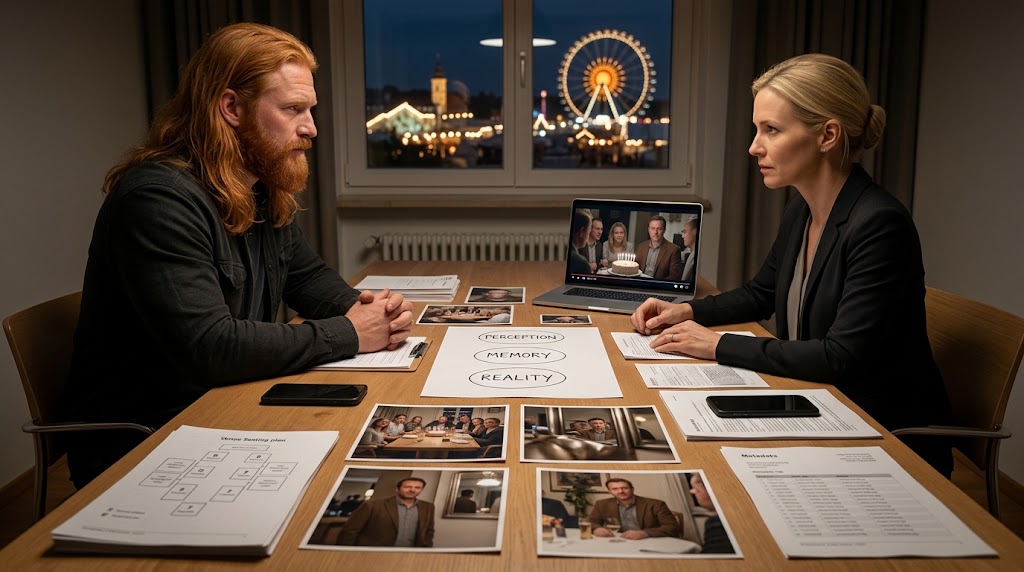
Caelwyn had drawn three circles on the paper.
STACY:
“No labels?”
CAELWYN:
“I thought you’d enjoy the suspense.”
STACY:
“I don’t.”
He points to the first.
CAELWYN:
“Perception.”
The second.
“Memory.”
The third.
“Reality.”
STACY:
“Which one lies?”
CAELWYN:
“That was going to be my question.”
STACY:
“All three can.”
The problem began with a photograph.
Seven people.
Six chairs.
Everybody remembered the seventh person.
Nobody could explain who he was.
At first, there were ordinary explanations.
People misremember.
People assume strangers belong because everyone else behaves as though they belong.
Crowds, alcohol, noise, distraction and expectation can all make memory less reliable.
No Unnatural required.
CAELWYN:
“So maybe the problem isn’t what they saw.”
STACY:
“Maybe.”
CAELWYN:
“It’s what they accepted.”
That changes the question.
Perfect invisibility would be difficult.
Erasing yourself from every eye, every photograph, every camera, every reflection and every memory would be difficult.
But perhaps something doesn’t need to become invisible.
Perhaps it only needs to become socially unquestioned.
CAELWYN:
“So the ideal concealment isn’t invisibility.”
STACY:
“Possibly not.”
CAELWYN:
“It’s belonging.”
STACY:
“Or the appearance of belonging.”
They check the records.
Six invitations.
Six confirmed guests.
Six place settings.
Six drink packages.
Six names on the booking.
No Peter.
No Martin.
No seventh guest.
But every photograph shows seven people.
Then they check the video.
The unknown man appears for thirty-two seconds.
He never blinks.
CAELWYN:
“That’s useful.”
STACY:
“Not enough.”
“Why?”
“People can go thirty-two seconds without blinking.”
“You enjoy ruining things.”
“Yes.”
She freezes the frame.
Behind the group is a polished metal panel.
The table is reflected.
The lights.
Sean.
Anna.
But where the unknown man should be—
nothing.
Caelwyn stops smiling.
CAELWYN:
“That’s more useful.”
STACY:
“Yes.”
Another photograph.
The man is seated.
His reflection is standing.
Different cameras.
Different owners.
Different timestamps.
Then the venue records.
Six booked seats.
But after the celebration, the system logged seven occupied positions around the table for almost three hours.
No seventh booking.
No manual override.
No edit.
CAELWYN:
“So when do we call it Unnatural?”
STACY:
“Not yet.”
CAELWYN:
“Stacy.”
STACY:
“Not yet.”
Because once you name the thing, the name begins shaping the investigation.
Ghost.
Entity.
Possession.
Projection.
Contamination.
People start collecting evidence that fits the label and overlooking what doesn’t.
So Stacy gives it the only name the evidence supports.
STACY:
“An anomaly.”
CAELWYN:
“That is painfully dull.”
STACY:
“It’s accurate.”
Then Caelwyn looks back at the three circles.
Perception.
Memory.
Reality.
CAELWYN:
“What if none of them is lying?”
STACY:
“Explain.”
CAELWYN:
“What if everybody really saw him?”
“Yes.”
“And everybody really remembers him?”
“Yes.”
“And he really occupied space?”
“Yes.”
“But not in the way our model says a person occupies space.”
Stacy looks at the photograph.
STACY:
“Possibly.”
That is the first real fracture.
Not proof of what the man was.
Not proof of why he was there.
Only this:
something was present that did not fit the normal agreement between perception, memory and physical record.
And then Caelwyn notices something else.
CAELWYN:
“When did the illusion break?”
STACY:
“When Mara counted.”
“Did anything change then?”
“No.”
“The man didn’t appear?”
“No.”
“The chair didn’t vanish?”
“No.”
“The photographs didn’t alter?”
“No.”
“So the only thing that changed…”
STACY:
“…was that someone stopped accepting the contradiction.”
Outside, people are still celebrating.
Music.
Glasses.
Laughter.
The world still looks completely normal.
Caelwyn looks at the photograph one last time.
CAELWYN:
“Maybe that’s the first sign.”
STACY:
“Of what?”
CAELWYN:
“Not seeing something strange.”
He looks at her.
“Realising something ordinary has been strange for a very long time.”
AND WHAT DO YOU THINK?
Human perception and memory constantly smooth over gaps and contradictions.
Usually that helps us function.
But in Delta Green, the Unnatural is real.
So what if something does not need to fool your senses perfectly — only to make your mind keep correcting the mistake for it?
At what point does an unlikely explanation become less reasonable than an impossible one?
Different views are welcome. Disagreement is welcome.
Spam, trolling and disrespect are not.
Enter a Delta Green world where the impossible does not always look impossible: