TITLE: Why Do Players Avoid Mysteries at the Table?
SUBTITLE: Players rarely avoid mystery itself. They avoid investigations that turn curiosity into an exam.
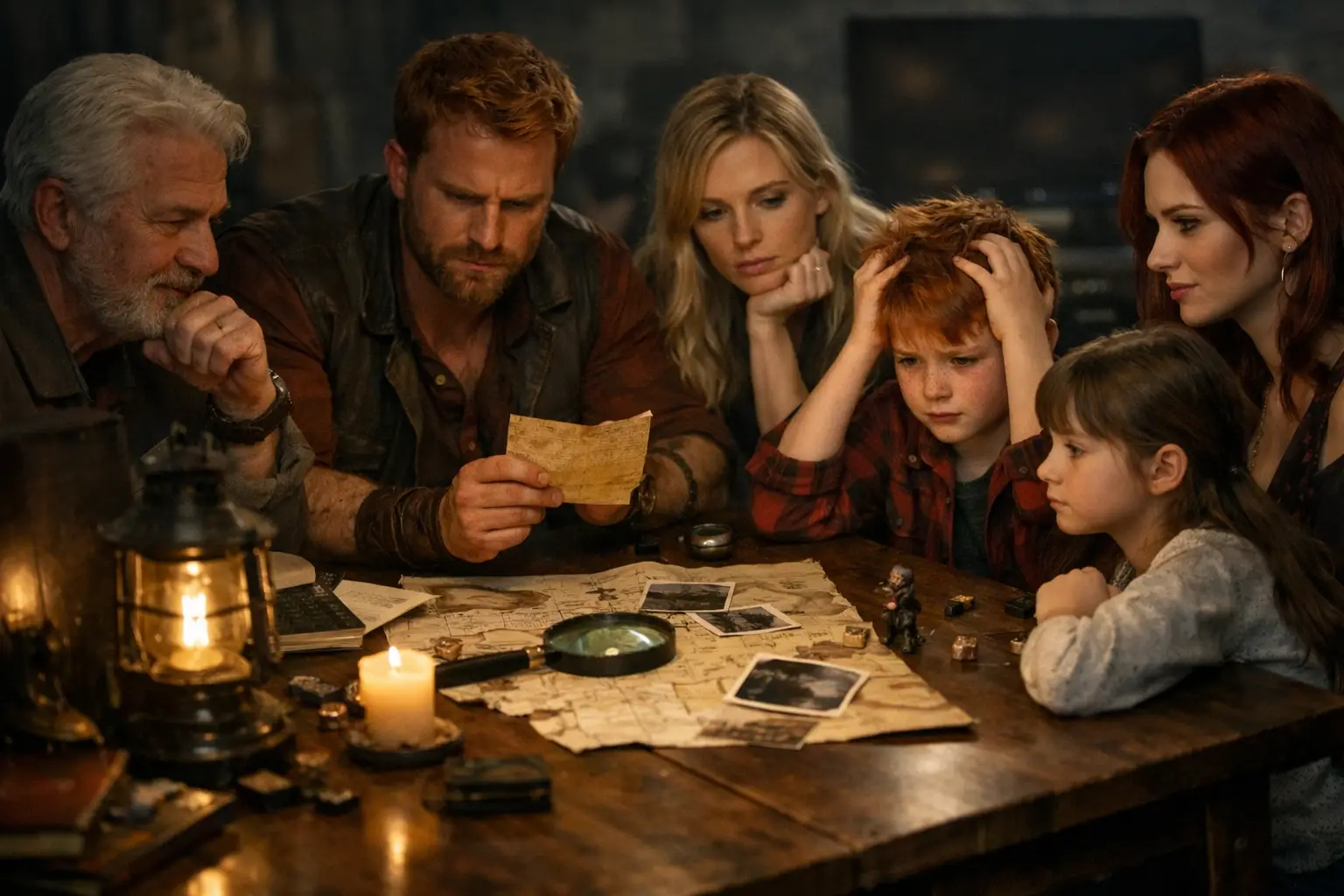
BODY: A sealed study. A dead magistrate. Rain traces black lines down the windows while four players stare at a letter opener as though it might be grading them.
Why do players avoid mysteries at the table?
Usually, they do not.
Crime fiction has filled bookshelves for generations. Mystery series keep audiences watching because one answer reveals the next question. Escape rooms persuade perfectly sensible adults to pay money to be locked inside a room with a box they cannot open. The X-Files made investigation, paranoia and incomplete answers into television ritual. Indiana Jones keeps chasing things that should probably have remained buried. The Name of the Rose builds murder, theology, politics and danger around the search for truth. Dan Brown has made a considerable career out of whispering that there is another door behind the door.
Human beings are not suffering from a shortage of curiosity.
So when a tabletop group becomes cautious around a mystery, the better question is not whether they dislike investigation.
It is what the table has taught them investigation means.
If previous mysteries taught them that one failed roll can hide the vital clue, one wrong theory can waste an hour, or one missed drawer can stop the story, then hesitation is rational.
The problem is not mystery.
The problem is a bad mystery contract.
Mystery should be an invitation, not an examination
A good mystery says:
There is something here worth knowing.
You can reach for it.
You may misunderstand it. You may make a terrible decision because of it. Other people may reach for it first.
But the world will answer.
A bad mystery quietly asks whether the players are clever enough to reproduce the Game Master’s private chain of reasoning.
That turns curiosity into performance anxiety.
Players stop asking, “What do we want to do?”
They start asking, “What does the GM want us to notice?”
Once that happens, agency has already begun to disappear.
The first repair is trust. Players should know that sensible investigation produces meaningful information. They do not have to discover the exact wording of the correct question or search the one drawer ordained by destiny.
Their job is to interpret the world and decide what to do.
The Game Master’s job is to give them enough world to interpret.
Learn from GUMSHOE: give them the core clue
One of the most useful lessons to borrow from GUMSHOE is simple: information required to continue an investigation should not be hidden behind one fragile roll.
If the investigator searches the relevant scene with the appropriate competence, give them the core information.
The roll can still matter.
It can determine how quickly they find it, how much detail they uncover, whether somebody notices them searching, whether they leave evidence behind, whether the archivist now wants a favour, or whether they discover the truth before the train leaves.
The clue remains.
The cost changes.
Suppose the investigators need to learn that a letter came from Marseille.
On a strong result they identify the printer, date the paper and notice a handwritten address on the reverse.
On a poor result they still identify Marseille, but only after spending half the night with a nervous printer who now knows exactly what they are asking about.
The investigation continues.
The situation has changed.
That is not the same as giving players the solution.
The Game Master should not say:
“This means you must go to the monastery.”
Give them the letter.
Give them the Marseille printer’s mark.
Give them the address.
Give them the same ink in Professor Bellamy’s diary.
Then stop.
What does it mean?
Who do they show it to?
Do they travel to Marseille? Watch the address? Break into the printer’s office? Ask a journalist? Follow the money? Compare the ink? Find out who bought that paper?
That part belongs to the players.
The core clue creates agency only when interpretation remains open.
Give players something they can use
Mysteries become stronger when clues are not merely facts but objects of action.
A photograph.
A railway ticket.
A diary with six pages removed.
A witness who refuses to enter a church.
A key with no obvious lock.
A ledger containing three names the characters recognise and one they do not.
A strange coin found in the dead man’s mouth.
Something has entered their hands.
Now they can do something with it.
Different characters may attack the same mystery from different directions. The historian knows where the seal came from. The socialite knows who would dare wear it publicly. The burglar knows which window could have been opened from outside. The veteran notices that the supposed witness describes the gunshot incorrectly. The occultist has seen that symbol before and wishes, rather urgently, that he had not.
None of them needs to be the table’s officially appointed Clever Person.
Their characters know different worlds.
Let that matter.
Learn from Pulp: a mystery needs a pulse
Investigation does not have to mean sitting around a table discussing documents for four hours.
Some groups love that.
Everyone else may eventually begin investigating the possibility of dinner.
The strongest mystery stories understand rhythm.
The X-Files moves between evidence, interviews, argument, pursuit, danger and revelation. Indiana Jones turns archaeology and puzzles into travel, traps, betrayal and action. The Name of the Rose allows intellectual investigation to exist beside murder, political pressure, forbidden spaces and physical danger.
Action is not a distraction from mystery.
Action can carry the mystery.
A useful rhythm is:
Discovery leads to decision. Decision creates action. Action provokes reaction. Reaction reveals new information. New information raises the stakes.
Professor Bellamy knows something about the expedition.
The characters go to his apartment.
It has been torn apart.
Someone escapes through the rear window.
They chase him.
If they catch him, perhaps they get his notebook and the name of his contact.
If they almost catch him, he may escape but lose a matchbook from the Hotel Alexandria.
If they fail badly, he keeps everything — but a terrified cab driver remembers where he was told to go.
If they make a complete disaster of it, they arrest the wrong man in public and the cult now knows exactly who is investigating.
The Hotel Alexandria has not vanished because somebody rolled badly.
But arriving there first, arriving late, and arriving while the cult is waiting for you are three very different situations.
Failure should change the investigation, not stop it.
That is also why failure does not mean “you win anyway.”
Success should preserve advantages.
Failure should cost time, position, secrecy, resources, trust or safety.
If the players make a spectacular mess, by all means send them into the desert.
Just put something in the desert.
Build an escalation spiral
Keeping the story moving is not enough.
A mystery should gather pressure.
The first clue answers one question and creates a larger one.
A strange symbol connects one murder to an archaeological expedition.
The expedition leads to a missing survivor.
The survivor reveals that somebody else has been collecting the artefacts.
Now a faction becomes involved.
The faction has a deadline.
The deadline becomes tonight.
And the train leaves in forty minutes.
The characters know more than they did three sessions ago.
They are also in considerably more trouble.
That is the escalation spiral.
Escalation does not simply mean adding more enemies.
Danger can increase. Time can shrink. The scale can widen. The consequences can become personal. The moral answer can become less obvious. Political actors can enter. A private secret can become public. A murder investigation can become a struggle over who is allowed to define the truth.
Success should escalate the story as well.
If the investigators save Bellamy, let that success matter.
Bellamy lives.
He can help them.
Then perhaps he says:
“You still don’t understand. I wasn’t the one they came to kill.”
The door opens under better conditions because the players succeeded.
But it still opens.
The players are not the only pieces on the board
This is where many mysteries become too small.
The investigators act.
The villain reacts.
The investigators act again.
That works, but a living world contains more than two sides.
The murderer acts.
The police act.
The university acts.
The church acts.
A newspaper acts.
A rival occult society acts.
And somewhere across town, a criminal organisation is smuggling antiquities through the harbour and has absolutely nothing to do with the murder.
At least not yet.
Every meaningful faction should be capable of action without waiting for the players.
Ask what that faction would be doing if the player characters did not exist.
Then ask what the players have changed.
Those are different questions.
The cult may already be preparing to move an artefact.
The police may already be under political pressure to arrest somebody quickly.
The university may already be destroying embarrassing records.
The smugglers may simply be trying to move stolen statues before customs changes shift.
Then the investigators enter the system.
Perhaps they mistakenly believe the smugglers are working for the cult and raid their warehouse.
They are wrong.
The artefact is not there.
In a linear mystery, this was a wasted scene.
In a living world, they have just attacked a criminal organisation that previously had no reason to care about them.
Now it does.
A wrong conclusion has created a correct consequence.
That is counteraction.
And not every counteraction has to come from the central antagonist. Rivals, allies, institutions and unrelated factions all possess interests of their own.
The world should not wait politely for the investigators to finish Scene Seven.
Let stories collide because of play
There is an important temptation to resist here.
Do not solve complexity by declaring that everything was secretly connected from the beginning.
Sometimes that is satisfying.
Do it constantly and the world starts to feel remarkably small. Every murderer works for the same conspiracy, every aristocrat knows the same cult and the baker is presumably waiting for his membership card.
A living campaign can do something more interesting.
Two stories can genuinely be unrelated.
Until something happens.
Imagine that for fifteen sessions the group has been following two separate stories.
In one, they are protecting Bellamy, the surviving witness to an occult murder.
In another, they have built a long relationship with Lady Harcourt, a political ally involved in a completely separate conflict.
The players decide that Bellamy will be safe at Harcourt’s country house.
It is a reasonable plan.
But somebody followed the driver.
Or an informant talked.
Or the murderer won access to information the players failed to protect.
He finds Bellamy.
Harcourt is there.
He kills them both.
At that moment the two stories become one.
Not retroactively.
There was no hidden master plan connecting Bellamy and Harcourt.
The connection is the murder itself.
Harcourt’s daughter wants to know who killed her mother.
Her political faction mobilises.
The police now have two bodies and a public scandal.
Harcourt’s enemies try to exploit her death.
Her friends start asking why the investigators brought Bellamy into her home.
And the murderer may slowly realise that eliminating one witness has accidentally started a political war.
Antagonists are allowed to make mistakes too.
That is what makes this kind of consequence powerful.
But the causality has to be real.
If the murderer had no way to discover Bellamy’s location, he should not magically appear at the house because the GM wants a dramatic scene.
That is not consequence.
That is teleportation wearing a trench coat.
The world must respect its own logic.
When it does, players can look back and see where events turned.
“We put Bellamy there.”
“We trusted the driver.”
“We never checked who was following us.”
Now the campaign possesses history.
Story A and Story B were separate until play created Story C.
That is emergence, not retcon.
Some of the best connections in a long campaign do not exist before Session One.
They are made at the table.
Let players become better investigators
A good mystery campaign should teach its players how to investigate inside that particular world.
Early on, give them tangible clues. Restate important facts naturally. Show them that sensible experimentation produces information and that a wrong theory does not end play.
Let different forms of competence work.
Over time, the players begin asking better questions.
Who knows this name?
Who benefits if this document disappears?
Where did the money come from?
Who had access?
What is missing?
What happens if we do nothing and simply watch?
That development is a reward in itself.
The mystery does not become harder because the Game Master hides clues more effectively.
It becomes richer because the players become capable of seeing more relationships between the clues they already have.
Eventually you can place a photograph, a railway timetable and the name of a dead priest on the table and watch somebody sit forward.
“Wait.”
That moment has been earned.
Solving the mystery should change the world
The answer to “Who killed the magistrate?” can end a case.
It should not necessarily end the story.
Once the players discover the truth, the truth becomes something that exists inside the world.
Who knows it?
Who believes it?
Who fears it?
Who can suppress it?
Who can profit from it?
Who will distort it?
What do the characters do with it?
Expose the murderer?
Protect them?
Blackmail them?
Trade the information?
Burn the evidence?
Give it to a rival faction?
In a living-world approach such as Rexborn, discovery is not a finish line. It changes relationships, Influence, behaviour and memory. Factions act on what they know. Rumours reshape what people believe they know. The consequences can outlive the original investigation.
A solved mystery should be capable of ending a case without ending the story.
A failed investigation should be capable of creating a story that did not exist before.
That is where mystery stops being a chain of clues and becomes part of a living campaign.
So why do players avoid mysteries at the table?
They often do not.
They avoid waiting for permission to continue.
Give them the core clue.
Let them decide what it means.
Give them more than one way forward.
Let action carry investigation and investigation create action.
Let success reward them.
Let failure cost them without killing the story.
Escalate the pressure.
Let antagonists counteract.
Let unrelated factions continue pursuing their own lives.
And when two stories collide because of something that actually happened in play, let the collision matter.
Then the players are no longer solving the Game Master’s plot.
They are investigating a world.
Give them a mystery worth touching — and make sure the world moves when they do.
MYTHVEIL
We create worlds people want to live in.
Stories that remember. Worlds that change.
Read: https://mythveilchronicles.com/
Play: https://startplaying.games/gm/dunchan
Watch: https://www.youtube.com/@MythveilChronicles
Support: https://www.patreon.com/MythveilChronicles
Collaborate: https://www.linkedin.com/in/francisco-jos%C3%A9-z-b05aab371/
SEO_TITLE: Why Players Avoid Mysteries in TTRPGs — and How to Keep Investigation Moving
SLUG: why-players-avoid-mysteries-at-the-table
META_DESCRIPTION: Players do not dislike mysteries. Learn how core clues, GUMSHOE principles, pulp action, meaningful failure, escalation, counteraction, factions and living-world consequences keep TTRPG investigations moving.
KEYWORDS: TTRPG mystery, RPG investigation, mystery campaign, GUMSHOE clues, pulp RPG, investigative roleplaying, meaningful failure, escalation spiral, faction play, emergent narrative, living world RPG, Rexborn Framework, Mythveil
SUMMARY: Players rarely avoid mystery itself. They withdraw when investigation feels like an exam where one failed roll or wrong theory can stop the story. Strong mystery design gives players core information, leaves interpretation and choice in their hands, keeps investigation moving through action, allows failure to change circumstances rather than halt play, escalates pressure, lets multiple factions act independently and allows separate storylines to collide organically through play.
CTA_CAMPAIGN: KEINE
CTA_SEMINAR: https://startplaying.games/adventure/cmqzlufe80063jj04bafujpq0
CTA_COLLABORATION: https://www.linkedin.com/in/francisco-jos%C3%A9-z-b05aab371/
CTA_PATREON: https://www.patreon.com/MythveilChronicles