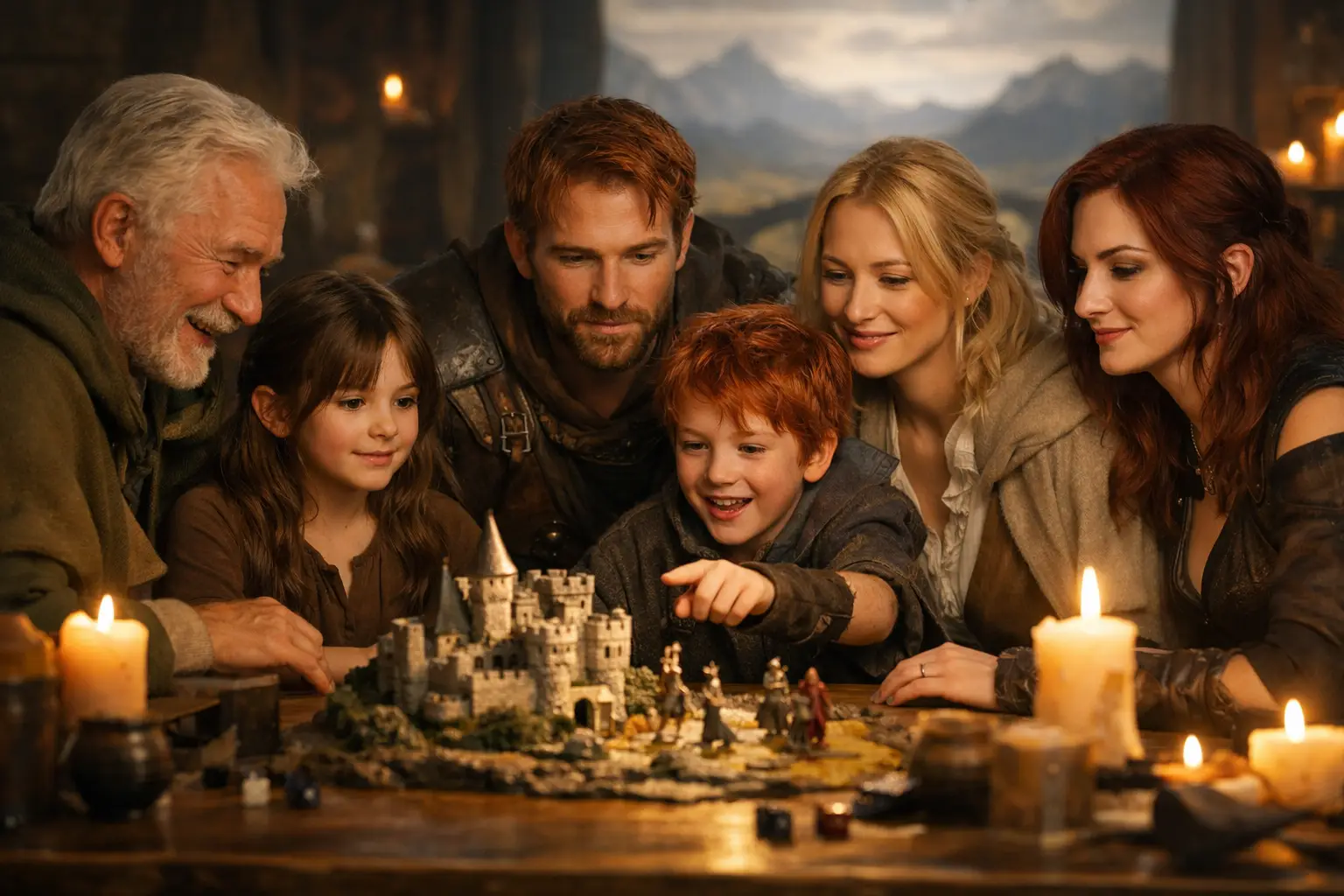
Narrative Roleplaying Makes Worlds Remember
How Bardic Resonance, Influence and reaction turn player actions into history
The duke is dead.
Not because the adventure needed a corpse in the ballroom. The players exposed him three sessions ago. They believed that if the truth became public, the city would finally be able to deal with what he had done.
Technically, they were right.
Unfortunately, truth is only the beginning of what people do with an event.
In one tavern, a drunken local is already telling anyone who will listen that the evidence was forged. He did not see most of it. He does not know the players. He does, however, possess the confidence traditionally granted to men who know almost nothing.
For the moment, that hardly matters.
Then the story moves.
Someone repeats it.
Perhaps the parish priest hears a version through his congregation. Perhaps the duke’s daughter hears that doubts are spreading. Perhaps a workers’ organisation hears something entirely different: that the old family is already rewriting what happened.
Now people with interests, relationships and Influence have the story in their hands.
They act.
Others push back.
The players return to the city a week later and find a sermon being quoted in the market, new notices nailed beside the gates and two factions blaming each other for unrest that did not exist when the group left.
Nobody reset the world while the adventurers were away.
The story moved.
That is the point at which narrative roleplaying becomes something more interesting than delivering a plot.
> An action ends when the players stop acting. Its resonance may only be beginning.
Narrative is not the event
The word narrative is used so broadly in roleplaying that it can mean almost anything.
A campaign with a lot of dialogue is called narrative.
A rules-light game is called narrative.
A Game Master who enjoys dramatic description is called narrative.
None of those things are necessarily wrong, but they miss something more useful.
An event happens.
Narrative is what people decide that event means.
The players expose Duke Harrow.
That is the event.
To the duke’s daughter, outsiders destroyed her father.
To the workers he exploited, somebody finally challenged a man everyone had been afraid to touch.
To the city magistrates, the players may have created a constitutional nightmare.
To the church, perhaps the immediate concern is not whether the duke was innocent but whether private actors have begun deciding who may rule.
To a rival noble house, the whole affair may simply look like an opportunity.
One event.
Several meanings.
And those meanings are not decorative commentary around the real story.
People act because of them.
> Events happen once. Meaning keeps happening.
This is where Bardic Resonance begins.
Bardic Resonance asks what an event becomes
At Mythveil, Bardic Resonance is not simply the idea that people gossip.
It asks a more useful question:
> What does this event become as its resonance moves through the world?
Nobody perceives an event from nowhere.
People see pieces.
They hear reports.
They interpret those reports through loyalty, profession, religion, fear, class, ambition, memory and previous experience.
Then they tell somebody else.
The result is a little like the children’s game of passing a message along a line, except adults are usually much better at altering stories deliberately.
A servant says the duke looked terrified.
A soldier says the players humiliated him in front of his own household.
A sympathiser says the evidence was dubious.
A political ally quietly upgrades that to:
“There are serious questions concerning the evidence.”
A priest says:
“No man should be condemned without lawful judgement.”
By the time the statement reaches another district, people are saying:
“Even the church believes Duke Harrow was framed.”
No supernatural force changed the information.
People did.
> Stories change as they pass through people because people are not neutral channels.
Some distort because they misunderstand.
Some simplify.
Some remember badly.
Some are frightened.
Some want to protect somebody.
Some recognise immediately that a particular version is useful.
That difference matters.
A rumour is not powerful merely because it exists
This is where Bardic Resonance needs the Influence Game.
It does not matter very much that the village idiot believes the duke was innocent if nobody with any ability to affect the situation ever hears him.
Truth does not automatically create power.
Neither does nonsense.
A story needs somewhere to go.
Sometimes that route is concrete.
The fool says it in the tavern.
A known servant of the duke is sitting three tables away.
He hears it.
No simulation is required. The connection happened in the world.
But we do not want to define every drinker in every tavern, every parishioner, every clerk, every cousin and every servant merely so information can travel.
That would turn a campaign into municipal administration with dice.
Influence lets us abstract the parts of the social world that exist beyond the immediate camera.
Suppose the parish priest has Religion 6, giving him a 60 per cent Influence chance within that sphere.
He was nowhere near the tavern.
But the town already contains a parish, parishioners, confession, church gatherings, households and the ordinary social traffic that comes with them.
A 60 per cent check tells us whether this story penetrates that sphere strongly enough to reach him.
Perhaps a parishioner mentions it after Mass.
Perhaps someone brings it to confession.
Perhaps a worried family asks his advice.
The precise route only needs a name if it later matters.
The important thing is that the story did not magically teleport to the priest. His Influence represents the chance that events moving through that part of society reach him.
> Direct contact tells us that the story arrived. Influence tells us whether the wider social field carries it further.
And if the roll fails?
He does not hear it.
Not yet.
The world does not rearrange itself because the Game Master would find the next scene convenient.
At the table, two Influence rolls are enough
This can become extremely complicated if we allow it.
So do not.
For ordinary table play, the light version needs only two questions.
Did they hear it?
Can they act on it successfully?
That is enough.
The first Influence roll determines whether an indirectly travelling story reaches a relevant actor or faction.
If the priest has Religion 6, that is 60 per cent.
Success: he hears a meaningful version of the story.
Failure: he does not.
If he witnessed the event directly or an established NPC tells him directly, skip this roll. He already knows.
Then we ask what the information means to him.
That part should not usually be random.
His biography, beliefs, faction, interests and current situation tell us what he makes of it.
Perhaps the priest thinks Duke Harrow was guilty.
He also believes that public order is beginning to collapse.
So his reaction is not:
“The duke was innocent.”
It is:
“Whatever his crimes, this city cannot survive if anyone with enough swords can appoint themselves judge.”
Now he wants to act.
Second Influence roll.
Can he make that interpretation matter?
Perhaps he preaches about lawful authority.
Religion 6.
Sixty per cent.
Success means the sermon produces meaningful movement through his sphere.
Failure does not necessarily mean nobody heard him speak. It means the action did not achieve enough leverage to alter the relevant world state.
And if somebody actively resists him, the second roll becomes opposed.
> Hear it. Act on it. Done.
That is enough for a human Game Master to run the system without needing a second career in network analysis.
Influence begins when people start playing the story against one another
Now the interesting part begins.
The priest has successfully pushed his interpretation.
The duke’s daughter hears about the sermon.
For her, this is useful.
She says:
“Even the church is questioning what happened to my father.”
That is not quite what the priest said.
Welcome to Bardic Resonance.
The workers’ faction hears what she is doing.
They counter:
“The church is helping the nobility bury the duke’s crimes.”
Now different actors are throwing versions of the same event back and forth, supporting some, blocking others and redirecting meaning towards their own interests.
This is the Influence Game.
> Bardic Resonance puts the story into motion. The Influence Game begins when actors start amplifying it, redirecting it, supporting it or trying to stop somebody else from doing the same.
Influence is not merely the ability to spread a story.
It is also the ability to resist somebody else’s resonance.
A faction may attempt to:
legitimise a version,
discredit another,
carry a rumour into a new social sphere,
stop a publication,
convince an institution,
mobilise supporters,
isolate an opponent,
support somebody else’s interpretation,
or redirect the whole argument towards a different question.
Now Influence rolls and opposed rolls matter.
The faction may have enormous capacity and still fail.
A weaker group may succeed at precisely the right moment.
Two sides may both succeed and polarise the city instead of producing a clear winner.
> Influence measures capacity. The roll determines what that capacity achieves in this moment.
The world does not change because a faction wanted something.
It changes because somebody acted and the game determined whether that action worked.
A story needs reach, but reach does not make it true
This distinction matters enormously.
The village fool may accidentally know the truth.
The priest may sincerely believe something false.
If only one possesses a pulpit, those facts do not have equal social consequences.
> Truth and Influence are separate resources.
Likewise, an influential story does not need an influential origin.
The fool may begin it.
What matters is whether the story can enter a social field in which somebody can use it.
A supporter of the duke might hear a circulating rumour and recognise its value.
He does not need to trust the original speaker.
He only needs to think:
People might believe this.
Then he changes it.
Funds it.
Repeats it.
Passes it to someone with greater legitimacy.
A story that began as:
“I reckon those strangers forged the evidence.”
may become:
“Residents have raised concerns.”
Then:
“Serious doubts remain.”
Then:
“Reliable witnesses contest the accusations.”
And finally:
DUKE HARROW — MARTYR OF GREYBRIDGE.
> A story can gain authority while losing any memory of where it came from.
That is not an exception to narrative roleplaying.
It is one of the ways societies actually behave.
Factions react to what they believe, not to the Game Master’s truth
This is where faction play becomes much richer.
A faction does not need perfect information to act.
It needs a world view, goals, resources and enough information to form a judgement.
One faction knows the truth.
Another believes a rumour.
A third knows the rumour is false but finds it useful.
A fourth does not care what happened and sees only the opportunity created by everyone else’s argument.
Then they act.
This is why a living campaign does not require every faction to understand every other faction.
They can affect one another without agreeing on reality.
> The world does not only react to what happened. It reacts to what people believe happened.
And once people act on those beliefs, even a false interpretation can create true consequences.
The duke was corrupt.
The rumour that he was framed is false.
The priest hears it.
The daughter amplifies it.
People gather.
The gates are armed.
Trade slows.
A rival house offers support.
Now the economic and political consequences are completely real.
The lie did not become true.
It became causal.
Bardic News closes the loop
There is still one vital step missing.
Suppose we simulate all of this beautifully between sessions.
The priest preaches.
The daughter exploits it.
The workers counter.
The magistrates panic.
Two Influence rolls succeed, one fails and another is opposed.
Wonderful.
If all of that remains inside the Game Master’s notebook, it is barely part of the campaign.
The players need the changed world returned to them.
That is Bardic News.
> Bardic Resonance is what the world makes of an event. Bardic News is how the players experience what the world has made of it.
Do not simply tell them:
“Public opinion has shifted against you.”
Let the world speak.
A new notice appears at the gate.
A priest delivers a sermon.
Two people argue in a market.
A merchant refuses service.
A worker buys the characters a drink.
A pamphlet shows a grotesque caricature of them.
A song has acquired a verse that was definitely not there last month.
The players hear:
“Everybody knows what you did to Duke Harrow.”
And somebody at the table says:
“That is not what we did.”
Excellent.
Now the world is talking back.
> The players know what they did. Bardic News shows them what the world believes they did.
Different settings should use different forms.
In Warhammer, news may travel through pamphlets, sermons, taverns, criers, songs and market gossip.
In Delta Green, it may be an internal memo, police report, news broadcast, podcast, colleague or conspiracy forum.
In Vampire, it may be Elysium gossip, Harpy judgement, invitations, social exclusion and whispers carried by retainers.
In science fiction, perhaps newsfeeds, propaganda, military reports or corporate messaging.
The world should report itself in the language and media of the world.
Bardic News is not a neutral summary.
It is another piece of that world.
Bardic News creates the next player action
This is why the system is not merely a sophisticated reputation tracker.
Bardic News generates play.
The players hear the priest’s sermon.
Now they can confront him.
Ignore him.
Convince him.
Publicly challenge him.
Find out who supplied his information.
Use the workers’ faction as a counterweight.
Publish the duke’s actual records.
Approach the daughter.
Exploit their new reputation.
Leave town and allow the conflict to develop without them.
The changed world offers new action potential.
Then the players act.
And their new action enters a world already changed by everything that came before.
> Every new action enters a world already changed by the actions that preceded it.
That is where memory stops being a database and becomes causality.
A world remembers because yesterday becomes one of today’s causes
Imagine this continuing for months.
The players expose the duke.
A rumour spreads.
The priest reacts.
The daughter uses his reaction.
The workers oppose her.
The city magistrates intervene.
The players support the workers.
A rival noble house then backs the daughter because it fears a workers’ victory more than it ever cared about Harrow.
A food shortage follows unrest at the gates.
A neighbouring town sends aid and gains political leverage.
Three years later, the original exposure of Duke Harrow may barely be discussed.
Yet the alliance between those two towns exists because of it.
So does the workers’ council.
So does the feud between two noble families.
So does the annual procession commemorating the “Greybridge Martyrs”, despite the players still insisting that nobody was martyred and there were only four of them.
This is structural memory.
> Memory becomes history when yesterday’s consequences become part of today’s causes.
Eventually, the world may remember an event even when most people have forgotten how the original story began.
The argument becomes a custom.
The emergency law becomes ordinary law.
A temporary alliance becomes tradition.
A ruined building remains empty.
A child grows up hearing a family version of the event.
A faction founded in reaction to the crisis is now part of the political landscape.
The past is no longer merely remembered.
It is embedded.
> The world remembers because it never fully returns to the state it had before the players acted.
Human-scale play and deeper AI simulation
All of this can be played without software.
At the table, keep it simple.
For each important resonance:
Did the relevant actor hear it?
Influence roll.
Can they successfully act on it?
Influence roll or opposed roll.
Then update the world and show the result through Bardic News.
That is enough.
A computer or AI simulation assistant can take the same logic further between sessions.
It can follow several versions of the same event.
Track which factions know which version.
Model different interpretations.
Resolve multiple Influence actions and counteractions.
Track delays.
Notice when one faction’s move creates an opportunity for another.
Carry consequences into NPC relationships, institutions and future situations.
The important point is that AI does not replace the model.
It increases its resolution.
> Without AI, simulate the movements that matter. With AI, you can simulate more of the world that produced them.
And the AI should not simply invent whatever would make the next episode dramatic.
It works from the researched world, existing factions, NPCs, Influence, previous events and established relationships.
The stronger the world model, the less it needs to guess.
The Game Master still judges what becomes true.
AI assists simulation.
It does not become the author of reality.
The loop that becomes history
The complete movement is surprisingly simple.
A player acts.
People perceive only parts of that action.
They interpret it.
Bardic Resonance turns the event into stories.
Influence determines which relevant actors hear those stories.
Those actors decide what the stories mean to them.
They act.
Influence rolls and opposed rolls determine what succeeds.
The world changes.
Bardic News returns that changed world to the players.
The players interpret what they see.
Then they act again.
And again.
And again.
> Player Action → Bardic Resonance → Influence → Faction Action and Counteraction → Changed World → Bardic News → New Player Action
After enough turns, nobody needs to manufacture a history.
The campaign has one.
The Five Traitors of Greybridge
Years later, the group enters a town they have never visited before.
On the wall beside an inn hangs an old print.
The colours have faded.
A heroic-looking Duke Harrow stands beneath a broken banner while shadowy figures surround him.
Across the bottom, in large letters:
REMEMBER HARROW — MURDERED BY THE FIVE TRAITORS OF GREYBRIDGE
The players stare at it.
Finally one says:
“There were four of us.”
Quite.
The world remembered.
Not accurately.
Not fairly.
Not in the form the players would have chosen.
But the event survived.
It became argument.
Argument became Influence.
Influence became action.
Action created reaction.
Reaction created new choices.
Those choices created institutions, loyalties, grudges, laws, stories and places that did not exist before.
That is what narrative roleplaying can do when a world is allowed to answer.
The players do not merely experience the story.
They disturb the world.
The world interprets the disturbance.
Then it sends something back.
> Players create events. Bardic Resonance turns them into meaning. Influence turns meaning into action. Bardic News returns the changed world to the players. Repeated long enough, that cycle becomes history.
And that is how a fictional world remembers.
MYTHVEIL
We create worlds people want to live in.
Stories that remember. Worlds that change.
Read: https://mythveilchronicles.com/ Play: https://startplaying.games/gm/dunchan Watch: https://www.youtube.com/@MythveilChronicles Support: https://www.patreon.com/MythveilChronicles Collaborate: https://www.linkedin.com/in/francisco-jos%C3%A9-z-b05aab371/