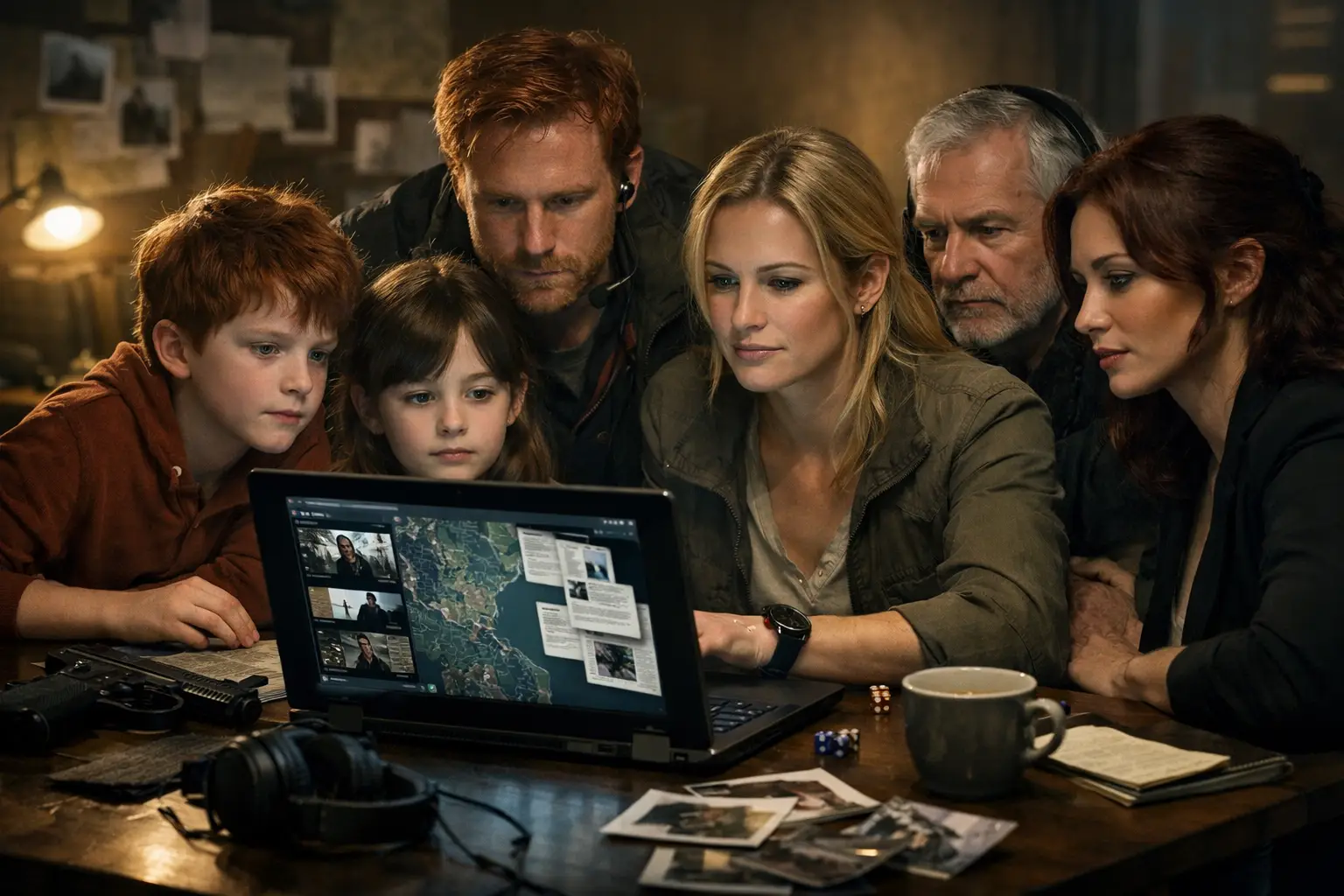
What Makes a Delta Green Online Campaign Last?
Impossible Landscapes, altered records, and the horror of a past that refuses to remain finished.
The briefing arrives at 23:17.
A voice none of the agents recognises gives them an address, a name, and one instruction: do not involve local law enforcement. Then the call ends.
Across several time zones, a handful of people fall silent behind their screens. One begins searching the address. Another writes down the caller’s exact phrasing. A third checks whether the number can be traced and discovers that the phone has no record of receiving the call.
Months later, the team reopens the archived briefing.
The address is unchanged. The voice is the same. The instruction remains.
The timestamp now reads 1995.
One of the agents was twelve years old in 1995.
Their name is already in the attachment.
A Delta Green online campaign lasts when an operation does more than produce another closed case. It leaves behind records, relationships, lies and personal damage that remain capable of changing what the agents believe happened.
Impossible Landscapes makes that principle especially dangerous. Arc Dream Publishing’s campaign stretches four operations across decades and turns the King in Yellow into an assault on perception, identity and reality itself. The agents do not simply investigate history. They enter a history that is still editing itself.
A world that remembers is disturbing. A world that can revise what it remembers is something else entirely.
The situations used here are spoiler-light examples of the kind of play the campaign can support, not summaries of its published operations.
Record One: The briefing needs a stable surface
Surreal horror does not begin by making everything incomprehensible.
It begins by giving the investigators something solid enough to lose.
The opening briefing should therefore be clean. There is a place to visit, a person to find, an incident to contain and an official reason the team has been selected. The agents may distrust the source, but they understand the task. They can form a plan, divide responsibilities and decide what risks they are prepared to accept.
That clarity is not the enemy of horror. It is the surface against which horror becomes visible.
If every witness lies, every document changes and every corridor leads somewhere impossible from the first minute, the players cannot investigate. They can only wait for the next strange image. A campaign of pure instability quickly becomes less frightening than a badly organised filing cabinet.
Impossible Landscapes is powerful because the ordinary procedures of investigation continue to matter even as their foundations weaken. Agents still interview witnesses, compare dates, read reports, inspect rooms and argue about jurisdiction. They remain professionals attempting to establish a sequence of events.
The terror begins when the sequence establishes them in return.
A good Handler protects that contrast. The surreal elements do not replace investigation. They infect it.
The report is useful, but contains a sentence nobody remembers reading.
The photograph is clear, but one face belongs to someone who should not be present.
The floor plan is accurate, except for the room the agents have already entered.
Each contradiction gives the players something to do. They can compare copies, question sources, preserve evidence, challenge a superior or decide that one version is safer than another. Mystery remains active because uncertainty creates choices rather than removing them.
Record Two: The case becomes history
A single Delta Green operation can be brutal and unforgettable. A campaign becomes a record of erosion.
The agents survive the first assignment. They produce a convincing lie, return compromised evidence, repair what they can at home and tell themselves that the incident is over. The final report gives the operation a number. Someone marks it closed.
Then time passes.
That passage matters in Impossible Landscapes. The campaign’s scale allows an event to become part of the agents’ biographies before it returns as part of the threat. What was once a room, a witness or a damaged object becomes an old memory with emotional sediment around it. The players no longer remember only what happened. They remember who their agents were when it happened.
That is where long-form horror gains depth.
An agent’s Bond is not meaningful merely because the Handler can threaten it. It becomes meaningful when the agent begins changing the relationship in order to protect the lie.
At the beginning of the campaign, Agent Reyes has a daughter who believes her mother inspects contaminated buildings for the government.
Several operations later, the daughter no longer asks where the bruises came from.
Not because she accepts the explanation.
Because she has learned that questions make her mother leave the room.
Nothing supernatural is required in that scene. The unnatural has already done its work by changing how love behaves.
A lasting Delta Green online campaign preserves those changes. Notes do not record only injuries, clues and SAN loss. They record promises, absences, evasions, altered routines and the small decisions by which agents keep ordinary life at a distance. The campaign remembers what the agents were trying to preserve, and therefore understands what each new operation may cost.
Record Three: History begins to disagree
Online play gives the Handler an unusual advantage: the campaign naturally produces several archives.
There is what everyone heard in the shared call.
There is what individual agents received privately.
There is what the official report claims.
There is what each player remembers.
And somewhere beneath them is what may actually have happened.
These versions should not be treated as competing piles of trivia. They are different forms of authority.
A private message can make one agent the sole witness to an impossible detail. An internal memo can turn the team’s success into negligence. A saved audio file can contradict the recap everyone accepted three months ago. Two players can receive slightly different versions of the same document and spend half a session deciding whether the difference is deliberate, supernatural or administrative incompetence.
The last possibility should never be dismissed too quickly. Bureaucracy remains one of humanity’s most reliable methods of producing cosmic dread without requiring a cosmic entity.
Used carefully, these records let Impossible Landscapes attack certainty without attacking trust at the table.
That distinction is essential.
The Handler may destabilise the fiction. They must not destabilise the players’ confidence that the game is being run fairly.
A player can discover that an in-world document has changed. They should not be told that they simply remembered it incorrectly when the Handler has secretly replaced the file without any structure or purpose. Confusion becomes horror only when the group can investigate it. Otherwise it is merely the person controlling the information refusing to admit what they did.
Mythveil therefore keeps emotional and procedural anchors stable even when history is not. Character decisions remain recorded. Safety agreements remain clear. Important clues remain obtainable through more than one route. Changes possess consequences that can be observed, resisted or interpreted.
The world may be lying. The game must not.
Record Four: The agents find themselves in the evidence
There is a point in many investigations when the case stops being an external object.
The agents recognise a name.
A witness recognises them.
A file contains their signature.
A photograph places one of them in a room they have never seen.
In an ordinary conspiracy campaign, this might reveal a forgotten operation, an impostor or an institutional betrayal. In Impossible Landscapes, the more disturbing possibility remains open: the evidence may not be exposing a hidden past. It may be creating a past that now exerts pressure on the present.
This changes how character history functions.
The character sheet is no longer only a record of who the agent was before play. It describes who the agent currently believes they were.
A military posting, a former partner, a childhood address or an unexplained gap in employment can become contested territory. The Handler does not need to overwrite these details for shock value. That would reduce the player’s contribution to a trap. The deeper move is to let the campaign ask what happens when the world produces an incompatible version.
Does the agent trust their memory?
Do they trust the document?
Do they call the person who should be able to confirm the truth?
What happens when that person remembers both versions?
The horror is not simply that the past may have changed. It is that relationships, duties and guilt can survive the change.
An agent may find evidence of a decision they do not remember making and still feel responsible for its consequences. Another may preserve a photograph because it proves a friend once existed, even though every official record now denies that person’s life. The team may become the only community capable of confirming its own shared history.
The group is no longer merely solving the mystery.
It is trying to preserve an account of having survived it.
Record Five: Time must not remove agency
A campaign about unstable reality can easily become a guided descent in which the players witness impressive horrors but cannot meaningfully alter anything.
That is not inevitability. It is spectatorship wearing a yellow mask.
Delta Green may confront agents with loss they cannot prevent. Impossible Landscapes may expose them to structures larger than reason, chronology or institutional power. None of that requires the Handler to remove choice.
When time becomes unreliable, agency changes shape.
The agents may not control which version of the past becomes dominant. They can still decide which memory they protect, which person they continue to recognise, which document they preserve, which lie they refuse to repeat and which truth they are willing to inflict on someone else.
They may be unable to save the world. They must still be allowed to decide what kind of damage the world survives.
This makes hard choices more significant, not less.
Destroying a file may protect an agent’s family but erase the only evidence that a victim existed. Exposing an impossible history may break institutional containment while giving survivors language for what happened to them. Accepting Delta Green’s version may preserve operational cover and require the team to betray its own memory.
Neither path needs to be clean. Both must alter what follows.
Failure should also move the campaign. A missed clue does not halt the investigation; it allows one version of events to gain ground. A witness who disappears does not merely remove information; their absence changes who controls the story. A botched containment may create a report that later becomes the official source used against the agents.
In a conventional campaign, agency often means changing what happens next.
Here, it can mean deciding which meaning survives what happened before.
Record Six: Delta Green remembers strategically
Delta Green is not a neutral archive with guns.
It is a damaged institution composed of compartments, rivalries, inherited procedures, incomplete histories and people who have survived by deciding which truths others are permitted to know.
The organisation does not merely keep secrets from the public.
It keeps different secrets from different parts of itself.
That makes institutional memory one of the campaign’s most important living systems.
One section possesses a report declaring the operation successful. Another has photographs suggesting the team never reached the site. A superior knows an agent lied but protects them because the lie preserved a useful asset. An internal rival reclassifies an old witness to discredit a current investigation. A later cell receives a training document based on the agents’ worst decision, with the names changed and the mistake preserved.
Years later, the surviving agents discover that their operation has become doctrine.
The official version says civilian exposure was prevented.
The agents remember the hospital corridor.
Both versions now have consequences.
The report influences assignments, access and trust inside the organisation. The memory influences who the agents are still willing to obey. Neither can be dismissed as flavour. They are forces acting upon future operations.
This is where a campaign becomes more than recurring imagery or a chain of published scenarios. The institution changes its behaviour because of what it believes happened, even when that belief is false, incomplete or temporally impossible.
What Mythveil adds to Impossible Landscapes
The special challenge of Impossible Landscapes is not producing more strange images. The campaign already provides a vast architecture of surreal horror, research and handouts.
The challenge is ensuring that each contradiction gains weight instead of becoming decorative confusion.
At Mythveil Chronicles, the campaign is treated as a living field of relationships, records, influence and changing world states. The Rexborn Framework supports the Handler in following which version of an event currently exists, who remembers an earlier version, what documents changed, which relationships remain anchored and how consequences can appear before, after or outside their apparent causes.
The purpose is not to identify one secret master timeline and keep it safely behind the screen.
It is to understand how several incompatible truths act upon the world.
Suppose the agents destroy an archive.
A normal continuity pass asks who noticed, who lost access, who kept a copy and what faction now benefits.
An Impossible Landscapes campaign must also ask whether the archive still existed in the earlier operation, whether anyone remembers reading it, whether a later report was built from information that has now vanished, and whether destroying it has created the conditions under which it was first discovered.
That is not merely a plot twist.
It is a change in the ecology of knowledge.
The Handler tracks enough of that ecology to let the players encounter the effects. An old contact behaves differently. A room now contains evidence of a meeting that never occurred. A family remembers an agent under another name. A Delta Green file has changed its assessment of the team. The investigators’ choices still matter because each choice shifts who can act, what can be known and which history has institutional support.
Surrealism becomes meaningful when its changes possess consequences. Otherwise it is only decoration behaving strangely.
The online campaign becomes the unreliable archive
A physical table can create extraordinary surreal horror. Online play adds a medium naturally suited to Impossible Landscapes: evidence that can persist, duplicate and change.
A file can retain an old creation date after its contents alter.
A shared folder can contain a document nobody uploaded.
A private channel can show a message sent by an agent before that character joined the campaign.
An audio recording can sound identical until one player notices that the background conversation now includes their name.
The most effective uses remain restrained. If every handout changes, none of them can anchor investigation. If every private message conceals a revelation, secrecy becomes routine. One altered record, placed after months of reliable continuity, can do more than a gallery of visual effects.
The digital table should feel less like a production dashboard and more like a case archive the players have learned to trust.
Then the archive betrays that trust in the fiction.
Not randomly.
Not constantly.
At the moment when the contradiction can force a decision.
Final Record: The operation is already closed
Years later, the archived briefing is opened again.
The address is unchanged.
The instruction still reads: do not involve local law enforcement.
The date is now twelve years earlier.
Beneath the original recipient list appears the name of an agent who joined the team only last month.
Nobody remembers adding it.
One agent remembers seeing it there from the beginning.
The operation is marked:
CLOSED – NO FURTHER ACTION REQUIRED
The surviving team knows this is false.
One of them also knows who wrote it.
The operation ended that night.
The campaign lasted because the record did not.
That is what Impossible Landscapes can become in a carefully built Delta Green online campaign: not merely a succession of impossible places, but a living history in which memory, evidence, institutions and identity continue acting upon one another across the years.
The agents forget, lie and break.
The archive remembers.
Then it changes its mind.
Read. Play. Watch. Support. Or Collaborate.
Mythveil Chronicles creates living worlds through deep research, human storytelling and the Rexborn Framework.
Read: https://mythveilchronicles.com/
Play: https://startplaying.games/gm/dunchan
Watch: https://www.youtube.com/@MythveilChronicles
Support: https://www.patreon.com/mythveilchronicles_bydunchanhuntergames
Collaborate: https://www.linkedin.com/in/francisco-jos%C3%A9-z-b05aab371/
MYTHVEIL
We create worlds you want to live in. Stories that remember. Worlds that change.