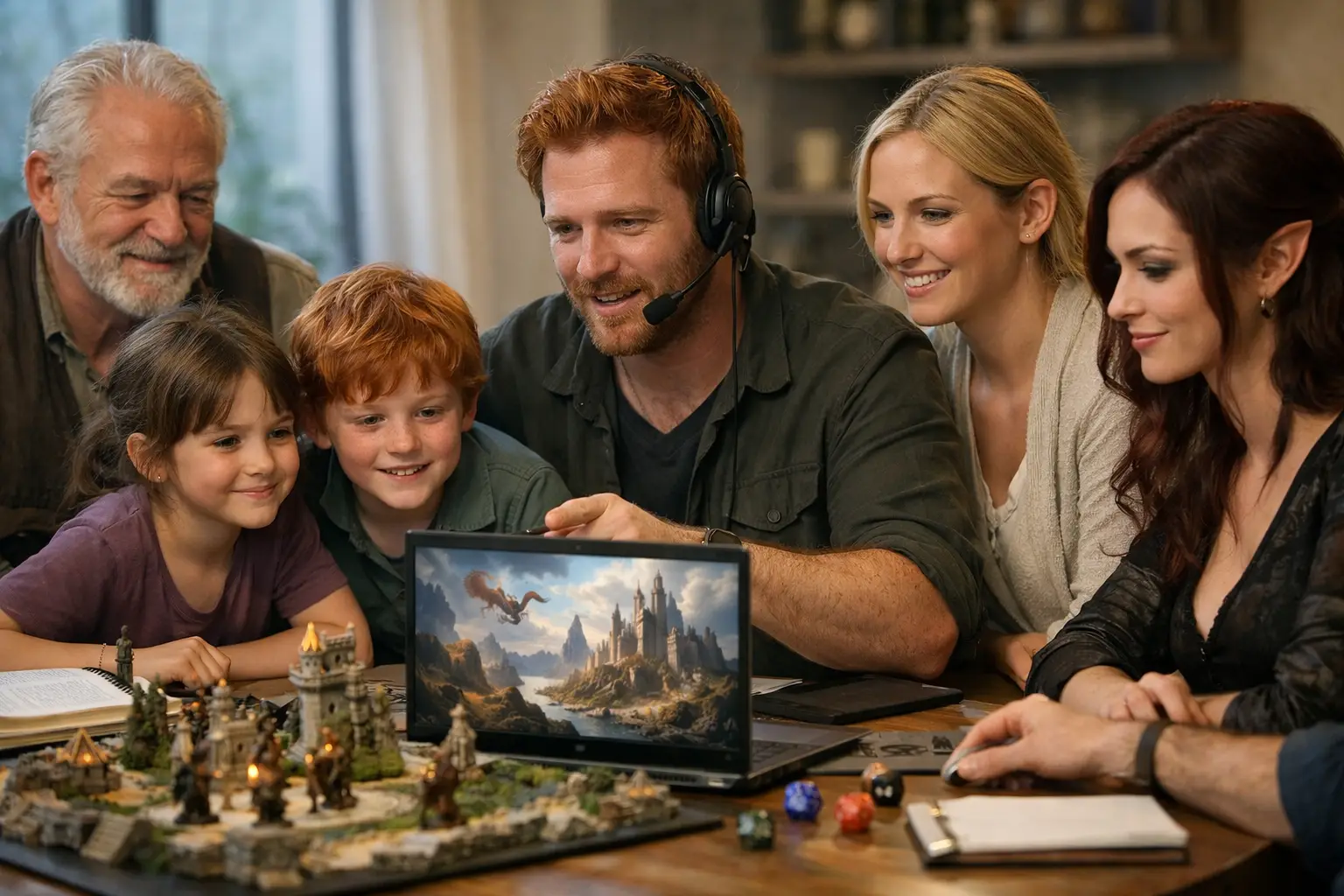
A player pauses before speaking. Their investigator has found a letter that could expose a friend, save a stranger, and place a dangerous truth in the hands of a faction that never forgets.
The room is quiet because the choice matters.
Online Game Master mentoring is not chiefly about learning how to fill that silence. It is about learning how to build the kind of world that earns it.
Many Game Masters already know the rules, own the sourcebooks, and can prepare an exciting opening scene. The harder craft is sustaining meaning.
How do you make a campaign feel coherent across months of play? How do you let players change the world without losing its tension, history, or internal logic? How do you turn improvisation into consequence rather than drift?
A worthwhile mentor helps you answer those questions with care, structure, and an honest eye for the places where a campaign is not yet alive.
What online Game Master mentoring is really for
Mentoring is not a catalogue of tricks for producing louder encounters or faster plots.
It is a creative partnership that examines how you think, prepare, facilitate, and reflect. A mentor can recognise patterns that are difficult to see from behind the screen:
- the mystery whose clues all lead to one predetermined answer,
- the faction that exists only in your notes,
- the player whose character no longer receives meaningful pressure,
- or the villain whose plan cannot survive contact with player agency.
The online format suits this work particularly well.
Sessions can focus on a campaign dossier, a recording or recollection of a difficult game, a map, a set of character histories, or the architecture of an entire setting. You can return to shared documents between meetings, test an idea at your own table, and then bring back the consequences.
The mentoring process becomes part workshop, part creative laboratory, and part steady lantern carried through the fog.
That does not mean every Game Master needs a mentor. A lively peer group, careful self-reflection, and years at the table can teach a great deal.
Mentoring becomes most valuable when you reach a threshold: you have ambition for your campaign, but your current methods are no longer enough to carry it where you want it to go.
The difference between advice and a creative framework
Generic advice can be useful.
Start scenes late. Ask players questions. Prepare situations rather than outcomes.
None of these ideas are wrong. Their value, however, depends on the campaign in front of you.
A horror investigation needs a different rhythm from a political fantasy chronicle. A campaign for newcomers may need clearer invitations to act, while an experienced group might thrive on ambiguity and competing loyalties.
A mentor should not impose one preferred style as universal law.
They should help you identify the experience you want to create, then show you where your preparation, pacing, table culture, and world design support that experience—or quietly undermine it.
This is where a framework matters.
It gives you a way to connect the visible moment at the table to the deeper machinery beneath it.
If the players humiliate a noble patron, who hears about it? What does it cost the patron to respond? Which rival sees an opportunity? What changes in the city before the next session, even if the characters never learn every detail?
Living-world design treats these questions as part of the campaign rather than decorative lore.
The setting does not wait in a cupboard until the heroes knock. It contains motives, memories, pressures, and people pursuing their own imperfect aims.
From plots to pressures
A fixed plot often asks:
> How do I get the party to the next scene?
A pressure-based campaign asks:
> What will happen if nobody intervenes?
The second question creates room for genuine choice.
During mentoring, you might take one planned storyline and rebuild it around forces already in motion:
- a cult racing to complete a ritual,
- a labouring district approaching unrest,
- a family concealing an inheritance,
- or an alien intelligence testing the limits of human fear.
Each force receives an aim, resources, vulnerabilities, relationships, and a likely next move.
The Game Master is still preparing. In fact, they may be preparing with greater precision.
But they are no longer guarding a single sequence of scenes. They are tending a field of possibilities in which player action can leave tracks.
From lore to usable memory
Worldbuilding is only valuable when it enters play.
A hundred years of royal genealogy may delight you, but players will feel its presence only when an old succession dispute changes who welcomes them at the palace gate.
Good mentoring helps distinguish between lore that inspires preparation and lore that creates decisions.
It can also establish a practical memory system built around:
- faction notes,
- relationship maps,
- unresolved promises,
- altered locations,
- recurring symbols,
- and consequences waiting to mature.
You do not need to simulate every cobblestone in a city.
You need to remember what matters—and make that memory visible when the moment arrives.
What a strong mentoring process should include
The best online Game Master mentoring balances imagination with direct feedback.
It should give you space to articulate your ambitions, but it should also challenge the habits that limit your table.
Early conversations should clarify the campaign’s intended emotional experience.
Is it tragic investigation, desperate survival, slow-burn political dread, mythic wonder, or a mixture of several forms?
Tone is not simply a matter of descriptive prose. It lives in:
- the choices available,
- the pace at which information arrives,
- the safety agreements at the table,
- and the consequences that follow violence, compromise, mercy, and failure.
From there, a mentor can examine the practical foundations:
- session structure,
- scenario hooks,
- character integration,
- faction design,
- clue placement,
- campaign pacing,
- and note-taking.
You may work through an upcoming session in detail and then examine how it fits into the larger campaign.
Feedback should be specific enough to use.
“Raise the stakes” is not enough.
A useful observation sounds more like this:
> The players understand what the antagonist wants, but they cannot yet see what changes if they do nothing. Introduce evidence of the antagonist’s progress before asking them to choose.
Or:
> The party has three allies, but none of them has asked for a costly favour. Create a debt that reveals character rather than simply blocking the next objective.
A mentor should also respect the reality of your available time.
There is little value in a campaign architecture that requires twenty hours of preparation every week. Some Game Masters want elaborate faction clocks and detailed historical research. Others need a leaner practice that can survive work, family, health, and the ordinary demands of life.
Craft is not measured by how exhausted you become.
Questions worth bringing to a mentor
Arrive with a living problem rather than a vague wish to “get better.”
Perhaps your players are engaged in individual scenes but are not developing a shared party identity.
Perhaps your sandbox has become directionless.
Perhaps you feel compelled to protect your setting from disruptive choices, even though those choices may be exactly what would make it memorable.
Bring a recent example.
Describe what you expected, what the players did, how you responded, and what felt unsatisfying afterwards.
That single moment may reveal an issue of preparation, communication, pacing, confidence, or several of them at once.
It is also worth asking what not to prepare.
This can be a difficult lesson for ambitious worldbuilders.
A mentor can help you preserve the material that gives your world depth while releasing the material that prevents you from listening at the table.
A campaign is not a novel with an audience interrupting the chapters.
It is a shared act of discovery.
The human work behind better sessions
Technique matters, but Game Mastering is also a relational craft.
Players need to understand what kind of story they are entering. They also need to trust that their choices will be received in good faith.
They need room to surprise you without being punished for refusing an invisible path.
That trust is built through consistency.
If the world responds to one character’s reckless decision but forgets another character’s sacrifice, players learn that consequence is arbitrary.
If you invite moral complexity but reward only the most obvious solution, the campaign begins to narrow.
If you promise horror, tenderness, or political intrigue, the table needs to encounter those elements through play—not only in a campaign pitch.
At Mythveil Chronicles, this long-form attention to factions, history, player action, and persistent consequence sits at the heart of the Rexborn Framework.
The purpose is not simulation for its own sake.
It is to give stories memory, so that a choice made in a rain-soaked alley can still alter the shape of a city many sessions later.
The right mentor will not make your games sound like theirs.
They will help you recognise the world you are trying to bring into being, then equip you to let it breathe under the pressure of real player choices.
Start with one unresolved moment from your table.
Look at what it was asking for.
There is often an entire campaign waiting inside that question.
—
Build campaigns that remember your players
Mythveil Chronicles works with Game Masters, designers, groups, and creative partners who want to build living worlds shaped by memory, research, consequence, and genuine player agency.
Explore the Rexborn Framework, join a Mythveil seminar, enter one of our long-running campaigns, or begin a conversation about mentoring and collaboration.
Read. Play. Watch. Support. Or collaborate.
Play with Mythveil: https://startplaying.games/gm/dunchan
Explore Mythveil Chronicles: https://mythveilchronicles.com/
Collaborate on LinkedIn: https://www.linkedin.com/in/francisco-jos%C3%A9-z-b05aab371/
Mythveil — We create worlds you want to live in..