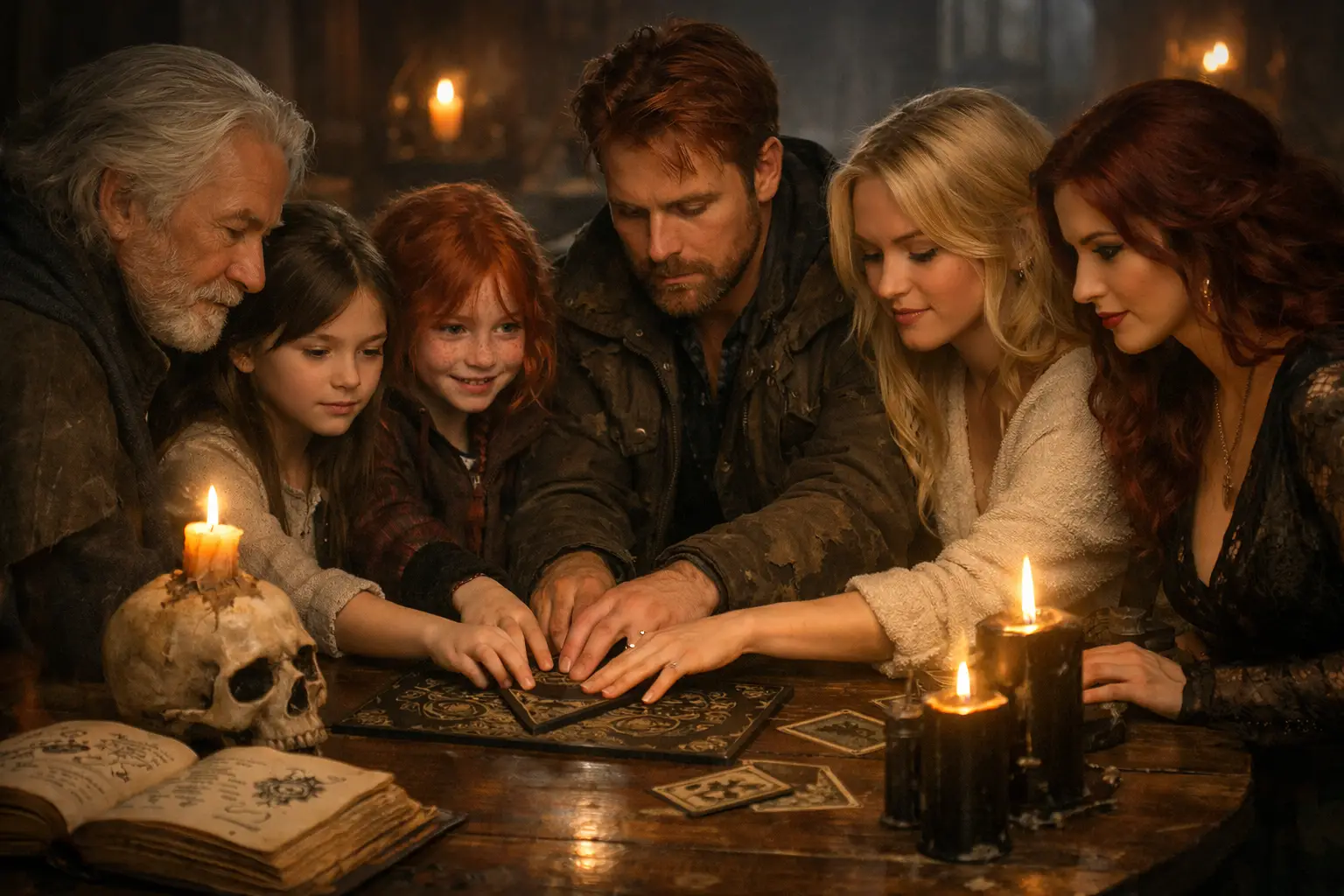
The circle on the cellar floor is almost dry. The candles have burned low. One name has been spoken aloud too many times, and now the room feels occupied by something that has not yet chosen a shape.
That is where occult horror roleplay lives.
Not in jump scares alone. Not in gore for its own sake. Not in a monster kicking down the door every twenty minutes. Occult horror works because it suggests that the world has hidden architecture. Beneath ordinary life, there are rites, debts, symbols, forbidden memories, and old powers that do not care whether anyone believes in them.
When roleplay touches that deeper layer, fear becomes personal.
Occult horror is not simply horror with candles and Latin on the wall. Its heart is the collision between the visible world and an invisible order that is dangerous to uncover. A slasher threatens the body. A ghost story threatens the home. Occult horror threatens meaning itself.
The characters discover that the strange mark on the victim’s skin is not decoration. The folk song heard in three different villages is not coincidence. The abandoned chapel was not forgotten by accident. Someone built a pattern into the world, and the more the players understand it, the more the pattern begins to understand them.
That is the real terror.
In a strong occult horror campaign, knowledge is never neutral. Every clue should feel like a key that might also be a knife. The players want answers, but answers cost something. A ritual text may explain how to seal the thing beneath the hill, but reading it aloud stains the reader’s dreams. A family archive may reveal the truth behind a century of disappearances, but it also proves that one of the player characters was never outside the story.
This is why occult horror thrives on implication. You do not need to explain everything. In fact, you should not. The moment every symbol has a clean definition, the mystery shrinks. Good occult horror gives the players enough structure to make meaningful choices, but enough darkness to keep dread alive.
The Game Master’s job is not to hide the truth forever. The job is to make the truth feel heavy.
A useful way to build occult horror is to start with three layers.
First, the surface layer. This is the ordinary world: the village, the manor, the university, the city street, the police file, the funeral, the missing person report. This layer must feel believable. The more grounded it is, the harder the supernatural impact lands.
Second, the symbolic layer. This is where patterns begin to appear: repeated animals, old songs, recurring dreams, strange dates, family names, religious imagery, weather that changes at the wrong moment, architecture that seems to point toward something. These symbols do not need to be explained immediately. They create pressure.
Third, the hidden layer. This is the actual occult engine beneath the story: the pact, the cult, the sleeping god, the ancestral crime, the magical law, the buried saint, the thing that has been fed for generations. This layer should have logic. Not modern rational logic necessarily, but mythic logic. It should behave according to rules, even if the players only learn those rules slowly.
That is where many horror campaigns fail. They create weirdness, but not structure. Strange events happen because the Game Master wants them to be strange. After a while, the players stop feeling fear and start feeling noise.
Occult horror needs coherence. The players should eventually be able to look back and realize that the signs were there from the beginning. The black dog at the crossroads. The missing church bell. The widow who would not cross running water. The old rhyme about the seventh child. None of it was random. The world was speaking before anyone knew the language.
Atmosphere matters, but atmosphere alone is not enough.
Candles, rain, graveyards, and whispered prayers are useful tools, but they are not the core. The core is consequence. If the players disturb a rite, something should shift. If they expose a cult, the cult should react. If they save someone who was meant to die, the pattern should correct itself in another way. The world must remember.
That memory is what turns a spooky session into a campaign.
Occult horror also becomes stronger when the supernatural is not treated as a simple enemy faction. A cult should not only be “bad people in robes.” A cult is a community of belief. Some members are monsters. Some are victims. Some are desperate. Some are correct about one terrible thing and catastrophically wrong about everything else.
That makes choices harder.
If the villagers sacrifice one person every thirteen years to prevent something worse from waking, what happens when the players stop them? If the old priest lies to protect the town, is he villain, guardian, coward, or all three? If the spirit haunting the house is cruel because it was betrayed, does justice mean destroying it or listening to it?
Occult horror is strongest when there are no clean hands.
For players, this means the best characters are not fearless action figures. They are people with beliefs, doubts, attachments, and wounds. A skeptical doctor, a guilty priest, a disgraced scholar, a grieving sibling, a detective who has seen too much, a noble who inherited the wrong house—these characters give the horror something to grip.
The occult should tempt them personally.
Do not only threaten their hit points. Threaten their certainty. Their family history. Their faith. Their ambition. Their memory. Their name.
A monster can kill a character.
A revelation can change what that character thinks they are.
That is the blade occult horror keeps hidden until the right moment.
For Game Masters, pacing is crucial. Occult horror should breathe. Give the players moments of investigation, silence, ordinary conversation, and uneasy safety. Then let something small go wrong. A door that was locked is open. A dead man’s handwriting appears in a fresh letter. A child repeats a phrase from a book nobody has shown her. The moon is wrong in the painting.
Do not rush to the scream.
Let the players lean closer first.
The best scares often come from recognition. The players see a symbol in session seven and realize it was present in session one. They hear a name and understand why an NPC panicked three sessions ago. They finally translate the inscription and realize the ritual was not meant to summon something.
It was meant to keep something human.
That kind of horror stays.
It follows the group after the session ends because it feels discovered rather than delivered. The players do not merely consume the mystery. They uncover it, interpret it, argue with it, and become part of it.
That is the promise of occult horror roleplay.
Not just fear.
Meaning under pressure.
A world with roots in the dark.
A story where every symbol has teeth.
At Mythveil Chronicles, this is the kind of horror we build: cinematic, research-backed, mythic, and alive with consequence. Worlds are not painted backdrops. They remember. They answer. Sometimes they whisper your name before you have introduced yourself.
Read more Mythveil essays: https://mythveilchronicles.de
Play in a Mythveil campaign: https://startplaying.games/gm/dunchan
Watch Mythveil on YouTube: https://www.youtube.com/@MythveilChronicles
Support the work on Patreon: https://www.patreon.com/c/mythveilchronicles
Or collaborate with us if you want to build worlds that do not merely exist, but endure.