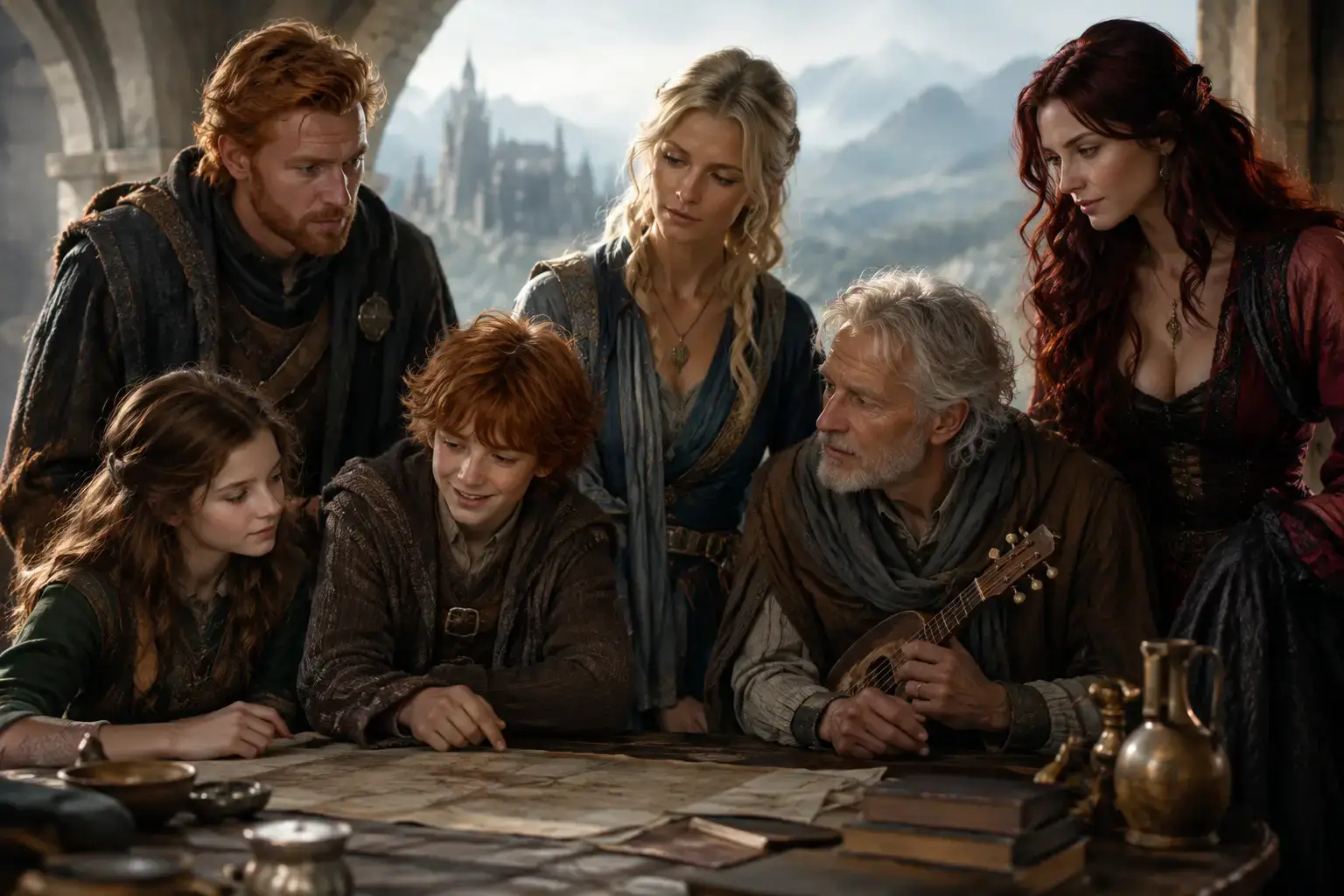
How to Create Believable Fictional Religions in Living Worlds
A shrine is burning at the edge of the village.
Its keeper stands before the flames, insisting that the fire is a blessing. The fishermen kneel in prayer. A merchant watches the smoke with growing concern. Beside the well, three families accuse the keeper of murdering their children.
The shrine has stood for four hundred years.
Tonight, everyone seems to remember its history differently.
The adventurers have arrived at an unfortunate moment. Nobody has asked them to defeat a monster. No ancient prophecy has declared their arrival. Yet their presence matters, because the village is about to make a decision that may change its future.
And somewhere beyond the harbour, the tide is rising.
This is where we begin to understand how to create believable fictional religions for tabletop roleplaying games.
Not with a list of gods, divine domains or sacred weapons, but with people.
People who believe, doubt, celebrate, argue, worship, remember and sometimes discover that the traditions which have carried them through life no longer provide the answers they seek.
A fictional religion becomes convincing when it exists as more than a decorative feature of the setting. It must belong to the people who practise it, influence the societies in which they live and possess a history that continues to develop.
But how do we build such a religion without turning worldbuilding into an endless theological encyclopaedia?
Perhaps the answer begins with understanding what religion actually does.
Start with Human Experience, Not Just Divine Names
Sean: I have a question. Why do so many fictional religions begin with a list of gods and what each one controls?
Stacy: Because it’s easy to organise. God of war, goddess of harvests, god of the sea. Add symbols, temples and a few holidays, and the whole thing looks finished.
Eljara: Until someone asks what those people actually believe, and suddenly nobody has an answer.
Caelwyn: A pantheon is a useful reference. But it isn’t a religion.
One of the most common mistakes in fictional religion worldbuilding is treating faith as a catalogue of supernatural authorities.
The gods have names. Their priests wear distinctive clothing. Their temples occupy suitable locations. Perhaps they even offer magical abilities to their followers.
Yet beyond these details, religion has little influence on how people understand themselves or live together.
Real religious traditions are considerably more complicated.
They can provide explanations of the cosmos, moral guidance, communal belonging, cultural identity and ways of interpreting life’s extraordinary experiences.
They may offer consolation in grief, hope in uncertainty or courage during hardship.
But religion does not exist solely because people suffer.
It also grows through wonder, gratitude, joy, beauty, love, philosophical reflection and experiences understood as encounters with the sacred.
A community might celebrate the first flowering of spring because it understands the renewal of life as a gift. A family might maintain ancestral prayers not because they fear the dead, but because remembering previous generations is an expression of affection.
An astronomer could spend a lifetime studying the heavens as an act of devotion. A musician might understand composition as participation in a divine harmony.
Sean: I rather like that last one.
Eljara: Naturally you do.
Sean: Music is a perfectly respectable approach to understanding the universe.
Stacy: Provided somebody remembers to repair the instruments.
Caelwyn: And perhaps pays the musicians occasionally.
For worldbuilders, the important question is not simply what followers believe about their gods.
It is how their understanding of the sacred shapes their experience of the world.
A credible fictional religion gives people reasons to live within it, not merely reasons to obey it.
Belief, Theology and the Nature of Reality
Before designing sacred institutions and elaborate ceremonies, we should consider a distinction that becomes particularly important in fantasy settings.
What do the inhabitants believe?
And what is actually true within their world?
These questions are related, but they are not identical.
Eljara: Suppose a goddess of storms genuinely exists. Her priests can summon lightning, and she occasionally appears above the mountains. Surely that settles the matter?
Caelwyn: It settles the question of whether something exists. It does not necessarily settle what that something means.
Sean: Or whether the priests understand her correctly.
A world in which divine beings demonstrably exist does not automatically eliminate theology, philosophy or religious disagreement.
The existence of a god does not explain everything about its nature, intentions or relationship with mortals.
Does the goddess of storms govern all storms, or only those within her sacred territory? Is she their creator, their guardian or merely a powerful being capable of influencing them?
Does she possess moral authority because she is divine? Can she make mistakes? Are her commands eternal truths, temporary instructions or the expressions of a particular relationship with her followers?
Two religious traditions might acknowledge the same supernatural being while interpreting its significance in radically different ways.
One community considers the goddess a protector of sailors. Another fears her as the embodiment of divine judgement. A third honours her as a necessary expression of the natural world without assuming that she possesses human emotions.
All three may have witnessed the same miracles.
Mara: So they can see the same thing and still disagree about what it means?
Caelwyn: Very much so.
Chibi: Like when it rains?
Mara: Yes. One farmer might be happy, and another might be worried about a flood.
Chibi: I like puddles.
Stacy: Until they reach the workshop.
The same principle applies to settings where supernatural events are rare, ambiguous or perhaps entirely absent.
Religion does not need a regularly appearing deity to influence society.
Sacred traditions may centre on ancestors, cosmic principles, enlightened teachers, spirits, ethical disciplines or particular understandings of existence rather than conventional gods.
A believable fictional religion begins with a coherent worldview, but that worldview does not have to explain every mystery.
Indeed, questions without universally accepted answers often give a tradition its philosophical depth.
Build Religion into Everyday Life
Stacy: Before we design another magnificent cathedral, can we please discuss what ordinary people actually do with their religion?
Sean: You mean rituals?
Stacy: I mean Tuesday morning.
Eljara: A terrifying concept for anyone who has ever planned a religious festival.
Religion becomes part of a believable setting through repetition and ordinary experience.
Consider how a family begins its day. Perhaps they share a brief prayer before breakfast. Perhaps they leave the first portion of a meal for their ancestors. Perhaps they greet the sunrise in silence or observe certain rules when preparing food.
A traveller might touch a carved stone before crossing a bridge. A physician could recite an invocation before treating the sick. A merchant may consider honesty in trade a sacred obligation.
Other inhabitants might participate only occasionally, observe traditions without sharing their underlying beliefs or reject religious practice altogether.
That variation is important.
Religion is rarely experienced identically by everyone who belongs to a community.
For practical worldbuilding, it helps to consider three overlapping dimensions.
Personal Faith
Personal faith concerns what individuals believe and practise, particularly when nobody else is watching.
A soldier carries a prayer written by his mother. A priest privately questions an interpretation she is expected to teach. A sceptical investigator lights a candle for a dying friend despite insisting that the gods do not exist.
These acts reveal something about identity, memory and relationships.
They also allow players to encounter religion through individuals rather than institutions alone.
Community Traditions
The second dimension is the shared religious life of a household, village, district or wider community.
Festivals, marriages, funerals, coming-of-age ceremonies, pilgrimages and seasonal celebrations establish a society’s rhythm.
They create collective memories.
Two villages may honour the same saint but celebrate her festival differently. One crowns her image with flowers. The other uses iron because local tradition remembers her as the protector of blacksmiths.
Neither interpretation has to be fraudulent.
Both may reflect centuries of local history.
Mara: I think I’d like the village with the flowers.
Chibi: I want to ring the bell.
Stacy: There’s a proper time for that, Chibi.
Chibi: Now?
Stacy: Definitely not now.
Sean: And so begins the first great liturgical controversy.
These everyday traditions matter because they tell us what people love about their religion.
Not every sacred celebration needs to conceal a sinister ritual.
Sometimes a feast is simply a feast.
And that is worth remembering.
Religious Institutions
The third dimension concerns organised authority.
Who maintains temples? Who educates priests or religious teachers? How are ceremonies financed? Who preserves sacred texts, interprets doctrine or settles disputes?
Some traditions possess centralised hierarchies. Others rely on local teachers, hereditary custodians, communal councils or informal networks.
There is no single institutional model that every religion must follow.
Where religious organisations exercise authority, they also become social actors.
Temples may provide food and shelter. Monasteries could preserve scholarship and historical records. Religious schools might offer education. Sacred courts may adjudicate disputes.
These institutions require people, resources, buildings and cooperation.
They can also produce conflict, inequality or abuses of power.
A religious organisation can be sincerely devoted to charitable work while struggling with financial pressures, internal disagreements or political influence.
That complexity is not a contradiction in good worldbuilding.
It is a reflection of how institutions function.
Let Rituals Carry Meaning
Sean: We’ve talked about what people believe. But how do we help players experience those beliefs during a game?
Stacy: Give them something they can see, hear or participate in.
Rituals translate religious ideas into recognisable actions.
A funeral procession might carry lanterns instead of torches because the community believes the dead must be guided rather than driven into the next world.
At a wedding, the couple could exchange bowls of water from their respective homes, symbolising the joining of families.
A warrior might surrender a weapon before entering a sanctuary, expressing the belief that sacred ground must remain beyond ordinary political violence.
Such details communicate meaning without requiring a lengthy explanation.
But rituals should not exist merely to decorate a scene.
They belong to particular communities and histories.
The same funeral rite may look very different in a wealthy capital and an isolated mountain settlement. A grand temple can employ musicians, incense and ceremonial clothing. A poor household may perform an equivalent rite with a single candle and a familiar prayer.
Both expressions can carry profound significance.
Eljara: And the difference tells us something about wealth, access and power.
Stacy: Certainly. But also about adaptation. People find ways to preserve what matters with the resources they have.
For a Game Master, rituals also offer meaningful decisions.
Will the adventurers honour the funeral customs of an enemy? Can they accept sanctuary from a religious community whose doctrines they reject? Would a character break a sacred prohibition to protect someone they love?
Those choices reveal much more than a successful Religion skill check.
They allow belief to become part of character development.
Give Fictional Religions a History
A religion that has existed for centuries should carry the marks of those centuries.
Its doctrines, practices and institutions will have encountered political changes, disasters, cultural exchanges, reformers, charismatic leaders and generations of ordinary believers.
Caelwyn: One of the things I find least convincing is a religion that has apparently existed unchanged for a thousand years.
Sean: Not even a disagreement over a translation?
Eljara: Or who gets to sit nearest the altar?
Stacy: Or who has to pay for repairing the roof?
History changes religious traditions.
Sometimes slowly enough that participants barely notice.
Other transformations emerge from decisive events: the death of a revered teacher, a political revolution, the discovery of an old manuscript, a devastating war or a reform movement that challenges established authority.
Yet change does not always mean abandonment.
A community may preserve ancient prayers while interpreting them differently. A religious institution might adapt its organisation without rejecting its fundamental teachings.
Local customs can survive even when official authorities disapprove of them.
A festival may outlive the doctrine that originally inspired it.
Sean: That’s rather like an old song. People still know the melody, even when they’ve forgotten what the original words meant.
Caelwyn: And sometimes the forgotten verses return.
For believable fictional religions, we should ask what the tradition remembers.
Which historical events are celebrated?
Which are mourned?
What disagreements remain unresolved?
Who preserved the community during its darkest period?
What promises were made by its leaders, and were those promises fulfilled?
The answers create a history that players can discover rather than merely read.
The Same History Can Produce Different Interpretations
Imagine a city devastated by plague.
Its religious leaders once promised that faithful observance would protect the population. Thousands nevertheless died.
What happened afterwards?
Some believers may have abandoned the institution. Others might have reinterpreted the promise. A reform movement could have emerged, arguing that the disaster exposed corruption among the clergy.
Perhaps religious communities established hospitals and charitable societies in response.
A century later, the descendants of these groups might still disagree about what the plague meant.
None of those responses requires the original believers to have been foolish or dishonest.
Their interpretations emerge from different experiences, interests and convictions.
That is how history becomes a living part of religion.
Religion Is Never Just One Voice
Eljara: There’s another mistake that bothers me. We often design a fictional religion as though every follower shares exactly the same opinions.
Sean: Which would be a remarkable achievement, considering how difficult it is to get six people to agree on where to have lunch.
Stacy: Especially this particular group.
A religion can contain considerable diversity while maintaining a recognisable identity.
A dockworker, a noble patron, a scholar and a village healer may all belong to the same tradition.
Their experiences of faith, however, can differ enormously.
One values its charitable institutions. Another is fascinated by theology. A third participates chiefly through family customs. Someone else believes deeply but distrusts the official leadership.
Religious disagreements need not always concern fundamental doctrines.
They might involve language, ritual, education, gender roles, political authority, inheritance, sacred property or the responsibilities of religious leaders.
A reform movement could advocate translating sacred texts into everyday speech.
A traditional community might fear that translation will erase meanings preserved through centuries of scholarship.
Both positions can contain sincere convictions alongside institutional interests.
Caelwyn: A believable religious dispute becomes interesting when we understand why intelligent, decent people might disagree.
Eljara: And when we recognise that sincere belief does not automatically prevent ambition, fear or manipulation.
The same applies to scepticism and dissent.
An outspoken critic might still participate in family celebrations. A former priest may retain affection for the community he left. Someone who rejects a religious institution can nevertheless consider its charitable work indispensable.
These relationships create a setting in which faith is a human reality rather than a simple division between believers and enemies.
Religion, Politics and Social Power
Religion often interacts with politics, economics and social structures.
Sometimes religious authorities legitimise rulers. Sometimes they challenge political power. Religious organisations may own land, preserve knowledge, operate hospitals or maintain relationships across national boundaries.
They might also influence taxation, legal traditions and public expectations.
But we should be careful not to reduce religion to political manipulation.
Eljara: Political power is certainly part of the story. But it isn’t the whole story.
Stacy: Quite. Somebody still has to look after the sick, organise the harvest festival and make sure the orphanage has enough food.
Sean: All while the bishop and the duke argue about who is entitled to appoint the new abbot.
Caelwyn: And while the abbot would very much prefer somebody else to take the position.
For a Game Master, religious institutions provide opportunities to develop factions with meaningful relationships.
Consider a monastery that preserves historical records.
Its archives could be valuable to scholars, rulers, merchants and adventurers.
The monastery may seek independence from political interference. Its members might disagree over whether certain documents should be made public.
A local ruler could offer financial support in exchange for influence.
Meanwhile, the villagers may care less about the archives than about the monastery’s medical assistance and winter food supplies.
These interests create situations that can develop naturally during a campaign.
The players are not required to choose between a purely benevolent church and an obviously evil one.
They encounter an institution whose members, responsibilities and relationships may pull it in different directions.
And their own decisions can become part of that story.
Do Not Mistake Mystery for Ignorance
Mara: What happens if the people don’t know whether their god is really listening?
Caelwyn: Then they face a question many religious traditions have explored in different ways.
Chibi: Maybe the god is busy.
Sean: That would explain several theological controversies rather neatly.
Eljara: I suspect the theologians might want a slightly more substantial explanation.
In some fantasy settings, supernatural beings speak directly to mortals. Divine magic works, prayers receive visible answers and extraordinary events may occur with some regularity.
In others, the boundary between religious experience and supernatural reality remains uncertain.
Neither approach automatically creates greater depth.
Even when miracles are real, their meaning can remain disputed.
A healing might be understood as divine grace, evidence of magical intervention or a phenomenon that challenges existing theological assumptions.
A prophecy could be genuine without its interpretation being obvious.
The appearance of a powerful supernatural being may confirm its existence while raising new questions about its moral authority.
Doubt also deserves a place within fictional religion.
A priest struggling with belief need not be a hypocrite. A sceptic is not necessarily ignorant. A devout person can ask difficult questions while remaining committed to their tradition.
Religious conviction and intellectual reflection are not opposites.
Nor should every mystery exist solely to be solved by the adventurers.
Sometimes uncertainty forms part of the culture itself.
An unanswered prayer, a sacred story with competing interpretations or a historical event nobody fully understands can enrich a world without requiring the Game Master to reveal one definitive answer.
How to Bring Fictional Religions into Actual Play
We have discussed theology, history, ritual, community and institutions.
But none of those elements matters much at the gaming table if players never encounter them.
Stacy: So how do we turn all this into something playable without handing everybody a forty-page theological introduction?
Sean: I would start with a story.
Eljara: I would start with someone who wants something.
Caelwyn: Both are useful. Religion becomes tangible when the characters meet people whose lives are shaped by it.
The best introduction is often a small encounter.
An elderly woman asks the adventurers to help carry an offering to a remote sanctuary.
A village celebrates a seasonal festival. The characters are invited to participate, but one of their companions is uncomfortable with a particular tradition.
A priest requests protection for a travelling group of pilgrims. The local authorities suspect that the pilgrimage conceals a political gathering.
Each situation gives players something concrete to experience.
Nobody needs to memorise a pantheon before taking part.
The meaning of the religion emerges through encounters, decisions and relationships.
A Practical Worldbuilding Test
Before introducing a fictional religion into your campaign, consider five questions:
- What does this tradition mean to its followers? Think beyond fear and obedience to belonging, celebration, philosophy, identity and hope.
- How does it shape ordinary life? Consider customs, rituals, family relationships, festivals and ethical expectations.
- What is its history? Give it important memories, changes, unresolved questions and regional differences.
- Who interprets and represents it? Include institutions where appropriate, but also ordinary practitioners, reformers, critics and local communities.
- How can the player characters engage with it? Offer encounters, relationships and choices whose consequences can develop over time.
You do not need an elaborate answer to every question.
A few thoughtful details can establish more credibility than hundreds of disconnected facts.
The important thing is to create a tradition capable of influencing the lives of its followers.
Respect the People Behind Real Traditions
Fictional religion often draws inspiration from historical cultures and existing religious traditions.
That can enrich worldbuilding, but it also requires care.
Living religions are not collections of exotic symbols that can be rearranged without context. Their practices possess meanings for real communities.
Research their history, consider whose perspectives you are using and avoid treating unfamiliar religious practices as automatically sinister or irrational.
Stacy: And remember that horror doesn’t require turning somebody else’s sacred traditions into a catalogue of frightening props.
Eljara: Human ambition and moral failure provide quite enough darkness without that.
Players should also have a say in how religion intersects with their characters.
Some may enjoy theological debate or playing devout characters. Others prefer religion to remain a cultural background element.
Discuss expectations, boundaries and sensitive material before making religious identity the centre of a conflict.
A believable world benefits from depth.
A good campaign also benefits from trust.
The Rexborn Approach: Faith as Part of a Living World
Sean: We’ve created beliefs, traditions, histories and institutions. But what happens when the adventurers begin changing things?
Caelwyn: That is where our approach to living worlds becomes particularly useful.
At Mythveil Chronicles, the Rexborn Framework helps us consider religions as continuing parts of the setting rather than static collections of lore.
Religious communities possess histories, relationships and interests. Their institutions interact with politics, culture, local traditions and other social forces.
When players intervene, their decisions can influence those relationships.
Exposing corruption might strengthen a reform movement without destroying the wider faith. Protecting a sacred site could improve relations between communities. A religious leader’s death may create uncertainty, but succession could also bring stability or reconciliation.
Not every development needs to become a crisis.
Guardian and Nemesis help us consider continuity, adaptation and opposing pressures without assuming that religious change must always lead to persecution, schism or catastrophe.
Through Bardic News, relevant developments can reach the characters as sermons, letters, rumours, public proclamations or personal conversations.
The Game Master maintains the world’s history and interprets developments. The players remain free to make their own decisions.
Eljara: So the religion doesn’t change merely because the Game Master has prepared the next adventure.
Caelwyn: No. It develops through the circumstances already present in the world, including the actions of the characters.
Stacy: Which means a monastery can repair its roof, a community can reconcile after a dispute and a religious festival can take place without somebody summoning an ancient demon.
Sean: You’re taking all the fun out of it.
Mara: I think the festival sounds nice.
Chibi: Can I ring the bell now?
Stacy: Not during the sermon.
Chibi: After?
Eljara: There may yet be hope for negotiations.
Rexborn is one structured way of supporting this kind of world development. Its underlying principles can also be used with simple campaign notes, a timeline and an understanding of how people and institutions relate to one another.
The purpose is not to determine what characters must believe.
It is to create a world in which belief has a past, a present and a future.
The Shrine at the Edge of the Village
Let us return to the burning shrine.
The keeper still insists that the fire is a blessing.
Perhaps she sincerely believes it. Perhaps an ancient tradition demands that the sanctuary be renewed by fire once every century. Perhaps she has misunderstood a prophecy or witnessed something she cannot explain.
The bereaved families believe the shrine’s guardians betrayed them.
The merchants fear that the destruction will threaten the annual pilgrimage, upon which much of the village economy depends.
Some fishermen remember stories of another fire generations earlier.
A young priest argues that the shrine should be rebuilt.
An elderly woman quietly says it should never have existed in the first place.
None of these people needs to be lying.
They belong to the same community, but they carry different memories, interests and understandings of the sacred.
The adventurers might investigate what caused the fire. They could help the families seek justice, protect the keeper from an angry crowd or discover that the dispute has roots in a much older event.
They might also decide that the conflict is not theirs to resolve.
Whatever happens, the village will continue living.
There will be funerals. Arguments. Prayers. Work to be done.
Some people will leave.
Others will remain and attempt to rebuild what has been lost.
Perhaps the shrine will rise again.
Perhaps the community will discover that its faith can survive without the building.
And perhaps, years later, a child will ask why the village holds a procession every autumn, carrying extinguished lanterns towards the sea.
Someone will tell the story.
Sean: It might not be the same story everyone remembers.
Eljara: Of course not. That’s what makes it interesting.
Stacy: And somebody will still have to organise the procession.
Mara: I hope they remember the families.
Caelwyn: If we’re fortunate, they will.
Chibi: And the bells?
Sean: Especially the bells.
That is when a fictional religion begins to feel believable.
Not when every theological question has been answered, or every sacred text has been written.
But when its people have lives beyond the next adventure.
When their beliefs shape what they cherish, how they disagree and what they hope to preserve.
When a ritual can carry joy as readily as sorrow.
When faith can inspire both tradition and transformation.
And when the choices made by the player characters become part of a history that others will inherit.
To create believable fictional religions, give people something meaningful to believe, something worth questioning, and a world in which both can matter.
Because gods may shape the heavens.
But people live their faith beneath them.
And the world remembers.
—
Build Believable Living Worlds with Mythveil Chronicles
At Mythveil Chronicles, we explore worldbuilding through history, mythology, religion, culture and the choices that shape societies.
Our long-form tabletop RPG campaigns are designed around living worlds, evolving factions, meaningful player agency and consequences that remain part of the story.
The Rexborn Framework supports this philosophy by connecting world history, institutions, cultural development and player actions.
Experience a Living World
Discover our current online tabletop RPG campaigns, available seats and weekly schedule.
Explore the Mythveil Weekly Campaign Calendar
Play with Mythveil on StartPlaying
Explore Campaign Design Together
Our Mythveil Seminar: Campaigns That Remember Your Players follows a collaborative Round Table approach.
Bring your own campaigns, experiences and questions. Together, we explore worldbuilding, player agency, continuity and the challenges of building meaningful long-form stories.
The aim is not to impose one correct way of designing campaigns, but to learn from one another and discover what makes our worlds more believable, responsive and memorable.
Read. Play. Watch. Support. Or Collaborate.
Read Mythveil Chronicles | Play on StartPlaying | Watch on YouTube | Support on Patreon | Collaborate on LinkedIn
Mythveil Chronicles – Real TTRPG. Real story. Real choices. Real consequences.
The world remembers.