
English · Deutsch · Italiano · Español
Mistborn · The Cold · Week 4 — The Other Side of Spring
Mara & Chibi · Southern Scadria · Kallin’s Reach · Centuries After the Ice Death
In the north, they remembered the day the ash stopped falling.
In the south, they remembered the day the warmth disappeared.
In the north, the Catacendre meant restoration.
In the south, it meant the Ice Death.
For centuries, these histories belonged to people separated by distance, culture and memory.
Then the airships came.
Letters crossed the seas.
Records were exchanged.
Children began hearing stories their grandparents had never known.
And in a mountain settlement called Kallin’s Reach, two young investigators discovered an uncomfortable truth.
The day their ancestors called the end of the world was remembered elsewhere as its salvation.
What Is Spring?
CHIBI:
“Mara?”
MARA:
“Yes?”
CHIBI:
“What’s spring?”
Mara looked up from her notebook.
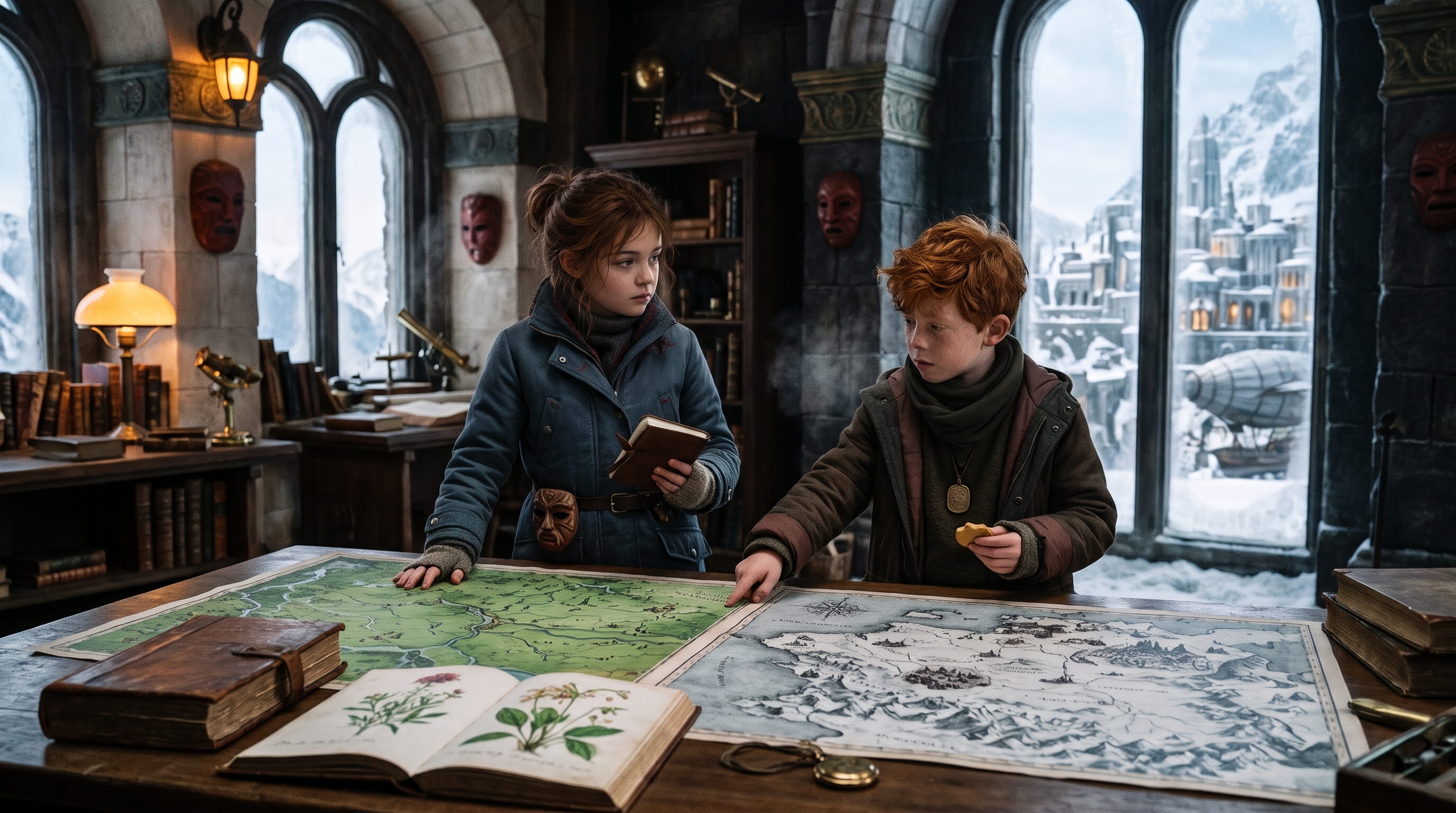
She was nine years old, brown-haired and very particular about the proper order of questions.
Chibi was eight, red-haired and generally interested in asking whichever question seemed most inconvenient.
MARA:
“It’s a season.”
CHIBI:
“I know that.”
MARA:
“Then why are you asking?”
He pointed towards the book between them.
It showed green fields, flowering trees and a sky without a single snow cloud.
CHIBI:
“Because it says spring began on this day.”
Mara studied the date.
MARA:
“The Catacendre.”
CHIBI:
“Yes.”
He looked towards the frozen mountains beyond the window.
CHIBI:
“But our winter began on the same day.”
Mara hesitated.
CHIBI:
“So which one was spring?”
She considered the illustration.
MARA:
“Apparently that depends where you lived.”
Chibi nodded thoughtfully.
CHIBI:
“I’d rather live in the part where the books are right about the weather.”
Generations had passed since the Catacendre.
Southern Scadria had survived the Ice Death through the knowledge introduced by the Sovereign and the extraordinary development of Feruchemical medallions.
The people of Kallin’s Reach lived among frozen mountains.
They travelled in protected galleries.
Used warming medallions.
Built and maintained great Malwish airships.
And regarded the Metallic Arts as both practical technology and part of their cultural inheritance.
For Mara and Chibi, none of this was unusual.
They had never known a world without the medallions.
Nor had they ever seen an open field filled with grass.
Then an airship called the Second Dawn returned from the north.
Its captain, Serin, brought cargo, historical documents and travellers who had grown up in an altogether different Scadria.
The Girl from the Green World
SERIN:
“Well, if it isn’t my two favourite investigators.”
CHIBI:
“We’re your favourites?”
SERIN:
“Among investigators under ten.”
Mara smiled.
MARA:
“How was the north?”
SERIN:
“Different.”
CHIBI:
“How different?”
SERIN:
“They grow crops outdoors.”
Chibi stared.
CHIBI:
“Without a roof?”
SERIN:
“Yes.”
CHIBI:
“Or a furnace beneath the soil?”
SERIN:
“Yes.”
He looked towards Mara.
CHIBI:
“That sounds like a very poorly supervised garden.”
One of the travellers was a ten-year-old northern girl named Aveline.
Her mother had come to help exchange historical records between northern and southern scholars.
Aveline described rain that didn’t freeze.
Grass growing in the open.
Trees covered with leaves.
Warm earth.
And flowers that appeared without anybody tending a heating chamber.
Chibi listened with fascination.
Then asked whether northern biscuits were different from southern ones.
Aveline considered that an excellent question.
They became friends.
But when Aveline looked outside the hangar, her smile faded.
AVELINE:
“Is it always this cold here?”
MARA:
“Not always.”
Aveline looked relieved.
MARA:
“Sometimes it’s colder.”
AVELINE:
“And people live here?”
CHIBI:
“Of course.”
AVELINE:
“Why?”
Mara thought about that.
MARA:
“Because it’s home.”
Aveline nodded slowly.
AVELINE:
“I suppose that’s a very good reason.”
The Same Date
The local archivist, Venn, had received a chest of northern historical records.
He laid two accounts on the reading table.
One came from the north.
It described the end of falling ash.
The clearing sky.
A changed landscape.
The beginning of a civilisation that could grow food under conditions its ancestors had barely imagined.
The other account came from Keret’s Hollow, one of the old southern settlements.
It had been preserved in later copies of a ledger associated with a storyteller named Sean and a healer named Eljara.
Mara recognised the names.
Weeks earlier, she and Chibi had studied the records of the first Firemothers and Firefathers.
They had found a list headed:
Those Who Kept the Fire.
Now another section lay open.
Those Who Did Not See the Spring.
It recorded people who had died before the southern settlements received the Sovereign’s knowledge.
Children.
Workers.
Travellers.
Families who had vanished on the old roads.
Mara read the northern account.
Then the southern one.
MARA:
“They have the same date.”
Venn nodded.
VENN:
“Yes.”
CHIBI:
“But one says the world was restored.”
VENN:
“Yes.”
CHIBI:
“And the other says the world died.”
VENN:
“Yes.”
Aveline stared at the documents.
AVELINE:
“I didn’t know.”
Mara turned.
MARA:
“Didn’t know what?”
AVELINE:
“That the Catacendre did this to your people.”
The northern account was not a lie.
Sazed had taken up the powers of Ruin and Preservation, becoming Harmony.
He restored Scadrial from the devastation caused by the Lord Ruler and the struggle that followed.
For the north, the Catacendre brought an end to the ash and made a new civilisation possible.
The southern account was not a lie either.
The same restoration catastrophically cooled the world of the southern peoples, who had adapted to a warmer climate.
They lost their old way of life.
Only later did the Sovereign bring the Excisors and the means to share stored warmth through unsealed Feruchemical medallions.
One event.
Two histories.
Neither made the other disappear.
The Problem with a Saved World
AVELINE:
“In our books, Harmony saved the world.”
Mara nodded.
MARA:
“In ours, the Catacendre nearly destroyed it.”
Aveline looked distressed.
AVELINE:
“Does that mean our history is wrong?”
Mara thought for a long time.
MARA:
“I don’t think it’s wrong about what happened to your people.”
She touched the southern document.
MARA:
“But it doesn’t tell what happened to ours.”
Chibi leaned forward.
CHIBI:
“It’s like writing a story about a rescue and forgetting the people who weren’t rescued.”
Aveline stared at him.
AVELINE:
“That’s horrible.”
CHIBI:
“Yes.”
He paused.
CHIBI:
“And rather poor storytelling.”
The next morning, Venn arranged a public discussion in the Hall of Remembrance.
The enormous carved figure of the Sovereign looked down upon the gathering.
Firemother Sella attended.
So did Rhava, the local sanctuary keeper.
Some people were curious about the northern documents.
Others were angry.
One man stood.
MAN:
“So the northerners worship the power that froze our ancestors?”
Rhava raised a hand.
RHAVA:
“We should be careful about claiming we know precisely what Harmony understood or why each decision was made.”
MAN:
“But our people died.”
RHAVA:
“Yes.”
MAN:
“And the northerners call it salvation.”
Rhava looked at both records.
RHAVA:
“They remember what happened to them.”
She touched the southern ledger.
RHAVA:
“We remember what happened to us.”
The man folded his arms.
MAN:
“Then perhaps they should read our books.”
Chibi whispered to Mara.
CHIBI:
“That seems reasonable.”
MARA:
“It does.”
A society remembers its past through stories, ceremonies and monuments.
These memories help people understand who they are.
But they are selective.
No monument contains every name.
No schoolbook includes every experience.
And no community can safely assume that its version of an event is the only one worth preserving.
The problem is not that the north remembered salvation.
Nor that the south remembered disaster.
The problem begins when one account is treated as the entire history of Scadrial.
A shared world does not guarantee a shared experience.
And a shared date does not guarantee a shared memory.
The Two Maps
Venn asked the children to help prepare a display.
Mara loved maps.
Chibi had reservations.
CHIBI:
“Can a map explain everything?”
MARA:
“No.”
CHIBI:
“Then why are we making two?”
MARA:
“Because one isn’t enough.”
He considered that.
CHIBI:
“Fair.”
The first map showed the northern lands.
Regions transformed by the end of the ash.
Agricultural settlements.
New roads and towns.
The Elendel Basin.
The second map showed the south.
Abandoned cities.
Disrupted trade routes.
Frozen valleys.
Surviving refuges.
And, generations later, the routes opened through Feruchemical technology and Malwish airships.
Mara placed the maps side by side.
Then stopped.
MARA:
“Something’s wrong.”
CHIBI:
“What?”
MARA:
“We’ve arranged them as though they describe different events.”
Chibi looked at the dates.
CHIBI:
“But they don’t.”
She moved the maps together.
The world became whole.
The dates still matched.
One map was filled with new green landscapes.
The other with the scars of winter.
CHIBI:
“Two colours.”
MARA:
“Two consequences.”
Some council members wanted to keep the northern documents out of public view until everyone agreed about their meaning.
Venn objected.
VENN:
“Agreed about what?”
COUNCIL MEMBER:
“About what people should believe when they read them.”
VENN:
“Then let’s give them the evidence.”
COUNCIL MEMBER:
“Some people may be offended.”
Venn sighed.
VENN:
“Some people are offended by accurate weather reports.”
Chibi nodded approvingly.
Rhava examined the records.
COUNCIL MEMBER:
“Do you think they should be displayed?”
RHAVA:
“Yes.”
COUNCIL MEMBER:
“Even if they challenge our traditions?”
She looked towards the stone relief of the Sovereign.
RHAVA:
“A tradition worth preserving should not depend upon forbidding people to examine history.”
The Storm
That evening, a storm struck Kallin’s Reach.
The airship hangars were secured.
The outside galleries closed.
And the heating crews began transferring visitors into the lower protected halls.
Then one of the upper heating conduits failed.
A section of the route between the reception galleries and the lower settlement began losing warmth.
The northern visitors were delayed.
The southern children checked their medallions.
Aveline looked at them.
AVELINE:
“Do I need one?”
Sella examined her condition.
SELLA:
“Not necessarily. Your body tolerates the cold differently. But we’ll keep you warm and monitor how you’re feeling.”
Mara checked her reserve.
MARA:
“Enough for the protected route.”
Chibi checked his.
Then frowned.
CHIBI:
“Less than I thought.”
SELLA:
“Have you been using it?”
CHIBI:
“Outside the hangar.”
SELLA:
“Then we’ll issue you another checked medallion.”
He looked embarrassed.
CHIBI:
“I should have checked earlier.”
SELLA:
“Yes.”
She knelt beside him.
SELLA:
“And now you have.”
The repair teams went to work.
Anika, the surveyor Mara and Chibi had helped rescue after the strange light over the Mirror Flats, guided visitors towards a safer passage.
Captain Serin coordinated supplies.
Rhava organised a warm waiting area.
Sella supervised the medallion distribution.
Nobody waited for a god to appear.
Nobody expected the Sovereign to repair the conduit.
The people did the work that kept their community alive.
The emergency ended without serious injury.
And Aveline learned something that her northern schoolbooks had never taught her.
Two children could stand in the same cold air and face different levels of danger.
Their bodies were adapted to different conditions.
They needed different protection.
Being in the same world did not mean experiencing it in the same way.
The Question Nobody Wanted
The next morning, the council gathered around the two maps.
Mara described the northern record.
Then the southern record.
The same date.
The different consequences.
Chibi raised his hand.
One council member sighed.
COUNCIL MEMBER:
“Yes?”
CHIBI:
“I have a question.”
COUNCIL MEMBER:
“Of course you do.”
Chibi pointed towards the northern history.
CHIBI:
“If Harmony restored the world, why did our ancestors have to freeze?”
Silence.
Aveline stared at the table.
Mara looked towards Rhava.
The council member opened his mouth.
Then closed it.
COUNCIL MEMBER:
“That is a complicated matter.”
CHIBI:
“I know.”
He waited.
CHIBI:
“That’s why I asked.”
Rhava stood.
RHAVA:
“I cannot tell you exactly what Harmony knew or why every decision was made.”
Chibi nodded.
CHIBI:
“All right.”
She looked surprised.
RHAVA:
“All right?”
CHIBI:
“Yes. It’s better than pretending.”
Rhava considered that.
RHAVA:
“We know the world was restored from terrible danger.”
She touched the northern map.
RHAVA:
“We also know that the restoration caused terrible suffering in the south.”
She looked at the children.
RHAVA:
“Both facts matter.”
Aveline raised her hand.
AVELINE:
“Can we be grateful for what happened in the north and still be sorry for what happened here?”
Rhava nodded.
RHAVA:
“I believe we must be capable of both.”
Mara looked at the maps.
MARA:
“Even if the stories make each other uncomfortable?”
Rhava smiled.
RHAVA:
“Especially then.”
A Letter Across the World
Venn decided that the two histories would be displayed together.
The northern records would describe the end of the ash.
The southern records would describe the Ice Death.
Stacy’s astronomical observations would be included with their uncertainties identified.
Sean and Eljara’s surviving accounts would preserve the names of those who had died and those who had kept the southern settlements alive.
The Sovereign’s arrival would be remembered.
So would the generations of Firemothers, Firefathers, engineers, travellers and workers who had turned his discovery into a civilisation.
The display would not pretend that every question had been answered.
It would give people the opportunity to keep asking.
Before the Second Dawn departed, Mara wrote a letter to the children of the north.
We have been reading your histories of the Catacendre.
They describe a day when the ash stopped and the world began to recover.
Our histories describe the same day.
But here, it was the beginning of the Ice Death.
We do not think you are wrong to remember the people who were saved.
We only ask you to remember that others suffered.
We would like to learn more about your history.
Perhaps you would like to learn more about ours.
Chibi read it.
CHIBI:
“You forgot something.”
MARA:
“What?”
CHIBI:
“You didn’t ask them to answer.”
Mara considered that.
Then added:
Please tell us what your ancestors remembered.
Chibi nodded.
CHIBI:
“Better.”
Aveline gave Mara an illustrated book of northern plants before leaving.
There were trees.
Grass.
Flowers.
And fields without protective roofs.
AVELINE:
“I’ll write to you.”
CHIBI:
“About spring?”
AVELINE:
“Yes.”
CHIBI:
“And the summer?”
AVELINE:
“Yes.”
CHIBI:
“And the biscuits?”
Aveline laughed.
AVELINE:
“I’ll send you a recipe.”
CHIBI:
“International cooperation.”
MARA:
“Continental.”
CHIBI:
“Even better.”
Aveline looked towards the frozen mountains.
AVELINE:
“I’m sorry I didn’t know about the Ice Death.”
MARA:
“You didn’t cause it.”
AVELINE:
“I know. But I think I should have known.”
Mara smiled gently.
MARA:
“Now you do.”
The World Beyond the Window
That evening, Mara and Chibi sat beside the western observation window.
Kallin’s Reach glowed beneath the frozen mountains.
The airship hangars stood quiet.
Somewhere in the archives, Venn was beginning to prepare the display that would place the northern and southern histories side by side.
Mara opened her notebook.
What happened to the world?
Why did the north remember restoration?
Why did the south remember the Ice Death?
Who kept the southern settlements alive?
How should both peoples remember one another?
Chibi looked over her shoulder.
CHIBI:
“That’s a lot of questions.”
MARA:
“Yes.”
CHIBI:
“Do you have all the answers?”
MARA:
“No.”
CHIBI:
“Good.”
She looked at him.
MARA:
“Good?”
He offered her a honey biscuit.
CHIBI:
“If we already knew everything, there wouldn’t be much left to discover.”
Mara smiled.
MARA:
“That’s true.”
Chibi blinked.
CHIBI:
“Another agreement?”
MARA:
“Don’t make a fuss.”
They watched the snow for a while.
Then Chibi asked another question.
CHIBI:
“Do you think we’ll ever see spring?”
Mara thought of Aveline’s book.
The green fields.
The flowers.
The rain.
MARA:
“Perhaps.”
CHIBI:
“Would you like to?”
MARA:
“Very much.”
He nodded.
CHIBI:
“Me too.”
He considered the frozen settlement below them.
CHIBI:
“But I don’t think I’d want to forget winter.”
Mara turned.
MARA:
“Why?”
He thought for a long time.
CHIBI:
“Because it’s where we learned to take care of one another.”
Mara looked towards the heating chambers.
The medallions.
The people who maintained them.
The civilisation their ancestors had struggled to preserve.
MARA:
“That’s worth remembering.”
CHIBI:
“Even when we get somewhere warm.”
Stacy and Caelwyn had discovered evidence that Scadrial itself had changed.
Sean and Eljara had confronted the possibility that the same transformation was remembered elsewhere as salvation.
Generations later, Mara and Chibi inherited a world shaped by both histories.
The Sovereign’s technology had helped their people survive.
Firemothers and Firefathers had kept the warmth available.
And countless ordinary people had built a civilisation.
Now the children were learning that survival was not the same thing as understanding.
The north had been rescued from one disaster.
The south had suffered another.
Neither history could erase the other.
And the descendants of both peoples had inherited the responsibility to listen.
The world had been saved.
But nobody had asked the whole world what salvation meant.
Mara closed her notebook.
Chibi took her hand.
Beyond the mountains lay the northern lands, where children had grown up beneath a sky their ancestors remembered as a blessing.
Perhaps someday they would travel there.
Perhaps they would see spring.
Perhaps they would hear stories they had never imagined.
And perhaps, in return, someone would finally listen to theirs.
The cold had changed the world.
But the greatest change might begin when its people learned to listen to one another.
CTA — THE OTHER SIDE OF SPRING
What happens when the same event is remembered as salvation by one civilisation and catastrophe by another?
Discover the conclusion of The Cold, our November Mistborn series, where Harmony’s restoration, the Southern Scadrian Ice Death and the Sovereign’s legacy become a story about history, responsibility and the courage to listen.