
English · Deutsch · Italiano · Español
The Long Winter · Week 3 — What Sleeps Beneath the Ice
Sean & Eljara
On an Imperial ice world, a green shoot appears inside an ancient chapel. A voice promises to end the winter. The people call it a miracle. But when the promise begins to demand a sacrifice, the question is no longer whether spring will come. It is who must pay for it.
THE FIRST GREEN LEAF
SEAN:
“Eljara, when was the last time you saw something truly extraordinary?”
ELJARA:
“That depends on what you consider extraordinary.”
“A miracle.”
“Then we’d first need to agree on what makes something a miracle.”
Sean smiles beneath his grey-white beard.
SEAN:
“I was afraid you’d say that.”
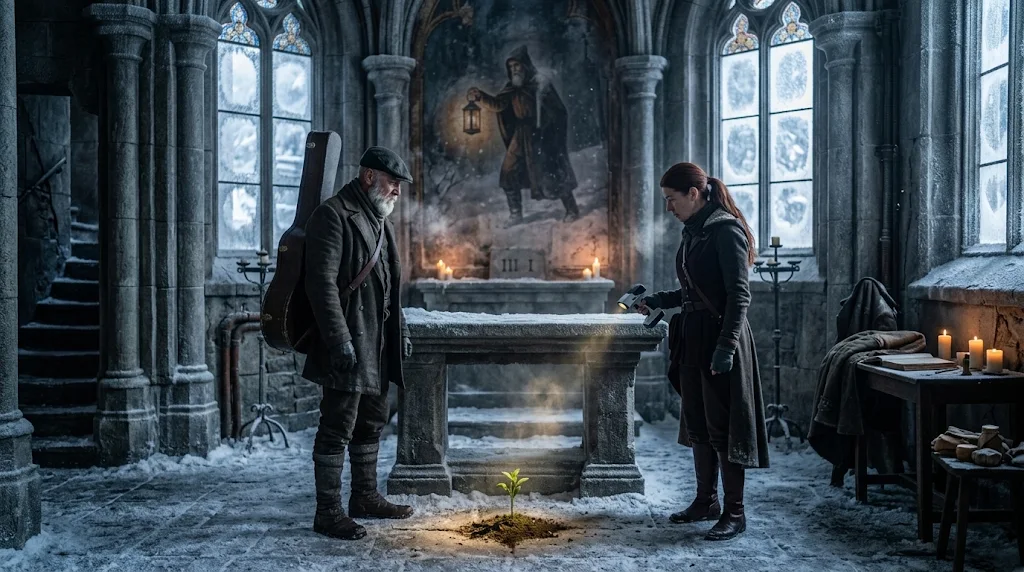
He gestures towards an image of an ancient Imperial chapel.
Beyond its thick walls, an ice world lies buried beneath centuries of snow. Generations have lived and died without knowing a warm summer.
Yet beside the chapel altar, a tiny green plant has begun to grow.
ELJARA:
“That’s remarkable.”
SEAN:
“Especially when the soil hasn’t thawed in living memory.”
“Has anyone measured the temperature?”
“Aye. The ground around the plant is warm.”
“And the source of the heat?”
“Unknown.”
She studies the little leaves.
ELJARA:
“Then we have a genuine phenomenon that deserves investigation.”
SEAN:
“And a population that sees something rather more important.”
“What?”
“Hope.”
He looks towards the frozen settlement.
SEAN:
“Imagine spending your entire life keeping the cold outside your door. Then one morning, something green appears.”
Eljara nods.
ELJARA:
“To people who’ve never experienced spring, even a single leaf might feel like a promise.”
SEAN:
“And three nights later, a voice speaks beneath the altar.”
“What does it say?”
He pauses.
SEAN:
“The spring will return.”
WHY HUMANITY DREAMS OF SPRING
ELJARA:
“Winter has carried religious meaning throughout human history, but not always the same meaning.”
SEAN:
“Tell me.”
“In the ancient Greek story of Demeter and Persephone, the loss and return of fertility are connected with separation, grief and reunion.”
“A mother searching for her daughter.”
“Yes. A story involving agriculture, divine power, mortality and the relationship between the living world and the underworld.”
“And in the north?”
“The Fimbulwinter of Norse tradition belongs to the events preceding Ragnarök. In one influential account, three terrible winters pass without a summer between them.”
Sean looks towards the snow.
SEAN:
“An entire world approaching catastrophe.”
ELJARA:
“Exactly. We shouldn’t pretend these traditions teach the same thing merely because both concern winter.”
“But they show how people have tried to understand suffering and renewal.”
“Yes.”
Sean studies the chapel.
SEAN:
“Then imagine what a thousand years of winter could do to a community’s religion.”
ELJARA:
“It might reshape the stories people tell about endurance, punishment, hope and salvation.”
“And make the promise of spring almost irresistible.”
“Especially to people who believe they have no other way out.”
THE SAINT BENEATH THE MOUNTAIN
An old painting hangs behind the chapel altar.
It depicts a woman carrying a lantern through the snow.
SEAN:
“The people call her the Lady of Returning Light.”
ELJARA:
“An official Imperial saint?”
“Not that anyone can establish. It’s a local tradition.”
“What do the records say?”
“The chapel priest believes she was a servant of the Emperor who descended beneath the mountain and promised to return.”
“And the older records?”
“They describe the lantern-bearer without clearly identifying her.”
Eljara considers this.
ELJARA:
“Then different generations may have understood the same story in different ways.”
SEAN:
“Which isn’t unusual in the Imperium.”
The Imperial Creed has spread across countless worlds, often incorporating local customs into forms of devotion directed towards the Emperor. But tolerance has limits, and religious authorities can judge unfamiliar traditions heretical.
ELJARA:
“So the priest may sincerely believe the voice belongs to a holy figure.”
SEAN:
“While an Inquisitor might suspect something from the Warp.”
“And a scholar might ask whether the legend predates Imperial settlement.”
Sean nods.
SEAN:
“Three explanations. One green plant.”
ELJARA:
“And none of them established merely by the plant’s existence.”
WHEN A MIRACLE IS REAL
SEAN:
“Now here’s what makes the situation dangerous.”
ELJARA:
“What?”
“The warmth is real.”
He shows her the measurements.
The temperature beneath the chapel has risen. The soil is no longer frozen. The plant continues to grow.
SEAN:
“Something has changed.”
ELJARA:
“Yes. But we still don’t know why.”
“Ancient machinery?”
“Possible.”
“Geothermal heat?”
“Also possible.”
“A psychic phenomenon?”
“In the Warhammer universe, certainly worth considering.”
“And a genuine miracle?”
She looks at him.
ELJARA:
“The setting includes extraordinary manifestations associated with Imperial faith. We cannot simply dismiss that possibility.”
“Nor can we assume that anything supernatural is holy.”
“Exactly.”
Sean leans back.
SEAN:
“Because Chaos doesn’t always arrive screaming.”
ELJARA:
“No.”
“Sometimes it offers the one thing people desperately need.”
“Which makes the offer powerful.”
He gestures towards the frozen homes.
SEAN:
“A warm room. Enough food. Children who no longer freeze.”
ELJARA:
“None of those desires is wrong.”
SEAN:
“But someone might exploit them.”
She nods.
ELJARA:
“A genuine benefit does not prove that the giver is benevolent.”
THE PRICE OF SPRING
SEAN:
“Then the voice speaks again.”
ELJARA:
“What does it say?”
“Nothing returns without a gift.”
Eljara falls silent.
SEAN:
“At first, people bring offerings to the chapel.”
“Such as?”
“Food. Candles. Personal possessions. Things that matter to them.”
ELJARA:
“Religious offerings can express gratitude, devotion or petition. They aren’t inherently sinister.”
“No. But the priest says each gift brings spring closer.”
“Does he have evidence?”
“None that we can verify.”
Sean opens a settlement ledger.
SEAN:
“Then the priest announces that the Lady requires a living pilgrim to descend beneath the shrine.”
Eljara looks up.
ELJARA:
“Who volunteers?”
“Nobody.”
“Then who is chosen?”
“An unregistered worker. Someone without legal protection or a recognised place in the colony’s rationing system.”
Her expression hardens.
ELJARA:
“That’s not a voluntary sacrifice.”
SEAN:
“The priest calls it an honour.”
“An honour imposed on someone else?”
“A chance to save the colony, he says.”
ELJARA:
“Then we must ask who has the authority to demand that price—and why the people choosing it aren’t the ones expected to pay.”
Sean nods.
SEAN:
“There’s a difference between risking your own life to save others and declaring somebody else’s life expendable.”
ELJARA:
“And calling a victim a martyr doesn’t erase that difference.”
He looks at the little green plant.
SEAN:
“Strange, isn’t it? A promise of new life has become an excuse to take one.”
THE GOD WHO ANSWERS
The chapel’s instruments register another increase in temperature.
Beneath the altar, something produces a sequence of vibrations.
Three pulses.
A pause.
A fourth.
SEAN:
“Those sounds again.”
ELJARA:
“Are they connected with the heat?”
“We don’t know.”
“Geological movement?”
“Possible.”
“Machinery?”
“Possible.”
“Something attempting to communicate?”
Sean looks at her.
SEAN:
“That’s what the priest believes.”
ELJARA:
“But the sequence alone doesn’t prove it.”
“No.”
Then a recording from the empty chapel arrives.
A voice is audible.
Soft.
Almost gentle.
You have mistaken the gift.
A pause.
I did not ask for what you could spare.
Another pause.
I asked for what you could not bear to lose.
The recording ends.
ELJARA:
“Has anyone identified the speaker?”
SEAN:
“No.”
“Then we still don’t know whether the source is technological, psychic or something else.”
He nods.
SEAN:
“But we know the priest’s interpretation was never established.”
ELJARA:
“And that the voice appears to be demanding something more.”
Sean looks towards the chapel.
SEAN:
“Or something different.”
A SPRING WITHOUT SACRIFICE
SEAN:
“What would you do?”
ELJARA:
“First, protect the person selected for the descent.”
“And then?”
“Investigate the heat source without agreeing to an irreversible ritual.”
Sean considers the measurements.
SEAN:
“What if there’s an ancient machine beneath the chapel?”
ELJARA:
“Then perhaps the colony could learn to use its heat safely.”
“Warm homes.”
“Possibly.”
“Greenhouses.”
“Perhaps.”
“Food for the children.”
“If the technology can be understood and operated safely.”
Sean smiles.
SEAN:
“Imagine that. Spring arriving because people learned to cooperate instead of sacrificing one another.”
ELJARA:
“That would be a far better discovery than an unexplained command.”
He looks towards the little plant.
SEAN:
“Perhaps the greatest danger isn’t believing in miracles.”
ELJARA:
“What is?”
“Believing that a miracle gives someone the right to demand cruelty.”
She nods.
ELJARA:
“Faith, hope and curiosity need not be enemies of responsibility.”
“And what about the voice?”
“We keep investigating.”
Sean smiles faintly.
SEAN:
“Because a promise that cannot survive a question is a very dangerous promise.”
Outside, the winter continues.
The green shoot remains alive.
And somewhere beneath the chapel, the warmth is growing.
THE QUESTION WE LEAVE OPEN
SEAN:
“If a voice beneath the ice promised to end your world’s suffering, would you listen?”
ELJARA:
“And if it demanded something precious in return, how would you decide whether the bargain was just?”
SEAN:
“What if the miracle was genuine?”
ELJARA:
“Then the question would become even more important.”
The long winter has taught the colony how to endure. Now it must decide what it is willing to become in order to see spring.
PLAY EPIC. FEEL THE STORY.
Not every miracle is a blessing. Not every promise of salvation is made in good faith.
In Black Tide: Shadow of Leviathan, faith, fear and difficult choices shape the fate of entire communities. What you believe matters. What you are willing to sacrifice matters even more.
Explore Black Tide on Mythveil Chronicles · Join the campaign on StartPlaying
Real TTRPG. Real story. Real choices. Real consequences.