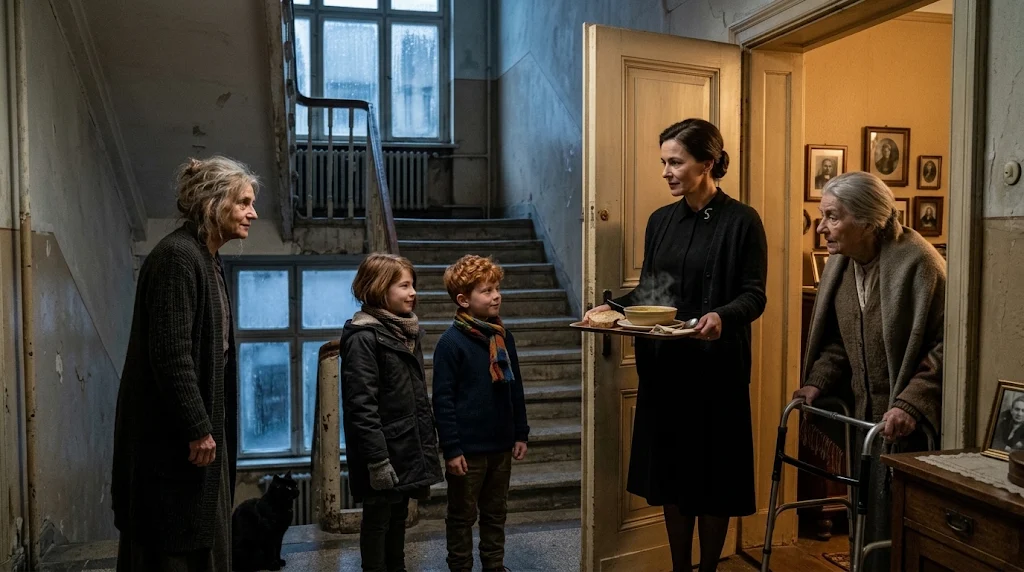

World of Darkness · November 2026 · Week 2 · The Price of Warmth
Mara & Chibi — A World of Darkness Short Story
At six twenty on a November evening, Chibi announced that he had discovered a fundamental problem with charity.
Mara looked at him.
“Go on.”
“It has too many stairs.”
They stood on the fourth-floor landing of an old apartment building in Berlin-Moabit. The heating had failed again, and cold air crept through the windows.
Down in the cellar, a place called the Hearth was serving hot soup.
The room was warm. The food was free. Everyone was welcome.
There was just one difficulty.
Frau Kessler couldn’t reach it.
She was seventy-eight, a retired postal worker with a troublesome knee and a walking frame. She lived alone at the top of the building, and the stairs had become an expedition she could no longer manage without help.
Mara had knocked because she hadn’t seen the old woman all day.
Frau Kessler opened the door with a woollen blanket around her shoulders.
“Good evening, you two.”
“Are you cold?” Mara asked.
“A little.”
Chibi glanced at the radiator behind her.
“Your heating’s broken too?”
“Afraid so.”
“There’s soup downstairs.”
“I know.”
“And blankets.”
“I know that too.”
“And a perfectly ridiculous number of chairs.”
Frau Kessler smiled.
“Then it sounds lovely.”
“Why don’t you come?”
She looked towards the staircase.
For a moment, she said nothing.
Then she tapped her walking frame.
“Because, my dear boy, getting down those stairs would be difficult. Getting back up would require a small miracle.”
Chibi considered this.
“Have you tried complaining to the stairs?”
“Repeatedly.”
“Any results?”
“Not the slightest.”
He nodded gravely.
“Typical management.”
Mara and Chibi found Clara Winter in the cellar.
The Hearth was already busy.
People sat around small tables, drinking tea and eating vegetable soup. Warm lamps shone upon old rugs and wooden furniture. Beside the entrance stood a newly painted notice.
NO MEMBERSHIP REQUIRED. NO OBLIGATION TO ATTEND.
Chibi examined it.
“That’s good.”
Clara approached with a tray of empty bowls.
“I’m glad you approve.”
“We’ve found a problem,” Mara said.
Clara stopped.
“Something wrong with the food?”
“No.”
“The heating?”
“No.”
“The chairs?”
“Only their location,” Chibi explained.
Clara raised an eyebrow.
Mara pointed upwards.
“Frau Kessler lives on the fourth floor. Her knee is bad. She can’t come down.”
Clara looked towards the stairs.
“I’m sorry to hear that.”
“Could you take her some soup?”
Adrian, the young volunteer arranging bread behind the counter, looked up.
“We don’t normally do deliveries.”
“Why not?” Mara asked.
“Because we have to organise the volunteers, keep track of the food and make sure everyone gets enough.”
“That sounds sensible,” Chibi admitted.
“Thank you.”
“But she’s still cold.”
Adrian opened his mouth.
Then closed it again.
Clara studied the children.
“We can prepare a bowl for her.”
“And take it upstairs?” Mara asked.
“Yes.”
Chibi looked relieved.
“Excellent. I was beginning to think we’d discovered the world’s first charitable organisation defeated by geography.”
Frau Varga appeared beside them.
Her black cat had apparently been following the children.
The animal inspected the soup counter with the grave expression of a government official looking for irregularities.
“What’s happening?” the old woman asked.
“An expedition,” Chibi replied.
“To where?”
“The fourth floor.”
“Remarkably ambitious.”
“There’s soup involved.”
“Ah. Now I understand.”
Clara took a clean tray.
Adrian placed a bowl upon it, together with bread, a spoon and a folded napkin.
Then he reached for his notebook.
“I’ll put Frau Kessler on the delivery list.”
Mara looked up.
“Did she ask to be on a list?”
Adrian hesitated.
“It’s just for organising things.”
“Will you invite her to your meetings?”
“Perhaps, if she’s interested.”
“But she hasn’t said she’s interested.”
Clara rested a hand on the counter.
“Adrian.”
“Yes?”
“Record that we’ve delivered one meal to the fourth floor. Nothing more unless she wants us to keep her details.”
He looked surprised.
“What about future deliveries?”
“We can ask her whether she would like them.”
“And if she doesn’t?”
“Then we don’t arrange them.”
Adrian considered this.
“That makes planning harder.”
“It does.”
Clara picked up the tray.
“But apparently we’re learning to distinguish between helping people and acquiring them.”
Frau Varga smiled into her tea.
Chibi whispered to Mara, “I think we’re improving the establishment.”
The climb took considerably longer than Clara expected.
Not because the stairs were particularly difficult.
Because Chibi insisted upon counting them.
“Seventy-three. Seventy-four. Seventy-five.”
“Chibi,” Mara said.
“Seventy-six.”
“Please.”
“Seventy-seven. Historical accuracy matters.”
Clara glanced at Frau Varga.
“Is he always like this?”
“Only when awake.”
“Seventy-eight!”
“Which,” Frau Varga continued, “is unfortunately most of the day.”
At the top, Clara knocked on Frau Kessler’s door.
The old woman opened it cautiously.
“Yes?”
“Good evening,” Clara said. “I’m Clara Winter, from the Hearth.”
Frau Kessler’s expression changed.
“Oh.”
“We heard you were having difficulty getting downstairs.”
“I’m managing.”
“I’m sure you are.”
Clara lifted the tray slightly.
“But we brought supper, in case you’d like some.”
Frau Kessler looked at the steaming bowl.
Then at Clara.
“Do I have to sign anything?”
“No.”
“Give you my telephone number?”
“No.”
“Come to one of your gatherings?”
“Absolutely not.”
Frau Kessler remained in the doorway.
“You’re very sure about that?”
Clara hesitated.
Not because she didn’t know the answer.
Because she understood how much the answer mattered.
“Yes,” she said. “I’m sure.”
The old woman stepped aside.
“Then perhaps you’d better come in before the soup gets cold.”
Her apartment was small and tidy.
Old photographs stood along the mantelpiece. A pair of battered walking shoes rested beside the door. On the kitchen wall hung a framed certificate recognising forty years of postal service.
Chibi studied it.
“You delivered letters for forty years?”
“Forty-two.”
“That’s a lot of letters.”
“It certainly was.”
“Did you read them?”
Frau Kessler gave him a look.
“Of course not.”
“Not even the interesting ones?”
“Especially not those.”
Chibi thought about that.
“You must have been very trustworthy.”
“I tried.”
Mara helped set the table while Clara placed the soup before the old woman.
Frau Kessler tasted it.
Her eyes closed briefly.
“Oh, that’s good.”
Clara smiled.
“I’m glad.”
For a while, nobody spoke.
Then Frau Kessler set down her spoon.
“Last winter, another group offered to help me.”
Clara listened.
“They brought groceries. Helped with a few forms. Very nice people.”
“What happened?” Mara asked.
“They began asking me to attend their meetings. Then to make donations. Then to persuade my neighbours to join.”
Chibi frowned.
“Did you want to?”
“No.”
“Then why didn’t you just tell them?”
“I did.”
Frau Kessler looked at her bowl.
“After that, they stopped visiting.”
The kitchen fell quiet.
Clara’s expression grew serious.
“I’m sorry.”
Frau Kessler shrugged.
“People are entitled to decide how they spend their time.”
“Yes,” Clara replied.
“But it taught you not to trust offers of help.”
The old woman looked up.
“Yes.”
Clara Winter belonged to the Ministry.
She was Kindred, a vampire who had survived far longer than anyone in the apartment could imagine.
She understood how gratitude could become loyalty.
How loyalty could become obligation.
And how obligation could become a chain that the person wearing it would sometimes defend.
Her faith spoke of liberation from the powers that governed human lives.
Yet she belonged to a community that also understood the usefulness of dependence.
There were members of the Ministry who would have regarded Frau Kessler as an opportunity.
Clara looked at the old woman’s hands wrapped around the warm bowl.
Tonight, she decided not to.
“May I ask you something?” Clara said.
Frau Kessler nodded.
“If we offered to bring you soup again tomorrow, would you want us to?”
“Perhaps.”
“Then we’ll ask before arranging anything.”
“And if I say no?”
“Then you’ll have said no.”
Frau Kessler studied her face.
“And I’ll still be welcome downstairs?”
“Of course.”
“Even if I never attend one of your meetings?”
“Yes.”
Mara smiled.
Chibi looked thoughtful.
“Actually, I have another question.”
Clara closed her eyes.
“Of course you do.”
“If the soup is free, does that mean the bread is free too?”
“Yes.”
“And the biscuits?”
Frau Varga sighed.
“There it is. The real investigation.”
Before leaving, Clara offered to bring additional blankets.
Frau Kessler accepted one.
She declined another delivery that evening.
Nobody argued.
At the door, she suddenly remembered something.
“Wait.”
She disappeared into the kitchen and returned carrying a large old thermos.
“I don’t use this much anymore.”
Clara looked at it.
“Are you sure?”
“It still works perfectly. You could use it for your deliveries.”
“You don’t have to give us anything.”
“I know.”
Frau Kessler smiled.
“That’s why I’d like to.”
Clara accepted the thermos.
“Thank you.”
“And one more thing.”
“Yes?”
“If you ever need help sorting letters or filling envelopes, I can do that sitting down.”
Chibi looked delighted.
“A professional!”
“A retired professional,” Frau Kessler corrected.
“Even better. More experience.”
For the first time that evening, Clara laughed without any hesitation.
Later, when the children had gone upstairs, Adrian found Clara in the warming room.
She was washing the donated thermos.
“Are we starting a delivery service?”
“Not quite.”
“Then what are we doing?”
“Trying to help people who can’t come here.”
“We don’t have enough volunteers to visit everyone.”
“I know.”
“And we can’t promise food forever.”
“I know that too.”
Adrian folded his arms.
“Then what can we promise?”
Clara dried the thermos carefully.
“That we’ll tell the truth about what we can offer.”
He considered this.
“And we won’t expect them to join?”
“No.”
“Some of the others won’t like that.”
Clara glanced towards the dark wooden door leading to the Ministry’s inner chamber.
A serpent was carved into its surface.
Beyond it waited people who understood favours as the beginning of influence.
“I know,” she said.
Adrian lowered his voice.
“Will they make you change your mind?”
For a moment, Clara did not answer.
Then she put the thermos on the shelf.
“They may try.”
On the fourth floor, Frau Kessler sat beside her window.
The radiator was still cold.
Her knee still hurt.
The hospital appointments and household bills hadn’t disappeared.
But she had eaten a hot meal, and the blanket across her lap was soft.
Beside the empty bowl stood a little paper napkin.
On it, Chibi had written a note.
IF THE STAIRS WON’T LET YOU COME TO THE SOUP, THE SOUP WILL COME TO YOU.
Underneath, in smaller handwriting, Mara had added:
Only if you want it.
Frau Kessler read the note twice.
Then she laughed.
Across the courtyard, Frau Varga watched a light come on in the old woman’s window.
The black cat sat beside her.
“Well?” she asked him.
The cat blinked.
“Yes,” Frau Varga murmured. “Clara did something good.”
She glanced down towards the cellar.
“That doesn’t mean we’ve forgotten what she is.”
The cat began washing one paw.
“Quite.”
Below them, the warm room continued serving soup.
Behind its inner door, older obligations waited.
And somewhere between the cellar and the fourth floor, a small boundary had been redrawn.
Not every gift was a bargain.
Not every kindness had to become a debt.
And a place could only truly claim to welcome people when it remembered those who could not reach its door.
EXPLORE THE WORLD OF DARKNESS
A warm room can offer refuge. A generous gift can create loyalty. But what happens when kindness becomes a way to claim someone else’s freedom?
Discover Blood in the Bayou, our Vampire: The Masquerade chronicle set in New Orleans, where alliances, hidden motives and personal choices shape a world that remembers.
Campaign: Blood in the Bayou · Play on StartPlaying
Mythveil Chronicles — Worlds That Remember.