
English · Deutsch · Italiano · Español
The Long Winter · Week 2 — When Survival Becomes Tradition
Stacy & Caelwyn
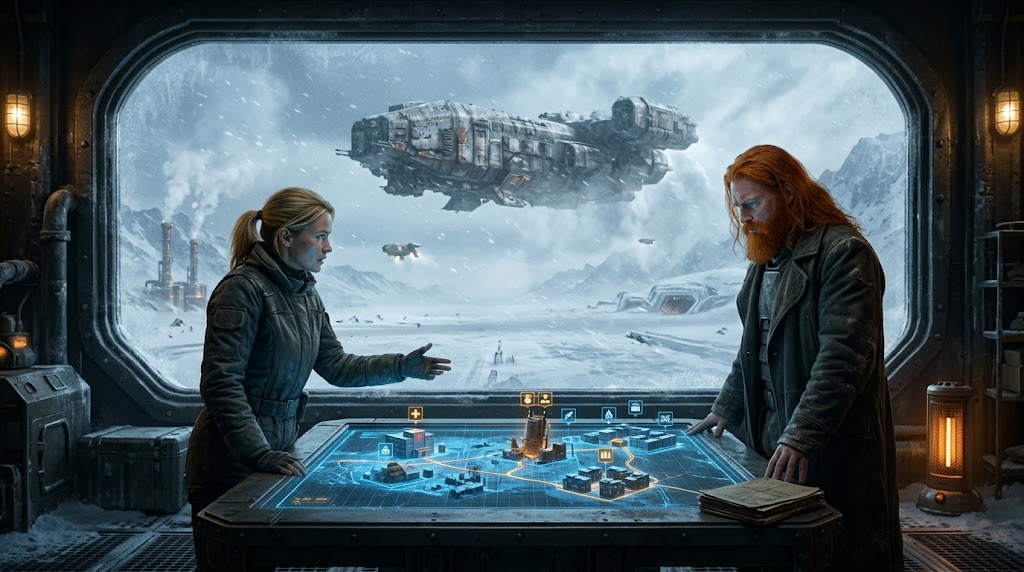
An Imperial ice world is under siege. The last expected supply ship has arrived. Its cargo could save thousands of lives—but there isn’t enough for everyone.
In the 41st millennium, victory is not always measured in enemies defeated. Sometimes it means keeping a world alive. Discover decisions with lasting consequences in Black Tide: Shadow of Leviathan.
THE SHIP ABOVE THE ICE
STACY:
“Imagine an Imperial ice world under siege.”
CAELWYN:
“Orks?”
“Approaching the settlement. The defenders are exhausted, food is running out and several heating systems have failed.”
“Then a supply ship arrives.”
“Exactly.”
“Excellent. Problem solved.”
Stacy brings up the cargo manifest.
Food. Medicine. Promethium. Ammunition. Replacement machinery.
STACY:
“There’s not enough of anything.”
CAELWYN:
“Of course there isn’t.”
“And nobody knows when another ship will arrive.”
“Then unload everything immediately.”
“Where?”
“The landing field.”
“Under Ork fire?”
Caelwyn studies the map.
CAELWYN:
“Somewhere safer, then.”
“The cargo lifts are damaged. The transport vehicles are limited. A blizzard is approaching.”
He sighs.
CAELWYN:
“This is going to be one of those conversations.”
STACY:
“One where the answer isn’t simply to shoot something.”
THE ENEMY WITHOUT A WEAPON
CAELWYN:
“The Valhallan Ice Warriors understand cold-weather warfare.”
STACY:
“They do. But experience doesn’t make anyone immune to freezing.”
“Proper clothing, equipment and training help.”
“And so do food, fuel, functioning machinery and medical care.”
Caelwyn examines the defensive positions.
CAELWYN:
“A regiment could win every firefight and still lose the campaign.”
STACY:
“Precisely. Soldiers need supplies even when they’re not firing. Equipment needs maintenance. Batteries perform differently in severe cold. Engines and weapons can fail if they’re not prepared for the conditions.”
“And a soldier with frozen hands isn’t much use to anyone.”
“Severe cold can impair coordination and judgment, yes.”
Caelwyn looks towards the approaching Orks.
CAELWYN:
“At least you can shoot an Ork.”
STACY:
“You can’t shoot a broken supply chain.”
“An unfortunate limitation of military technology.”
“Sometimes the most important person in a winter campaign is the one who knows how to keep the heating working.”
CAELWYN:
“Try putting that on a heroic Imperial recruiting poster.”
A ROAD MADE OF ICE
CAELWYN:
“Real history offers some rather grim examples.”
STACY:
“The Winter War?”
“Finland and the Soviet Union, 1939 to 1940. Winter mobility, local knowledge, equipment and logistics mattered enormously.”
STACY:
“Yes. Although winter alone didn’t determine the outcome. The Soviet Union ultimately gained territorial concessions, despite terrible losses.”
“And then there’s Leningrad.”
Stacy’s expression grows serious.
STACY:
“During the siege, Lake Ladoga became a vital supply route. In suitable winter conditions, supplies crossed the frozen lake along the Road of Life.”
CAELWYN:
“An actual road across the ice.”
STACY:
“An extraordinary logistical achievement amid immense civilian suffering. Transport capacity, weather, enemy action and the condition of the ice could determine whether supplies arrived.”
“So the same winter that threatened the city also offered a route to reach it.”
“Exactly.”
Caelwyn studies the Imperial transport again.
CAELWYN:
“Then getting supplies to a planet isn’t the same thing as getting them to its people.”
STACY:
“And having supplies doesn’t guarantee they can be used. Some medicines must not freeze. Machinery may require special handling. Cargo needs protection, storage and distribution.”
He folds his arms.
CAELWYN:
“I preferred the Orks.”
THE QUARTERMASTER’S CHOICE
Stacy highlights five locations.
A hospital.
A heating plant.
An underground agricultural facility.
A defensive position.
A residential district.
STACY:
“The ship can unload only a fraction of its cargo before the storm becomes too dangerous. Who receives the first supplies?”
CAELWYN:
“The heating plant.”
“Why?”
“Because without power, everything else begins to fail.”
“And the defenders?”
“They need ammunition.”
“And the hospital?”
“Medicine.”
“And the civilians?”
“Food.”
Stacy waits.
CAELWYN:
“You’re enjoying this far too much.”
STACY:
“I’m asking you to make a decision.”
He considers the settlement.
CAELWYN:
“Then I’d ask which failures become critical first. Which repairs can restore essential services? How long can the defenders hold? What does the hospital actually need to save lives immediately?”
STACY:
“Better.”
“And I’d speak to the people who understand those systems.”
“Rather than giving everything to whoever shouts loudest?”
“Precisely.”
Stacy shows him the governor’s residence.
STACY:
“The governor also wants heating fuel.”
CAELWYN:
“Does he?”
STACY:
“For his private apartments.”
CAELWYN:
“Then he can borrow a blanket.”
WHO GETS TO EAT?
STACY:
“The colony is also rationing food.”
CAELWYN:
“A reasonable emergency measure.”
“Some soldiers and outdoor workers receive larger rations because they have higher energy requirements.”
“Understandable.”
“But several civilian districts are receiving too little to remain healthy.”
“Then the system is failing them.”
STACY:
“What if the stores genuinely don’t contain enough food?”
CAELWYN:
“Then we have to reduce waste, protect vulnerable people and find ways to restore production.”
“Exactly. Fairness doesn’t always mean giving everyone identical portions. Different people have different needs.”
“But it certainly doesn’t mean giving the governor the best dinner.”
“Not without a defensible reason.”
He studies the figures.
CAELWYN:
“A ration ledger can look perfectly orderly while people starve.”
STACY:
“Because a ledger cannot tell us whether supplies actually reached the people listed on it.”
CAELWYN:
“Or whether somebody diverted them along the way.”
“That’s something to investigate, not merely assume.”
He nods.
CAELWYN:
“Winter doesn’t create every injustice.”
STACY:
“But scarcity can expose the ones already present.”
WHEN EMERGENCY BECOMES TRADITION
STACY:
“Now imagine the colony survives.”
CAELWYN:
“Finally, some good news.”
“The Orks are defeated. The generators are repaired. New supplies arrive.”
“And the rationing ends.”
“No.”
Caelwyn stares at her.
STACY:
“The authorities keep the emergency controls because another crisis might occur.”
“Of course they do.”
“Fifty years pass. Then a hundred. Children are taught that their ancestors survived because everyone obeyed the rationing laws.”
CAELWYN:
“And eventually questioning those laws becomes disrespectful.”
STACY:
“Perhaps even heretical.”
“Despite the food shortage having ended generations ago.”
“Yes.”
Caelwyn considers the settlement.
CAELWYN:
“Then survival has become tradition.”
STACY:
“Which isn’t necessarily bad. Emergency reserves, maintenance routines and survival training can be valuable traditions.”
“But permanent restrictions and unquestionable authority might preserve the wrong things.”
“Exactly.”
He looks back at the ship.
CAELWYN:
“Then the greatest danger isn’t always that people forget the winter.”
STACY:
“What is?”
“That they remember the wrong lessons.”
THE QUESTION WE LEAVE OPEN
The final cargo landers descend towards the frozen settlement.
Below them, soldiers defend the landing field. Engineers wait for replacement parts. Medical workers prepare for the wounded. Families hope that food and fuel have finally arrived.
STACY:
“If this were your city, who should decide how the last supplies are distributed?”
CAELWYN:
“And when your children remember this winter, will they inherit the knowledge that saved you—or the fear that kept you obedient?”
PLAY EPIC. FEEL THE STORY.
In Black Tide: Shadow of Leviathan, every decision has consequences beyond the battlefield. Duty, survival and sacrifice may collide—but the world remembers your choices.
Explore Black Tide on Mythveil Chronicles · Join the campaign on StartPlaying
Real TTRPG. Real story. Real choices. Real consequences.