Cosmere · Spooky October · Week 1

The impossible becomes ordinary when people have lived beside it long enough. Enter Stonewalkers: The Lost Honorblade of Roshar.
MARA:
“Chibi?”
CHIBI:
“Shh.”
MARA:
“What are you doing?”
CHIBI:
“Waiting.”
“For what?”
“For it to move.”
Mara looked down too.
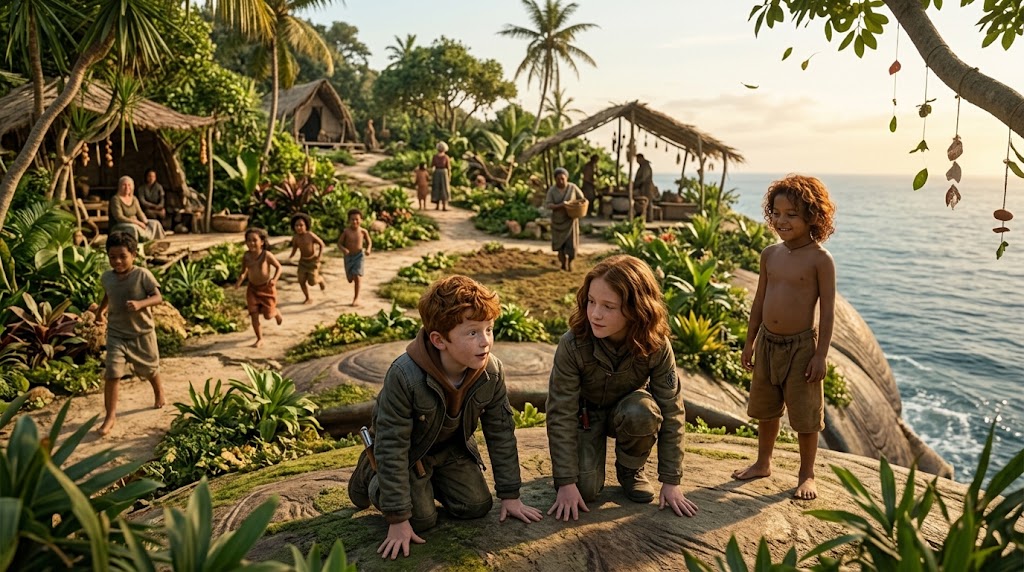
The ground beneath their feet was covered with plants, woven paths, shelters and all the ordinary evidence that people lived here.
Nothing moved.
At least, nothing that looked like an island moving.
“You know you’re standing on it?”
“Yes.”
“The whole time?”
“Yes.”
“And it’s alive?”
“Yes.”
Chibi frowned.
Then he crouched and put both hands flat against the ground.
Mara waited.
“Well?”
“I don’t know.”
“What don’t you know?”
“If it knows I’m here.”
Mara considered this.
“You could say hello.”
Chibi looked horrified.
“What if it says hello back?”
There are probably easier places to explain the difference between natural and supernatural than the Reshi Isles.
An island is supposed to be land.
That seems straightforward.
Except when the island is alive.
The Reshi live upon enormous creatures called Tai-na.
They build homes there.
They hunt and gather there.
Children grow up there.
Families remember where things are on a landscape that is itself a living being moving through the sea.
To an outsider, this is astonishing.
Possibly terrifying.
To a child born there, it is home.
That difference matters.
Especially in October.
Because when adults talk about frightening things, we often imagine that fear begins with the thing itself.
Darkness is frightening.
Ghosts are frightening.
Monsters are frightening.
Dead things are frightening.
Living islands are certainly frightening.
Children are less cooperative.
They learn what deserves fear.
And they learn it from us.
A Reshi child had found Chibi.
This was unfortunate for everyone except the two children.
Neither spoke the other’s language particularly well.
This presented no obvious obstacle.
Within minutes they had invented a game.
Mara was not certain about the rules.
She was fairly certain neither player was either.
It involved jumping between patches of ground, avoiding certain cracks and touching a wooden post before the other person did.
“What happens if you step there?” Mara asked.
Chibi pointed at one of the forbidden patches.
“You die.”
The Reshi child said something.
Chibi listened.
“No. Sorry.”
He pointed again.
“Then the island eats you.”
Mara stared at him.
“That seems worse.”
“Yes.”
“Why are you smiling?”
“Because I’m winning.”
He jumped.
The other child shouted.
Chibi froze.
“What?”
The child pointed urgently towards his foot.
Chibi looked down.
He had landed beside a small opening between thick growths.
Something moved inside.
He jumped backwards so quickly that Mara laughed.
“That wasn’t funny.”
“It was a little funny.”
“There was a thing.”
“There are lots of things.”
“It had legs.”
“That doesn’t narrow it down much.”
The Reshi child was laughing now too.
Chibi folded his arms.
“I don’t like this game anymore.”
The child pointed towards another path.
Chibi immediately followed.
Mara sighed.
Apparently the game had recovered.
Children’s games are strange things.
They are full of death.
You are dead.
The monster got you.
Don’t touch the floor.
Don’t cross the line.
Run before it catches you.
Hide.
Stay quiet.
Don’t let it see you.
Then everyone gets up and plays again.
Adults sometimes treat this as meaningless.
It isn’t always.
Games can teach boundaries.
Timing.
Danger.
Cooperation.
Courage.
When to run.
When not to run.
Which places are safe.
Which places are not.
A warning repeated by an adult can become boring.
A rule inside a game can become unforgettable.
And in a world like Roshar, some of those rules may have begun with something very real.
That does not mean every children’s story is secretly a survival manual.
Sometimes a silly game is simply a silly game.
Children deserve that too.
But stories and games have always been good places to hide knowledge.
Especially knowledge children need before they are old enough to understand why they need it.
Mara began to realise that the game had a geography.
Certain places were always safe.
Others were crossed quickly.
One particular patch was never stepped on.
At first she assumed this was part of the invented game.
Then she noticed an adult avoiding it too.
Mara stopped.
“Chibi.”
He was halfway through another jump.
“What?”
“I don’t think that bit is part of the game.”
He looked at the forbidden patch.
Then at the Reshi child.
“Why not?”
“I think the game is part of that bit.”
Chibi stared.
“That doesn’t make sense.”
“It does a little.”
“No.”
“You’re learning where not to go.”
“I was winning.”
“You can do both.”
He considered this.
“That seems suspicious.”
There is something wonderfully unsettling about growing up somewhere the ground beneath your feet is alive.
Most of us learn that the world is divided into things that are alive and things that are not.
Dog: alive.
Tree: alive.
Rock: not alive.
House: not alive.
Island: definitely not alive.
It is one of those categories that feels obvious until a fantasy world calmly refuses to cooperate.
For the Reshi, the distinction cannot work in quite the same way.
Home is not simply built on the world.
Home is built on someone.
Or something.
Even those words become difficult.
A Tai-na can be habitat, creature and object of reverence at once.
You can live upon it without reducing it to property.
You can depend upon it without pretending you control it.
You can know things about its behaviour without knowing everything it is.
For Mara, that was not frightening.
Not yet.
It was beautiful.
For Chibi, it was beautiful for approximately twelve minutes.
Then he asked the obvious question.
“What happens when it dies?”
Mara stopped.
The question had apparently occurred to neither of them until then.
Now it was impossible to put back.
Children do that.
Adults can spend hours discussing religion, ecology and philosophy without approaching the question sitting directly in the middle of the room.
A child arrives.
Points.
“What happens when it dies?”
There it is.
Mara looked across the island.
People had built lives here.
Not temporary camps.
Lives.
Children had been born here.
People had fallen in love here.
Arguments had happened.
Meals had been eaten.
Stories had been told.
People had died.
Generations could know the shape of this living place as intimately as other people know a village street.
What happens when your home can die?
Not burn.
Not collapse.
Not be conquered.
Die.
Mara did not know.
Neither did Chibi.
And neither of them invented an answer.
That mattered too.
Later they found the Reshi child again.
Chibi tried to ask.
This took some time.
First he pointed down.
Then pretended to sleep.
Then shook his head.
Then stuck out his tongue and went dramatically limp.
Mara stared at him.
“That is terrible.”
“You knew what I meant.”
“I did.”
“So it worked.”
The other child eventually understood.
The answer was longer than either Mara or Chibi could properly follow.
There were gestures towards the island.
Towards the sea.
Towards distant shapes.
A name was repeated.
Then another.
There was no single neat answer.
But there was something else.
The child did not seem surprised by the question.
Nor especially frightened by it.
Chibi looked at Mara.
“He knows it can die.”
“Yes.”
“And he still lives here.”
“Yes.”
Chibi looked genuinely puzzled.
“Why?”
Mara looked down at the ground.
“Because it’s home.”
That answer seemed to annoy him.
“That’s not a reason.”
“It is.”
“No. If something can die, you should live somewhere that can’t.”
Mara thought about that.
“Where?”
Chibi opened his mouth.
Nothing came out.
Mara waited.
Finally he pointed vaguely towards the horizon.
“There.”
“The sea?”
“No.”
“Another island?”
He hesitated.
“That one might die too.”
“Yes.”
“A rock island.”
“Highstorms.”
“A mountain.”
“Mountains can break.”
“A city.”
“Cities can be destroyed.”
Chibi frowned harder with every answer.
Eventually he sat down.
“This world is badly designed.”
Mara sat beside him.
“I think that’s all worlds.”
That was when the question stopped being about the Reshi Isles.
Homes are not permanent.
Neither are families.
Neither are cities.
Neither are countries.
Neither are bodies.
Children learn this slowly if they are lucky.
Quickly if they are not.
Adults spend much of their lives finding increasingly complicated ways not to think about it.
We insure houses.
Repair walls.
Write wills.
Build monuments.
Keep photographs.
Tell stories.
Plant trees whose shade we may never sit beneath.
We know things end.
And then we make homes anyway.
Perhaps living on a Tai-na simply makes that truth harder to hide.
The island beneath you is alive.
Therefore it can die.
That sounds frightening.
But the other side is equally important.
The island beneath you is alive.
Therefore your home is not merely somewhere you live.
It is something with which you live.
By late afternoon, Chibi had returned to the game.
Mara watched him leap over the forbidden patch.
This time he did not need to be warned.
He had learned.
The Reshi child shouted something.
Chibi shouted something back.
Neither sentence appeared to mean anything in the other’s language.
Both children understood perfectly.
Then the ground shifted.
Only slightly.
A long, deep movement beneath them.
Mara froze.
Chibi froze.
For one extraordinary moment, the entire world beneath their feet seemed to breathe.
Chibi’s eyes became enormous.
“Mara.”
“Yes.”
“It moved.”
“I noticed.”
“It really moved.”
“Yes.”
The Reshi child barely reacted.
That somehow made it stranger.
Chibi slowly crouched.
Once again he placed both palms against the ground.
This time Mara joined him.
They waited.
Nothing happened.
Chibi whispered:
“Do you think it knows we’re here?”
Mara thought about the people who had lived on this creature for generations.
About the stories they told.
About children learning which places to avoid by turning warnings into games.
About a home that moved through the sea.
About something so enormous that two small hands touching its back might mean nothing at all.
“I don’t know.”
Chibi nodded.
For once he seemed satisfied with that answer.
Then he leaned closer to the ground.
“Hello.”
Mara smiled.
They waited.
Nothing answered.
At least nothing they could understand.
Perhaps this is another way ordinary people learn to live with the supernatural.
They stop needing everything strange to stop being strange.
They learn its rules.
They tell stories about it.
They play around it.
They respect what can hurt them.
They laugh.
They teach their children.
And eventually something that would terrify an outsider becomes the place where somebody puts a child to bed.
That does not make the danger unreal.
It does not make every belief true.
It does not make death disappear.
It does something more ordinary.
It makes life possible beside all of them.
Azir can write procedures for the uncertain.
The listeners can live within relationships between body, spren, rhythm and identity that outsiders struggle even to name.
And here, on the Reshi Isles, a child can run across the back of something enormous enough to be mistaken for geography.
Perhaps that is the simplest answer we have found this week.
What happens when people live with the supernatural long enough?
Sometimes they build religions around it.
Sometimes laws.
Sometimes rituals.
And sometimes—
they invent a game.
Chibi suddenly jumped to his feet.
“Mara!”
“What?”
“You’re dead.”
“What?”
“You stepped on the wrong bit.”
“I did not.”
“You did.”
“When?”
“Before.”
“That doesn’t count.”
“It does.”
“Why?”
Chibi grinned.
“Island rules.”
Mara stared at him.
Then at the Reshi child, who was already laughing.
She got up.
“Fine.”
Chibi ran.
Mara chased him.
Beneath them, impossibly large and completely alive, their island carried them onwards.
Want to live inside a Roshar that remembers what you do? Join Stonewalkers on StartPlaying.
Spooky October · Cosmere · Week 1: Mara & Chibi — The Island That Breathes · Stacy & Caelwyn — The Things Azir Has a Form For · Sean & Eljara — The Rhythm After the Voice