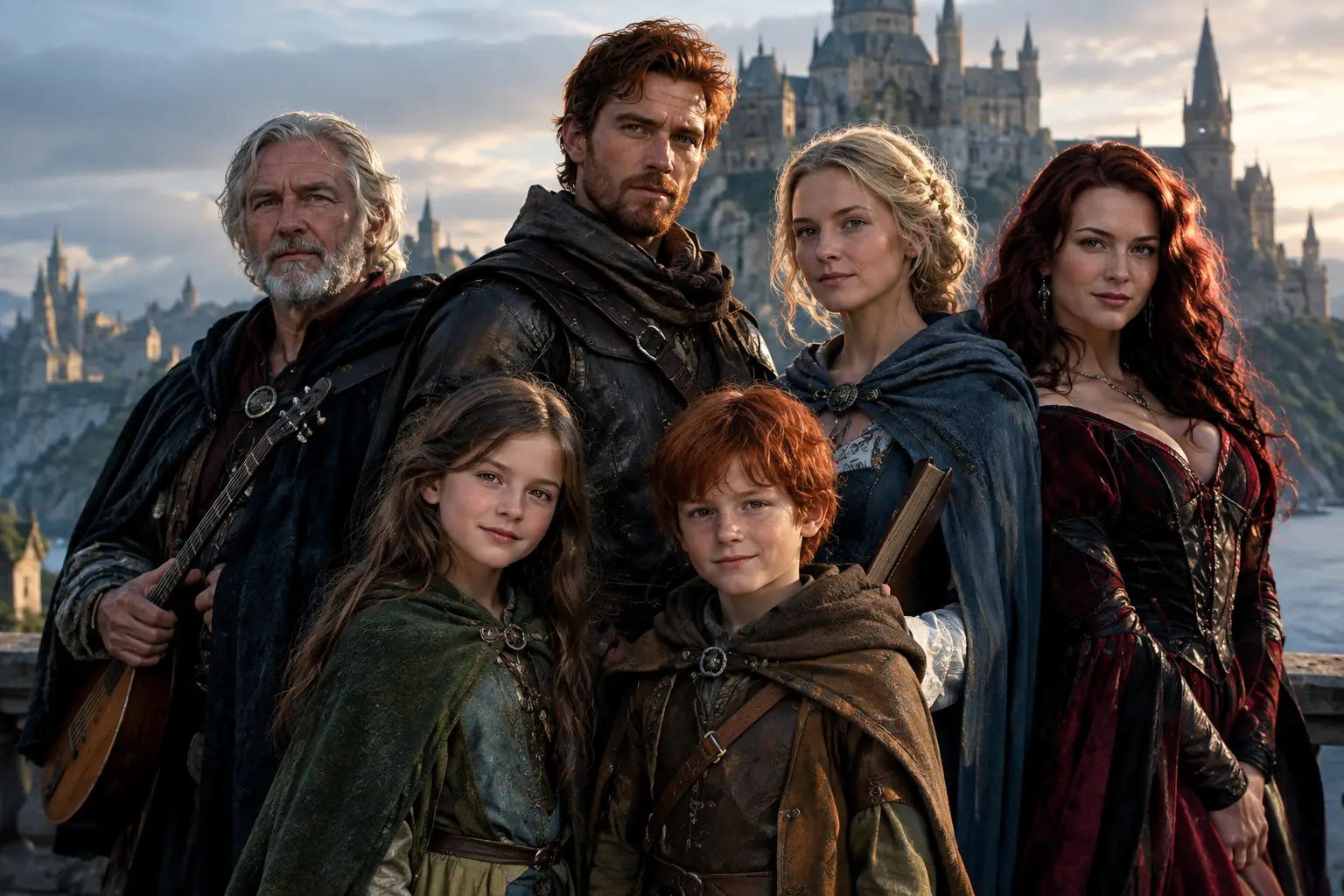
Political Intrigue RPG Recommendations That Last
The vote is due at dawn.
Your patron has offered protection.
Your rival has offered proof.
The person you love has asked you not to open the sealed letter.
By breakfast, the city may have a new ruler.
By winter, it may be burning.
The finest political intrigue RPGs are not simply games with nobles, councils, conspiracies or elaborate maps.
They understand that power is relational.
Someone controls the grain.
Someone controls the guards.
Someone knows which priest can be persuaded.
Someone owes somebody else a favour they desperately hope will never be called in.
And while the characters are deciding what to do, all of those people are making decisions of their own.
Political play lasts when three things are true:
Power is distributed.
Information is dangerous.
And time continues to move.
That is why choosing the right system matters.
But it is also why the system alone is never enough.
What political intrigue needs from an RPG
A setting can contain kings, senates, guilds, clans and centuries of hereditary resentment without producing meaningful intrigue.
Political play needs pressure.
Several people or organisations must want incompatible things.
They need resources with which to pursue those goals.
They need relationships that make direct action costly.
And, crucially, they must be able to act even when the player characters are looking somewhere else.
The best rules support some part of this.
Reputation.
Status.
Obligations.
Favours.
Social standing.
Resources.
Territory.
Investigation.
Faction relationships.
Institutional authority.
But rules cannot create political play on their own.
A secret should not simply be a clue that opens Scene Seven.
It should be dangerous to possess.
It might free a prisoner.
Destroy a marriage.
End a career.
Start a war.
Save a neighbourhood.
Or expose the characters who discovered it.
That is when information becomes political.
Political campaigns also need a table comfortable with disagreement.
Character conflict is not player conflict.
Betrayal in the fiction is not permission to violate trust at the table.
A Session Zero conversation about themes, boundaries, ambition, PvP, secrets and the acceptable level of betrayal is not administrative clutter.
It is the treaty that allows everyone to enjoy breaking treaties later.
With that foundation in place, several games offer particularly strong environments for political play.
Vampire: The Masquerade — power as intimacy
Few roleplaying games understand the uncomfortable intimacy of power as well as Vampire: The Masquerade.
Its cities are courts disguised as nightlife.
Every favour has interest.
Every invitation has meaning.
Every public apology probably has three audiences.
A Prince, Baron, Sheriff, Harpy, clan representative, cult leader or mortal institution becomes compelling when their authority depends upon relationships rather than simply a title on an organisational chart.
Vampire works especially well when the coterie has shared territory but different loyalties.
One character owes the court.
Another despises it.
A third has mortal interests that require cooperation with it.
Someone has accepted a boon they should not have accepted.
Someone else knows.
Now politics is personal.
The great strength of Vampire is that social power and personal horror can occupy the same scene.
The person whose support you need may also be the person who knows exactly what you did twenty years ago.
The ally protecting your domain may expect something your Humanity cannot comfortably survive.
Power costs something because relationships cost something.
That makes Vampire one of the strongest choices for court politics, favour economies, reputation and long-term personal consequence.
But its sharpest edge appears only when the campaign allows those relationships to evolve.
If every elder simply issues missions and every faction remains permanently labelled FRIENDLY, NEUTRAL or HOSTILE, much of the game’s political potential disappears.
Warhammer Fantasy Roleplay — politics with mud on its boots
Warhammer Fantasy Roleplay gives politics dirt beneath its fingernails.
Power does not exist only in castles.
It lives in guild halls.
Temples.
Merchant houses.
Watch barracks.
Courts.
Coaching inns.
Universities.
Parish records.
Dockyards.
Tax offices.
And the quietly terrifying desk of somebody who can decide whether your permit exists.
The Old World is particularly useful for political campaigns because status is visibly material.
A noble feud affects rents.
A guild dispute affects employment.
A religious disagreement affects who can safely preach.
A merchant decision affects food prices.
A corrupt official can make ordinary people suffer long before the player characters ever meet them.
This gives Warhammer political play weight.
A disputed inheritance might alter grain supplies.
A noble scandal might protect a cult.
An argument between guilds may determine whether a district survives winter.
A minor bureaucrat can matter because institutions matter.
And institutions are full of people.
That last part is crucial.
Do not make every official corrupt.
Do not make every noble monstrous.
Do not make every priest hypocritical.
Warhammer becomes much more human when sincere people are trapped inside damaged systems beside opportunists, cowards, idealists and people who simply want to get through Tuesday alive.
Political darkness works better when decency exists.
Otherwise there is nothing left to corrupt.
Legend of the Five Rings — politics as duty
Legend of the Five Rings excels at ritualised conflict.
A conversation can function like a duel.
A marriage can be diplomacy.
A gift can be an insult.
Silence can be a declaration.
Here, politics emerges from the collision between public duty and private desire.
Clan.
Family.
Status.
Honour.
Reputation.
Obligation.
All of these create pressure before anybody draws a sword.
The question is often not simply:
Can I get what I want?
It is:
Can I get what I want without shaming my family?
Can I obey my lord without betraying somebody I love?
Can I win publicly while losing privately?
Can I tell the truth in a way that does not destroy everyone who hears it?
That makes Legend of the Five Rings exceptionally strong for players who enjoy politics expressed through etiquette, relationships and social expectation.
It can require more setting literacy than some games.
That should not become an examination.
Players do not need to arrive knowing every rule of etiquette.
They need to understand what is emotionally at stake.
Teach the culture through play.
Let mistakes have context rather than treating the setting as a trap for people who have not completed the required reading.
Dune: Adventures in the Imperium — politics at several scales
Dune: Adventures in the Imperium is built for political pressure.
Houses compete through reputation, resources, family, agents, alliances and threats.
Power operates at several scales at once.
A personal relationship can affect a household.
A household decision can affect a planet.
A commercial decision can alter imperial politics.
That makes Dune particularly effective for groups that want to feel both the intimacy and scale of political power.
The shared House gives the players something larger than their individual characters to protect.
Success becomes collective.
So does failure.
But the most interesting political consequences are not punishments for success.
If the House secures a trade route, the victory should remain real.
The route is theirs.
The profit exists.
The political consequence comes because the world has changed.
A rival now has fewer options.
An ally may become dependent upon the House.
An imperial official may become interested.
Somebody who benefited from the previous arrangement has lost something.
Success produces movement because it succeeded.
That distinction matters enormously in long political campaigns.
Players should never learn that achieving anything merely summons a larger enemy.
They should learn that changing the world means other people now have to live in the world they changed.
Spire: The City Must Fall — politics from below
Spire approaches political intrigue from a very different direction.
Its characters are not trying to become comfortable near the throne.
They are part of an oppressed population resisting a system built to contain them.
Its politics therefore emerge through faith, rebellion, class, crime, art, survival and competing ideas about liberation.
The factions matter because they do not all agree about what victory means.
Reform.
Revolution.
Revenge.
Survival.
Religious transformation.
Escape.
These are not interchangeable objectives.
Two factions can oppose the same regime and still become dangerous to one another.
That is excellent political material.
Spire also demonstrates something worth remembering in any campaign:
Politics is not only something elites do.
A neighbourhood deciding who receives scarce medicine is political.
A religious community choosing whether to shelter fugitives is political.
Workers refusing an order is political.
A resistance cell deciding what collateral damage it can accept is political.
Power exists wherever people can meaningfully affect one another’s lives.
Because Spire deals directly with oppression and resistance, it deserves careful expectation-setting.
Its politics are not decorative court drama.
The themes are structural and personal at the same time.
That is precisely why it can be so powerful.
Call of Cthulhu — respectable institutions and inconvenient truths
Call of Cthulhu is usually described as an investigative horror game.
It can also produce excellent political intrigue.
Not because investigators usually control armies or governments.
Precisely because they often do not.
Old money.
Universities.
Newspapers.
Police departments.
Churches.
Private clubs.
Colonial institutions.
Respectable families.
Foundations.
Secret societies.
All can become forms of power.
The investigators may uncover the truth and still lack the authority to make anyone act upon it.
That creates a distinctive political tension.
Who can they trust?
Who controls publication?
Who owns the land?
Who funds the expedition?
Who knows the police chief?
Who can make evidence disappear?
What happens if the investigators expose the truth and the truth destroys people who were never responsible for it?
And what happens when respectable society would rather preserve a lie than acknowledge what is underneath it?
Call of Cthulhu becomes politically rich when the Mythos does not exist separately from human institutions.
The horror beneath the town should have relationships with the town above it.
Not necessarily because everyone belongs to the cult.
Often the more interesting situation is that almost nobody understands the whole thing.
One institution protects an old family.
Another protects its reputation.
Another protects jobs.
Another is simply afraid.
Together they can preserve a horror nobody individually intended to preserve.
That is politics.
Political play needs factions, not quest dispensers
Whichever system you choose, political intrigue becomes much stronger when factions are treated as actors rather than labels.
A faction is not:
The Church.
The Nobles.
The Revolutionaries.
The Thieves’ Guild.
Those are names.
A political faction becomes useful when you know:
What does it want?
What does it fear?
What does it control?
What does it lack?
Who does it depend upon?
Who threatens it?
What can it actually do?
What happens if the player characters never interact with it?
That final question is one of the most important.
If the answer is:
Nothing.
Then it is not really a faction.
It is scenery.
A living faction should already be pursuing something.
The royalists are trying to secure the succession.
The merchants are trying to reopen a trade route.
The church is debating whether to condemn a new doctrine.
The revolutionary movement is splitting over tactics.
The city watch is trying to prevent unrest without admitting that half its officers have not been paid.
None of this requires player involvement.
The players enter a world where political movement already exists.
That is where intrigue begins.
A faction is not one mind
This becomes even more important once players start interfering.
A faction may have an institutional goal.
Its leader interprets that goal.
Individual members have their own ambitions.
Those things can conflict.
The Church wants stability.
The Archbishop wants to preserve his reputation.
A reformist priest wants change.
The treasurer wants to prevent anyone discovering why three accounts do not balance.
A young believer genuinely wants to help the poor.
They are all part of the same institution.
That means the player characters do not simply receive:
Church Reaction: Hostile.
Instead:
The Archbishop condemns them publicly.
The reformist priest contacts them privately.
The treasurer tries to buy their silence.
The young believer begins repeating their accusations inside the congregation.
Now the faction has become political because it has become human.
Organisations contain disagreement.
Political play thrives on that disagreement.
Influence is where political power becomes practical
Once factions exist, the next question is:
Where can they actually act?
That is the purpose of the Influence Game in Mythveil.
Influence is not simply a score that says one faction is powerful.
It describes where power can be exercised.
The exact areas depend upon the setting.
A modern city might include:
Politics.
Police.
Media.
Finance.
Religion.
Healthcare.
Crime.
Transport.
Education.
Technology.
A fantasy city might use:
Nobility.
Guilds.
Temple.
Trade.
Military.
Underworld.
Arcane institutions.
Rural communities.
A Vampire chronicle may need:
Court.
Clan.
Mortal government.
Finance.
Media.
Crime.
Occult networks.
Reputation.
Boons.
The names matter less than the question:
Where does power live in this world?
Then ask what influence actually permits someone to do.
Political influence may delay legislation.
Secure a hearing.
Block a permit.
Place an ally in office.
Finance can buy property.
Withdraw credit.
Fund an organisation.
Keep somebody alive economically.
Media can amplify a scandal.
Suppress one.
Redirect public attention.
Crime can provide contraband.
Informants.
Smuggling routes.
Intimidation.
Religion can provide sanctuary.
Legitimacy.
Community trust.
Access to people who would never speak to the authorities.
Influence is not abstract power.
It is capacity.
And political play becomes much more convincing when reactions come from capacities that already existed.
The Influence Game does not replace the RPG system
This distinction matters.
Mythveil does not replace Vampire’s social structures.
Or Legend of the Five Rings’ status and obligations.
Or Dune’s House mechanics.
Or whatever political tools the original game already provides.
Those rules remain meaningful.
The Influence Game operates at another level.
It tracks the campaign world around those mechanics.
If a Vampire character gains a boon, the system tells us what that boon means within Vampire.
The living-world layer asks what relationships and institutions the boon can now affect.
If a Dune House acquires a resource, the game resolves that achievement.
The campaign layer asks who depended on the old distribution of that resource.
If Warhammer characters gain the support of a guild, the system continues functioning exactly as Warhammer.
The world layer asks what the guild can now actually do.
The aim is not to replace the game.
It is to remember what the game changed.
Political play begins before the players choose
Once factions and influence exist, ask:
What are they doing right now?
Before the player characters intervene.
The noble house is securing votes.
The guild is withholding deliveries.
The church is investigating its own reformers.
The rebels are arguing over violence.
The newspaper is preparing an accusation.
The cult is quietly buying property.
The city watch is moving officers from one district to another.
Now the world is already in motion.
Then the players act.
Suppose they expose evidence that a councillor has been selling prisoners to a secret cult.
A conventional plot might ask:
What scene comes next?
Political play asks:
Who has just been affected?
The councillor.
The councillor’s family.
The watch.
The cult.
The prisoners’ relatives.
Political rivals.
The press.
The church.
Smugglers who might replace the lost supply route.
Merchants who own the warehouses those smugglers use.
Now one player action can enter several existing systems.
That is where politics begins to feel alive.
Action creates reaction — and reaction creates counteraction
Political consequences should not simply mean that an enemy becomes angry.
People respond to changed circumstances.
The councillor flees.
Their deputy tries to stabilise the office.
The watch destroys evidence because several officers were involved.
The cult loses access to prisoners.
So it approaches smugglers.
The smugglers demand more money.
A merchant house notices unusual activity around its warehouses.
A political rival calls for an inquiry.
The councillor’s family claims the evidence was fabricated.
A priest begins publicly supporting the prisoners’ relatives.
Now the world has moved.
And importantly, these reactions can collide with stories that previously had nothing to do with one another.
Perhaps the campaign already contained a dockworkers’ dispute.
The cult’s new smuggling route now passes through those docks.
Suddenly two storylines connect.
Not because the Game Master reveals that everything was secretly connected from the beginning.
It was not.
Events created the connection.
That is emergent political play.
Political consequences should change the state of the world
Do not merely record:
The councillor was exposed.
Record what changed.
Council: Leadership unstable.
Watch: Public trust falling. Internal fear rising.
Cult: Institutional access damaged. Greater reliance on organised crime.
Smugglers: Political value increasing.
Prisoners’ families: More willing to organise publicly.
Opposition: New opportunity.
Church: Internal disagreement growing.
Public perception of the characters: Anti-corruption heroes to some. Dangerous agitators to others.
That is much more useful three months later.
The event belongs to the past.
The changed political state belongs to the present.
And the next player decision occurs inside that new state.
Information becomes political when different groups interpret it differently
Facts matter.
But politics is rarely made from facts alone.
It is made from interpretations of facts.
The players expose the councillor.
One newspaper writes:
CORRUPTION EXPOSED.
Another writes:
OUTSIDERS DESTABILISE CITY GOVERNMENT.
The cult claims the documents are forgeries.
The prisoners’ families call the characters heroes.
The watch believes they have made policing harder.
The opposition uses their names in speeches.
Somebody who was not present explains the entire affair in a tavern with complete confidence.
Civilisation has survived this process for quite some time.
At Mythveil, this transformation of events into reputation, rumour, propaganda, folklore and public memory is part of Bardic Resonance.
Political play becomes deeper when players realise they control what they do, but not every meaning the world assigns to it.
Political news should return the changed world to the table
Eventually those interpretations need to become playable again.
Not through an abstract report saying:
Politics +2.
Church -1.
Crime +3.
But through the world.
A newspaper headline.
A sermon.
A changed law.
A hostile guard.
A grateful family.
A merchant offering a private meeting.
A rival politician asking for support.
A protest using one of the characters’ names.
A song that gets the story almost completely wrong.
Bardic News is the point where the world’s interpretation returns to the players.
Now they know something has changed.
And they choose again.
That choice produces another reaction.
The cycle continues.
What Mythveil adds to political campaigns
The games above already contain excellent political possibilities.
Mythveil does not try to replace them.
We build around them.
Research gives the setting historical and social depth.
Influence identifies where power can actually act.
Factions turn that power into goals.
Leaders interpret those goals.
Individual NPCs complicate them with ambition, loyalty, fear and debt.
The world continues moving between sessions.
Player actions interrupt that movement.
NPCs react.
Factions respond.
Other factions counter.
Influence changes.
Stories collide.
Public interpretation changes what people believe happened.
The resulting news returns to the characters.
And then they decide what to do with the world they helped create.
This is why, for us, political play is not primarily about plotting a sufficiently complicated conspiracy.
It is about building enough independent interests that conspiracy, alliance, betrayal and reform can emerge naturally.
The Game Master does not need to know every future political crisis.
They need to know who wants what, who can do what, and what changed.
The world can do much of the rest.
Which political intrigue RPG should you choose?
Choose Vampire: The Masquerade if you want intimacy, status, favours and personal compromise.
Choose Warhammer Fantasy Roleplay if you want class, institutions, civic politics and consequences that reach ordinary people.
Choose Legend of the Five Rings if you want honour, duty, ceremony and the violence hidden inside etiquette.
Choose Dune: Adventures in the Imperium if you want dynastic politics, shared power and decisions that operate from the personal to the imperial scale.
Choose Spire: The City Must Fall if you want resistance, oppression, ideological conflict and politics from below.
Choose Call of Cthulhu if you want conspiracies embedded inside respectable institutions and characters forced to navigate power they cannot simply defeat.
The right choice depends less upon how many political rules the game contains than upon what kind of political cost you want the characters to experience.
And whichever system you choose, remember one principle:
The world should already be negotiating before the player characters enter the room.
Someone already wants the vote.
Someone already needs the scandal buried.
Someone already knows the secret.
Someone already fears what happens if tomorrow looks different from today.
Then the players arrive.
They choose.
People react.
Power moves.
And months later, when a character sees the consequences of a decision they almost forgot making, political intrigue becomes something more than court scenes and clever dialogue.
It becomes history.
MYTHVEIL
We create worlds people want to live in.
Stories that remember. Worlds that change.
Read: https://mythveilchronicles.com/
Play: https://startplaying.games/gm/dunchan
Watch: https://www.youtube.com/@MythveilChronicles
Support: https://www.patreon.com/MythveilChronicles
Collaborate: https://www.linkedin.com/in/francisco-jos%C3%A9-z-b05aab371/