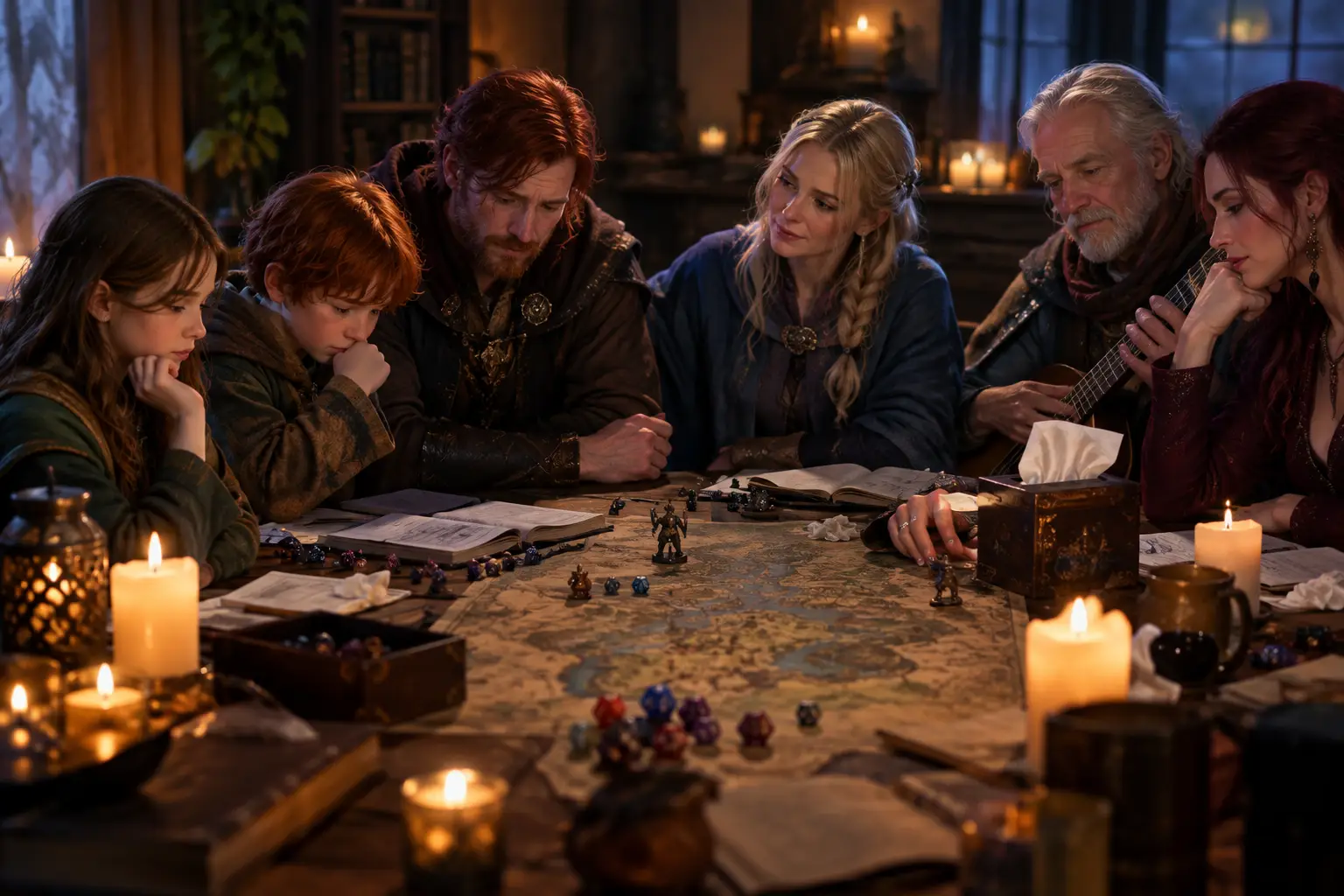
How to Facilitate Character Grief at the Table
A dead companion’s chair is still empty.
The party has won the fight. The treasure has been counted. The immediate danger is over. Yet no one reaches for the next scene.
This is the moment many Game Masters rush to fill.
A new quest.
A villain’s taunt.
A dramatic revelation.
A roll for initiative, because apparently swords can solve awkward silence.
Resist that impulse.
Learning how to facilitate character grief means recognising that silence can be part of the story’s action.
But before grief becomes story, there is a more important question.
Is everyone at the table safe exploring it?
At Mythveil, that question comes first.
Before character development.
Before continuity.
Before canon.
Before the clever consequence you have been preparing for twelve sessions.
Safety comes before story.
Always.
Once that trust exists, grief can become one of the deepest forms of roleplay available to a group. Not only grief for death, but grief for betrayal, exile, lost identity, corrupted relationships, transformed characters, broken ideals, and people who are still physically present but no longer quite the people their friends remember.
A living world can carry those losses forward.
But only if the people telling the story want it to.
Begin with the players, not the tragedy
Character grief is not the same as player grief.
A player may enjoy portraying fury after a mentor’s death and leave the session energised.
Another may find a fictional funeral unexpectedly close to something happening in their own life.
Someone may be comfortable with death but deeply uncomfortable with loss of memory.
Another may enjoy horror involving supernatural manipulation but not want their own character’s identity permanently rewritten without prior agreement.
The distinction matters.
Before a campaign establishes its emotional vocabulary, discuss what kinds of material the group actually wants to explore.
This does not require turning Session Zero into an academic conference.
It requires clarity.
What is off limits?
What can exist but remain off-screen?
What kinds of harm to player characters require explicit consent?
How do people signal that a scene needs to stop?
Can somebody leave the table without explanation?
Can a scene be rewound or removed from canon if everyone later agrees it went too far?
These questions matter because consent given at the beginning of a campaign is not permanent consent.
A player can be comfortable with tragic character death in January and not want to engage with it in August.
August wins.
No justification is required.
The same applies inside a scene.
If somebody says stop, stop.
If somebody asks to fade out, fade out.
If somebody needs a break, take the break.
If a player says that something happening to their character is no longer enjoyable, change it.
The perfect dramatic revelation is not more important than the person sitting at the table.
Safety tools are part of the game
Different groups use different safety tools.
The exact vocabulary matters less than whether everybody understands the tools and feels genuinely free to use them.
Lines and Veils can establish subjects that are excluded or kept off-screen.
An X-Card, pause signal, or simple verbal stop gives players a way to interrupt a scene without having to defend that decision.
An Open Door policy makes it explicit that anyone may step away.
Check-ins help during particularly intense scenes.
Rewind and Retcon allow a group to decide that something should not remain part of the fiction.
A short debrief after a heavy session gives everybody the chance to leave character and speak plainly.
The crucial element is not owning the correct safety vocabulary.
It is creating a table where using those tools carries no social penalty.
Sometimes nobody knows in advance what will hit close to home.
It may not be the death itself.
It may be someone packing away a dead character’s clothes.
A parent receiving a letter.
A dog waiting beside a door.
A familiar phrase spoken by the wrong person.
Good safety practice does not promise that nobody will ever feel emotion.
That would defeat much of the point of dramatic play.
It promises that when an emotional boundary appears, the player has control over what happens next.
Bleed should enrich, never harm
Roleplaying can stay with us after the session.
That is not automatically a problem.
A player may still feel affection for a fictional friendship the next morning.
They may be proud of a difficult choice.
A scene may encourage empathy, reflection, or a new way of thinking about a character.
That positive bleed can be one of the gifts of roleplaying.
But real distress is not a design target.
The Game Master should never ask:
How can I make the player genuinely grieve?
How can I use their personal history to make this scene hurt more?
How can I push until the emotion becomes real?
That is not deeper immersion.
That is crossing a boundary.
Character grief is playable material.
Player grief belongs to the player.
If the two touch, the player decides whether that connection feels meaningful, uncomfortable, or simply unwanted.
The Game Master does not diagnose it.
The Game Master does not decide that it is therapeutic.
We are here to facilitate roleplaying.
We are not covertly conducting treatment.
Safety does not weaken emotional play.
It is what allows emotional play to become deep without becoming coercive.
Let the loss belong to the characters
Once the table is safe, let relationships do the work.
The most affecting losses are rarely the ones announced with the loudest music.
They grow from ordinary presence.
The old investigator who always keeps a cigarette for a colleague.
The hive ganger who remembers everyone’s preferred drink.
The village priest who quietly protected the party from local suspicion.
The vampire who complains about the same terrible nightclub every week and still insists on meeting there.
The companion who always takes the chair beside the window.
These details create presence before absence.
Do not manufacture intimacy through a sudden confession five minutes before an NPC dies.
Let relationships accumulate texture.
Let people argue.
Let them joke.
Let them owe each other favours.
Let them disappoint one another.
Let them cook, travel, wait, complain, celebrate and occasionally behave like people rather than narrative devices.
Grief has weight because relationship came first.
Without that relationship, the party has lost an NPC.
With it, the world suddenly contains an empty chair.
Grief does not require death
Death is only one form of irreversible loss.
Sometimes the more disturbing grief comes from somebody who is still present.
This is especially powerful in horror.
In our Vampire: The Masquerade V5 New Orleans play, the emotional danger does not need to come from killing every important NPC.
Vampire gives us many darker possibilities.
Loyalty can be manipulated.
Memory can be altered.
A Blood Bond can distort a relationship.
Dominate can change what somebody remembers or believes happened.
Presence can complicate affection, dependence, fear and desire.
Hunger, political pressure, Humanity, Convictions, Touchstones and the slow compromises of unlife can all change someone without removing them from the story.
The character may still stand in front of the coterie.
They may still have the same face.
The same voice.
Perhaps even the same memories.
And yet something has changed.
That creates a different kind of grief.
Sometimes grief is not mourning someone who died.
It is mourning the person you can still see.
This can be extraordinarily effective roleplaying.
It can also be extremely uncomfortable material.
So the rule remains the same.
Before identity manipulation, memory alteration, forced emotional attachment, permanent personality change or similar themes become significant parts of play, establish whether the players actually want those themes applied to their characters.
Consent can be specific.
A player might be comfortable with temporary supernatural influence but not permanent personality alteration.
Another may welcome memory horror but not loss of agency during important character decisions.
Boundaries make the horror more playable, not less frightening.
Let characters grieve differently
When loss occurs, do not decide what it means for the characters.
One character may cry.
Another becomes practical.
Another is angry.
Another refuses to believe what happened.
Another wants to hunt whoever caused it.
Someone else may wash the blood from a weapon for far too long because doing something with their hands is easier than speaking.
All of those can be honest responses.
A useful first question is often small:
What does your character do in the next few minutes?
Not:
Give us your emotional monologue.
The answer may be:
I close his eyes.
I take her coat.
I sit down.
I search for the letter she mentioned.
I leave the room.
I say nothing.
Silence is not failed roleplay.
A player does not owe the table a performance of grief.
Sometimes:
“I keep his watch.”
is enough.
Twenty sessions later, that character may look at the watch before making an important decision.
The table will understand.
Grief can create disagreement without creating a quest
Shared loss does not mean shared interpretation.
One character may want revenge.
Another may say:
“She would never have wanted this.”
A third might answer:
“You did not know her as well as you think.”
Now grief has created conflict inside the group.
That does not mean the Game Master needs to turn it into a revenge storyline.
Let the players decide what happens next.
The group may seek justice.
They may withdraw.
They may try to repair what has been damaged.
They may forgive.
They may fail to forgive.
They may simply continue living.
This distinction matters in living-world play.
Loss may create pressure.
It should not create an instruction.
The world can ask:
What will you do with this?
It should not answer on the players’ behalf.
How to facilitate character grief through pacing
Grief needs room.
That does not mean it needs every scene.
Immediately after a major loss, characters may deal with practical realities.
Where is the body?
Who tells the family?
What happens to their equipment?
Who takes command?
Who knows what happened?
What must happen before dawn?
These concrete questions can help players enter the scene without requiring emotional performance.
Later, widen the lens.
What has changed?
Does the group keep something?
Does someone take over an unfinished promise?
Does an old disagreement suddenly feel different?
Has a faction lost an important intermediary?
Does one character blame themselves?
Has another become frightened of forming the same kind of attachment again?
Then allow the campaign to move.
Grief does not disappear because the characters investigate something else next week.
It becomes part of their history.
Use time deliberately
Time changes grief.
Shock may dominate immediately.
Anger may arrive later.
Regret may arrive after the danger is gone.
Months later, a familiar place can suddenly make the absence visible again.
An unfinished map.
A song in a tavern.
A chair nobody has deliberately left empty but nobody has moved either.
A title used by someone new.
A decision the missing person would have argued against.
Persistent campaigns have a special advantage here because memory can develop gradually.
The world does not need to announce the loss every session.
Sometimes it simply carries it.
And the characters change around it.
A character may decide:
I will never leave anyone behind again.
That promise might later be heroic.
It might later be disastrous.
Another may decide:
I will never let anyone get that close again.
That too can shape years of play.
Grief is therefore not only memory of the past.
It can change how a character imagines the future.
The character making a decision in Session Fifty is not necessarily the same person who would have made it in Session Five.
Not because their statistics changed.
Because they lived.
Make the world remember without taking control
A credible world responds to loss.
A dead captain leaves a command structure unstable.
A scholar’s missing knowledge creates a gap.
A priest’s death changes a community.
A vampire’s altered loyalty shifts the balance inside a coterie.
A political intermediary disappears, and two groups discover that they only tolerated each other because that person kept them talking.
This is where Mythveil’s living-world method becomes important.
People exist inside relationships.
Relationships exist inside institutions.
Institutions exist inside networks of influence.
Change one part, and movement may spread.
A personal loss can therefore remain intimate.
Or it can eventually change the map.
The deepest consequences can begin in a relationship and end by changing who controls a district.
That does not mean every death should launch a political crisis.
It means the world recognises that important people occupied real positions inside it.
Their absence may matter.
NPCs and factions do not grieve as one mind
A faction is not a single person wearing several coats.
When somebody important dies or changes, different people inside the same organisation may respond differently.
The institution wants stability.
The dead leader’s daughter wants time to mourn.
The deputy sees an opportunity for promotion.
An old friend wants revenge.
A political rival may be genuinely saddened.
The treasurer is deeply concerned that someone will inspect the accounts during the succession crisis.
All of those reactions can coexist.
The same applies when the loss is transformation rather than death.
One NPC may want the changed person restored.
Another sees the change as liberation.
A third benefits from it.
A fourth refuses to believe anything is wrong.
Now the emotional event becomes part of the wider living world.
NPC response creates faction response.
Faction response creates counteraction.
Other groups observe the weakness, opportunity or conflict.
Influence shifts.
Relationships change.
The world continues.
But grief itself is not a content generator.
That distinction matters.
Loss changes relationships, responsibilities and possibilities.
Story may grow from those changes.
The grief belongs to the characters.
New Orleans: when a relationship changes the map
Vampire: The Masquerade makes this particularly visible because relationships and power are already deeply entangled.
Imagine an NPC the coterie has known for months.
They know her loyalties.
They know who she trusts.
They know which mortal connections matter to her.
They know her grudges, ambitions and weaknesses.
Then something changes her.
Perhaps another Kindred has manipulated her loyalties.
Perhaps her memories are no longer reliable.
Perhaps an old Blood Bond has become relevant.
Perhaps pressure from clan, domain or sire has forced choices the coterie never expected.
The players notice because they knew who she was before.
That relationship creates the depth.
Then the characters decide how to respond.
Do they try to save her?
Expose what happened?
Take revenge?
Protect her reputation?
Destroy the person responsible?
Accept that the change is permanent?
Their response creates action.
Other NPCs react.
Factions react.
A boon becomes worthless.
An alliance collapses.
A haven becomes unsafe.
A district changes hands.
A Prince notices.
A rival sees an opportunity.
Something that began as grief over one relationship can eventually alter the political geography of the chronicle.
Not because every personal scene must escalate into geopolitics.
Because people are connected.
And changing a person can change everything attached to them.
Bardic Resonance: the world may remember them differently
There is another layer beyond consequence.
Memory is not neutral.
People interpret the dead.
They reinterpret the changed.
They simplify complicated lives.
They turn people into symbols.
This is where Bardic Resonance becomes especially powerful.
The coterie remembers a dead companion as the person who hated formal clothes, stole cigarettes and once spent three nights trying to repair a ridiculous old car.
The city remembers them as a hero.
Their enemies remember a murderer.
Their Clan remembers an embarrassment.
Twenty years later, there may be a portrait hanging somewhere that looks nothing like the person the characters knew.
The same applies to transformation.
The players may remember:
She was not always like this.
Her faction may insist:
She has always been loyal.
A Prince may rewrite the political narrative.
Newer NPCs may know only the later version.
Eventually the characters may become the last people who remember who someone used to be.
That is both horror and grief.
The world remembers the lost differently from the people who loved them.
And sometimes memory itself becomes contested territory.
Bardic News lets memory return
Bardic Resonance becomes tangible when the world gives some version of that memory back to the characters.
A song.
A newspaper article.
A memorial.
A street renamed after somebody who would have hated the idea.
A letter from a relative.
A young vampire who says they were inspired by a story about the dead.
A political speech that completely misrepresents what happened.
A portrait.
A grave.
An empty space on a map.
The characters encounter what memory has become after passing through other people, institutions and time.
That can be deeply moving.
It can also reopen material a player no longer wants to explore.
So the safety principle remains active.
The world may remember.
The table decides when that memory is welcome.
If a player does not want a particular grief thread brought back into focus, do not hide behind continuity.
Continuity serves the table.
The table does not serve continuity.
Give players authorship over remembrance
Invite players to decide how their characters carry the loss.
They may name a safehouse after someone.
Keep an unfinished project.
Return a keepsake.
Continue a tradition.
Refuse a tradition.
Never speak the name.
Tell the story constantly.
Remember the person privately rather than publicly.
All can be valid.
You can offer prompts without requiring performance.
Would you like to describe a memory?
Is there something your character keeps?
Has anything in their routine changed?
Do you want this to return later, or should we leave it here for now?
If the answer is no, move on.
Quiet play is still play.
So is choosing not to revisit something.
Replacement characters are not replacement people
If a player character dies, a new character should not be treated as a spare part arriving to fill the empty slot.
The new character deserves their own identity.
Their own relationships.
Their own complications.
Inside the fiction, the group may compare them unfairly to the person they lost.
They may keep their distance.
They may resent change.
They may unexpectedly bond with the newcomer.
That can create excellent roleplay.
But distinguish character exclusion from player exclusion.
The new character may have to earn trust.
The player does not have to earn their right to be at the table.
The person joining the scene should feel welcome even if the fictional relationships are complicated.
Make room for recovery
If every relationship ends in punishment, players learn something very quickly:
Do not care.
That is disastrous for a living campaign.
Grief needs contrast.
People recover.
New relationships form.
Humour returns.
A character laughs at something and then feels guilty for laughing.
Later they laugh without guilt.
Someone cooks dinner.
A new friendship begins.
The group visits an old place and discovers that it hurts less than it used to.
Moving forward is not the same as erasing what happened.
A world that remembers should contain renewal as well as loss.
Otherwise memory becomes a prison.
Sometimes the most important consequence of grief is not revenge.
It is that somebody eventually chooses to care again.
Know when to step out of the scene
Atmosphere matters.
Player wellbeing matters more.
If a scene becomes too intense, leave the fiction.
Do not search desperately for an elegant in-character transition.
Say:
Are we okay?
Do we want to continue?
Do we want to fade out?
Do we need five minutes?
Plain language is good.
After a difficult session, a short debrief can help.
What worked?
What was too much?
Should this remain central?
Should it move into the background?
Should we change something?
There is no prize for remaining perfectly immersed while somebody at the table is uncomfortable.
And if the group decides afterwards that something should not remain canon, remove it.
The living world will survive.
Probably more easily than the GM’s notes.
Safety is what makes depth possible
Character grief can become some of the deepest roleplay in a long campaign.
A dead friend can remain present through memory.
A transformed ally can force characters to ask whether love survives change.
An absence can reshape a faction.
A private loss can eventually alter a city.
Bardic Resonance can turn one person into several competing memories.
The choices characters make in response can reshape relationships, influence and the future of the world.
But none of that begins with tragedy.
It begins with trust.
Safety gives players the confidence to care.
Care creates attachment.
Attachment gives loss meaning.
Loss may create choice.
Choice creates action.
People react.
Factions move.
The world changes.
Memory carries what happened forward.
And eventually that changed world returns to the players.
But at every point in that process, consent remains active.
A living world does not prove that a loss mattered by refusing to move on.
It proves that it mattered because moving on leaves the world different.
The empty chair matters not because it must remain empty forever.
It matters because everyone who stays at the table is changed by who once sat there.
Let characters grieve.
Let worlds remember.
Let consequences change what comes next.
But always remember who the game is for.
MYTHVEIL
We create worlds people want to live in.
Stories that remember. Worlds that change.
Read: https://mythveilchronicles.com/
Play: https://startplaying.games/gm/dunchan
Watch: https://www.youtube.com/@MythveilChronicles
Support: https://www.patreon.com/MythveilChronicles
Collaborate: https://www.linkedin.com/in/francisco-jos%C3%A9-z-b05aab371/